
Can Black Seed Oil Replace a Prescribed Medicine?
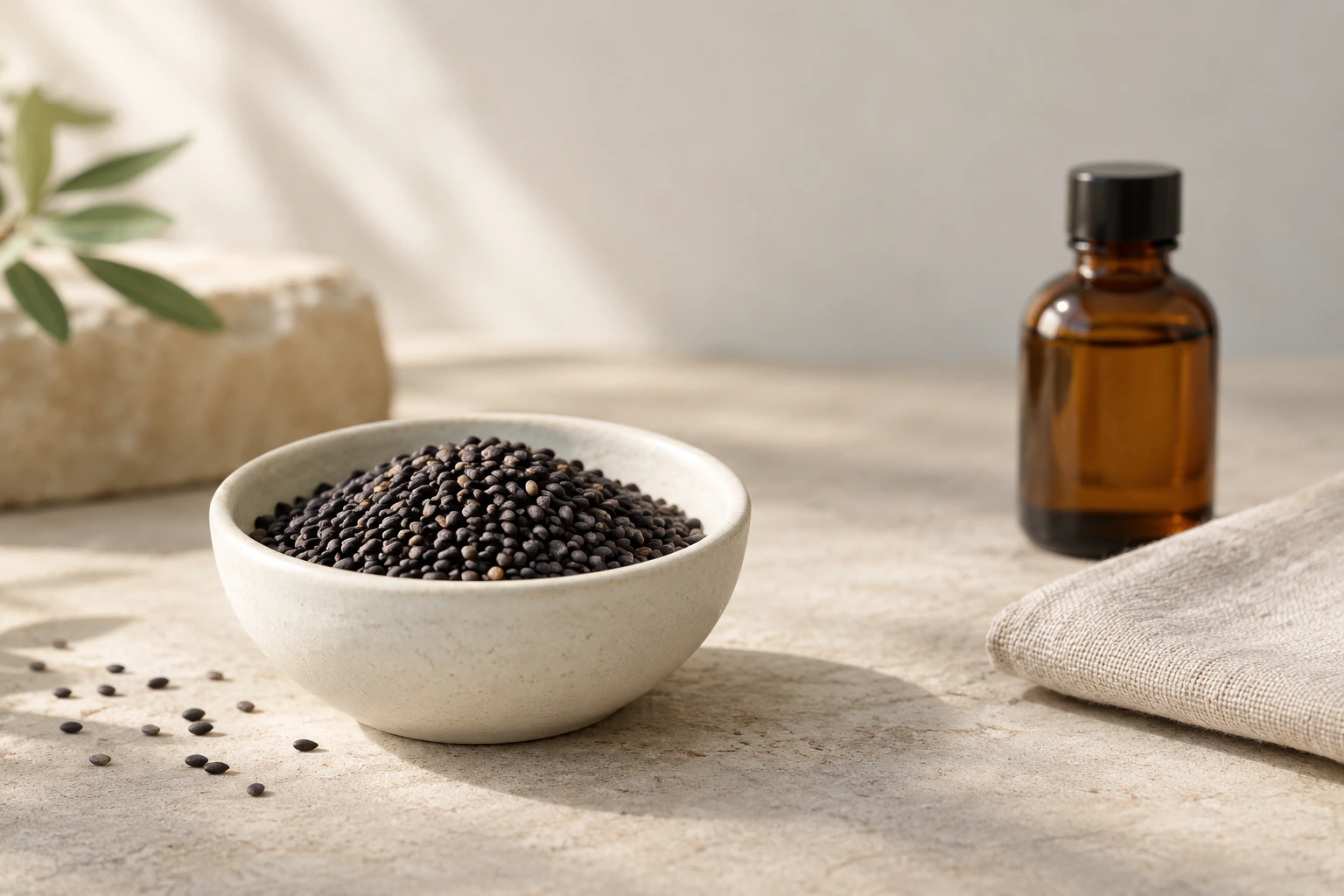
No documented case supports replacing a prescribed medicine with black seed oil — the trials used it as oral supplementation or an adjunct alongside other care, not as a substitute — and anyone who wants to reduce a medication should raise it with their prescriber rather than swap in a botanical.
Nirast makes Ethiopian Black Seed Oil. This article was written by Nirast’s editorial team and reports what the published research does and does not show.
See Nirast Ethiopian Black Seed Oil → · $29.99 a month · 30-Day Money-Back Guarantee
Published by Thang Phi, founder of Nirast and publisher of the Nirast Journal.
This is the question that quietly sits behind a lot of cure-all marketing, and it deserves a direct answer rather than a hedge. Replacing a prescribed medicine with a botanical is not a bigger version of taking a supplement. It is a decision about a diagnosed condition, and it belongs with the person who prescribed the treatment — not with a product page.
The short answer: no, and this is a question for your prescriber
There is no documented case in the evidence reviewed here of a patient successfully replacing a prescription with black seed oil, and no trial designed to test that idea. What exists are studies in which the oil was given as a supplement or as an add-on. That is a different experiment from substitution, and it answers a different question. If you are hoping the oil can stand in for something you have been prescribed, the honest answer is that the evidence does not support the swap, and the decision is one to bring to a clinician.
Why substitution is a different question from “does it help”
A trial that adds an oil on top of existing care tells you what the oil did alongside treatment. It cannot tell you what would have happened if the treatment had been removed, because the treatment was never removed. Those are not the same question, and the gap between them is where substitution claims go wrong. “It helped in a study where people kept taking their medicine” does not imply “it can take the place of that medicine”. Treating the two as interchangeable is the error this whole article exists to name.
What the trials actually did with black seed oil
The human studies used the oil as supplementation, in defined groups, for defined windows. One trial gave 1,000 mg of N. sativa oil daily for 12 weeks to women with polycystic ovary syndrome and compared it against a placebo (https://pubmed.ncbi.nlm.nih.gov/42601227/). A randomised pilot study gave a thymoquinone-containing Nigella sativa seed oil capsule to healthy volunteers — two capsules three times daily for 20 days — and compared their gut bacteria with an untreated control group (https://pubmed.ncbi.nlm.nih.gov/42744850/). In both, the oil was studied as a supplement, not as a replacement for any prescribed treatment. That is the entire scope of what the human evidence here shows.
Reviews of specific uses keep stopping short of a recommendation
Even where reviewers are positive, they stop before the point a substitution would require. A systematic review of Nigella sativa trials in children concluded that more high-quality studies are needed to establish efficacy, effective dose and form (https://pubmed.ncbi.nlm.nih.gov/41112345/). A review of thymoquinone in atherosclerosis stated that the compound cannot yet be unequivocally recommended as a therapeutic agent for that condition (https://pubmed.ncbi.nlm.nih.gov/42124081/). A standard of “not yet recommended as therapy” is a long way from “can replace therapy”. Reviews are written to be careful, and the care is exactly what makes them hard to quote as a reason to stop treatment.
A supplement is not a legal substitute for a disease treatment
There is also a structural reason substitution does not work. In the United States, only products regulated as drugs, over-the-counter medicines or medical foods may be marketed to treat, cure or prevent a disease (https://pubmed.ncbi.nlm.nih.gov/40662344/). A dietary supplement may not be marketed that way at all. A product cannot be a legal stand-in for a disease treatment if it is not permitted to claim it treats disease — and that is not a loophole, it reflects the difference in the evidence each category is expected to carry. A medicine that treats a condition has been evaluated for that job, in trials designed to test it. A botanical has not.
What consumer guidance calls this pattern
Consumer guidance on dietary supplements is blunt about the pattern: supplements marketed as substitutes for prescription medications — along with “miracle cure” claims — are common red flags (https://pubmed.ncbi.nlm.nih.gov/40662344/). The same guidance recommends verifying claims against trusted scientific databases and peer-reviewed journals, and seeking advice from a trained professional (https://pubmed.ncbi.nlm.nih.gov/40662344/). Notice who the guidance is protecting. The warning is not that botanicals are dangerous; it is that the substitution framing is where self-directed decisions get people into trouble.
The interaction side: why a swap is not automatically safer
If the appeal of substituting is that a plant “must be gentler” than a medicine, the evidence does not simplify into that. A review of herb-drug interactions reported a case of thrombocytopenia — a low platelet count — in a patient who had been taking evening primrose oil and black seed oil chronically; the authors describe the case as multifactorial, and note that Nigella sativa oil contains thymoquinone, which can lead to thrombocytopenia (https://pubmed.ncbi.nlm.nih.gov/35329893/). One case report is not a quantified risk, and the authors were careful about causation. But it does make a simple point: adding or swapping botanicals while on medication is not a free move, and it is precisely the situation a professional should see before you make it.
If you want to reduce a medication, do this instead
- Talk to your prescriber first. Bring the question to the person who knows your diagnosis and why the treatment was chosen. That conversation, not a product page, is where this decision belongs.
- Do not stop or reduce a medication on your own. A supplement article’s job is to stop a risky substitution, not to enable one.
- If you want to add a botanical, ask about interactions. Herb-drug interactions exist, and “natural” does not mean “inert”.
- Bring the label, not a forum post. If you discuss it with a professional, bring what the product actually states — ingredients, amount per serving, directions — rather than a claim from social media.
Where Nirast fits — and where it does not
Our product is a supplement, and this question is one where the honest answer does not favor buying it as a replacement for anything. Nirast Ethiopian Black Seed Oil is a softgel the page describes as tasteless and easy to swallow, cold-pressed from Nigella sativa, with 1,000 mg of black seed oil per serving and directions of “Take 2 softgels daily with water, preferably with food”. It is offered as one monthly subscription — one pouch for $29.99 — with free worldwide shipping, a 30-day money-back guarantee, and cancellation by emailing support@nirast.co at least 24 hours before the next renewal (https://try.nirast.co/black-seed-oil-otp/).
If your prescriber is happy for you to keep a convenient daily botanical in your routine, that is the honest job this product does: a taste-free softgel that is easy to take, alongside — not instead of — the care you have been given. It is not a substitute for a prescribed treatment, and it is not offered as one.
What the evidence does not show
What is missing is the exact study a substitution would need: a trial in which people with a diagnosed condition replaced their prescribed treatment with the oil and did at least as well. No such trial was found in the reviewed corpus, and the reviews that do exist keep concluding that more research is needed before their uses can be recommended as therapy. That absence, together with the guidance and interaction sources above, is why the answer is a firm no rather than a cautious maybe. It is also a boundary about evidence, not a claim that the oil does nothing — some trials reported effects on specific markers at the amounts they studied.
FAQ
Can I stop my medicine and take black seed oil instead?
No. No documented case or trial supports that swap, and the decision about any prescribed treatment belongs with your prescriber.
If black seed oil helped in a study, doesn’t that mean it can replace my treatment?
No. In those studies the oil was added alongside existing care. That tells you nothing about removing the care.
Is a natural product safer than a prescription?
Not automatically. Herb-drug interactions exist — one review reported a thrombocytopenia case linked to black seed oil taken with another oil — so “natural” is not a synonym for “risk-free”.
Can a supplement claim to treat the condition my medicine treats?
No. Only drugs, over-the-counter medicines or medical foods may be marketed to treat, cure or prevent disease. A supplement cannot make that claim.
What if I want to add black seed oil while staying on my medicine?
Ask your prescriber or pharmacist first, and bring the product’s actual facts — ingredients, amount per serving and directions — to that conversation.
Does this mean black seed oil is worthless?
No. It means the substitution question has no supporting evidence. Ingredient studies report effects on specific markers in specific groups; that is not the same as replacing a treatment.
References
- Nirast Ethiopian Black Seed Oil product page — https://try.nirast.co/black-seed-oil-otp/
- Common questions and misconceptions about dietary supplements and the industry — https://pubmed.ncbi.nlm.nih.gov/40662344/
- Nigella sativa oil in polycystic ovary syndrome, randomised placebo-controlled trial — https://pubmed.ncbi.nlm.nih.gov/42601227/
- Gut microbiome pilot study of thymoquinone-containing Nigella sativa seed oil — https://pubmed.ncbi.nlm.nih.gov/42744850/
- Clinical uses of Nigella sativa in pediatrics, systematic review and meta-analysis — https://pubmed.ncbi.nlm.nih.gov/41112345/
- Thymoquinone in atherosclerosis, review — https://pubmed.ncbi.nlm.nih.gov/42124081/
- Herb-drug interaction in inflammatory diseases, review — https://pubmed.ncbi.nlm.nih.gov/35329893/
Related reading
- Black Seed Oil: What It Is, What the Evidence Covers, and How to Choose a Form
- Does “Natural” Mean Black Seed Oil Is Safer Than a Medicine?
- Can You Take Black Seed Oil With Blood Pressure or Blood Sugar Medicine?
- Are Oil of Oregano and Black Seed Oil Interchangeable?
Related product: Ethiopian Black Seed Oil.