
Sleep Gummies: What They Are, What the Evidence Shows, and How to Choose
Sleep gummies are a gummy-format supplement marketed for sleep. They come in two broad types: melatonin products and melatonin-free versions built on magnesium, amino acids and botanicals. Melatonin has dedicated insomnia trials behind it; magnesium, L-theanine, tart cherry, passionflower and jujube have smaller, mixed studies — none is a treatment for insomnia.
Nirast makes Nirast Sleep + Vitamin Gummies. This article was written by Nirast’s editorial team and reports what the published research does and does not show.
See Nirast Sleep + Vitamin Gummies → · 30-Day Money-Back Guarantee
Published by Thang Phi, founder of Nirast and publisher of the Nirast Journal.
This guide walks the category and the decision rules.
What sleep gummies are
Sleep gummies are gummy-format supplements marketed for sleep. Melatonin, the sleep hormone, is sold in several forms — soft chew gummies, tablets, oral liquids, capsules, teas, lozenges and sprays (Melatonin Use in Pediatrics, 2024) — and melatonin products are widely available as US dietary supplements (US melatonin survey, 2025).
The gummy itself is a delivery format, not an active ingredient: formulation research describes gummies as hydrogel-based systems carrying vitamins, minerals and other bioactives, on a base of sucrose, glucose syrup and a gelling agent (Gummy delivery systems review, 2026).
Broadly, the category splits in two: melatonin products, and melatonin-free products built on magnesium — commonly used to support sleep (Lopresti et al., 2026) — and botanicals such as passionflower (Valeriana and Passiflora review, 2026).
Melatonin gummies vs melatonin-free gummies
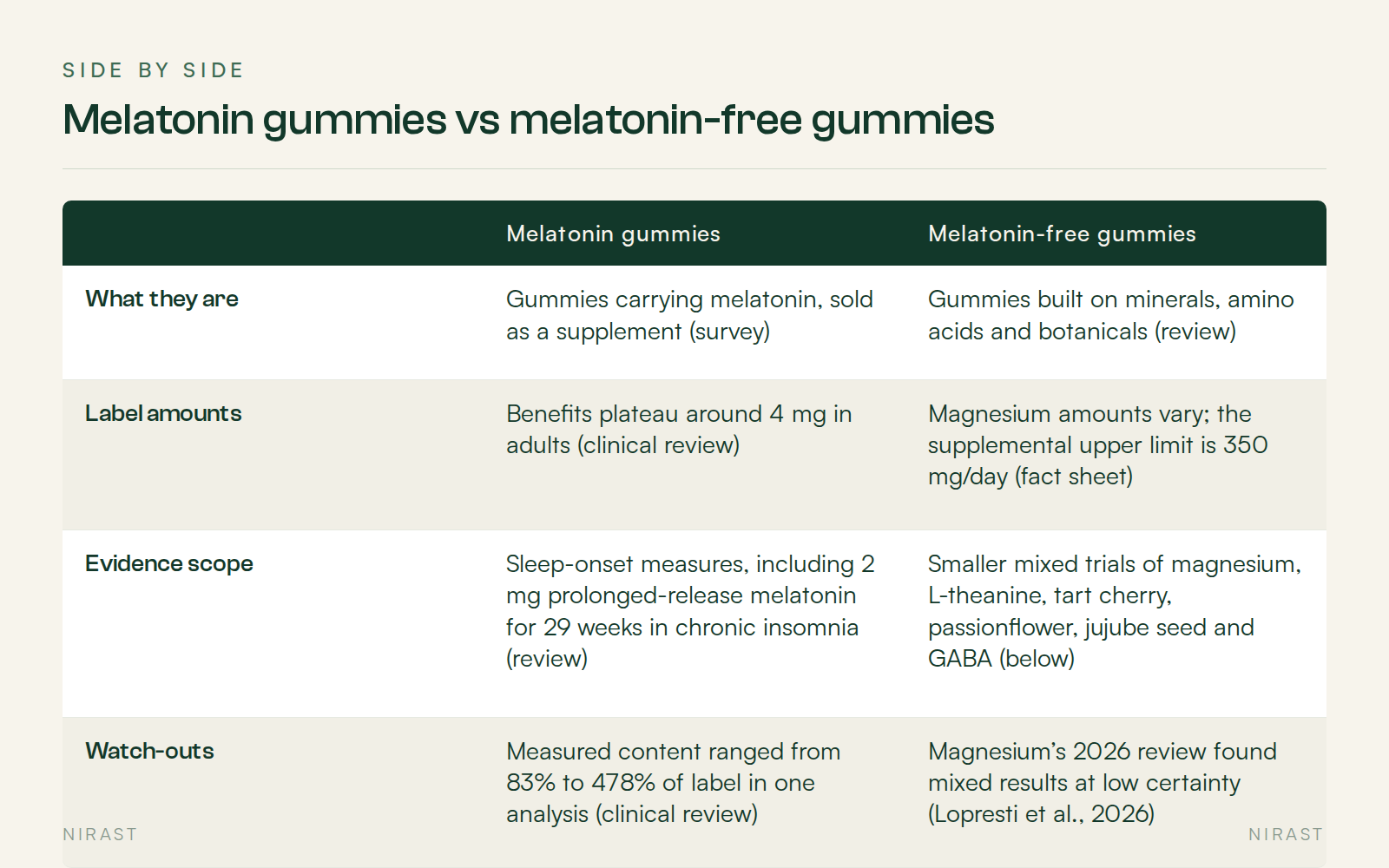
| Melatonin gummies | Melatonin-free gummies | |
|---|---|---|
| What they are | Gummies carrying melatonin, sold as a supplement (survey) | Gummies built on minerals, amino acids and botanicals (review) |
| Label amounts | Benefits plateau around 4 mg in adults (clinical review) | Magnesium amounts vary; the supplemental upper limit is 350 mg/day (fact sheet) |
| Evidence scope | Sleep-onset measures, including 2 mg prolonged-release melatonin for 29 weeks in chronic insomnia (review) | Smaller mixed trials of magnesium, L-theanine, tart cherry, passionflower, jujube seed and GABA (below) |
| Watch-outs | Measured content ranged from 83% to 478% of label in one analysis (clinical review) | Magnesium’s 2026 review found mixed results at low certainty (Lopresti et al., 2026) |
Melatonin’s evidence includes dedicated insomnia trials: a 29-week trial used 2 mg of prolonged-release melatonin nightly in adults with chronic insomnia, and reviews describe a real but modest effect limited by low bioavailability and a short half-life (Melatonergic agonists review, 2025). Melatonin-free ingredients rest on smaller, mixed trials.
What the evidence covers for melatonin-free ingredients
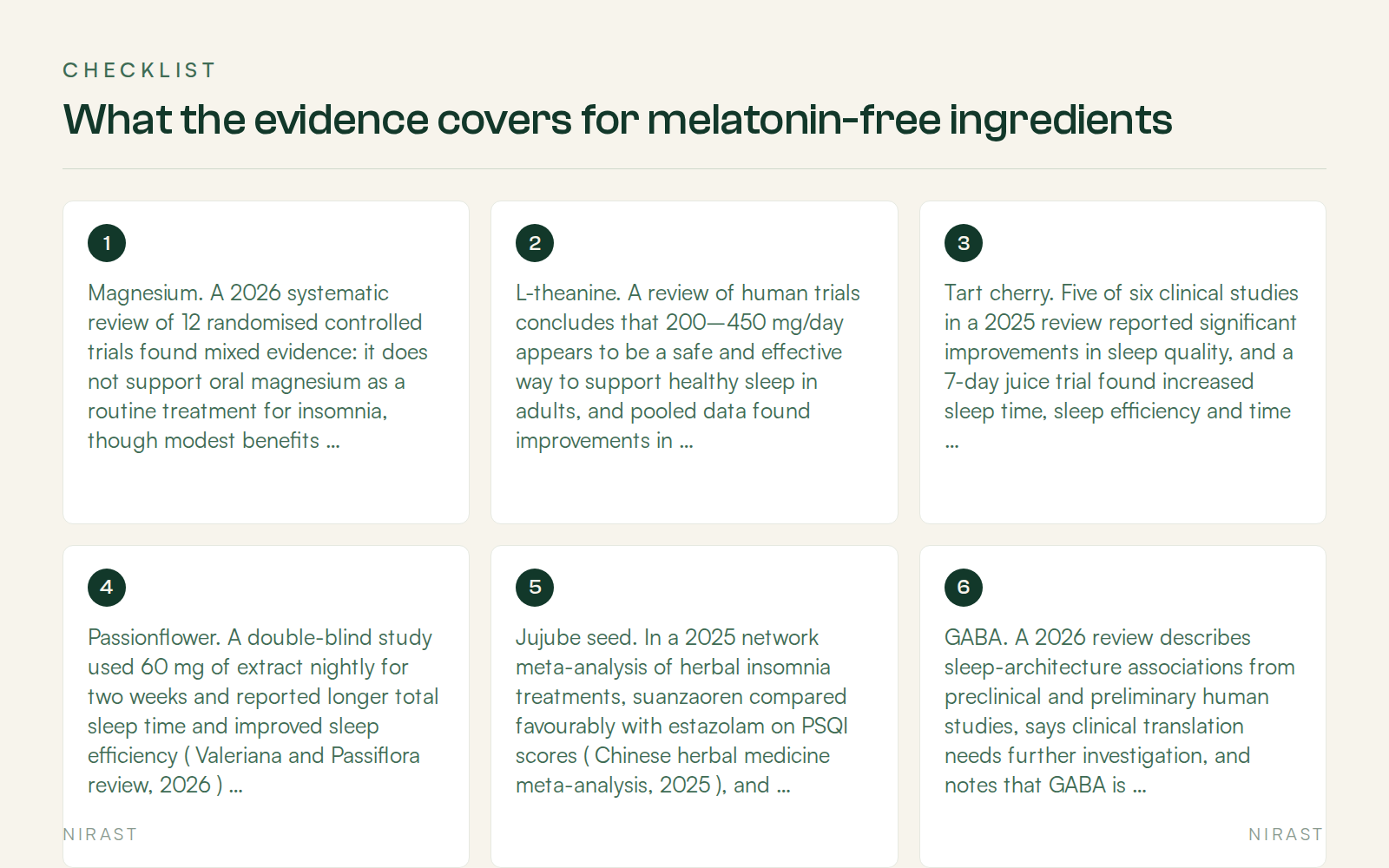
- Magnesium. A 2026 systematic review of 12 randomised controlled trials found mixed evidence: it does not support oral magnesium as a routine treatment for insomnia, though modest benefits for selected subjective outcomes remain possible in some adults, at low-to-very-low certainty (Lopresti et al., 2026). Observational work is more positive — 7,582 participants, higher intake correlating with better sleep-quality parameters (Magnesium and sleep review, 2025) — but associations are not trial outcomes. Form matters: aspartate, citrate, lactate and chloride absorb better than oxide and sulfate (NIH ODS fact sheet), and bisglycinate, taurate, threonate and malate are described as the readily absorbed forms (Sleep-diet review, 2026).
- L-theanine. A review of human trials concludes that 200–450 mg/day appears to be a safe and effective way to support healthy sleep in adults, and pooled data found improvements in subjective sleep-onset latency, daytime dysfunction and overall sleep-quality scores versus comparator (L-theanine review, 2026).
- Tart cherry. Five of six clinical studies in a 2025 review reported significant improvements in sleep quality, and a 7-day juice trial found increased sleep time, sleep efficiency and time in bed (Tart cherry review, 2025). Montmorency cherries carry roughly 13–15 ng of melatonin per gram (Melatonin-containing foods review, 2026) — but a 30-day trial of juice or capsules found no significant change versus placebo (same review).
- Passionflower. A double-blind study used 60 mg of extract nightly for two weeks and reported longer total sleep time and improved sleep efficiency (Valeriana and Passiflora review, 2026); a review of herbal sedatives describes sedative effects with sleep-quality improvements (Herbal sedatives review, 2026).
- Jujube seed. In a 2025 network meta-analysis of herbal insomnia treatments, suanzaoren compared favourably with estazolam on PSQI scores (Chinese herbal medicine meta-analysis, 2025), and a 2026 review says jujube-seed extract can improve sleep quality and mood in insomnia and mild-to-moderate depression while calling for higher-quality evidence (Jujube seed review, 2026).
- GABA. A 2026 review describes sleep-architecture associations from preclinical and preliminary human studies, says clinical translation needs further investigation, and notes that GABA is generally well-tolerated at typical supplement doses while long-term and high-dose data remain limited (GABA review, 2026).
A 2025 meta-analysis found moderate-certainty improvements in sleep efficiency, latency, total sleep time and wake after sleep onset — but no outcome rated high certainty (Dietary supplement meta-analysis, 2025). Better than nothing, short of a treatment.
What the evidence does not show
Three limits apply. First, the trials behind these ingredients tested ingredients, not finished gummy products (how ingredient evidence differs from product evidence). Second, a label amount is not a delivered amount: commercial analyses found contents from 83% to 478% of labelled doses (clinical review, 2026), a survey of children’s products found 0% to 667% (US survey, 2025), and an EU study quantified 0.91 to 23.43 mg per daily dose (EU quantification study, 2025). Third, none of this is treatment: for chronic insomnia, guidelines direct people to CBT-I and clinicians (position statement, 2026; AASM review, 2026).
How to choose a sleep gummy
Five steps:
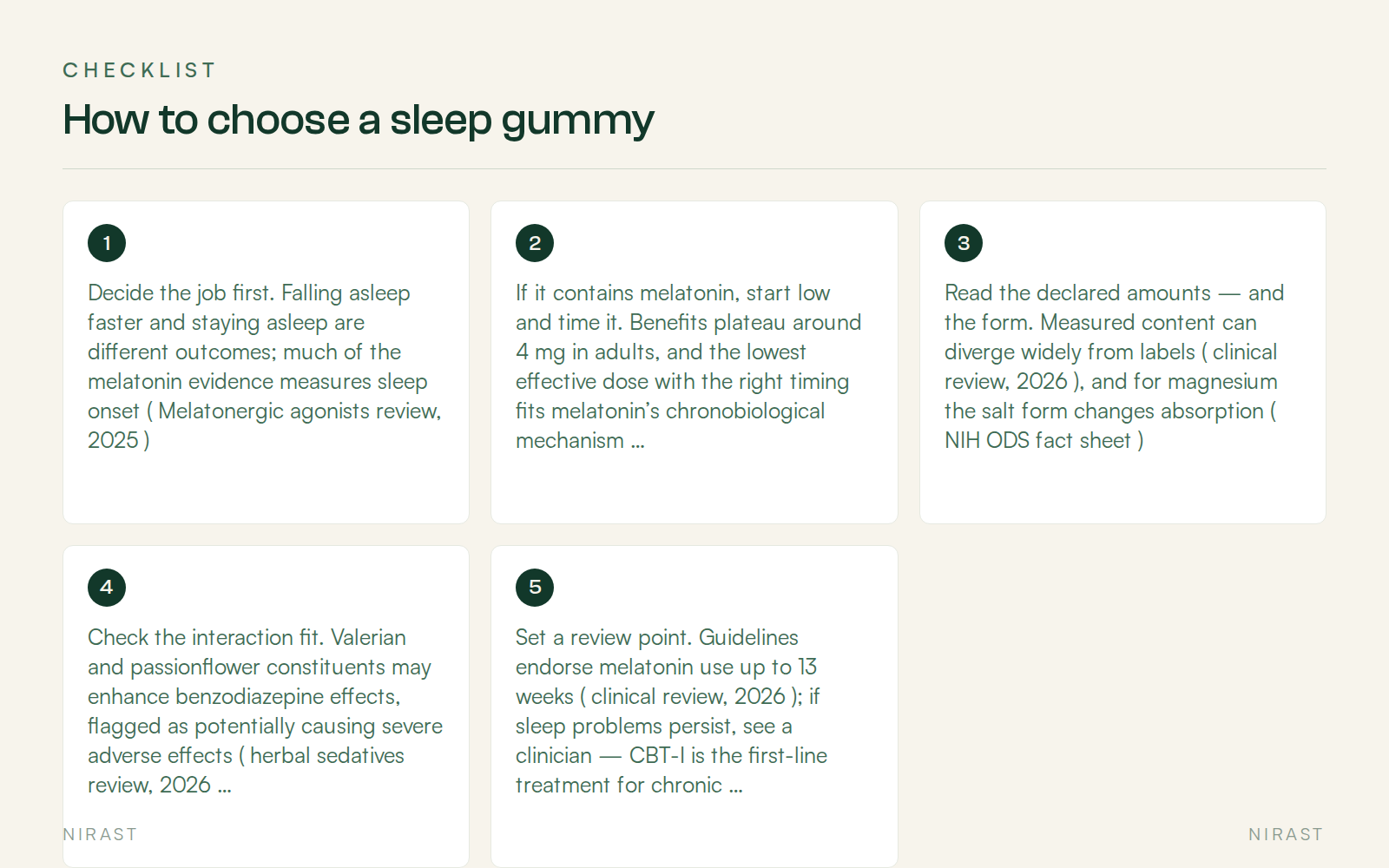
- Decide the job first. Falling asleep faster and staying asleep are different outcomes; much of the melatonin evidence measures sleep onset (Melatonergic agonists review, 2025).
- If it contains melatonin, start low and time it. Benefits plateau around 4 mg in adults, and the lowest effective dose with the right timing fits melatonin’s chronobiological mechanism better than conventional titration (clinical review, 2026).
- Read the declared amounts — and the form. Measured content can diverge widely from labels (clinical review, 2026), and for magnesium the salt form changes absorption (NIH ODS fact sheet).
- Check the interaction fit. Valerian and passionflower constituents may enhance benzodiazepine effects, flagged as potentially causing severe adverse effects (herbal sedatives review, 2026); medication users should clear any sleep supplement with a clinician first.
- Set a review point. Guidelines endorse melatonin use up to 13 weeks (clinical review, 2026); if sleep problems persist, see a clinician — CBT-I is the first-line treatment for chronic insomnia, and sleep hygiene alone is not adequate (position statement, 2026; AASM review, 2026).
The safety frame
The studied ingredients have reasonable short-term safety records: melatonin is described as safe and well-tolerated, and short-term use does not seem to cause adverse effects, though prolonged-use safety is unclear (melatonergic agonists review, 2025; sleep-diet review, 2026). Supplemental magnesium has a 350 mg/day upper limit for adults, and high supplemental doses can cause diarrhea, nausea and abdominal cramping (NIH ODS fact sheet). Keep melatonin products away from children: US poison control centers recorded a 530% rise in pediatric ingestions from 8,337 in 2012 to 52,563 in 2021 (MMWR, 2022), and caution is recommended in children (pediatric review, 2024). If you take medication, are pregnant, or manage a health condition, ask a clinician first.
FAQ
Do sleep gummies work?
It depends on what is inside. For melatonin, controlled trials include insomnia populations; the effect is modest and limited by half-life (melatonergic agonists review, 2025). Melatonin-free ingredients rest on smaller, mixed trials — magnesium’s 2026 review found inconsistent results, while L-theanine, tart cherry and passionflower report improvements in small studies (Lopresti et al., 2026; L-theanine review, 2026; tart cherry review, 2025). Pooled, several sleep measures improve with moderate certainty — none with high certainty (meta-analysis, 2025).
Are sleep gummies safe to take every night?
Melatonin guidelines endorse use up to 13 weeks, and prolonged-use safety is not settled (clinical review, 2026). Supplemental magnesium has a 350 mg/day upper limit for adults (NIH ODS fact sheet). Needing a sleep aid nightly for weeks is a conversation with a clinician, not a product decision.
Who should not take sleep gummies?
Children should only use sleep supplements under clinical guidance — pediatric melatonin ingestions rose sharply over the decade to 2021, and caution is recommended in this group (MMWR, 2022; pediatric review, 2024). People on sedatives or benzodiazepines should check first, because valerian and passionflower can enhance those drugs’ effects (herbal sedatives review, 2026). And anyone with ongoing insomnia, sleep-breathing problems, or a diagnosed condition should see a clinician (position statement, 2026).
Do magnesium sleep gummies actually help you sleep?
Possibly, for some measures, in some people. A 2026 systematic review of 12 randomised controlled trials found the evidence mixed — it does not support magnesium as a routine insomnia treatment, though modest benefits appeared for selected subjective outcomes, at low-to-very-low certainty (Lopresti et al., 2026). The readily absorbed forms are described as bisglycinate, taurate, threonate and malate (sleep-diet review, 2026).
How much melatonin is in a sleep gummy?
The label is the starting point, not the answer. Benefits plateau around 4 mg in adults (clinical review, 2026), and content analyses have found wide divergence — 83% to 478% of labelled doses in one set of commercial analyses (same review), and 0% to 667% in a 110-product survey (US survey, 2025). Favour products that declare what they contain.
Do sleep gummies help you stay asleep?
Measured support here is patchy. Pooled analysis found improvements in wake after sleep onset — time awake during the night — at moderate certainty (meta-analysis, 2025), and tart cherry trials have measured sleep efficiency and time in bed (tart cherry review, 2025). Melatonin’s short half-life is one stated limit on its effectiveness in chronic insomnia (melatonergic agonists review, 2025), so compare “stay asleep” claims with measured outcomes.
A melatonin-free gummy option: Nirast Sleep + Vitamin Gummies
If a melatonin-free gummy fits your routine, Nirast Sleep + Vitamin Gummies is one product to look at: strawberry-flavoured gummies whose pouch states MELATONIN FREE (product page). The label panel states 65 mg of magnesium per serving as magnesium glycinate and magnesium taurate, a 1,620 mg relaxing blend (tart cherry extract, L-theanine, jujube extract, passionflower extract, GABA and apigenin), a 568 mg blend from 17 real fruits, and 50% DV of vitamins A, C, D, E, B6 and B12 plus iron — with 35 calories and 3 g of total sugars. Each pouch holds 25 individually wrapped nightly packs, with vegan, gluten-free, nut-free and dairy-free badges. The offer is a monthly subscription displayed at $48.00 (1 pouch), $88.00 (2 pouches) and $116.80 (3 pouches) per month.
What this product is: a melatonin-free gummy supplement whose declared panel amounts can be compared against the evidence above — not a treatment, and not a substitute for clinical advice.
See Nirast Sleep + Vitamin Gummies here.
These statements have not been evaluated by the Food and Drug Administration. This product is not intended to diagnose, treat, cure, or prevent any disease. Talk to your doctor or pharmacist before starting a supplement, especially if you are pregnant, nursing, take medication or have a medical condition.
Related reading
- Melatonin-Free Sleep Gummies: What the Evidence Actually Shows
- Libido Gummies: What They Are, What the Evidence Shows, and How to Choose
- Pheromone Cologne: What It Is, What the Evidence Shows, and How to Choose
- Do Libido Gummies Work? What the Evidence Actually Shows
Related product: Nirast Sleep + Vitamin Gummies.