
Pheromone Cologne: What It Is, What the Evidence Shows, and How to Choose

A pheromone cologne is a fragrance that lists one or more compounds presented as human pheromones — such as androsterone or copulins — alongside its scent. Those compounds are candidates under study, not established attractants: none has been shown to reliably change how people respond to you, so the honest case for one is the scent itself.
Nirast makes Nirast For Him. This article was written by Nirast’s editorial team and reports what the published research does and does not show.
See Nirast For Him → · 30-Day Money-Back Guarantee
Published by Thang Phi, founder of Nirast and publisher of the Nirast Journal.
What “pheromone cologne” means on a label
The term covers a product category as much as a chemistry: a conventional fragrance paired with one or more compounds drawn from research on human chemical signals. Names that recur are androstadienone, androstenone, androstenol, estratetraenol and copulins — the molecules the research literature has proposed, without confirming, as pheromone candidates (Wyatt, 2015).
“Pheromone” itself has a strict definition. A pheromone is a chemical signal that changes the behaviour or physiology of another member of the same species, and establishing one takes three things: an identified molecule, a demonstrated response and bioassay confirmation (Wyatt, 2015; ACS Central Science, 2016). Human research has not cleared that bar: no actual molecules that serve as human pheromones have ever been identified (ACS Central Science, 2016).
The compounds — and what they actually are
Androstadienone is the molecule named most often: a steroid found predominantly in male secretions, called a putative sex pheromone for decades. A 2025 review concludes its categorisation as a human sex pheromone remains inconclusive (2025 review).
The four steroids that appear in the widest published claims — androstenone, androstenol, androstadienone and estratetraenol — lack robust bioassay-led evidence, though researchers still consider it possible, even probable, that humans have pheromones (Wyatt, 2015). The same four steroids occur in human axillary sweat (2021 review).
Copulins are five aliphatic acids first reported in rhesus macaque secretions and later found in human vaginal secretions. They were tested for effects on male attraction or physiology with no positive results, and the original behavioural claim was later discredited because the responses could not be reproduced (2025 review; ACS Central Science, 2016).
The vomeronasal organ — the pheromone-detecting structure in many mammals — is present in most adult humans but appears non-functional: the genes for its receptor proteins are mutated, and reviews describe it as vestigial (2023 anatomy review; ACS Central Science, 2016).
What the studies actually show
This is where the answer is genuinely mixed.
Some experiments report effects. In a double-blind, placebo-controlled study of 206 participants, androstadienone decreased aggression in men and increased reactive aggression in women (2023 study). Another study notes that specific associations with sexual behaviour are not yet established (2023 study).
Other studies find nothing. A pre-registered study found no significant shift in prosocial behaviour under androstadienone (2024 study), and a 2018 analysis reported Bayesian evidence that its action was not modulated by receptor genotype or participant sex (2018 study).
Reviewers read the whole literature cautiously. The same 2018 analysis describes the results as highly inconsistent; a methodological review counts almost 60 studies that claimed significant results for putative pheromones that had not been established as such — “quite possibly false positives” — and warns small samples looking for subtle effects invite exactly that (2020 review; Wyatt, 2015).
Perception is equally uneven. In one genotyped sample, 88 of 137 participants could not perceive androstenone at all, though the ability can improve with training (2025 study). A large museum study found two alleged sex-specific odour compounds were not perceived in sex-specific ways, casting doubt on their role in mate preferences (2025 study).
Two older claims still circulate. Menstrual synchrony, long investigated as a pheromone effect, has not replicated consistently — bleeding days in short cycles overlap by chance, giving an impression of synchrony (2025 review). Body odours do have measurable laboratory physiology: male axillary secretion extracts have been reported to affect luteinizing hormone pulsing and mood in women (2024 study) — small findings, not outcomes a product can claim.
The category has a commercial origin story: the pheromone-fragrance business traces to the 1990s, when a fragrance company patented androstadienone and estratetraenol as putative human pheromones; their activity as pheromones has not been rigorously demonstrated (ACS Central Science, 2016). A 2013 review is explicit about where that leaves sellers: further study is required before any commercial claim of “arousing” activity can be endorsed scientifically (2013 review).
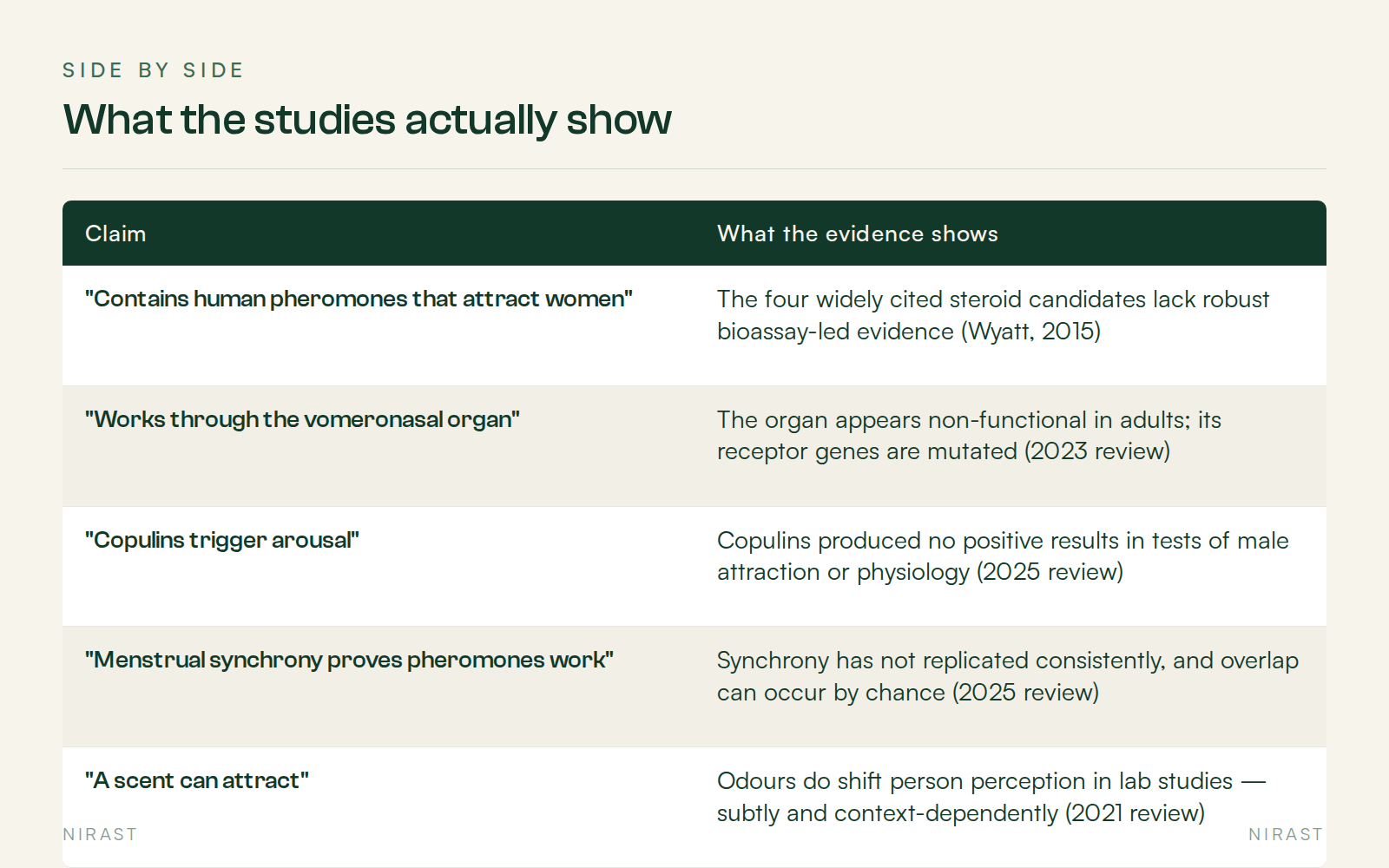
| Claim | What the evidence shows |
|---|---|
| “Contains human pheromones that attract women” | The four widely cited steroid candidates lack robust bioassay-led evidence (Wyatt, 2015) |
| “Works through the vomeronasal organ” | The organ appears non-functional in adults; its receptor genes are mutated (2023 review) |
| “Copulins trigger arousal” | Copulins produced no positive results in tests of male attraction or physiology (2025 review) |
| “Menstrual synchrony proves pheromones work” | Synchrony has not replicated consistently, and overlap can occur by chance (2025 review) |
| “A scent can attract” | Odours do shift person perception in lab studies — subtly and context-dependently (2021 review) |
What a fragrance can honestly do
Step away from the pheromone question and the honest case for a cologne is real. Research on person perception finds that the presence of an odour can influence how people are judged — through mood, priming and arousal — with attractiveness judgments among the more affected (2021 review). In one controlled study, faces were rated more attractive and confident with a pleasant fragrance present than with clean air (2024 study).
Keep the scale in view: a systematic review of 21 studies finds these effects subtle, often implicit and context-dependent (2026 review), and in a multimodal rating study body odours were the least attractive channel of four (2025 study). Wearers report that perfume improves mood, confidence and self-esteem (2026 survey study).
That is the honest promise of any cologne: a composed scent you wear well, a small documented effect on first impressions, and the confidence of knowing you smell good. How a scent is layered matters more than any label claim — see how to layer body oil so a scent lasts all day.
How to choose a pheromone cologne
Five decisions that hold up:
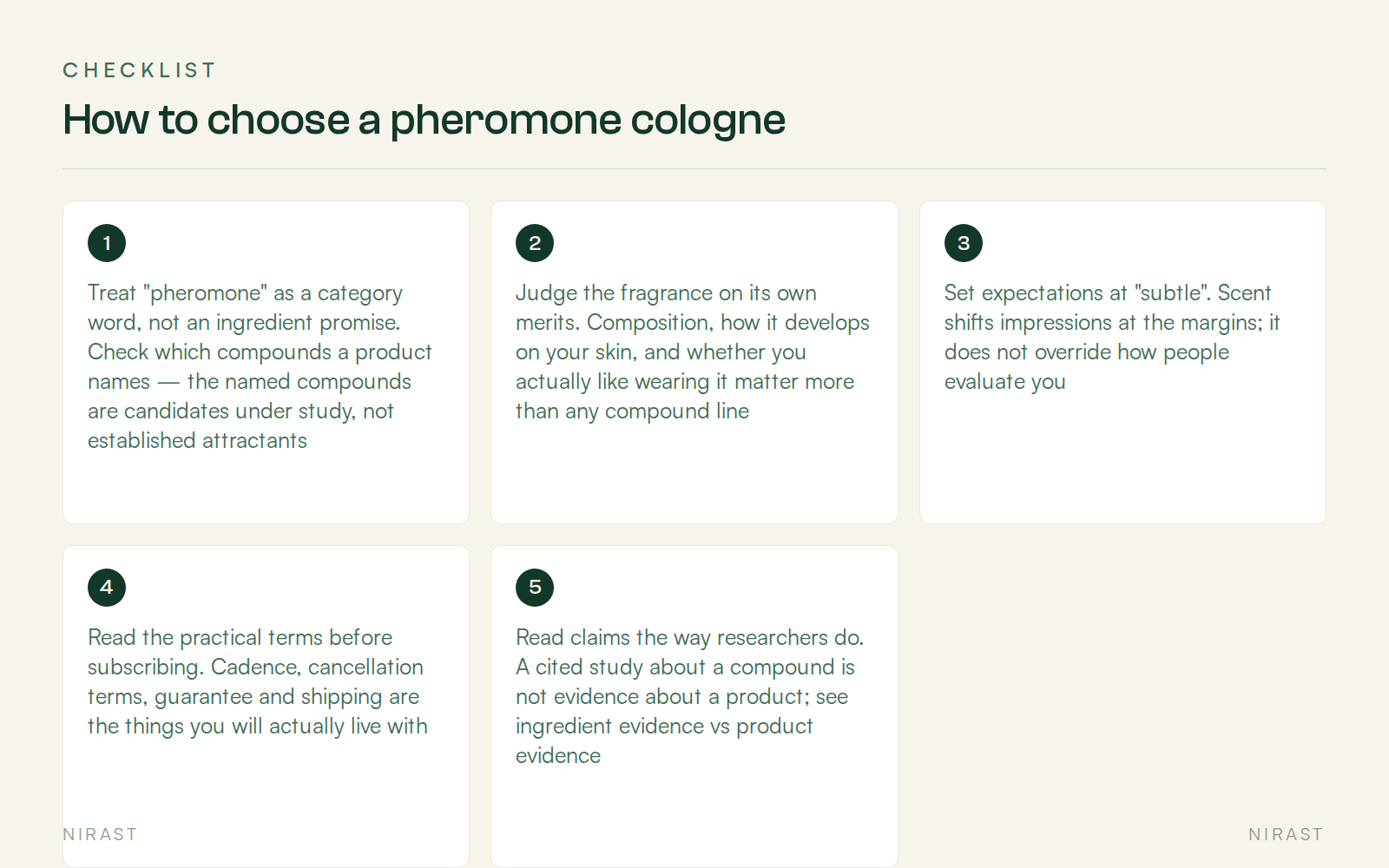
- Treat “pheromone” as a category word, not an ingredient promise. Check which compounds a product names — the named compounds are candidates under study, not established attractants.
- Judge the fragrance on its own merits. Composition, how it develops on your skin, and whether you actually like wearing it matter more than any compound line.
- Set expectations at “subtle”. Scent shifts impressions at the margins; it does not override how people evaluate you.
- Read the practical terms before subscribing. Cadence, cancellation terms, guarantee and shipping are the things you will actually live with.
- Read claims the way researchers do. A cited study about a compound is not evidence about a product; see ingredient evidence vs product evidence.
Safety: wearing fragrance on skin
Fragrance is a common trigger of allergic contact dermatitis, and dermatology guidance frequently recommends avoiding or minimising fragranced products for people with eczema, sensitive skin or suspected fragrance allergy (2026 review). Contact dermatitis is the adverse effect cosmetics most often cause, affecting roughly 1–5% of the general population, and cosmetics are not subject to pharmaceutical-level premarket testing (2026 review).
The practical version: test a new fragrance on a small patch of skin first, apply to intact skin, and stop if irritation develops — guidance that applies to every product in this category, ours included.
FAQ
What is pheromone cologne?
A fragrance that lists one or more compounds presented as human pheromones alongside its scent — commonly androstadienone, androstenone, androstenol, estratetraenol or copulins (Wyatt, 2015; 2025 review). Whether any of them functions as a pheromone in people remains unresolved (2025 review).
Do pheromone colognes actually work?
Not in the way the category implies: reviews describe the results as inconsistent, count almost 60 possibly-false-positive claims, and note that no molecule has been confirmed as a human pheromone (2020 review; ACS Central Science, 2016). What works is the scent itself: a pleasant fragrance shifts first impressions at the margins (2021 review).
What compounds are in pheromone cologne?
The recurring names are androstadienone, androstenone, androstenol and estratetraenol — steroids found in human axillary sweat — plus copulins, five aliphatic acids from 1970s primate research (2021 review; 2025 review). Individual products vary; Nirast For Him names Copulins and Androsterone in its “What’s Inside” section (product page).
Can a cologne make you more attractive?
Scent can shift perception — faces were rated more attractive and confident with a pleasant fragrance present (2024 study) — but these effects are subtle, implicit and context-dependent (2026 review). Treat a cologne as one small, real channel, not a lever.
How should I choose a pheromone cologne?
Choose the fragrance first: composition, how it wears, and the practical terms — cadence, cancellation, guarantee, shipping. Then read the compound claims with the researcher’s eye: a study about a compound is not evidence about a product (ingredient evidence explainer).
Is it safe to wear pheromone cologne every day?
Fragrance ingredients are a common cause of skin sensitisation, and dermatology guidance frequently recommends minimising fragranced products for people with eczema, sensitive skin or suspected fragrance allergy (2026 review). For most people, a well-formulated fragrance worn on intact skin is unremarkable; test new products on a small area first, and stop if irritation develops.
A cologne option: Nirast For Him
If the honest version of this category — a real fragrance, worn for its scent — is what you are after, Nirast For Him is one option to weigh. It is a pheromone-infused men’s cologne in oil form, applied as drops to the pulse points, and its page describes a proprietary pheromone blend built into the composition (product page).
The scent itself is the pitch: a Fresh Woody Aromatic that opens with mint, green apple and lemon, moves through vanilla and geranium, and settles into vetiver, oakmoss and cedar (product page). The What’s Inside artwork names two compounds — Copulins and Androsterone — the same category of candidates under study, not established attractants; no cologne can promise how others will respond (product page).
What the offer looks like: a subscription-only product with four tiers displayed at $29.00, $29.00, $58.00 and $87.00 per shipment (billed monthly, monthly, every 2 months, every 3 months); an Add To Cart checkout; a 30-Day Money-Back Guarantee; free worldwide shipping (orders processed within 4–7 business days; delivery 5–7 business days after shipment); cancellation by emailing support@nirast.co at least 24 hours before renewal (product page).
If a well-made scent you enjoy wearing is the honest reason to buy a cologne, see the Nirast For Him page here.
These statements have not been evaluated by the Food and Drug Administration. This product is not intended to diagnose, treat, cure, or prevent any disease. Talk to your doctor or pharmacist before starting a supplement, especially if you are pregnant, nursing, take medication or have a medical condition.
Related reading
- Pheromone Cologne for Men: How to Wear It and What to Expect
- Do 'Pheromone' Ingredients in a Scented Body Oil Actually Influence Attraction?
- Libido Gummies: What They Are, What the Evidence Shows, and How to Choose
- Sleep Gummies: What They Are, What the Evidence Shows, and How to Choose
Related product: Nirast For Him.