
Testosterone Boosters: What the Evidence Shows and How to Judge One

Testosterone boosters are dietary supplements marketed to raise or support testosterone — not prescription testosterone therapy. Across 52 studies of 27 proposed boosters, most failed to increase total testosterone; the positive signals that do appear are narrow. Symptoms of low testosterone need morning blood tests and a clinician, not a supplement.
Nirast makes Nirast Ultimate Alpha Stack. This article was written by Nirast’s editorial team and reports what the published research does and does not show.
See Nirast Ultimate Alpha Stack → · 30-Day Money-Back Guarantee
Published by Thang Phi, founder of Nirast and publisher of the Nirast Journal.
What “testosterone booster” actually means
A testosterone booster is a supplement — regulated as a subset of foods, not as a drug. In the United States, supplements need no FDA approval before marketing unless they contain a new dietary ingredient; manufacturers, not regulators, carry the safety and labeling obligations (ISSN review, 2025).
A systematic review of two decades of data — 52 studies covering 27 proposed boosters — found that most fail to increase total testosterone, despite marketing claims that they significantly increase it (IJIR review, 2024).
The condition it borrows from is narrower: male hypogonadism is a clinical syndrome of symptoms plus consistently low morning testosterone; under 1% of men have the organic form, the obesity-related form 2% to 8% (JAMA review, 2026).
What the evidence says about the common ingredients
Fenugreek has one of the few pooled analyses: a 2026 meta-analysis found a small increase in total testosterone across six randomized trials (385 men; standardized mean difference 0.25, 95% CI 0.02–0.48), while the free-testosterone estimate crossed the null. Certainty was rated very low, and the authors concluded the data do not support strong commercial claims (Frontiers in Nutrition, 2026).
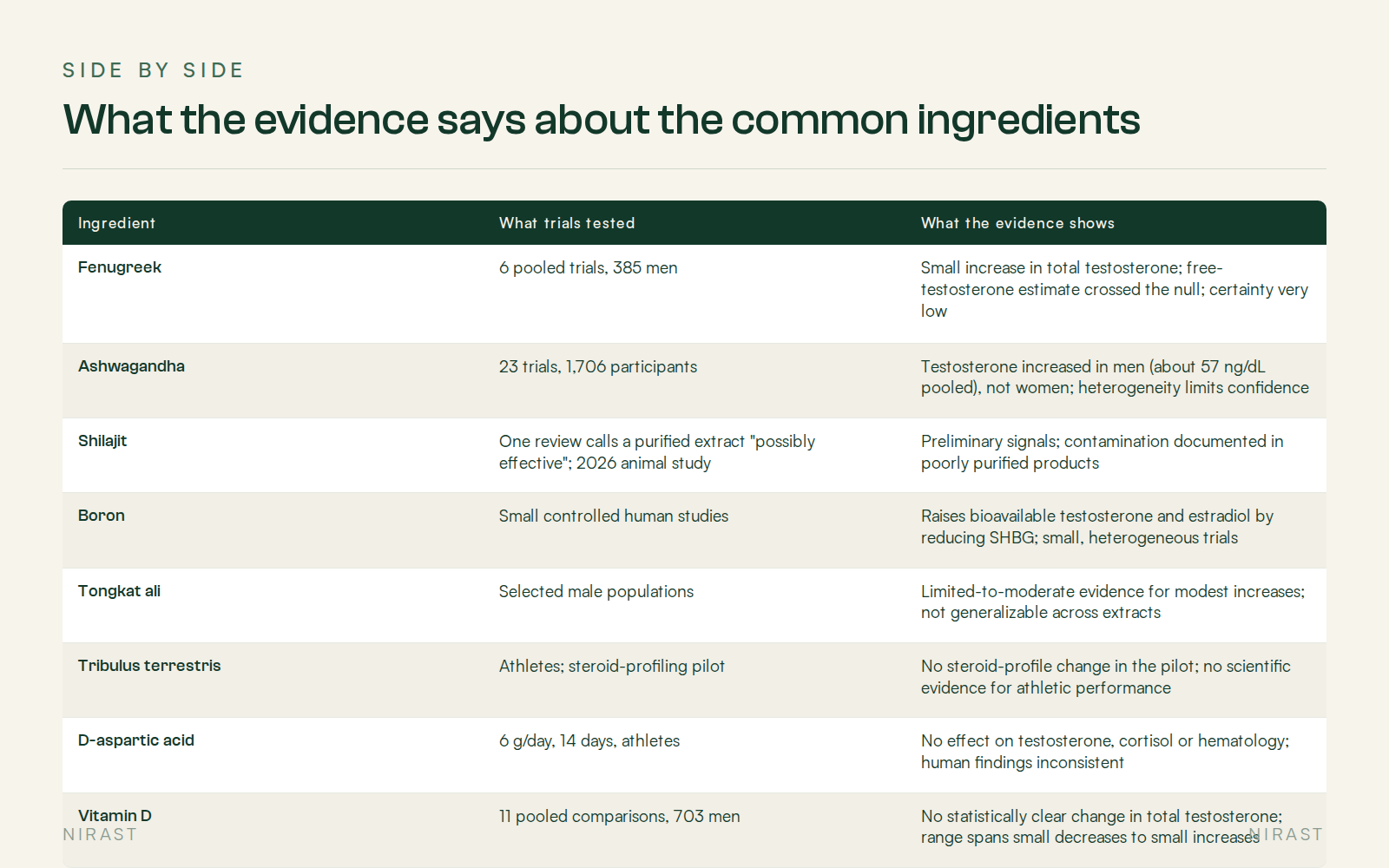
Ashwagandha has more trials and similar limits: a 2026 meta-analysis of 23 randomized trials (1,706 participants) found testosterone increased in men — about 57 ng/dL pooled — but not in women, with no estradiol effect, and heterogeneity tempers the result (Planta Medica, 2026).
Shilajit’s evidence is thinner than its reputation. One review counts a purified extract as “possibly effective” in late-onset hypogonadism, and a 2026 animal study reported large testosterone increases in a follow-up its authors call preliminary; it also documented liver and kidney tissue changes in most samples, and heavy-metal contamination in poorly purified products (Pharmaceuticals study, 2026).
Boron acts differently: human studies show it raises bioavailable testosterone and estradiol by reducing sex hormone-binding globulin — but the trials are small and heterogeneous (Nutrients critical review, 2026).
Tongkat ali sits in the same band: a 2026 critical review grades standardized extracts of ashwagandha, fenugreek and tongkat ali as limited-to-moderate evidence for modest increases in selected populations — low baseline testosterone, aging symptoms, infertility or stress — and warns the grades are preparation-specific (Pharmacological Research, 2026).
Tribulus terrestris has the least to show: a 2026 pilot found no significant changes in urinary steroid profiles among athletes taking it daily, and a survey-plus-review paper states there is no scientific evidence supporting it for athletic performance; it also reports users frequently overestimate efficacy and underestimate risks, and adulteration with unlisted ingredients (JPBA pilot, 2026; Nutrients survey, 2026).
D-aspartic acid failed its most recent test: 6 g/day for 14 days did not affect testosterone or cortisol in athletes, and human findings have been inconsistent (Nutrients trial, 2023).
Vitamin D, a common add-on, is a clear case of trials contradicting marketing: across 11 comparisons (703 men), supplementation produced no statistically clear change in total testosterone (Nutrients meta-analysis, 2026).
| Ingredient | What trials tested | What the evidence shows |
|---|---|---|
| Fenugreek | 6 pooled trials, 385 men | Small increase in total testosterone; free-testosterone estimate crossed the null; certainty very low |
| Ashwagandha | 23 trials, 1,706 participants | Testosterone increased in men (about 57 ng/dL pooled), not women; heterogeneity limits confidence |
| Shilajit | One review calls a purified extract “possibly effective”; 2026 animal study | Preliminary signals; contamination documented in poorly purified products |
| Boron | Small controlled human studies | Raises bioavailable testosterone and estradiol by reducing SHBG; small, heterogeneous trials |
| Tongkat ali | Selected male populations | Limited-to-moderate evidence for modest increases; not generalizable across extracts |
| Tribulus terrestris | Athletes; steroid-profiling pilot | No steroid-profile change in the pilot; no scientific evidence for athletic performance |
| D-aspartic acid | 6 g/day, 14 days, athletes | No effect on testosterone, cortisol or hematology; human findings inconsistent |
| Vitamin D | 11 pooled comparisons, 703 men | No statistically clear change in total testosterone; range spans small decreases to small increases |
How to judge a testosterone booster
Labels may carry structure/function claims, but claims to diagnose, cure, mitigate, treat or prevent disease are not permitted on a supplement (ISSN review, 2025).
Marketing in this space is unreliable at scale: a content analysis of 253 websites offering testosterone treatment found information commonly divergent from evidence-based guidelines, and only 28.5% acknowledged that testosterone therapy may impair fertility (JCEM analysis, 2026).
Three questions when you read a label. Are ingredients named with amounts, or hidden in a blend? Does the evidence describe the ingredient in a population — or the finished product in your hand? That gap is where this category’s overpromising lives (Ingredient evidence vs product evidence). And what verifies what is in the bottle? Batch documents (What a batch certificate of analysis documents) — and percentage claims deserve the same scepticism as any statistic (How to read a “93% of users said” claim).
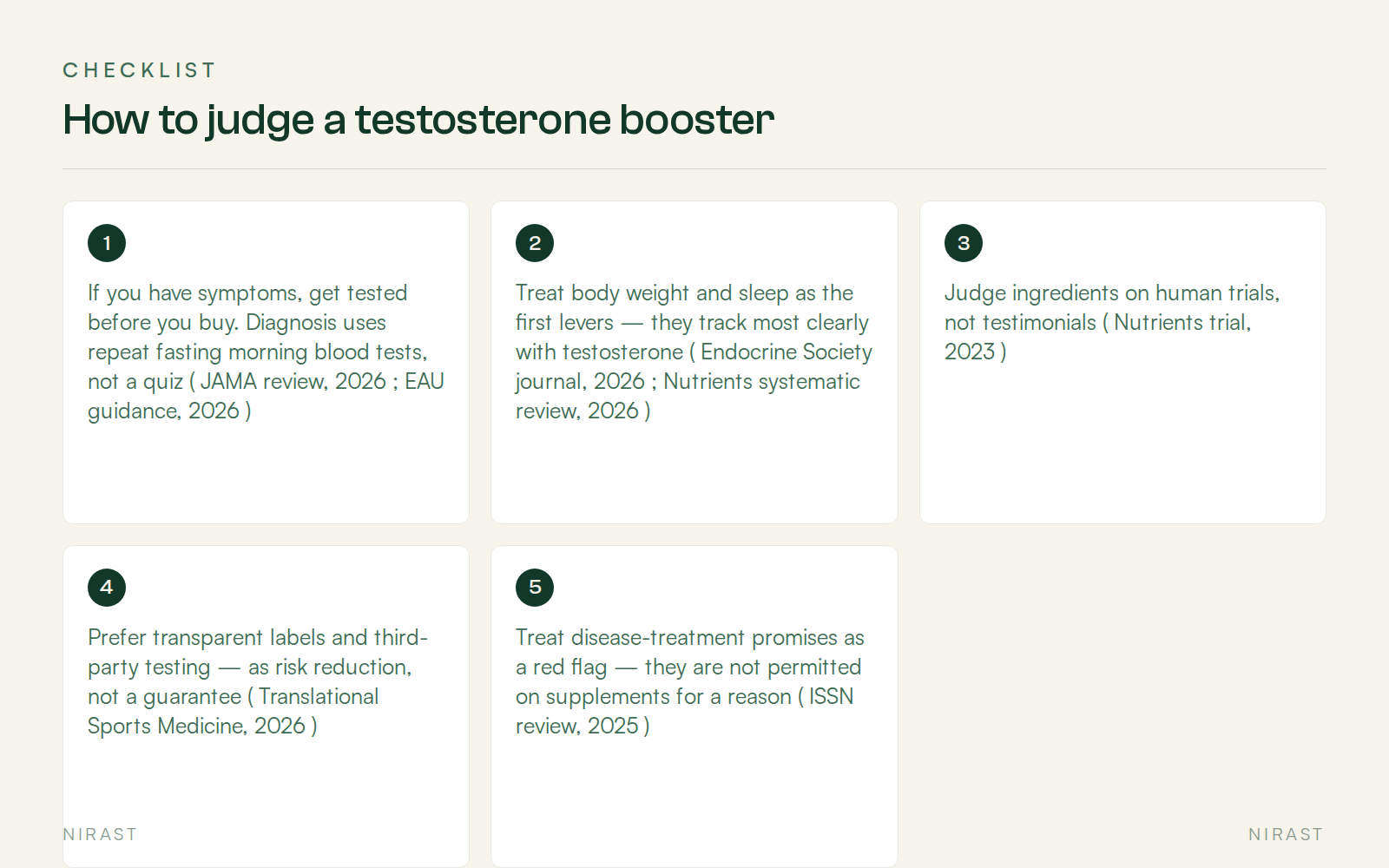
Five decisions:
- If you have symptoms, get tested before you buy. Diagnosis uses repeat fasting morning blood tests, not a quiz (JAMA review, 2026; EAU guidance, 2026).
- Treat body weight and sleep as the first levers — they track most clearly with testosterone (Endocrine Society journal, 2026; Nutrients systematic review, 2026).
- Judge ingredients on human trials, not testimonials (Nutrients trial, 2023).
- Prefer transparent labels and third-party testing — as risk reduction, not a guarantee (Translational Sports Medicine, 2026).
- Treat disease-treatment promises as a red flag — they are not permitted on supplements for a reason (ISSN review, 2025).
What actually moves testosterone: body weight, sleep, and health conditions
In NHANES data on 4,984 men, age explained only 2.5% of the variation in testosterone, while body-fat and waist measures each explained about 18% to 20% (Endocrine Society journal, 2026). Weight loss of 5% to 10% has been associated with clinically meaningful testosterone increases — roughly 3 nmol/L per 10 kg lost — and it is the first-line management for obesity-induced hypogonadism (Nutrients systematic review, 2026; JAMA review, 2026).
Sleep has experimental support too: total sleep deprivation of 24 hours or more significantly reduces testosterone in healthy men, while short-term partial restriction did not; real-world magnitude remains uncertain (Endocrine & Metabolic Disorders, 2026).
When should low testosterone be a clinician’s question?
When there are symptoms. Hypogonadism is confirmed with two fasting morning samples below roughly 264 to 300 ng/dL, measured between 7 and 10 am (JAMA review, 2026); European guidance sets the threshold at 12 nmol/L or less (EAU guidance, 2026).
Prescribed testosterone is a monitored treatment, not a wellness product: in the TRAVERSE trial it was non-inferior to placebo for major cardiovascular events in men with confirmed hypogonadism and elevated cardiovascular risk, with erythrocytosis the most reproducible adverse effect (J Endocrinol Invest review, 2026). It also suppresses the signal that drives sperm production, so fertility preservation belongs in the conversation before starting (Frontiers in Reproductive Health, 2026). And in a cohort of more than 350,000 men, about one in three prescriptions had no evidence of hypogonadism — off-label use carried higher long-term cardiovascular risk (EBioMedicine cohort, 2026).
For supplements, two risks need a clinician conversation: contamination — surveys repeatedly find undeclared anabolic steroids and SARMs in supplements, with hormonal products marketed for muscle growth frequently adulterated (Frontiers in Sports, 2026; Society for Endocrinology, 2026) — and ingredient-specific harm, such as ashwagandha’s liver-injury cases (Case Reports in Hepatology, 2026). If you take medication, have liver disease, or are treated for a hormone condition, have that conversation before the purchase.
FAQ
What is a testosterone booster?
A dietary supplement marketed to raise or support testosterone — regulated as a food, not a medicine. The category’s systematic review found most fail to increase total testosterone (IJIR review, 2024); none is approved to treat low testosterone.
Do testosterone boosters actually increase testosterone?
Fenugreek and ashwagandha show small, population-specific signals in pooled analyses, while Tribulus, D-aspartic acid and vitamin D mostly failed their tests (Frontiers in Nutrition, 2026; Planta Medica, 2026). Certainty for the positive signals is low to very low.
Which ingredients in testosterone boosters are backed by human trials?
Fenugreek, ashwagandha, shilajit and tongkat ali have human trials behind them, though pooled effects are small (Pharmacological Research, 2026); boron’s studies are small but controlled (Nutrients critical review, 2026). Tribulus, D-aspartic acid and vitamin D have null or inconsistent records (Nutrients trial, 2023).
Are testosterone boosters safe?
Documented concerns include contamination with undeclared steroids and SARMs (Frontiers in Sports, 2026), ashwagandha-associated liver injury (Case Reports in Hepatology, 2026), and heavy metals in some shilajit products (Pharmaceuticals study, 2026). Anyone on medication or with liver disease should ask a clinician first.
What is the difference between a testosterone booster and testosterone therapy?
A booster is a supplement sold without pre-market approval; it cannot treat a diagnosed hormone condition. Testosterone therapy is a prescription medicine for confirmed hypogonadism, monitored because of real trade-offs including erythrocytosis and suppressed sperm production (J Endocrinol Invest review, 2026; Frontiers in Reproductive Health, 2026).
When should you see a doctor about low testosterone?
When you have symptoms — and before treating them with a supplement. Diagnosis uses repeat fasting morning blood tests against thresholds such as 264 to 300 ng/dL, or 12 nmol/L or less in European guidance (JAMA review, 2026; EAU guidance, 2026).
A two-formula option: the Nirast Ultimate Alpha Stack
If you want a supplement option in this category, the Nirast Ultimate Alpha Stack is a two-formula system: T Breakthr™ (120 vegan capsules) and EstControl™ (72 vegan capsules), taken as a daily capsule routine, ideally with a meal or snack (product page). The T formula’s US-visible ingredient list includes fenugreek (as TestoSurj™), ashwagandha KSV-66, shilajit, boron, nettle root, tongkat ali, black maca, fadogia agrestis, zinc bisglycinate, rhodiola and turkesterone; the EstControl list includes DIM, resveratrol, milk thistle, broccoli-sprout compounds, NAC and glutathione (product page).
The offer: tiers at $135.99 (one pack), $237.99 (two packs) and $331.49 (three packs), delivery every 24, 48 or 72 days, a 30-Day Money-Back Guarantee, free shipping, and cancellation by email at least 24 hours before a renewal (product page).
The honest boundary: a dietary supplement — not testosterone therapy, and not a treatment for hypogonadism. If your symptoms suggest low testosterone, get tested first. For a transparently labeled two-formula capsule routine, start with the Ultimate Alpha Stack here.
These statements have not been evaluated by the Food and Drug Administration. This product is not intended to diagnose, treat, cure, or prevent any disease. Talk to your doctor or pharmacist before starting a supplement, especially if you are pregnant, nursing, take medication or have a medical condition.
Related reading
- Natural Testosterone Booster: What the Evidence Shows and When to See a Clinician
- Amla Capsules: What the Evidence Shows
- Pheromone Cologne: What It Is, What the Evidence Shows, and How to Choose
- Probiotics for Weight Loss: What the Evidence Shows — and What It Can't Do
Related product: Nirast Ultimate Alpha Stack.