
Does Where You Buy Black Seed Oil Change What You Can Verify?
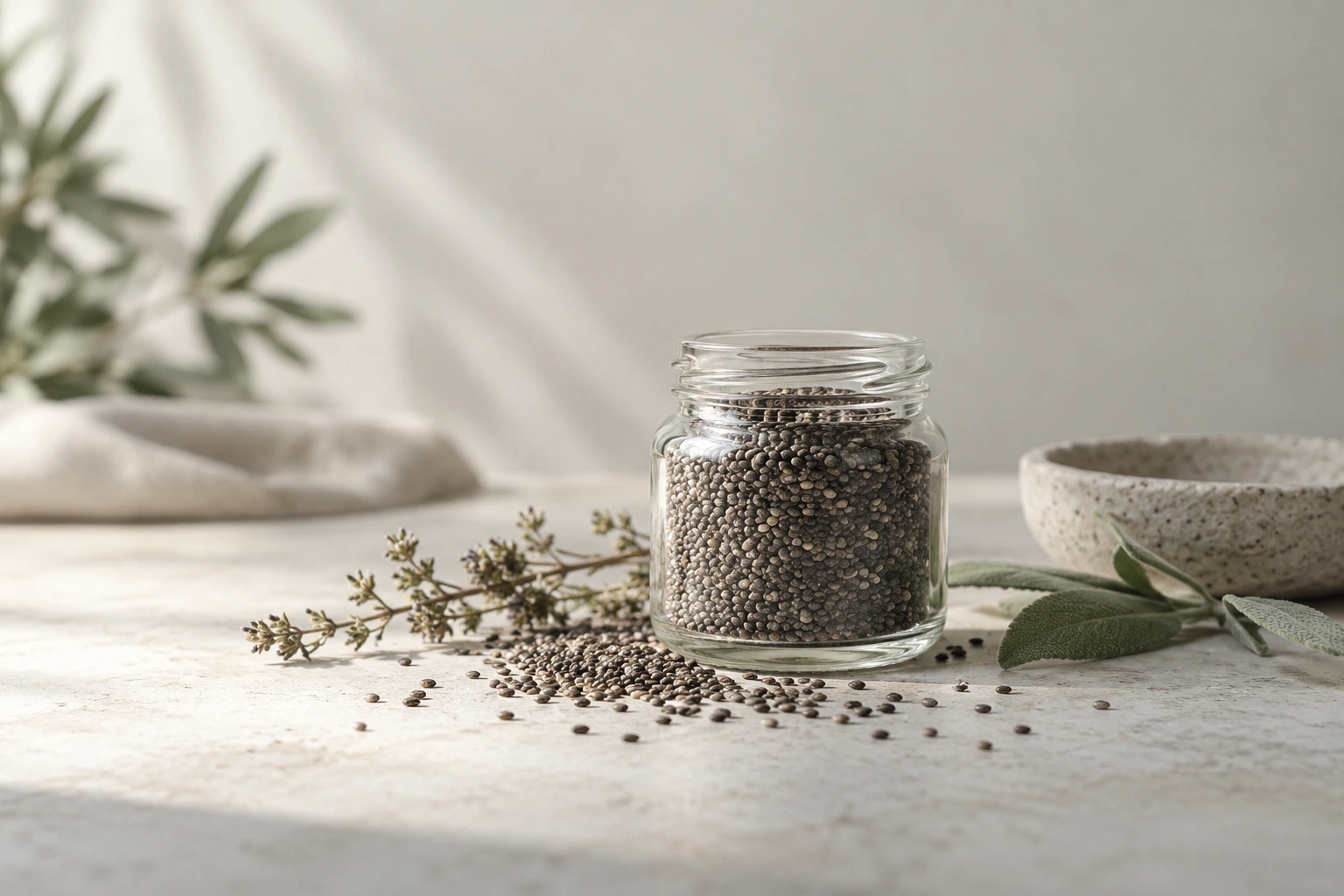
Where you buy a pack of black seed oil does not change what can be verified about it. The checkable facts belong to the pack — the botanical name, the amount per serving with the serving defined, and the form — plus any testing document a seller publishes that a buyer can match to a lot. A shelf card or marketplace listing that shows a potency number without a document is no more checkable than a brand page.
Nirast makes Ethiopian Black Seed Oil. This article was written by Nirast’s editorial team and reports what the published research does and does not show.
See Nirast Ethiopian Black Seed Oil → · $29.99 a month · 30-Day Money-Back Guarantee
Published by Thang Phi, founder of Nirast and publisher of the Nirast Journal.
It is a reasonable instinct. Choosing a shop you trust, or a listing with more detail, feels like it should buy you more certainty about what is inside the pack. But “where” and “what” are two different questions. The things a buyer can actually check are properties of the bottle, pouch or softgel in hand, and those properties do not improve or degrade according to which storefront sold them. Understanding that changes what you should look at — and what you should ask the seller for.
The verifiable facts travel with the pack, not the shelf
Start with the property that is fixed before any product is even made: the plant. The oil in a pack of black seed oil is pressed from Nigella sativa, an annual flowering plant in the Ranunculaceae family — a botanical identity that belongs to the plant and therefore to any pack that correctly names it (a narrative review of Nigella sativa extraction and composition, https://pubmed.ncbi.nlm.nih.gov/36140949/). A store cannot make that identity more or less true. Either the pack names Nigella sativa or it does not.
The same logic covers the amount and the form. When a label states “1,000 mg of black seed oil per serving”, the two parts of that figure — the milligram amount and the definition of a serving — are printed on the pack, and the dose form (a softgel, a liquid oil, a capsule) is a property of the product itself. The Nirast pack, for example, places its identity (Nigella sativa), its amount (1,000 mg per serving) and its softgel form directly on the pack, which is exactly where a buyer looks first (product page, https://try.nirast.co/black-seed-oil-otp/). None of those elements is supplied by the retailer; they come attached to the product.
So the first move in verifying a pack is not “which shop?” but “what does the pack itself say, and is it specific?” A pack that names the botanical, states an amount per serving, defines that serving, and names the form has given you three things you can hold a seller to. A pack that says only “black seed oil” and “supports wellness” has given you nothing checkable, wherever it sits.
What a “third-party tested” badge does and does not give you
Here is where purchase channels genuinely feel like they should matter, and where the confusion usually starts. Many listings, shop cards and brand pages carry a “third-party tested” or “lab tested” badge. Those words describe an arrangement; they are not, by themselves, a document you can inspect. The artefact you can actually check is the report or certificate attached to the specific lot — the piece of paper (or PDF) with a laboratory name, a method, a result and a batch identifier that ties it to the pack in your hand.
This distinction is not a technicality. A manufacturer may contract with an independent organisation to verify a product’s quality, but the U.S. Drugs and Lactation Database (LactMed) notes that such a verification “does not certify the safety or effectiveness of a product”, and that it is a different thing from a document a consumer can read (LactMed, black seed monograph, https://pubmed.ncbi.nlm.nih.gov/30000936/). The badge is a promise; the lot document is evidence. A buyer who learns to ask for the second is no longer relying on the first.
That matters because a potency number on a card — a thymoquinone percentage, say — is only as good as its traceability. A “5%” or “2%” figure is a measurable property, and marketed products really do differ: a voltammetric analysis of black seed oils and supplements found thymoquinone content ranging from 1.77 to 5.77 mg/mL across named samples (peak quantification of thymoquinone in Nigella sativa products, https://pubmed.ncbi.nlm.nih.gov/40442198/). The figure is real and varies; what converts it from a marketing line into something you can check is a report that links the number to the lot you bought. Without that link, the number is a claim — whether it appears on a brand’s own page or on a marketplace listing.
Why the storefront adds nothing on its own
The intuitive belief is that a trusted retailer vouches for what it sells. In the supplement category that belief runs into a regulatory fact. Dietary supplements do not require pre-marketing approval from the U.S. Food and Drug Administration, and, as LactMed records, “differences are often found between labeled and actual ingredients or their amounts” (https://pubmed.ncbi.nlm.nih.gov/30000936/). A storefront is a distribution channel, not a quality gate that the product has already passed. The store did not make the oil, test the oil or assume responsibility for the label’s accuracy beyond what any seller owes.
The product-chemistry reason points the same way. A structured review of defined natural products found that “species, plant part, cultivation, processing, extraction solvent, storage and adulteration can alter the composition of the administered product”, and concluded that a tea, a decoction, a standardised extract and a purified compound “should be treated as different medicinal products even when they share a botanical source” (structured review, adjunctive natural-product therapies, https://pubmed.ncbi.nlm.nih.gov/42653115/). Every one of those variables is fixed during production, before the pack reaches any retailer. The store that hands you the pack inherits decisions it had no part in making.
The document to ask for before you buy
If the channel does not carry the verification, what does? For a defined botanical oil, the review above specifies what a serious preparation actually documents: the seed-oil’s thymoquinone or other marker-compound ranges, its oxidation state, and the pressing and extraction conditions (https://pubmed.ncbi.nlm.nih.gov/42653115/). That is the specification a bare number lacks. A listing that shows “5%” but no specification has told you a target; it has not told you what was measured or how.
Labelling compounds the problem, because what is printed is not guaranteed to be complete. A case report and literature review on spice allergy notes that, under EU food-information rules, spices constituting less than 2% of a finished product may be declared generically as “spices” or “herbs”, so “spices and herbs are often not specified in the final food product labeling” (cumin anaphylaxis and spice allergy, https://pubmed.ncbi.nlm.nih.gov/42519315/). The practical lesson is not that labels lie; it is that the presence of a specific plant must not be assumed from a listing’s silence. If a document matters to your decision, the only reliable route is to ask the seller for it directly and read what it covers.
A short checklist that works in any shop
Because these facts belong to the pack, the same four questions apply everywhere you might buy:
- Botanical name. Does the pack name Nigella sativa, or only “black seed oil”?
- Amount per serving — with the serving defined. Is the milligram figure stated alongside what counts as a serving, so the number means something?
- Form. Is it a softgel, a capsule or a liquid oil, and is that the form you wanted?
- The batch document. Will the seller send you the lot’s test report or specification — a document with a laboratory, a result and a batch identifier — rather than pointing at a badge?
Any pack that can answer all four is checkable; any store that only offers a shelf card with a potency figure is not. The questions travel with you from a big-box shelf to a marketplace listing to a brand’s own page, because the answer never depended on the shelf.
Where Nirast’s pack fits
This is the checklist the pack behind this page is built to answer. Nirast Ethiopian Black Seed Oil is a softgel pressed from cold-pressed Nigella sativa oil, stated at 1,000 mg of black seed oil per serving, and it names its botanical identity and its form directly on the pack (https://try.nirast.co/black-seed-oil-otp/). It is sold as one monthly subscription — one pouch for $29.99, with a 30-day money-back guarantee and free worldwide shipping, and cancellation by emailing support@nirast.co at least 24 hours before the next renewal.
The honest bridge here is the same rule the rest of this page makes: apply the four questions above to this pack exactly as you would to any other. Check the botanical name it prints, the amount per serving and its definition, and the softgel form. If you want a form that is easy to take as a daily routine, you can read the current offer and its terms at https://try.nirast.co/black-seed-oil-otp/. If you would rather buy elsewhere, the checklist still works — that is the point.
References
- Narrative review on oil extraction, encapsulation and composition of Nigella sativa — https://pubmed.ncbi.nlm.nih.gov/36140949/
- Nirast Ethiopian Black Seed Oil product page — https://try.nirast.co/black-seed-oil-otp/
- Voltammetric quantification of thymoquinone in Nigella sativa products — https://pubmed.ncbi.nlm.nih.gov/40442198/
- Drugs and Lactation Database (LactMed), black seed monograph — https://pubmed.ncbi.nlm.nih.gov/30000936/
- Structured review of defined natural products as adjunctive therapies — https://pubmed.ncbi.nlm.nih.gov/42653115/
- Cumin anaphylaxis and allergy to spices: case report and literature review — https://pubmed.ncbi.nlm.nih.gov/42519315/
FAQ
Does buying from a pharmacy or a trusted store make a supplement more verifiable?
No. Trust in a shop does not transfer to the product’s label. The verifiable facts — botanical identity, amount per serving, form and any lot document — belong to the pack itself, and supplements are not pre-approved for accuracy before sale.
What is the single most useful document to ask for?
The lot’s test report or specification: a document with a laboratory name, a method, a result and a batch identifier that matches your pack. A “third-party tested” badge is a claim; that document is what you can actually check.
A listing shows “5% thymoquinone” — is that enough?
A number alone is not a document. Thymoquinone content genuinely varies between marketed products, so ask for the specification that ties the figure to your lot. A target with no traceable measurement is still just a claim.
Do I need to know the store before I trust the bottle?
You need to know what the pack says and whether the seller will show you its documents. Where the pack was sold tells you about the channel, not about the contents.
Can a very “clean” listing be trusted because it lists fewer ingredients?
A listing’s brevity is not information. Because label rules can allow generic declaration, the absence of a named ingredient in a listing is not proof of its absence. Ask for the full ingredient list and the specification directly.
Related reading
- Black Seed Oil: What It Is, What the Evidence Covers, and How to Choose a Form
- How to Verify a "Single-Origin" or Farm-Level Black Seed Oil Claim
- Where Black Seed Oil Findings Disagree — and What It Means for Your Expectations
- Are Oil of Oregano and Black Seed Oil Interchangeable?
Related product: Ethiopian Black Seed Oil.