
What “Cold-Pressed” Actually Tells You About a Black Seed Oil
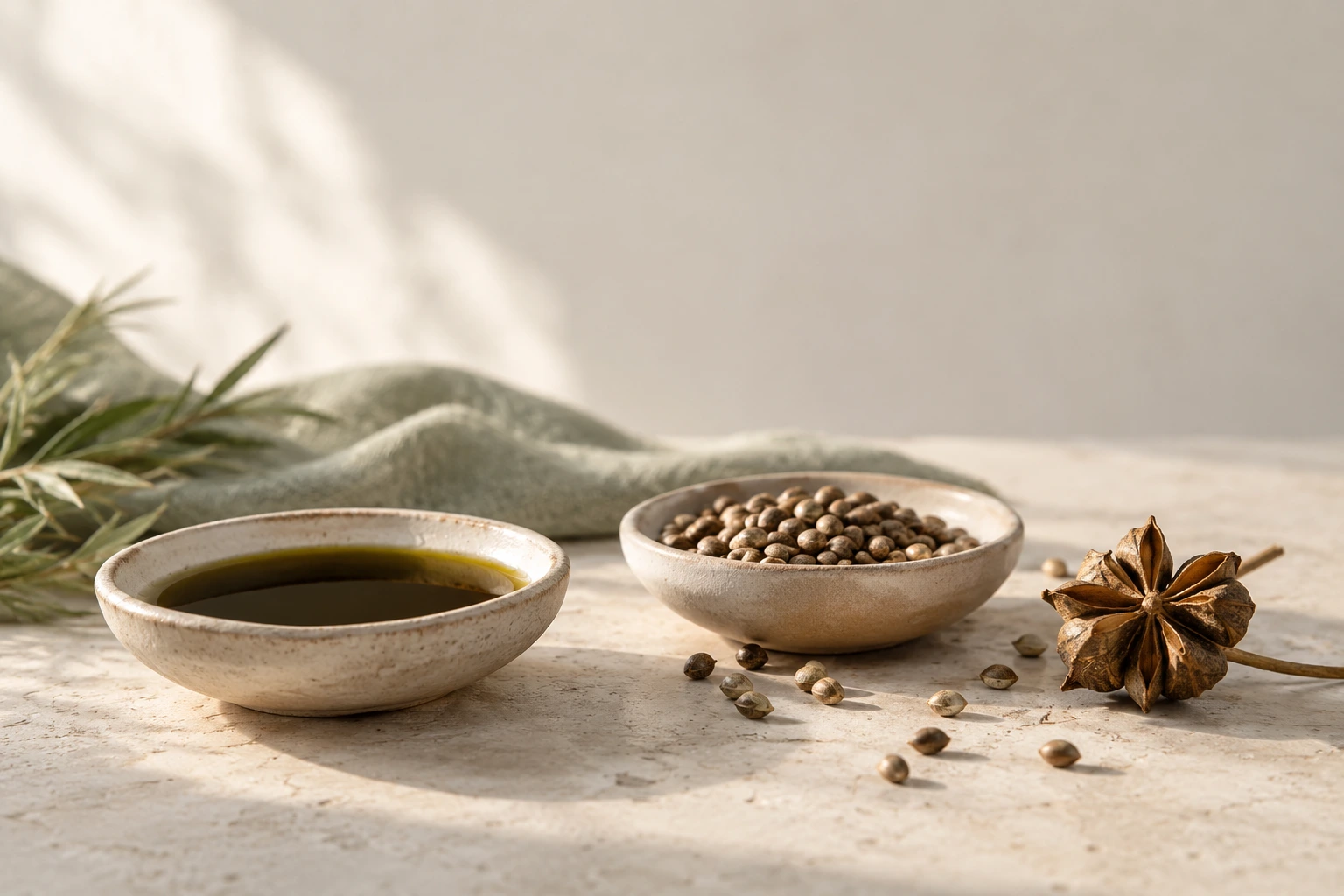
What “Cold-Pressed” Actually Tells You About a Black Seed Oil
The Short Answer
Cold-pressed is a description of how an oil was extracted — pressed mechanically, without applied heat — not a measurement of any active compound inside it. On a label it tells you the process was gentler than hot or solvent extraction; it does not tell you how much thymoquinone a serving holds, how much oil is in each softgel, or how strong the product is, so it belongs beside the stated amount per serving rather than in place of it.
Nirast makes Ethiopian Black Seed Oil. This article was written by Nirast’s editorial team and reports what the published research does and does not show.
See Nirast Ethiopian Black Seed Oil → · $29.99 a month · 30-Day Money-Back Guarantee
Published by Thang Phi, founder of Nirast and publisher of the Nirast Journal.
That is the whole of what the phrase carries. It is a real and useful fact about the making of the oil, and it is a bad proxy for strength. If you are holding two black seed oils and one says “cold-pressed,” you now know one thing about one of them: how it was pressed. You do not yet know anything about how much of anything is in it.
Where the Words “Cold-Pressed” Come From
The phrase is not a marketing invention. “Cold-pressed” is a defined term in the international food standard for edible fats and oils — the Codex Alimentarius standard CXS 19-1981 — and the definition is deliberately narrow. It describes edible vegetable oils “obtained, without altering the oil, by mechanical procedures, e.g. expelling or pressing, without the application of heat,” and it allows only gentle clean-up afterwards: washing with water, settling, filtering and centrifuging. Nothing hotter, nothing chemical.
That matters because it tells you what the claim is about. The standard is a process and labelling rule. It says how the oil may be made if it wants the name; it says nothing about how much of any compound the oil contains, how pure it is, or what it does in the body. Those are separate questions, and a label is not answering them when it prints “cold-pressed.”
The full definition sits in Section 2.3 of the standard, reproduced here: Codex Alimentarius CXS 19-1981 standard text.
Does Cold-Pressing Make a Bottle Stronger?
Not reliably, and in at least one controlled test the answer ran the other way. A 2017 study in Acta Scientiarum Polonorum compared cold-pressed and hot-pressed rapeseed oil at three seed-moisture levels, with and without roasting. The pressing method clearly changed the oil’s composition — the authors note that “the type of pressing process (cold-pressing or hot-pressing) and whether the seeds have undergone roasting has also been shown to affect the resulting oil and the level of native antioxidants it contains.”
But the direction was not the one the adjective implies: the hot-pressed oils “have been shown to have higher levels of these compounds than cold-pressed oils,” referring to tocopherols and plastochromanol-8. Cold-pressing is a gentler process; it is not automatically a richer one. The study also found that cold-pressed oil from the lowest-moisture seed had the lowest peroxide values and the highest tocopherol content among the cold-pressed samples — a reminder that the seed matters as much as the press.
That study is on rapeseed, not black seed, so the specific numbers do not transfer. What transfers is the principle: pressing method is a real variable that can move composition in either direction. Read the study abstract here: Siger, Jozefiak & Gornas (2017), Acta Sci. Pol. Technol. Aliment. 16(1):69-81.
“Cold-Pressed” Is a Definition, Not a Grade
The standard is explicit that the words are reserved. Section 6.1 restricts the designation “cold pressed oil” to oils that actually meet the Section 2.3 definition, and forbids additives in virgin or cold-pressed oils. The Appendix also sets quality thresholds that apply to the category — for example a peroxide value up to 15 milliequivalents of active oxygen per kilogram for virgin and cold-pressed oils, and up to 10 for other fats and oils, plus an acid value of 4.0 mg KOH/g.
So “cold-pressed” is a claim about method that a producer is expected to be able to support, not a score. There is no “more cold-pressed” than another. One bottle is either pressed within the definition or it is not; the phrase cannot rank two compliant products against each other on potency, because potency is not the thing it measures.
Cold-Pressed Black Seed Oil Is Not Automatically More Stable
It is tempting to read “cold-pressed” as “fresh and well-preserved,” and that reading fails too. A 2024 study in La Rivista Italiana delle Sostanze Grasse cold-pressed black cumin (Nigella sativa) seed oil with a manual screw press kept “below 50 C during the extraction” and then measured how it held up. The peroxide values of the oil ranged from 15.43 to 29.59 meq O2/kg — above the 10 meq O2/kg reference commonly used for edible oils — which the authors attribute to lipoxygenase activity and a high free fatty acidity of 8.85–13.14%. Oxidative stability then fell as storage time increased, and sun-exposed storage was the worst of the conditions tested; shaded and refrigerated storage held up better.
The lesson is not that cold-pressing is bad. It is that the adjective does not stand in for the storage and handling that actually protect an oil. A cold-pressed oil can be less stable than a hot-pressed or refined one, and a bottle left in sunlight will degrade regardless of how it was pressed. You can read the study here: Arslan & Acar (2024), La Rivista Italiana delle Sostanze Grasse 101:165-174.
What the Evidence Does Not Show
Nothing here establishes that a cold-pressed oil is better for you than a hot-pressed one, or that any particular bottle carries more thymoquinone because of the words on its label. The pressing studies measure composition, not health outcomes, and they were run on laboratory oils rather than on the product a customer takes home. The Codex standard is a labelling rule with no view on potency or benefit at all.
There is also no single universal standard behind the phrase. The Codex definition forbids heat throughout, while some national guidelines permit limited heat before or after pressing and European olive-oil rules tie “cold extraction” to temperatures below 27 C. The same two words can therefore describe slightly different process limits in different markets. Treat “cold-pressed” as a true statement about method and as a false comfort about strength or shelf life.
How to Read the Words on a Bottle Before You Buy
The useful move is to demote the adjective and promote the number. Every oil label states an amount per serving; almost none of them make it easy to compare. Two things make the figure usable:
- The amount per serving. Compare like with like — milligrams to milligrams, at the serving the label defines.
- The serving definition. “1,000 mg per serving” means something only once the label tells you what a serving is: two softgels, one capsule, a teaspoonful. Without that unit, the milligram figure cannot be turned into a per-dose number or checked against another product.
If a label gives the amount per serving but not the unit that defines the serving, the comparison genuinely stops, and the honest next step is to ask the seller for the serving definition and, if potency matters to you, the analytical method behind any composition claim. That request is reasonable: a substantive claim is one a seller is expected to be able to stand behind.
A Cold-Pressed Black Seed Oil You Can Take as a Softgel
Nirast’s Ethiopian Black Seed Oil is a cold-pressed Nigella sativa oil delivered in a softgel — the format the brand is built around. Three things about it are worth naming plainly, because they are what you can verify at the point of purchase:
- It is cold-pressed black seed oil from Nigella sativa, the same plant the studies above examine, and it states 1,000 mg of black seed oil per serving.
- It takes the taste out of the equation. The softgels are described as tasteless and easy to swallow, which matters for an oil whose strong, pungent character is the reason many people never manage a daily spoonful.
- The offer is simple. One pouch, one monthly subscription at $29.99, cancel any time by emailing support@nirast.co at least 24 hours before your next renewal, backed by a 30-Day Money-Back Guarantee.
If your reason for seeking a cold-pressed oil is a preference for a mechanical, heat-limited extraction over a solvent process, this product matches that preference. You can see the full label and subscribe here: Nirast Ethiopian Black Seed Oil.
FAQ
Does cold-pressed mean the oil is stronger?
No. “Cold-pressed” describes the extraction method. It sets a limit on heat, not a level of any compound, so it cannot tell you one oil is stronger than another.
Is cold-pressed black seed oil better than regular black seed oil?
It is gentler in process, and that is a reasonable thing to prefer. The evidence does not show it is automatically richer in antioxidants — in a controlled rapeseed comparison, the hot-pressed oils held more tocopherols.
Why is cold-pressed black seed oil so pungent?
Black seed oil’s aroma comes from its volatile compounds, and it is a property of the seed and the oil rather than of how it was pressed. It is also why many people prefer a softgel.
Does cold-pressed oil need to be refrigerated?
Light and heat degrade any oil over time, and a black cumin oil study found sun-exposed storage to be the worst condition tested. Store it away from light and heat regardless of how it was pressed.
Should I pay more for a cold-pressed black seed oil?
Only if you specifically value a heat-limited mechanical extraction. If you are paying more expecting a measurable boost in a compound or a health outcome, the phrase does not offer that.
What should I check instead of the “cold-pressed” label?
The stated amount of oil per serving and the serving definition that gives that figure meaning. Those are the numbers you can actually compare between two products.
Related reading
- Black Seed Oil: What It Is, What the Evidence Covers, and How to Choose a Form
- Does 'Cold-Pressed' Make a Black Seed Oil Better? What a Label Actually Tells You
- Ethiopian vs Egyptian Black Seed Oil: What Actually Differs
- Pressed Black Seed Oil vs the Whole Seed and the Spice: What Actually Differs
Related product: Ethiopian Black Seed Oil.