
Amla Capsules: What the Evidence Shows
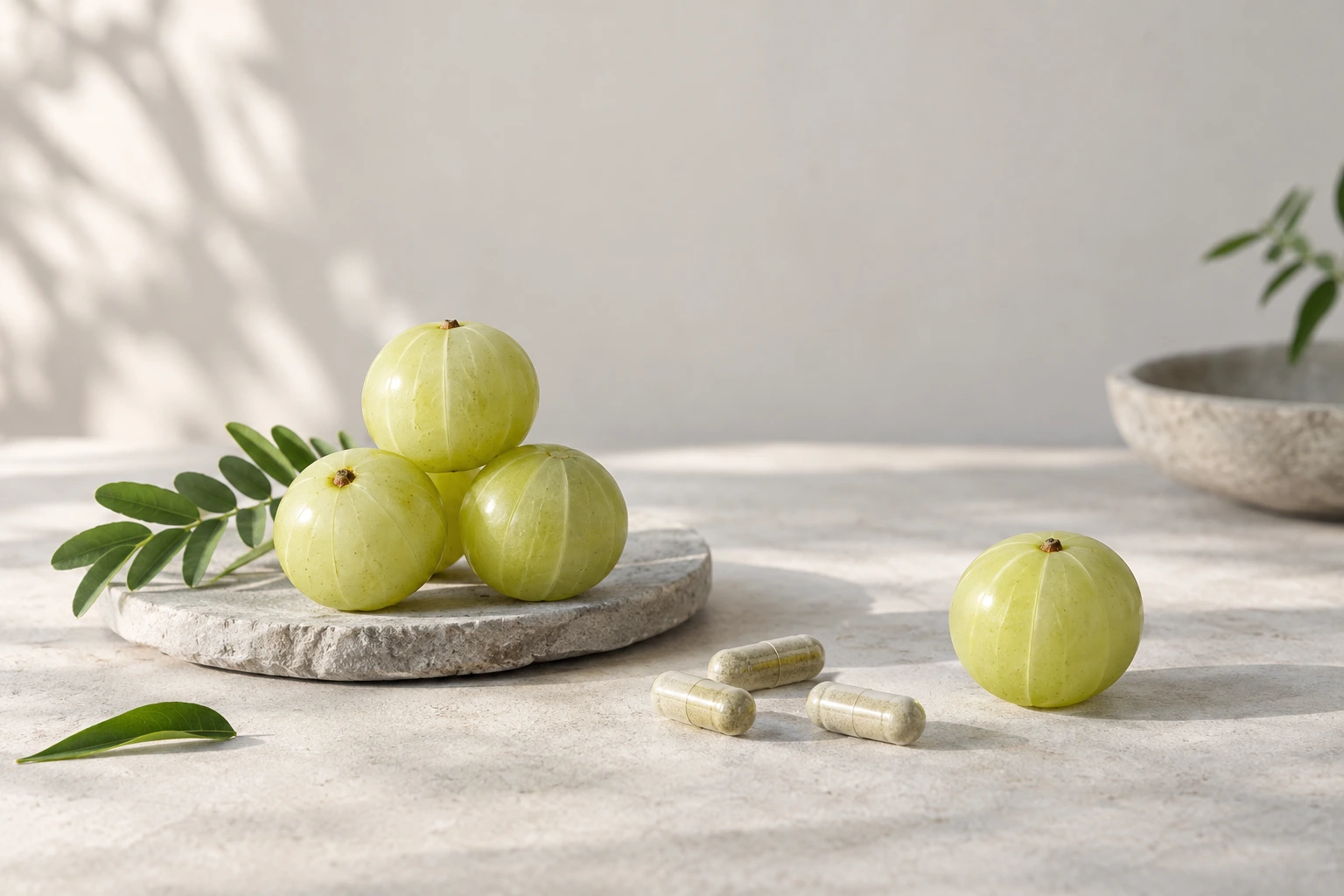
Amla capsules deliver a vitamin C–rich fruit extract. In trials, that extract lowered total and LDL cholesterol by about 21 and 25 mg/dL over 12 weeks and improved antioxidant markers in some trials; hair and immunity claims rest on thinner evidence. Capsules suit a measured, consistent daily dose.
Nirast makes Nirast Amla Superfruit Capsules. This article was written by Nirast’s editorial team and reports what the published research does and does not show.
See Nirast Amla Superfruit Capsules → · 30-Day Money-Back Guarantee
Published by Thang Phi, founder of Nirast and publisher of the Nirast Journal.
That is the honest short version: amla has real human trial data — for cholesterol markers, oxidative-stress markers and, more thinly, blood sugar — and real null results alongside them. Below: what the studies found, which forms they used, how to read a label, and where the evidence stops.
What amla is, and why it comes in capsules
Amla is the fruit of Phyllanthus emblica, a tree native to India and Southeast Asia, known in English as Indian gooseberry and long used in traditional medicine (PMID 35624683). Its distinguishing feature is vitamin C density: one review of Indian gooseberry cultivars reports ascorbic acid at 400–900 mg per 100 g of fresh fruit, and an earlier composition report gives 193–720 mg/100 g across varieties (PMID 38475421, PMID 35624683). About 100 g of fresh fruit — two to three pieces — is described as covering the daily vitamin C need used by several health authorities (PMID 35624683).
Beyond vitamin C, amla carries polyphenols — gallic acid, ellagic acid and emblicanin among them — linked in the same literature to its antioxidant activity, and the fruit is distinctly acidic, with titratable acidity around 2.03–2.21% across cultivars (PMID 35624683, PMID 38475421). Capsules exist because fresh amla is seasonal and sour and because the trials mostly tested concentrated forms; in every form the buyer’s question is the same — how much, how often, for how long.
What the evidence shows for cholesterol and lipid markers
The clearest human evidence concerns blood lipids. A meta-analysis of four randomized placebo-controlled trials — 227 adults with dyslipidemia — found that amla extract lowered total cholesterol by about 21 mg/dL and LDL cholesterol by about 25 mg/dL, and raised HDL cholesterol by about 4.7 mg/dL, over 12 weeks. Triglycerides did not change significantly (PMID 39678212).
Read the caveats with the numbers: the review rates its certainty of evidence as low, reports high heterogeneity for every outcome, and says larger statin-comparison trials are needed before it can support use in dyslipidemia (PMID 39678212). A 2025 open-label study in 39 adults with abnormal lipid levels — 500 mg of amla extract twice daily for 90 days — found significant reductions in triglycerides, total cholesterol, LDL and VLDL, with no change in HDL or fasting blood sugar and no reported adverse symptoms (PMID 40621119). A separate review notes clinical studies of Emblica officinalis showing drops in CRP, LDL and total cholesterol (PMID 36671636).
The proposed mechanism runs through cholesterol synthesis: amla extracts are reported to downregulate HMG-CoA reductase expression — the enzyme statins inhibit — and to enhance lipoprotein lipase activity (PMID 40621119). That is mechanism, not evidence of equivalence to medication; the statin comparison has not been made in an adequately sized trial (PMID 39678212).
What the evidence shows for antioxidant status and vitamin C
A review of amla’s composition summarises the antioxidant case this way: polyphenols and vitamin C give amla antioxidant activity, with in-vivo effects including improved antioxidant status and support of the body’s own antioxidant defence system (PMID 35624683). The human trial evidence is small but specific: in a randomized, double-blind, placebo-controlled trial in smokers, 250 mg twice daily for 60 days was associated with reduced peroxidation and increased antioxidant status, and in a similar metabolic-syndrome trial, 250 or 500 mg capsules twice daily for 12 weeks reduced lipid peroxidation and raised glutathione (PMID 35624683).
The same review records a null result worth equal billing: healthy adults taking 125 mg capsules four times a day showed non-significant changes in antioxidant status and lipid peroxidation (PMID 35624683). The oxidative-stress signal appeared in people under specific stress — smoking, metabolic syndrome — not in healthy volunteers, and these trials measured markers, not clinical outcomes.
What the evidence shows for blood sugar and HbA1c
Blood sugar evidence is thinner and older. A 2024 trial paper, summarising earlier work, reports that people with newly diagnosed type 2 diabetes taking 1–2 g of aqueous amla concentrate daily for three months showed significant reductions in fasting and post-meal glucose and in HbA1c (PMID 39421612); amla reviews describe powder trials in which 3 g per day reduced blood glucose over 21 days and 10 g per day over 90 days (PMID 35624683).
A 2024 open-label study of a combination product — amla plus olive extracts — found significant glycemia reductions over two months in participants with type 2 diabetes (about 27.9%) and prediabetes (about 4.7%), no change in those with normal baseline glycemia, and no reported side effects (PMID 39421612). Two extracts, though, so the results cannot be attributed to amla alone.
Two cautions sit on top of this: the 2025 lipid study found no significant change in fasting blood sugar (PMID 40621119), and a 2026 critical review of plant-based antidiabetic products concludes the evidence across diabetic complications is predominantly preclinical, with controlled human outcomes required for clinical efficacy claims (PMID 42738647). If you take diabetes medication, treat amla as a conversation with your clinician.
Hair, skin and immunity: where the claims outrun the data
Hair. The one human hair trial found in this evidence base tested a syrup, not capsules: a triple-blind randomized controlled trial in 60 women with female pattern hair loss took 10 mL of amla syrup three times daily for 12 weeks (PMID 37487962). The amla group showed a significant increase in the anagen-to-telogen ratio versus placebo (P = 0.002), but no significant improvement in hair count, hair thickness or the terminal-to-vellus ratio, and the authors state that further studies are needed (PMID 40536553, PMID 37487962). Capsule-form hair evidence was not located; capsule hair-growth claims extrapolate from a liquid-product trial with partial results.
Immunity. An updated review of plant immunomodulators describes amla’s constituents as contributing to immunomodulatory effects, and tabulates an animal study — oral doses of 12–50 mg/kg — reporting restoration of IL-2 and IFN-γ production (PMID 41641006): animal-level evidence at animal doses. A composition review of Indian gooseberry concludes clinical trials should be the focus of future research to substantiate its traditional benefits (PMID 38475421).
Skin. The trials covered here measured lipids, oxidative markers, blood sugar and hair — not skin endpoints; “amla for glowing skin” rests on vitamin C generalities.
How amla forms compare: extract, powder, syrup, fruit
Trials have used several forms, and the form determines how much you take and how checkable the dose is:
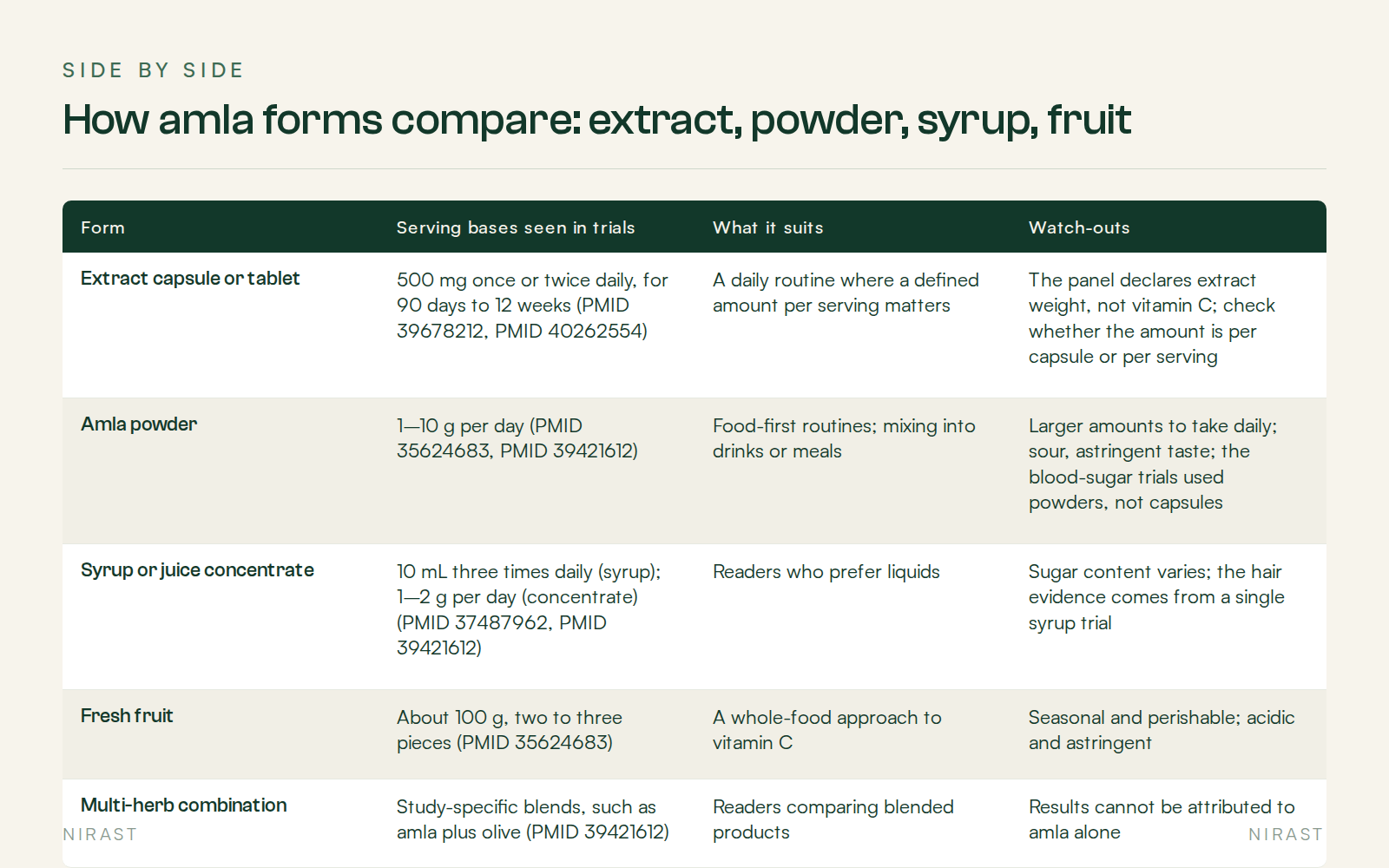
| Form | Serving bases seen in trials | What it suits | Watch-outs |
|---|---|---|---|
| Extract capsule or tablet | 500 mg once or twice daily, for 90 days to 12 weeks (PMID 39678212, PMID 40262554) | A daily routine where a defined amount per serving matters | The panel declares extract weight, not vitamin C; check whether the amount is per capsule or per serving |
| Amla powder | 1–10 g per day (PMID 35624683, PMID 39421612) | Food-first routines; mixing into drinks or meals | Larger amounts to take daily; sour, astringent taste; the blood-sugar trials used powders, not capsules |
| Syrup or juice concentrate | 10 mL three times daily (syrup); 1–2 g per day (concentrate) (PMID 37487962, PMID 39421612) | Readers who prefer liquids | Sugar content varies; the hair evidence comes from a single syrup trial |
| Fresh fruit | About 100 g, two to three pieces (PMID 35624683) | A whole-food approach to vitamin C | Seasonal and perishable; acidic and astringent |
| Multi-herb combination | Study-specific blends, such as amla plus olive (PMID 39421612) | Readers comparing blended products | Results cannot be attributed to amla alone |
How to read an amla capsule label
Start with the serving, because every other number hangs off it. The FDA’s labeling guide defines one serving as the maximum amount recommended per eating occasion, or one unit — a capsule — in the absence of a recommendation (FDA labeling guide). Then check the extract amount per serving (per capsule or per serving?), the servings per container and capsule count, and the directions — the trials dosed once or twice daily over months, so a once-daily label describes a different schedule (PMID 39678212, PMID 35624683).
Five checks before you choose an amla capsule
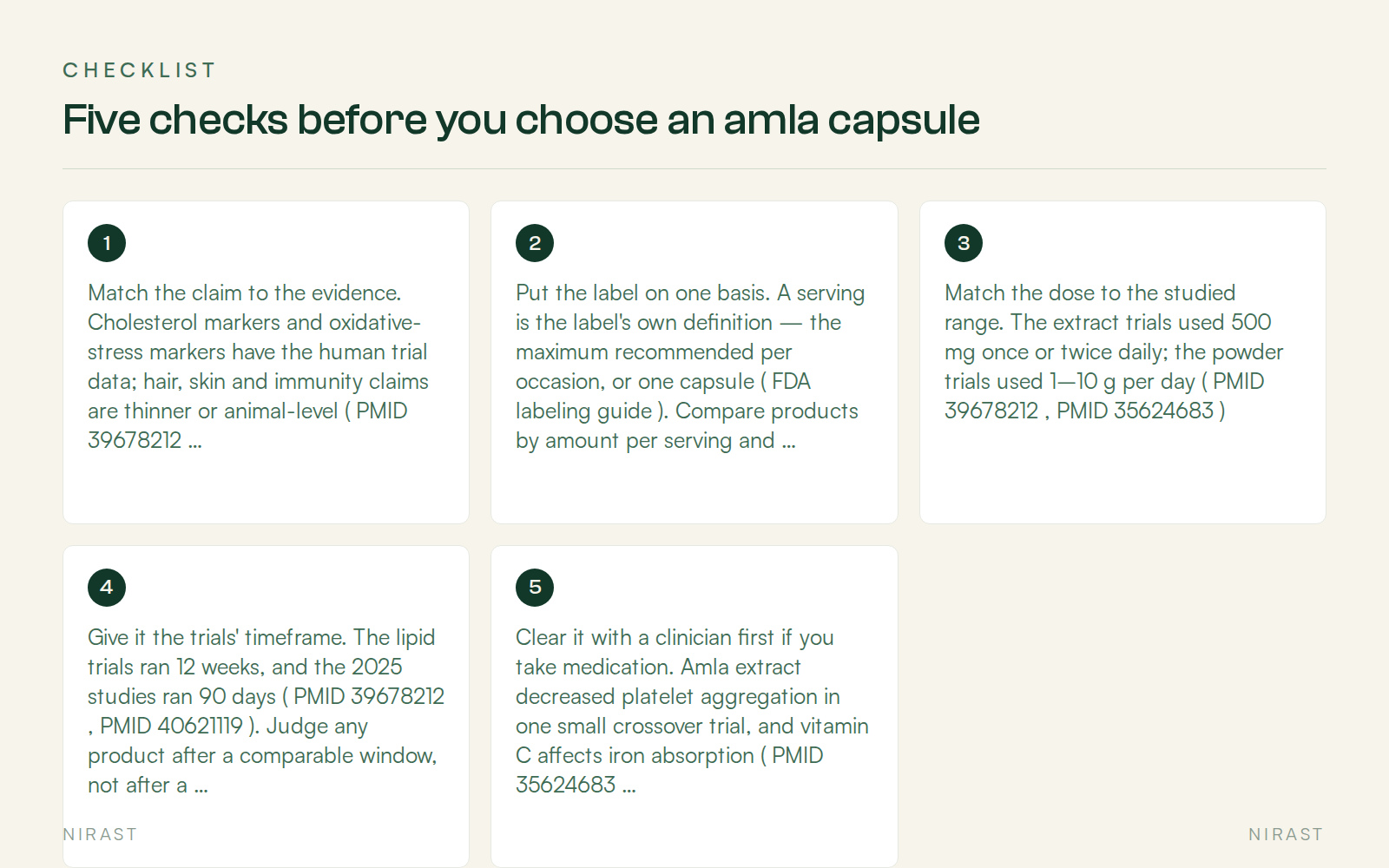
- Match the claim to the evidence. Cholesterol markers and oxidative-stress markers have the human trial data; hair, skin and immunity claims are thinner or animal-level (PMID 39678212, PMID 41641006). Decide which outcome you actually care about before comparing products.
- Put the label on one basis. A serving is the label’s own definition — the maximum recommended per occasion, or one capsule (FDA labeling guide). Compare products by amount per serving and servings per container, not by bottle size.
- Match the dose to the studied range. The extract trials used 500 mg once or twice daily; the powder trials used 1–10 g per day (PMID 39678212, PMID 35624683).
- Give it the trials’ timeframe. The lipid trials ran 12 weeks, and the 2025 studies ran 90 days (PMID 39678212, PMID 40621119). Judge any product after a comparable window, not after a week.
- Clear it with a clinician first if you take medication. Amla extract decreased platelet aggregation in one small crossover trial, and vitamin C affects iron absorption (PMID 35624683, PMID 42514388).
Safety: vitamin C load, digestion, iron and medications
In the trials reviewed here, amla preparations were well tolerated. The 2025 lipid study reported no clinically significant symptoms and no dropouts (PMID 40621119); the meta-analysis found adverse events few and mild — dyspepsia in treatment groups, mild diarrhea, fever and headache in placebo groups (PMID 39678212); and the combination study reported no side effects or treatment-emergent effects (PMID 39421612).
The vitamin C load is the part to watch in a concentrated product. For the general public, routine unsupervised intake above 2 g per day is described as unnecessary and a cause of gastrointestinal symptoms, and when oral doses are escalated, the guidance is to stop at loose stool, cramping, bloating, nausea, reflux or diarrhea (PMID 42514388). If you are prone to reflux or a sensitive stomach, treat gastrointestinal tolerance — not a target number — as your practical ceiling.
Iron deserves its own note. Vitamin C enhances absorption of non-heme (plant) iron — potentially useful for low iron intake or deficiency, but requiring caution in iron overload, hereditary hemochromatosis, repeated transfusion exposure, or selected blood conditions (PMID 42514388). A 2025 randomized trial in adults with iron-deficiency anemia adds nuance: iron alone was comparable to iron plus vitamin C for hemoglobin and iron status, so adding vitamin C does not automatically improve results (PMID 41287676).
Medication interactions round out the picture. A crossover trial in people with type 2 diabetes found 500 mg per day of amla fruit extract decreased platelet aggregation — relevant if you take blood thinners (PMID 35624683). If you take medication for blood pressure, cholesterol or blood sugar, or you are pregnant or managing a health condition, ask a clinician first.
What the evidence does not show
The limits matter as much as the findings:
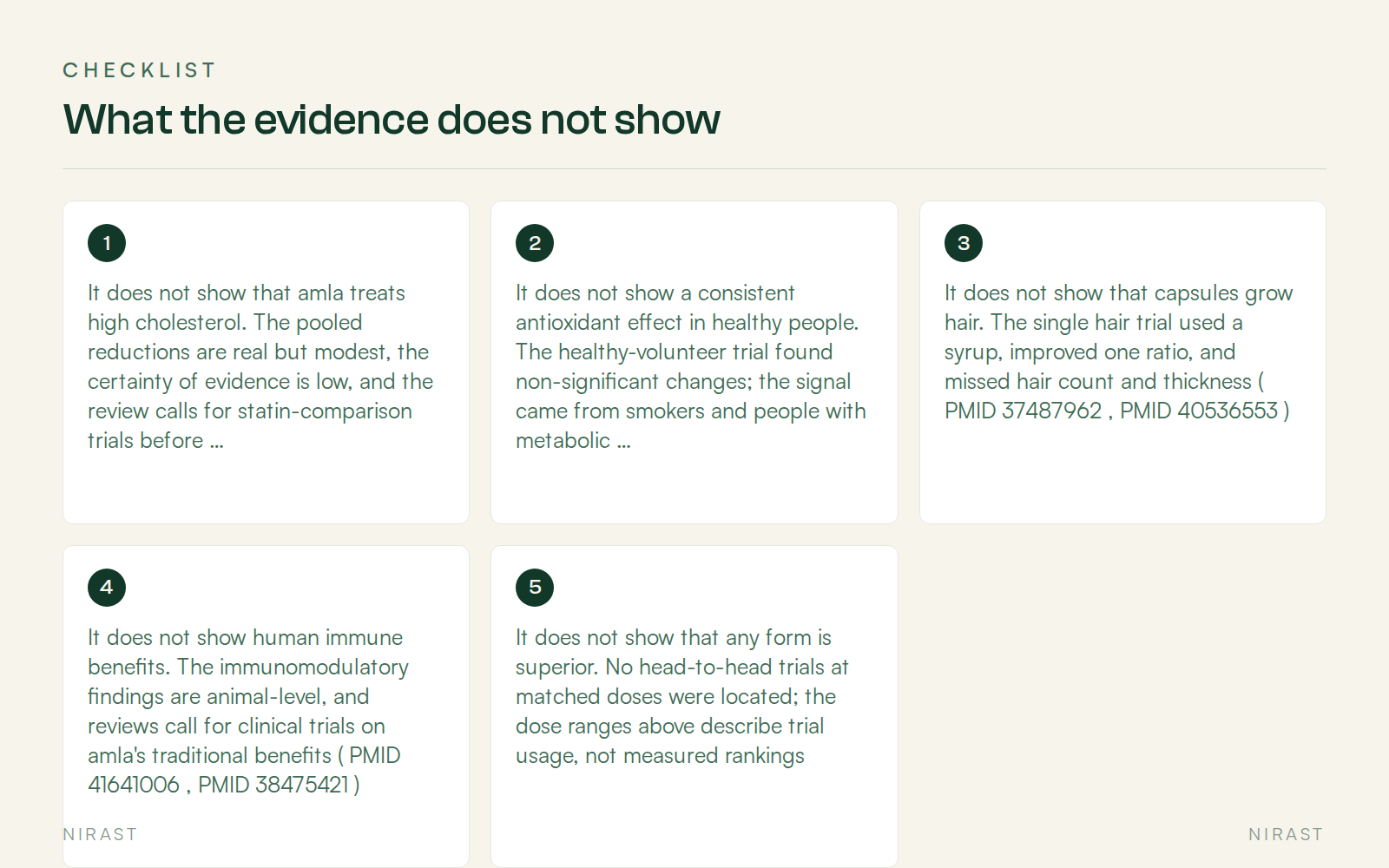
- It does not show that amla treats high cholesterol. The pooled reductions are real but modest, the certainty of evidence is low, and the review calls for statin-comparison trials before supporting clinical use (PMID 39678212).
- It does not show a consistent antioxidant effect in healthy people. The healthy-volunteer trial found non-significant changes; the signal came from smokers and people with metabolic syndrome (PMID 35624683).
- It does not show that capsules grow hair. The single hair trial used a syrup, improved one ratio, and missed hair count and thickness (PMID 37487962, PMID 40536553).
- It does not show human immune benefits. The immunomodulatory findings are animal-level, and reviews call for clinical trials on amla’s traditional benefits (PMID 41641006, PMID 38475421).
- It does not show that any form is superior. No head-to-head trials at matched doses were located; the dose ranges above describe trial usage, not measured rankings.
FAQ
What do amla capsules do for the body?
Amla capsules deliver a vitamin C–rich fruit extract whose polyphenols are linked to antioxidant activity (PMID 35624683). Human trials show modest cholesterol-marker improvements over 12 weeks, reduced oxidative-stress markers in people under metabolic stress, and some older blood-sugar findings (PMID 39678212). They are not a treatment for any condition.
How many amla capsules per day should you take?
Follow the label you own: a supplement’s serving is defined by its own directions — the maximum recommended per occasion, or one capsule (FDA labeling guide). For calibration, the extract trials used 500 mg once or twice daily, and the powder trials 1–10 g per day (PMID 39678212, PMID 35624683).
When should you take amla capsules?
The trials summarised here did not compare times of day; they tested daily dosing over 60–90 days and 12 weeks, so consistency is the factor they controlled (PMID 35624683, PMID 39678212). Some labels suggest the morning; matching your dose to a stable daily habit matters more than the clock.
Does amla reduce HbA1c?
Some earlier trials reported reductions in fasting and post-meal glucose and in HbA1c with amla concentrate or powder in people with type 2 diabetes (PMID 39421612, PMID 35624683); a 2024 combination-product study also found glycemia reductions, but its formula mixed amla with olive extract (PMID 39421612). Category reviewers still describe the antidiabetic evidence as predominantly preclinical (PMID 42738647), so amla is not a substitute for diabetes care — coordinate with your clinician.
Are amla capsules good for hair and skin?
The human hair evidence comes from a single trial of a syrup (10 mL three times daily for 12 weeks) that improved one ratio while missing hair count and thickness (PMID 37487962, PMID 40536553). Capsule-form hair evidence was not located, and the trials reviewed here did not measure skin endpoints. Treat hair and skin claims as unproven rather than disproven, and set expectations accordingly.
Who should not take amla capsules?
Anyone with a medical condition or on medication should ask a clinician first. Flags from the evidence: decreased platelet aggregation at 500 mg per day of amla extract matters if you take blood thinners (PMID 35624683); vitamin C enhances non-heme iron absorption, so iron-overload conditions warrant caution (PMID 42514388); and high-dose vitamin C causes gastrointestinal symptoms that limit comfortable intake for sensitive stomachs (PMID 42514388).
About Nirast Amla Superfruit Capsules
Nirast Amla Superfruit Capsules is a single-ingredient amla extract in capsule form. The Supplement Facts panel states 1,000 mg of amla fruit extract per serving — and a serving is 2 capsules — with 30 servings per container and 60 capsules per bottle (product page). The directions are simple: take 2 capsules daily with water, ideally in the morning (product page). The purchase is a monthly subscription backed by a 30-day money-back guarantee, and you can cancel by emailing support@nirast.co at least 24 hours before the next scheduled renewal (product page).
What it offers is a stated, checkable label — one ingredient, a declared amount per serving, clear directions.
If a measured daily capsule fits your routine, see the full label facts here: Nirast Amla Superfruit Capsules.
These statements have not been evaluated by the Food and Drug Administration. This product is not intended to diagnose, treat, cure, or prevent any disease. Talk to your doctor or pharmacist before starting a supplement, especially if you are pregnant, nursing, take medication or have a medical condition.
Related reading
- Amla Capsules Dosage per Day: What the Research Used and How to Read a Label
- Pheromone Cologne: What It Is, What the Evidence Shows, and How to Choose
- Probiotics for Weight Loss: What the Evidence Shows — and What It Can't Do
- Do Libido Gummies Work? What the Evidence Actually Shows
Related product: Nirast Amla Superfruit Capsules.