
Aged Garlic Extract: What Aging Changes, What the Evidence Covers, and How to Choose
Aged garlic extract is made by soaking fresh garlic in a dilute ethanol–water solution for months, a process that removes the pungent allicin chemistry and concentrates water-soluble compounds such as S-allyl-cysteine (SAC). Its human evidence centres on blood pressure in people with hypertension, and the effects are modest.
Nirast makes Aged Odorless Garlic with CoQ10. This article was written by Nirast’s editorial team and reports what the published research does and does not show.
See Nirast Aged Odorless Garlic with CoQ10 → · $29.99 a month · 30-Day Money-Back Guarantee
Published by Thang Phi, founder of Nirast and publisher of the Nirast Journal.
Aged garlic extract (AGE) is one of several ways garlic is sold as a supplement, and its chemistry differs from the raw clove; this guide covers the aging process, the evidence, the forms and the safety questions.
What is aged garlic extract?
Aged garlic extract is an odorless preparation made by immersing fresh garlic in a dilute aqueous ethanol solution over a prolonged period — the process descriptions in the literature run up to 20 months at room temperature (Molecules review, 2025; antiviral review, 2020). The long soak changes what the clove contains: the compounds that characterise aged preparations are water-soluble organosulfur compounds — chiefly S-allyl-cysteine (SAC) and S1-propenyl-cysteine (S1PC) — described in a 2025 review as having high oral bioavailability (Molecules review, 2025).
In a review of garlic’s bioactive constituents, thiosulfinates such as allicin — the compounds behind the familiar smell — were described as unnecessary for effectiveness and as decomposing during processing, and an allicin-free preparation standardized to a bioavailable component such as S-allylcysteine can be active; processing methods yield preparations with differing efficacy and safety (Amagase, 2006).
What the blood-pressure evidence shows
Blood pressure is where the human evidence concentrates: pooled analyses of garlic preparations in hypertensive participants report average systolic reductions of roughly 4–8 mmHg and diastolic reductions of roughly 2–5.5 mmHg — −8.3/−5.5 mmHg in a 12-trial analysis of 553 participants (Ried, 2020), −8.1/−4.3 mmHg in a 2025 meta-analysis of 12 reports covering 405 garlic-treated patients (updated meta-analysis, 2025), and −4.2/−3.1 mmHg in a 2025 analysis of 10 trials (long-term meta-analysis, 2025).
In a 12-week randomised trial of 50 patients with treated but uncontrolled hypertension, 960 mg/day of aged garlic extract (2.4 mg S-allylcysteine) was associated with systolic pressure averaging 10.2 mmHg lower than controls, and changes were not significant in participants whose baseline systolic was under 140 mmHg (Ried et al., 2010).
Two caveats belong next to those numbers: the 2025 meta-analysis also reports significant publication bias and heterogeneity, even as its trial-sequential analysis concluded enough trials had accrued (updated meta-analysis, 2025); and a 2024 meta-analysis of aged garlic extract and blood pressure was retracted in 2026 (retraction notice, 2026).
Cholesterol, arteries and immune measures: what else has been studied
Cholesterol. Garlic supplementation is pooled to small average reductions in total and LDL cholesterol: a 2026 meta-analysis of 108 trials reported total cholesterol −10.2 mg/dL and LDL −5.9 mg/dL (cardiovascular risk-factor meta-analysis, 2026), and a 2024 meta-analysis of garlic and onion extracts reported −15.2 and −12.0 mg/dL in hypercholesterolemic patients, with low certainty of evidence (Alliaceae meta-analysis, 2024). In aged preparations, a 6-week trial in adults with obesity reported lower IL-6 and TNF-α and a difference in blood LDL (Percival et al., 2018); an aged black garlic trial in grade I hypertension found no significant lipoprotein-subclass changes (ABG10+ trial, 2026).
Arteries. A 2025 review reports that aged garlic extract has been shown to improve atherosclerosis measures in clinical trials and animal studies, while noting clinical follow-up of up to one year and calling for longer, larger trials (atherosclerosis review, 2025). A 12-week trial in middle-aged endurance athletes reported improved pulse wave velocity with Kyolic aged garlic extract (athlete trial, 2025), and the 2020 review describes a mean pulse-wave-velocity reduction of 0.7 m/sec within three months (Ried, 2020). A one-year trial in 65 intermediate-risk patients found lower coronary calcium progression with a co-formulated capsule of 250 mg aged garlic extract plus B vitamins, folic acid and L-arginine — so the result is not attributable to aged garlic extract alone (Budoff et al., 2009).
Immune measures. In a 120-person randomised trial, 2.56 g/day of aged garlic extract improved γδ-T and NK cell proliferation at 45 days; cold-and-flu incidence at 90 days did not differ, but reported symptom burden was lower (Nantz et al., 2012; Percival, 2016). A review of garlic’s antiviral data describes randomised trials of commercial preparations reporting preventive cold-and-flu effects, while calling for higher-quality research (antiviral review, 2020). Cognitive findings come only from animal work — a 40-week supplemented diet improved memory measures in aging mice (mouse study, 2026).
Where the evidence thins out
Three limits matter for decisions. First, hard outcomes: the Cochrane review found only two trials addressing mortality and cardiovascular morbidity and concluded there is insufficient evidence to determine a therapeutic advantage there (Cochrane review, 2012). The 16–40% lower event risk associated with that blood-pressure effect comes from a review’s framing, not from a trial that measured events (Ried, 2020). Second, consistency: one 2025 analysis concludes the overall impact on hypertension may be limited and could not compare formulations (long-term meta-analysis, 2025), and earlier reviewers say more rigorous long-term trials are still warranted (Xiong et al., 2015). Third, transfer: pooled findings describe the preparations that were studied, and a review of Allium vegetables notes that processing and the food matrix limit bioactive bioavailability, with stabilized or encapsulated formulations giving more consistent results than raw garlic preparations in its assessment (Allium review, 2025).
How the forms compare
Garlic supplements are sold in a few preparation families, and the label usually tells you which one you are holding.
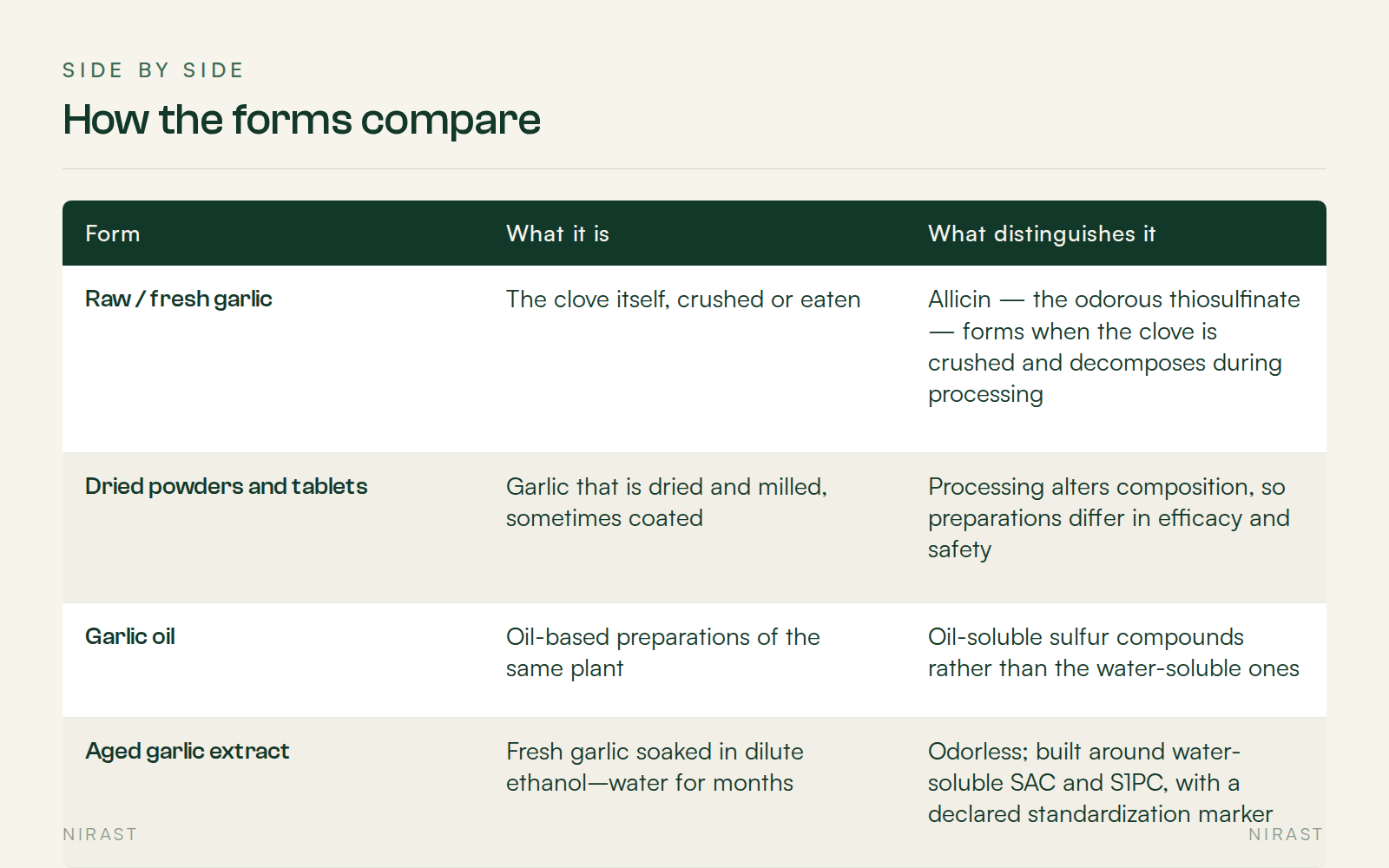
| Form | What it is | What distinguishes it |
|---|---|---|
| Raw / fresh garlic | The clove itself, crushed or eaten | Allicin — the odorous thiosulfinate — forms when the clove is crushed and decomposes during processing |
| Dried powders and tablets | Garlic that is dried and milled, sometimes coated | Processing alters composition, so preparations differ in efficacy and safety |
| Garlic oil | Oil-based preparations of the same plant | Oil-soluble sulfur compounds rather than the water-soluble ones |
| Aged garlic extract | Fresh garlic soaked in dilute ethanol–water for months | Odorless; built around water-soluble SAC and S1PC, with a declared standardization marker |
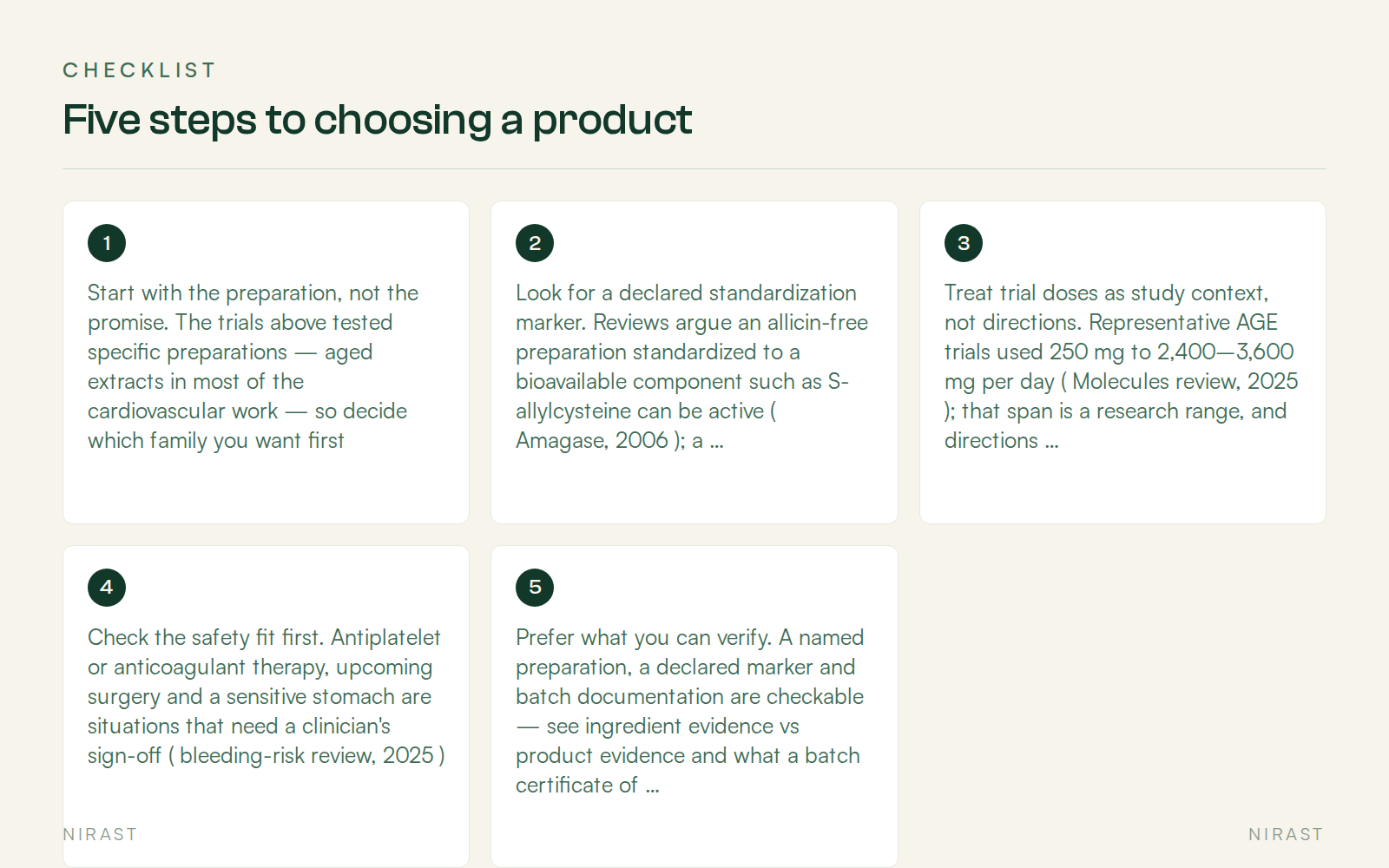
Five steps to choosing a product
- Start with the preparation, not the promise. The trials above tested specific preparations — aged extracts in most of the cardiovascular work — so decide which family you want first.
- Look for a declared standardization marker. Reviews argue an allicin-free preparation standardized to a bioavailable component such as S-allylcysteine can be active (Amagase, 2006); a declared marker is what makes the content checkable.
- Treat trial doses as study context, not directions. Representative AGE trials used 250 mg to 2,400–3,600 mg per day (Molecules review, 2025); that span is a research range, and directions come from the label.
- Check the safety fit first. Antiplatelet or anticoagulant therapy, upcoming surgery and a sensitive stomach are situations that need a clinician’s sign-off (bleeding-risk review, 2025).
- Prefer what you can verify. A named preparation, a declared marker and batch documentation are checkable — see ingredient evidence vs product evidence and what a batch certificate of analysis documents.
Who should be cautious with aged garlic extract
Garlic can exert mild antiplatelet effects that may be clinically relevant for people on anticoagulant or antiplatelet therapy; in the data reviewed, garlic use appeared broadly safe among people taking warfarin (bleeding-risk review, 2025). Reviews advise caution for patients on anticoagulation or undergoing surgery, note that high-dose garlic extracts or aged supplements have been associated with increased bleeding risk with anticoagulants, and that many surgical guidelines advise discontinuing garlic supplements before elective procedures (Allium review, 2025). Gastrointestinal discomfort is the adverse effect observed in meta-analyses (long-term meta-analysis, 2025), and one aged-garlic trial reported 92% acceptability (Ried et al., 2010). If you take medication, are pregnant or nursing, or manage a health condition, ask a clinician before adding any garlic supplement.
A softgel option built around aged garlic extract
Nirast Aged Odorless Garlic is an aged odorless garlic softgel product with CoQ10 ubiquinol, standardized for S-allyl cysteine (SAC), supplied as 60 softgels per pouch (product page). The offer is a monthly subscription at $29.99 — 1 pouch, delivered every month — with a 30-Day Money-Back Guarantee (product page). For CoQ10’s trial base, see astaxanthin vs CoQ10; for softgel absorption, see is a softgel absorbed as well as oil from a spoon?. If an aged odorless garlic softgel with CoQ10 ubiquinol fits what you decided above, see the product here.
FAQ
Is aged garlic extract the same as raw garlic?
No — aging changes the chemistry. Raw garlic forms allicin when crushed, an odorous thiosulfinate that decomposes during processing (Amagase, 2006); aged garlic extract is odorless, with water-soluble SAC and S1PC as its characteristic compounds (Molecules review, 2025).
Does aged garlic extract lower blood pressure?
In people with hypertension, pooled analyses report average systolic reductions of roughly 4–10 mmHg, and an aged-garlic trial in treated but uncontrolled hypertension reported a 10.2 mmHg average difference versus controls (Ried et al., 2010; updated meta-analysis, 2025). The effect was not significant at lower baseline blood pressure, and a 2024 pooled analysis of aged garlic extract and blood pressure was retracted in 2026 (retraction notice, 2026).
What is S-allyl-cysteine (SAC) and why does standardization matter?
SAC is one of the water-soluble organosulfur compounds that characterise aged preparations, described with high oral bioavailability (Molecules review, 2025). Reviews argue that an allicin-free preparation standardized to a bioavailable component such as S-allylcysteine can be active (Amagase, 2006), which is why a declared marker is the checkable part of a label.
Can I take aged garlic extract with blood pressure medication or blood thinners?
Garlic may exert mild antiplatelet effects that can be clinically relevant on anticoagulant or antiplatelet therapy, and reviews advise caution with anticoagulation and around surgery (bleeding-risk review, 2025). Garlic use appeared broadly safe among people on warfarin in the data reviewed (bleeding-risk review, 2025). This is a decision for your clinician, not for a label.
Does aged garlic extract have side effects?
Gastrointestinal discomfort is the adverse effect observed in meta-analyses of garlic (long-term meta-analysis, 2025), and an aged garlic extract trial reported the preparation was generally well tolerated with 92% acceptability (Ried et al., 2010). Bleeding-related caution applies mainly to people on anticoagulant or antiplatelet therapy (bleeding-risk review, 2025).
How much aged garlic extract do the studies use?
Representative AGE trials used between 250 mg and 2,400–3,600 mg per day (Molecules review, 2025). That range describes research protocols, not a serving recommendation — directions come from the label of the product you buy.
These statements have not been evaluated by the Food and Drug Administration. This product is not intended to diagnose, treat, cure, or prevent any disease. Talk to your doctor or pharmacist before starting a supplement, especially if you are pregnant, nursing, take medication or have a medical condition.
Related reading
- Garlic Supplement for High Blood Pressure: What the Evidence Shows
- Astaxanthin: What It Is, What the Evidence Covers, and How to Choose a Form
- Lymphatic Drainage: What It Is, What the Evidence Covers, and How to Choose an Approach
- Pheromone Cologne: What It Is, What the Evidence Shows, and How to Choose
Related product: Aged Odorless Garlic with CoQ10.