
Can You Take Black Seed Oil With Blood Pressure or Blood Sugar Medicine?
Nirast makes Ethiopian Black Seed Oil. This article was written by Nirast’s editorial team and reports what the published research does and does not show.
See Nirast Ethiopian Black Seed Oil → · $29.99 a month · 30-Day Money-Back Guarantee
Published by Thang Phi, founder of Nirast and publisher of the Nirast Journal.
The short answer
You can take black seed oil alongside blood-pressure or blood-sugar medicine only with your prescriber’s knowledge, not on your own judgement. Black seed has been studied in exactly these areas and has documented interaction potential, so the reason to tell your doctor or pharmacist is that dose timing or monitoring may need to change — this is not a call to make alone.
If you are on a prescription for blood pressure or blood sugar and you found black seed oil while researching your condition, the useful next step is not a number of softgels. It is a conversation: bring the product to your prescriber or pharmacist, mention that you are considering a daily black seed oil, and let them judge it against the rest of your regimen. This article explains why that is the right answer, and what the evidence behind it does and does not show.
Why this is a real question, not a formality
Two facts sit side by side, and together they explain why this is worth asking rather than assuming. The first is that black seed has been genuinely studied for cardiovascular and metabolic outcomes. The second is that supplements can change how medicines behave in the body, which is why the U.S. Food and Drug Administration tells anyone thinking of adding one to speak to a health professional first. When a botanical is associated with blood-pressure and blood-sugar effects, and a person is already taking drugs that target those same systems, the question is not hypothetical.
What black seed has actually done to blood pressure and blood sugar
The evidence base is large and pooled. A GRADE-assessed systematic review and dose-response meta-analysis of 82 randomised controlled trials, covering about 5,026 participants with doses from 200 to 4,600 mg/day over 1 to 48 weeks, reported improvements in systolic and diastolic blood pressure, fasting blood sugar and HbA1c, among other cardiometabolic measures (Pharmacological Research 2025, PMID 40714301). The point for this article is not the size of that benefit but the fact of it: black seed acts on systems your medication is also acting on, which is precisely why a prescriber should know it is in the picture.
How big are those average changes?
A second GRADE-assessed meta-analysis, pooling 31 trials and 2,145 participants with metabolic disease, put the average changes at roughly 3.25 mmHg lower systolic and 2.75 mmHg lower diastolic blood pressure, fasting glucose lower by about 18.6 mg/dL, and HbA1c lower by about 0.56, with no significant effect on insulin-resistance measures (Endocrinology, Diabetes & Metabolism 2026, PMID 41858302). Two things about those figures matter. They are modest pooled averages, not a promise for one person. And the authors themselves urge caution, because the trials were small, varied and short. A supplement that nudges markers your medicine also moves is a supplement your clinician needs to account for — not a replacement for treatment, and not something to layer on quietly.
The evidence that the ingredient can interact with cardiovascular medicines
This is where the question sharpens. A comprehensive review of cardiovascular herbs and their interaction with antihypertensive drugs reports that in hypertensive rats, Nigella sativa enhanced the blood-pressure-lowering effect of losartan and increased losartan plasma concentration, attributed to inhibition of the CYP3A4 and CYP2C9 enzymes, and that combining it with metoprolol lowered blood pressure more than either agent alone; the review states that dosage adjustments are necessary (Cardiovascular Effects of Herbal Products and Antihypertensive Drugs, Int J Mol Sci 2024). Read carefully, that is a reason for caution, not a recipe: the findings are from animals, not human trials, so a confirmed human interaction with losartan or metoprolol is not established. What it does establish is that the ingredient has real interaction potential with the very drug classes this question is about — and that a prescriber, who can change a dose or arrange monitoring, is the person equipped to weigh it.
The warfarin finding: what it does and does not tell you
Another documented interaction points the same way from a different direction. An in-vitro enzyme-kinetics study found that thymoquinone, black seed’s main bioactive, competitively inhibits CYP2C9-mediated warfarin metabolism, and its risk prediction suggested that thymoquinone above roughly 18 mg/day, or N. sativa oil above about 1 g/day, “might influence pharmacokinetic behavior of warfarin” (Chem Biol Interact 2022, PMID 35921950). Warfarin is an anticoagulant, not a blood-pressure or blood-sugar medicine, so this is not evidence of an interaction with your specific prescription — and because the product’s own thymoquinone amount per serving is not established, the threshold cannot be mapped onto a softgel either. Its value here is as a demonstration: a botanical that inhibits the same enzyme families your medicines are processed by is a botanical worth disclosing.
A case report about bleeding, and how much weight to give it
There is also a single, heavily confounded case report to be aware of, and not alarmed by. A 51-year-old man on chemotherapy and dual antiplatelet therapy, taking Nigella sativa oil in a trial at an escalated 2,000 mg/day, developed a large subcutaneous hematoma with low platelets; the Naranjo scale scored the reaction 4, or “possible”, and the authors urge clinicians to document herbal supplement use and counsel patients about herb-drug interactions (Hosp Pharm 2026, PMID 42682876). Multiple bleeding risks were present at once, so the report cannot show that black seed oil causes bleeding, and the context is antiplatelets and chemotherapy rather than blood-pressure or blood-sugar drugs. Its honest lesson is about disclosure, not prohibition.
What the FDA says about supplements and medicine
Official guidance is unusually direct on this. The FDA advises consumers to be informed and to talk to their doctor, pharmacist or other healthcare professional before deciding to purchase or use a dietary supplement, because taking supplements can involve health risks — and notes that the agency does not approve supplements for safety and effectiveness before they are marketed (FDA, Information for Consumers on Using Dietary Supplements). More specifically, it warns that certain supplements can change the absorption, metabolism or excretion of a medication, so a person may end up with too much or too little of the medicine, and it tells readers to call their health care professional first (FDA, Mixing Medications and Dietary Supplements). That is the whole answer to this question in the regulator’s own words.
What to tell your doctor or pharmacist
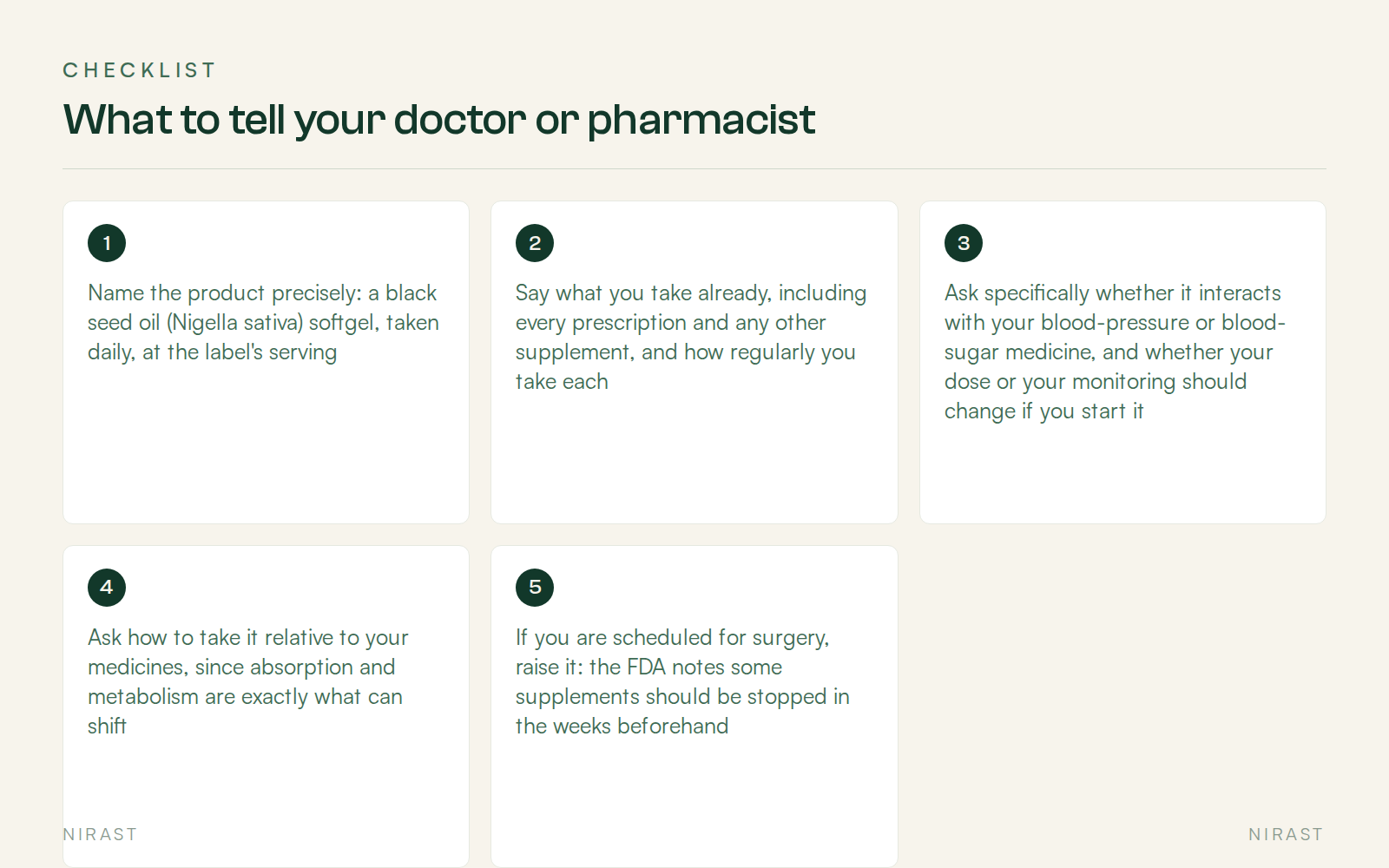
- Name the product precisely: a black seed oil (Nigella sativa) softgel, taken daily, at the label’s serving.
- Say what you take already, including every prescription and any other supplement, and how regularly you take each.
- Ask specifically whether it interacts with your blood-pressure or blood-sugar medicine, and whether your dose or your monitoring should change if you start it.
- Ask how to take it relative to your medicines, since absorption and metabolism are exactly what can shift.
- If you are scheduled for surgery, raise it: the FDA notes some supplements should be stopped in the weeks beforehand.
What the research cannot tell us
No human clinical trial has co-administered black seed with an antihypertensive or antidiabetic medicine, so no one can promise you a specific interaction with your drug or a specific dose adjustment; the interaction evidence is from animal and laboratory work, and the pooled meta-analyses describe average shifts across heterogeneous trials rather than your individual response. What the evidence does support is a clear direction: this ingredient has been studied for the same outcomes your medicines target and has documented interaction potential, so the safe path is the informed one — involve the clinician who can see your whole picture.
If you and your prescriber decide it fits your routine
Should your doctor or pharmacist clear it, the format is straightforward to work with. Nirast Ethiopian Black Seed Oil is a Nigella sativa black seed oil in tasteless, easy-to-swallow softgels, with directions on the product page to “Take 2 softgels daily with water, preferably with food.” A softgel gives a fixed, pre-measured serving, so it is easy to tell your clinician exactly how much you are taking and to change or stop it on their advice. It is a plain monthly subscription — one pouch, $29.99 per month — with a 30-day money-back guarantee and cancellation through support@nirast.co at least 24 hours before the next renewal. If your prescriber is comfortable, you can read the label and terms and order it here: https://try.nirast.co/black-seed-oil-otp/.
Frequently asked questions
Can I take black seed oil with blood pressure medicine?
Only with your prescriber’s knowledge. Black seed has been studied for blood-pressure effects and has documented interaction potential with cardiovascular medicines in animal studies, so your doctor or pharmacist should assess it against your specific prescription before you start.
Can I take black seed oil if I have diabetes?
Black seed has been studied in people with blood-sugar conditions, and pooled analyses report average reductions in fasting glucose and HbA1c, but that is ingredient-level evidence, not a treatment and not a reason to change your medication. Ask your prescriber first, especially if you take oral hypoglycaemic drugs.
Does black seed oil interact with metformin or insulin?
No human trial of black seed co-administered with an antidiabetic medicine was found, so a specific interaction with metformin or insulin is not established. The general FDA guidance still applies: a supplement can change how a medicine is handled, so disclose it before you start.
Does black seed oil lower blood pressure or blood sugar?
Pooled randomised trials report modest average reductions in systolic and diastolic blood pressure, fasting glucose and HbA1c. Those are population averages from small, varied studies, not a guarantee for an individual, and never a substitute for prescribed treatment.
Can black seed oil interact with blood thinners?
A laboratory study found thymoquinone inhibits the enzyme that metabolises warfarin, and a case report described bleeding in a patient on antiplatelet therapy and chemotherapy. Neither proves a human effect at supplement doses, but both are reasons to tell your clinician before combining them.
Should I stop my medicine to take black seed oil?
No. Nothing in this evidence suggests replacing a prescription with a botanical. The question is whether, and how, to add it alongside your medicines under a clinician’s supervision — not whether to drop treatment.
Sources
- Nigella sativa and cardiovascular risk factors: systematic review and meta-analysis of 82 RCTs, Pharmacological Research 2025 — https://pubmed.ncbi.nlm.nih.gov/40714301/
- Nigella sativa and cardiometabolic health in metabolic disease, Endocrinology, Diabetes & Metabolism 2026 — https://pubmed.ncbi.nlm.nih.gov/41858302/
- Cardiovascular effects of herbal products and their interaction with antihypertensive drugs, Int J Mol Sci 2024 — https://pmc.ncbi.nlm.nih.gov/articles/PMC11203894/
- Potential food-drug interaction risk of thymoquinone with warfarin, Chem Biol Interact 2022 — https://pubmed.ncbi.nlm.nih.gov/35921950/
- Subcutaneous hematoma with Nigella sativa oil and dual antiplatelet therapy: a case report, Hosp Pharm 2026 — https://pubmed.ncbi.nlm.nih.gov/42682876/
- FDA, Information for Consumers on Using Dietary Supplements — https://www.fda.gov/food/dietary-supplements/information-consumers-using-dietary-supplements
- FDA, Mixing Medications and Dietary Supplements Can Endanger Your Health — https://www.fda.gov/consumers/consumer-updates/mixing-medications-and-dietary-supplements-can-endanger-your-health
- Nirast Ethiopian Black Seed Oil product page — https://try.nirast.co/black-seed-oil-otp/
These statements have not been evaluated by the Food and Drug Administration. This product is not intended to diagnose, treat, cure, or prevent any disease. Talk to your doctor or pharmacist before starting a supplement, especially if you are pregnant, nursing, take medication or have a medical condition.
Related reading
- Black Seed Oil: What It Is, What the Evidence Covers, and How to Choose a Form
- Can Black Seed Oil Replace a Prescribed Medicine?
- Does “Natural” Mean Black Seed Oil Is Safer Than a Medicine?
- How Much Black Seed Oil Should I Take Each Day?
Related product: Ethiopian Black Seed Oil.