
Why Is Black Seed Oil Traditionally Described as a Remedy for Almost Every Illness?
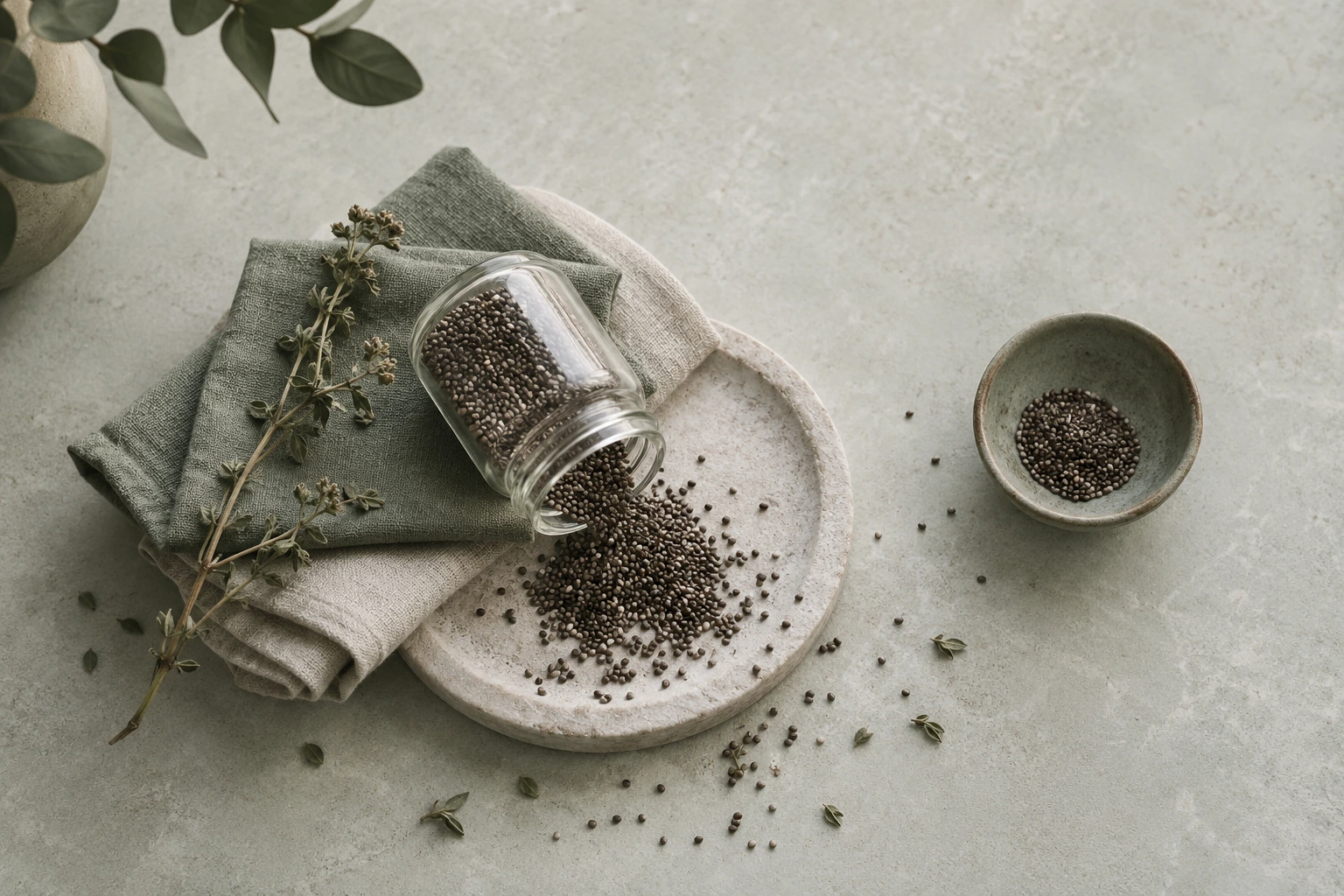
The breadth comes from a long textual and household tradition in which one seed was recommended for many complaints, and that history explains the wording without showing that any modern outcome follows — which is why a label should be read as history, not as a medical claim.
Nirast makes Ethiopian Black Seed Oil. This article was written by Nirast’s editorial team and reports what the published research does and does not show.
See Nirast Ethiopian Black Seed Oil → · $29.99 a month · 30-Day Money-Back Guarantee
Published by Thang Phi, founder of Nirast and publisher of the Nirast Journal.
It is strange, when you first notice it, that one seed should be credited with everything from coughs to chronic conditions. The explanation is not a hidden mechanism. It is a story about language: a single phrase, repeated for centuries, that attached an unusually wide promise to a single plant — and stayed attached even after medicine started asking for proof.
The short answer: the breadth is a property of the tradition
When a substance is described as treating almost everything, that is usually a clue about how the claim travelled, not about how it works. In the case of black seed, the widest version of the claim is a saying that has been repeated for centuries, and repetition is exactly how a phrase acquires breadth. A claim that passes through many hands, many regions and many generations accumulates uses the way a rumour accumulates detail. The breadth is the fingerprint of the tradition, not of a series of successful clinical trials.
Where the phrase comes from
The description of black seed as a remedy for almost every illness traces to a prophetic saying in Islamic tradition — that it is “a cure for every disease except death” — which was then repeated within Unani medicine and beyond (https://pubmed.ncbi.nlm.nih.gov/40842670/). That is the root of the wording. The review that documents the phrase is careful to present it as tradition and history; the saying is a statement about what was taught and believed, not a summary of trial results. Read at its source, the phrase is doing what tradition does: it commends a remedy, not establishes one.
The plant was documented long before it was tested
The history reaches back further than the saying. Dioscorides, writing in the first century CE, described “the black seeds” of a plant called melanthion — the plant now known as Nigella sativa — in his De Materia Medica (https://pubmed.ncbi.nlm.nih.gov/38005726/). Black cumin seeds and their oil also appear prominently in Ayurveda and traditional Islamic medicine as therapeutic agents for a range of ailments, including chronic illnesses (https://pubmed.ncbi.nlm.nih.gov/38005726/). This is genuine, traceable history, and it helps explain the confidence behind the modern marketing. A substance with nearly two thousand years of recorded use arrives on a product page already carrying the authority of age.
Why broad traditional use accumulates over time
Traditional systems did not work the way a modern trial does. There was no control group, no defined endpoint and no requirement to separate a remedy that worked from one that coincided with recovery. A plant that was available, cheap and considered safe would be recommended for whatever complaint a person brought, and the ones that seemed to help in some cases would be recommended again. Over centuries, that process produces exactly what we see: a long list of conditions attached to one favoured remedy. None of this makes the tradition dishonest. It simply means the breadth reflects how the list was built, and how it was built is not how evidence is built.
What the tradition records — and what it cannot
The distinction is worth stating precisely. A record of traditional use tells you what people did and what they believed, and sometimes why. It tells you that the plant was trusted, which can be real and meaningful. What it cannot tell you is whether a given use produced the outcome attributed to it, because the tradition did not test for that. This is why the same review that documents the breadth also states that extensive clinical trials are still needed to authenticate traditional uses on a scientific basis (https://pubmed.ncbi.nlm.nih.gov/40842670/). The tradition and the test are not enemies; they answer different questions.
How modern reviews treat the same plant
When researchers do bring modern methods to specific uses, the results are more careful than the tradition. A review of thymoquinone — a compound in black seed — in atherosclerosis describes the evidence as preclinical and states that the compound cannot yet be unequivocally recommended as a therapeutic agent for that disease (https://pubmed.ncbi.nlm.nih.gov/42124081/). A systematic review of Nigella sativa trials in children concluded that more high-quality studies are needed to establish efficacy, effective dose and form (https://pubmed.ncbi.nlm.nih.gov/41112345/). Those conclusions are far narrower than “a remedy for almost every illness”. They are also not a refutation of the tradition — they are simply the difference between documenting a use and proving it.
Reading “remedy for everything” on a product page
- Treat breadth as a historical signal, not an efficacy signal. The wider the claim, the more likely it is describing a tradition rather than a tested outcome.
- Look for the word “traditionally”. “Traditionally used for” is an honest framing; “cures” or “treats” is a disease claim a supplement may not legally make.
- Ask which version of the claim you are reading. A page that repeats a centuries-old saying is quoting history; a page that turns the saying into a promise has crossed a line.
- Do not let age substitute for evidence. Long use can be why a plant is worth studying. It is not the same as being studied.
- Read modern research as narrower, not contradictory. Where trials exist, they tend to describe specific conditions and bounded findings — a small, sharp point compared with the tradition’s wide brush.
Where Nirast fits into a history-led view
Our product sits inside this tradition, and the honest way to present it is as what it is: a modern, convenient form of a long-used botanical, sold as a dietary supplement rather than as a remedy for everything. Nirast Ethiopian Black Seed Oil is a softgel the page describes as tasteless and easy to swallow, cold-pressed from Nigella sativa, with 1,000 mg of black seed oil per serving and directions of “Take 2 softgels daily with water, preferably with food”. It is offered as one monthly subscription — one pouch for $29.99 — with free worldwide shipping, a 30-day money-back guarantee, and cancellation by emailing support@nirast.co at least 24 hours before the next renewal (https://try.nirast.co/black-seed-oil-otp/).
What that gives you is the old seed in a form that makes a daily habit easy: no bitter oil, no spoon, one pouch a month. If the appeal of black seed for you is the tradition itself — a botanical people have used for a very long time — then a taste-free softgel is a straightforward way to keep it in your routine, while reading every claim about it the way this article suggests: as history first, and as a medical promise only when a specific study of the product supports it.
What the evidence does not show
The traditional breadth does not convert into clinical proof, and the reason is structural rather than a matter of which studies happen to exist. A history of use tells you what was practised; it does not tell you which uses worked, because the tradition did not set out to measure that. Where modern reviews have looked at specific uses, they stop short of a firm recommendation and call for better studies. That leaves the traditional list exactly where it started — an interesting, long record of belief and practice, not a list of confirmed outcomes.
FAQ
Why is black seed oil said to cure almost everything?
Because a single prophetic saying — “a cure for every disease except death” — has been repeated for centuries. That repetition spread the claim widely; it did not test it.
Does a long history of use mean a remedy works?
No. A tradition records what people believed and practised. It can make a plant worth studying, but it is not itself a measure of whether a use produced an outcome.
Where does the phrase come from?
It traces to a prophetic saying in Islamic tradition, repeated within Unani medicine and elsewhere, rather than to a clinical trial.
How far back does the recorded use go?
At least to the first century CE, when Dioscorides described the seeds of a plant called melanthion in De Materia Medica.
What do modern reviews say about black seed?
They tend to be narrower than the tradition: reviews of specific uses describe early-stage or preclinical evidence and call for more high-quality studies rather than confirming broad benefit.
Can a product legally call itself a remedy for everything?
No. Only drugs, over-the-counter medicines or medical foods may be marketed to treat, cure or prevent disease, so a supplement promising broad cures is overreaching.
References
- Nirast Ethiopian Black Seed Oil product page — https://try.nirast.co/black-seed-oil-otp/
- Functional, nutraceutical and pharmacological properties of black seed, review — https://pubmed.ncbi.nlm.nih.gov/40842670/
- Potential pharmacological applications of Nigella sativa against chronic inflammatory diseases, review — https://pubmed.ncbi.nlm.nih.gov/38005726/
- Thymoquinone in atherosclerosis, review — https://pubmed.ncbi.nlm.nih.gov/42124081/
- Clinical uses of Nigella sativa in pediatrics, systematic review and meta-analysis — https://pubmed.ncbi.nlm.nih.gov/41112345/
Related reading
- Black Seed Oil: What It Is, What the Evidence Covers, and How to Choose a Form
- Are Oil of Oregano and Black Seed Oil Interchangeable?
- Black Seed Oil Benefits: What the Evidence Shows
- Can Black Seed Oil Cure a Disease on Its Own?
Related product: Ethiopian Black Seed Oil.