
Black Seed Oil Benefits: What the Evidence Shows
Black seed oil’s best-supported benefits are modest: controlled trials show small reductions in blood pressure, blood sugar and weight in people with metabolic conditions, plus symptom improvements in knee osteoarthritis and PMS. It is not a treatment, and some markers, including insulin resistance, showed no change.
Nirast makes Ethiopian Black Seed Oil. This article was written by Nirast’s editorial team and reports what the published research does and does not show.
See Nirast Ethiopian Black Seed Oil → · $29.99 a month · 30-Day Money-Back Guarantee
Published by Thang Phi, founder of Nirast and publisher of the Nirast Journal.
That conclusion comes from the strongest research on Nigella sativa — the botanical behind “black seed” — and it is more specific than either the marketing or the scepticism suggests. The trials are real, their results are statistically significant, and the average effect sizes are small. Below is what the pooled data shows, which individual trials found, where the evidence stops, and how to read a label before spending money on any black seed product.
The numbers: how large are the measured benefits?
The most comprehensive single source is a GRADE-assessed systematic review and meta-analysis of 31 randomized controlled trials, published in 2026, covering 2,145 participants with metabolic conditions such as type 2 diabetes, obesity, metabolic syndrome, fatty liver disease and high blood pressure (PMID 41858302). Pooled against control:
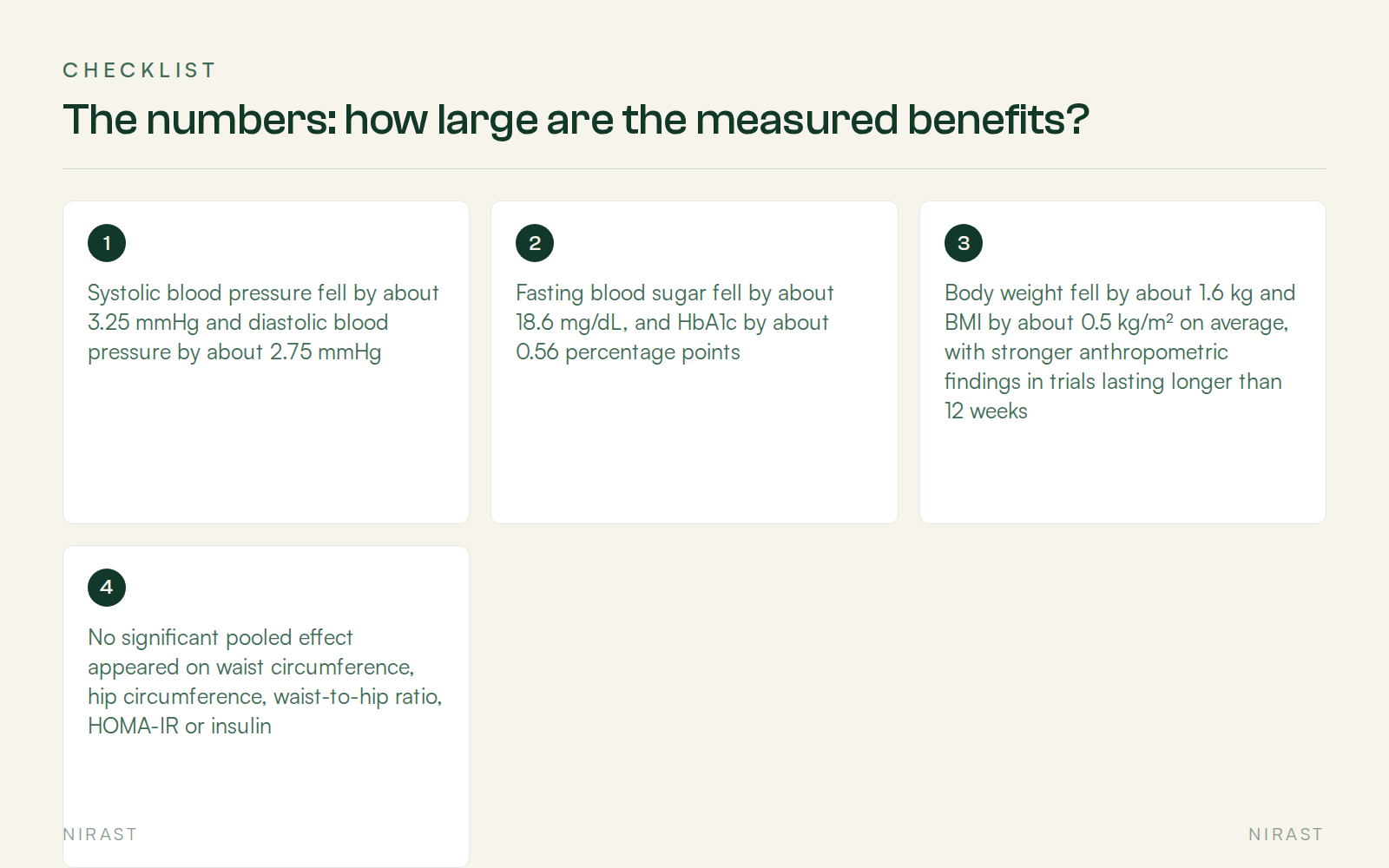
- Systolic blood pressure fell by about 3.25 mmHg and diastolic blood pressure by about 2.75 mmHg.
- Fasting blood sugar fell by about 18.6 mg/dL, and HbA1c by about 0.56 percentage points.
- Body weight fell by about 1.6 kg and BMI by about 0.5 kg/m² on average, with stronger anthropometric findings in trials lasting longer than 12 weeks.
- No significant pooled effect appeared on waist circumference, hip circumference, waist-to-hip ratio, HOMA-IR or insulin.
The authors are direct about the size of these effects. They describe them as modest, note that most included trials ran only 4–24 weeks, and point out that about 2 kg of weight change or 2–3 mmHg of blood-pressure change can sit below the 5% body-weight and 5 mmHg thresholds that clinicians use to mark meaningful change. Their own conclusion: these are small effects that may contribute alongside diet, exercise or medication, but are unlikely to produce large clinical benefit on their own. The paper also reports that its publication-bias and sensitivity analyses counsel caution for several outcomes, including fasting blood sugar.
A broader review of 82 studies (5,026 participants) shows the same pattern across a wider set of endpoints, with doses ranging from 200 to 4,600 mg/day and interventions from 1 to 48 weeks (PMID 40714301). That dose range is itself worth knowing: “black seed oil” trials are not one protocol, and results belong to the trial, not to the name on a bottle.
Where do the benefits look strongest?
Knee osteoarthritis. In a double-blind, randomized, placebo-controlled trial of 116 patients aged 50–70, oral black seed oil (2.5 mL every 8 hours for one month) lowered VAS pain scores by about 34% versus about 9% on placebo, and WOMAC scores by about 28% versus about 1%. The oil group also used significantly less acetaminophen during the trial, and the researchers reported no side effect (PMID 36150238).
But the osteoarthritis picture is mixed. A 2024 systematic review of six randomized trials (370 patients) found topical black seed oil beat placebo for pain in three trials, while oral results were inconsistent: improvement in one of two oral-oil trials, and no difference in the oral-capsule trial. In one topical trial, 1 mL of oil twice a day for 21 days was compared with diclofenac gel rather than a placebo. The review’s conclusion is refreshingly blunt: there is currently insufficient evidence to make clinical recommendations for or against using black seed oil to treat osteoarthritis (PMID 38650731).
Inflammation and quality of life. In a 45-patient triple-arm trial in knee osteoarthritis, oral oil (2.5 mL twice daily for six weeks) lowered hs-CRP — a marker of systemic inflammation — compared with both placebo and topical oil. Both oral and topical oil also improved quality-of-life scores versus placebo, although topical oil did not change hs-CRP (PMID 38107142).
Menstrual symptoms. A randomized, double-blinded, placebo-controlled trial in 40 women found two months of black seed capsules significantly increased serum estradiol and reduced total PMS symptom scores compared with placebo. The authors describe their own finding as preliminary — “beneficial yet exploratory” — and call for more research (PMID 41267796).
PCOS markers. In a randomized, double-blind trial in 60 women with polycystic ovary syndrome, 1,000 mg/day of black seed oil for 12 weeks significantly lowered IL-6 (an inflammatory marker) and fasting blood glucose versus placebo. It showed no significant difference in fasting insulin, HOMA-IR, QUICKI, luteinizing hormone or testosterone — a reminder that “helps PCOS” is not one thing (PMID 42601227).
Wound healing. A triple-blind randomized trial in 74 first-time mothers found a topical black seed emulgel improved episiotomy wound healing (REEDA score) and reduced pain at 10 days postpartum compared with placebo, with no adverse events reported in either group (PMID 40465634).
Children with type 1 diabetes. A 3-month randomized study in 60 children and adolescents found 450 mg of black seed oil twice daily was associated with significantly lower cholesterol, LDL cholesterol, and several oxidative-stress and inflammatory markers versus insulin alone. No side effects were recorded — but the study itself notes it had no placebo arm, a relatively small sample and short follow-up (PMID 40048139).
Black seed powder as food. In a 12-week double-blind trial in 120 people with, or at risk of, metabolic syndrome, 3 g/day of black seed powder significantly reduced cholesterol, LDL and glucose indices (PMID 38892617).
Which form should you choose: oil, capsules or powder?
If you decide black seed oil fits your routine, the form matters for dose control and consistency. Trials have used three main forms:
| Form | Serving used in trials | What it suits | Watch-outs |
|---|---|---|---|
| Liquid oil | 2.5 mL per dose, three times daily, in a knee osteoarthritis trial; 1 mL twice daily (topical) in another | Anyone comfortable measuring oil who wants a single-ingredient product | Oils vary widely in thymoquinone content |
| Softgel / capsule | 1,000 mg per day in the PCOS trial; about 1–3 g per day is the range reviews report for adults | Daily routines where taste or measuring is a barrier | Check the label: content and quality are not standardized across products |
| Seed powder | 3 g per day in the metabolic-syndrome trial | Cooking and food-first routines | Less oil per gram than liquid oil; taste |
No head-to-head trial settles which form is “best” — a limitation of the current evidence: the trials tested one form each, against their own comparators, rather than against one another. Reviews report adult intakes of about 1–3 g per day of the oil (PMID 40842670), while the published trials span 200–4,600 mg/day (PMID 40714301). Your best guide is the amount per serving printed on the label you can actually buy.
How should you choose and use black seed oil?
A practical checklist based on what the trials actually did:
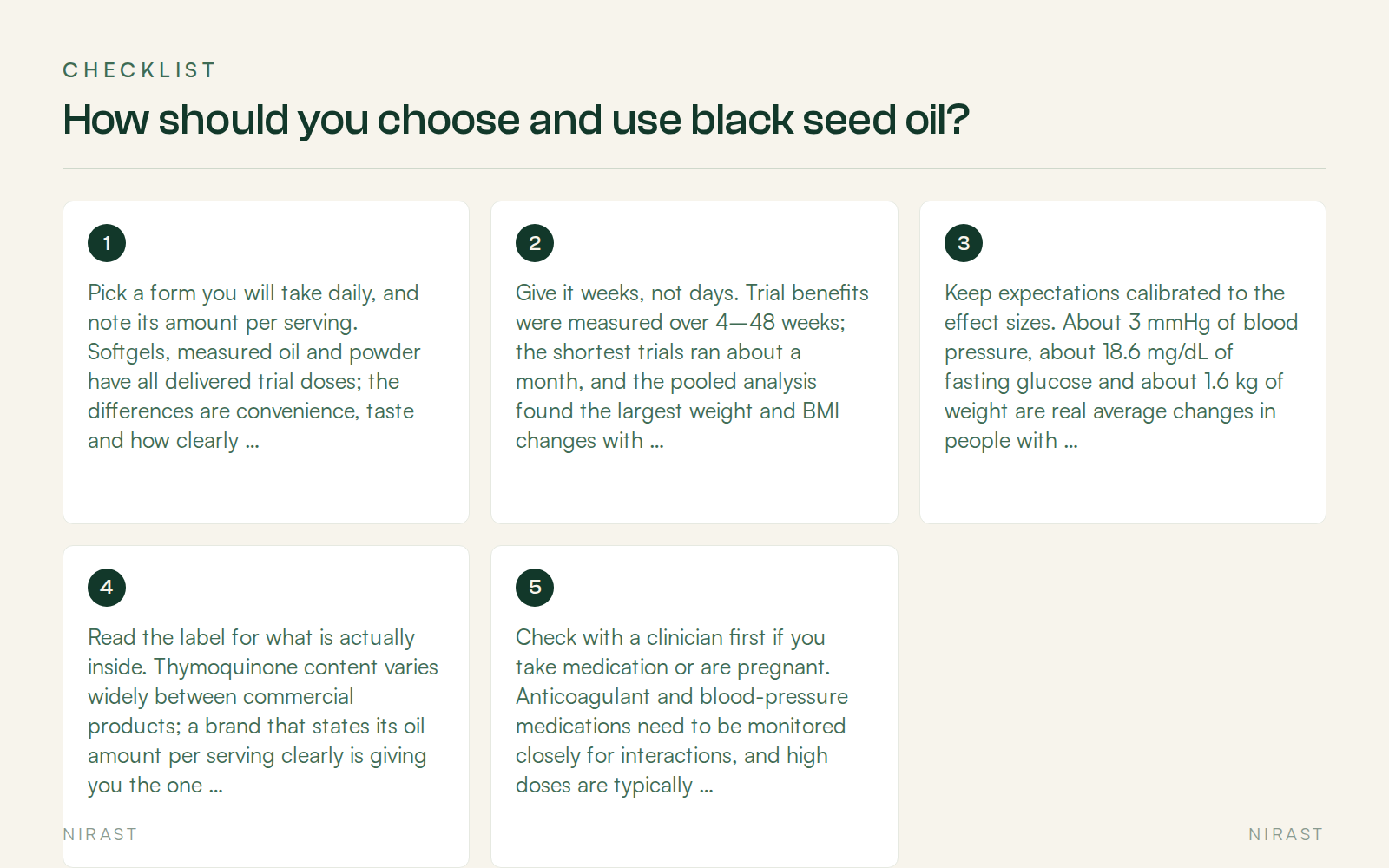
- Pick a form you will take daily, and note its amount per serving. Softgels, measured oil and powder have all delivered trial doses; the differences are convenience, taste and how clearly the dose is defined.
- Give it weeks, not days. Trial benefits were measured over 4–48 weeks; the shortest trials ran about a month, and the pooled analysis found the largest weight and BMI changes with supplementation beyond 12 weeks (PMID 41858302).
- Keep expectations calibrated to the effect sizes. About 3 mmHg of blood pressure, about 18.6 mg/dL of fasting glucose and about 1.6 kg of weight are real average changes in people with metabolic conditions — not transformations, and not substitutes for treatment.
- Read the label for what is actually inside. Thymoquinone content varies widely between commercial products; a brand that states its oil amount per serving clearly is giving you the one number you can check (PMID 38542995).
- Check with a clinician first if you take medication or are pregnant. Anticoagulant and blood-pressure medications need to be monitored closely for interactions, and high doses are typically not recommended in pregnancy (PMID 40842670).
What does the evidence not show?
Benefit lists in this category tend to leave out the limits. These are the ones that matter:
- No cure-all. Black seed has a long history of use for many conditions, but the controlled trials summarised here test specific outcomes in specific populations, and even the pooled effects are modest by the authors’ own assessment. Marketing that promises total transformation runs well ahead of the trial data.
- No support for stretching the trials to every endpoint. The studies above measured blood pressure, blood sugar, weight, joint symptoms, menstrual symptoms and wound healing. Cosmetic claims — hair regrowth, skin improvement — are different endpoints that these trials did not measure.
- No insulin-resistance effect in the pooled data. HOMA-IR and insulin did not move significantly across 31 trials, and the PCOS trial found the same null result for insulin markers.
- No consistency on dose or product. Trials used 200–4,600 mg/day in different forms, and commercial products differ in composition, so there is no single “proven” dose for benefits, and no guarantee any specific bottle matches a trial product.
Where does that leave the claims that made you curious about black seed oil? The honest answer: some of them have real trial support, at small effect sizes, in specific groups. The rest need more research — and that is exactly what the reviews keep saying.
Safety: what do the reviews report?
Across the trials, black seed oil was generally well tolerated. A 2025 systematic review and meta-analysis of pediatric trials reported no severe adverse effects and no statistically significant occurrence of side effects (PMID 41112345). The osteoarthritis review found no serious adverse events, though one included study recorded contact dermatitis in 7.1% of topical users and 13.4% of oral users, and capsule use was linked with a higher risk of increased appetite (PMID 38650731).
Side effects are described mainly with excess consumption, and gastrointestinal complaints — diarrhea, bloating, nausea — are the most common. Rare allergic reactions are possible in sensitive individuals; people on anticoagulant medication may experience mild blood-thinning effects; high doses are typically not recommended in pregnancy; and immunosuppressive treatment is flagged as a caution (PMID 40842670). One more note for perspective: preclinical studies in animals report dose-dependent liver and kidney effects for thymoquinone at high doses, so the safety profile is best described as dose- and context-dependent rather than uniformly benign (PMID 41302106). Nigella sativa itself has been approved for food use by the US FDA (PMID 40465634).
How should you read a black seed oil label?
The trial literature has a quality problem that affects buyers directly. Clinical studies often do not report the daily thymoquinone dose they administered — without it, dose-response relationships cannot be established, and results are hard to compare across products (PMID 42729546). Two surveys of the commercial market found thymoquinone content varying several-fold across products — from 0.07% to 1.88% wt/wt in one market sample — with seed origin and extraction method as the main drivers of the difference (PMID 38542995). Even extraction is a trade-off: one comparison found cold pressing preserved the highest total phenolic, tocopherol and thymoquinone contents relative to solvent and microwave methods, while also producing the highest peroxide value (PMID 38542995).
The practical translation: “black seed oil” on a label is not a standardised dose. When you compare products, the amount of oil per serving, the form, and the brand’s stated sourcing and extraction information are the facts you can actually use.
FAQ
What is black seed oil good for, according to the evidence?
The strongest pooled evidence is for modest improvements in blood pressure, fasting blood sugar, HbA1c, weight and BMI in people with metabolic conditions, plus symptom improvements in individual trials of knee osteoarthritis, PMS, some PCOS markers and topical wound healing. Effects are generally small, and studies are usually short — weeks to a few months.
Does black seed oil lower blood pressure?
In the 31-trial meta-analysis it lowered systolic blood pressure by about 3.25 mmHg and diastolic by about 2.75 mmHg on average. That is a real but modest effect — below the 5 mmHg threshold clinicians use as a marker of meaningful change — and it was measured in people with metabolic conditions, not a general population.
How long do you need to take black seed oil before you notice anything?
Trials measured benefits over 4–48 weeks, with most between 6 and 12 weeks, and the pooled analysis found the largest weight and BMI changes with supplementation longer than 12 weeks. If you try it, give it a comparable window and track something specific, like a blood-pressure reading.
Is black seed oil safe to take every day?
Reviews describe it as well tolerated, with gastrointestinal upset the most common complaint, typically with excess intake. Cautions include anticoagulant and blood-pressure medication interactions, high-dose use in pregnancy, and immunosuppressive treatment. If you take medication or are pregnant, ask a clinician first.
Oil, capsules or powder — which form is best?
No head-to-head trial settles this. Trials have used 2.5 mL oil doses, 1,000 mg capsules and 3 g powder daily, so the choice is mostly about taste, dose control and consistency. Choose the form you will actually take daily, and check the amount per serving on the label.
About Nirast Ethiopian Black Seed Oil
If a daily softgel is the form that fits your routine, our product is built for exactly that: Nirast Ethiopian Black Seed Oil is a softgel supplement stating 1,000 mg of black seed oil per serving, cold-pressed from Nigella sativa. The directions are simple — take 2 softgels daily with water, preferably with food — and the softgels are described on the product page as taste-free, gentle and easy to take, so there is no oil to measure and no aftertaste to work around. It is a straightforward way to take a stated amount of black seed oil every day.
The offer is a monthly subscription: 1 pouch for $29.99, delivered every month, backed by a 30-day money-back guarantee, and you can cancel by emailing support@nirast.co at least 24 hours before the next renewal. If you want to check the label facts and subscribe, you can find the full product page here: Nirast Ethiopian Black Seed Oil.
These statements have not been evaluated by the Food and Drug Administration. This product is not intended to diagnose, treat, cure, or prevent any disease. Talk to your doctor or pharmacist before starting a supplement, especially if you are pregnant, nursing, take medication or have a medical condition.
Related reading
- Black Seed Oil: What It Is, What the Evidence Covers, and How to Choose a Form
- Black Seed Oil Benefits for Men: What the Evidence Shows
- Black Seed Oil Benefits for Women: What the Evidence Shows
- Black Seed Oil Side Effects: What the Evidence Reports
Related product: Ethiopian Black Seed Oil.