
Oregano Oil: What It Is, What the Evidence Covers, and How to Choose a Form
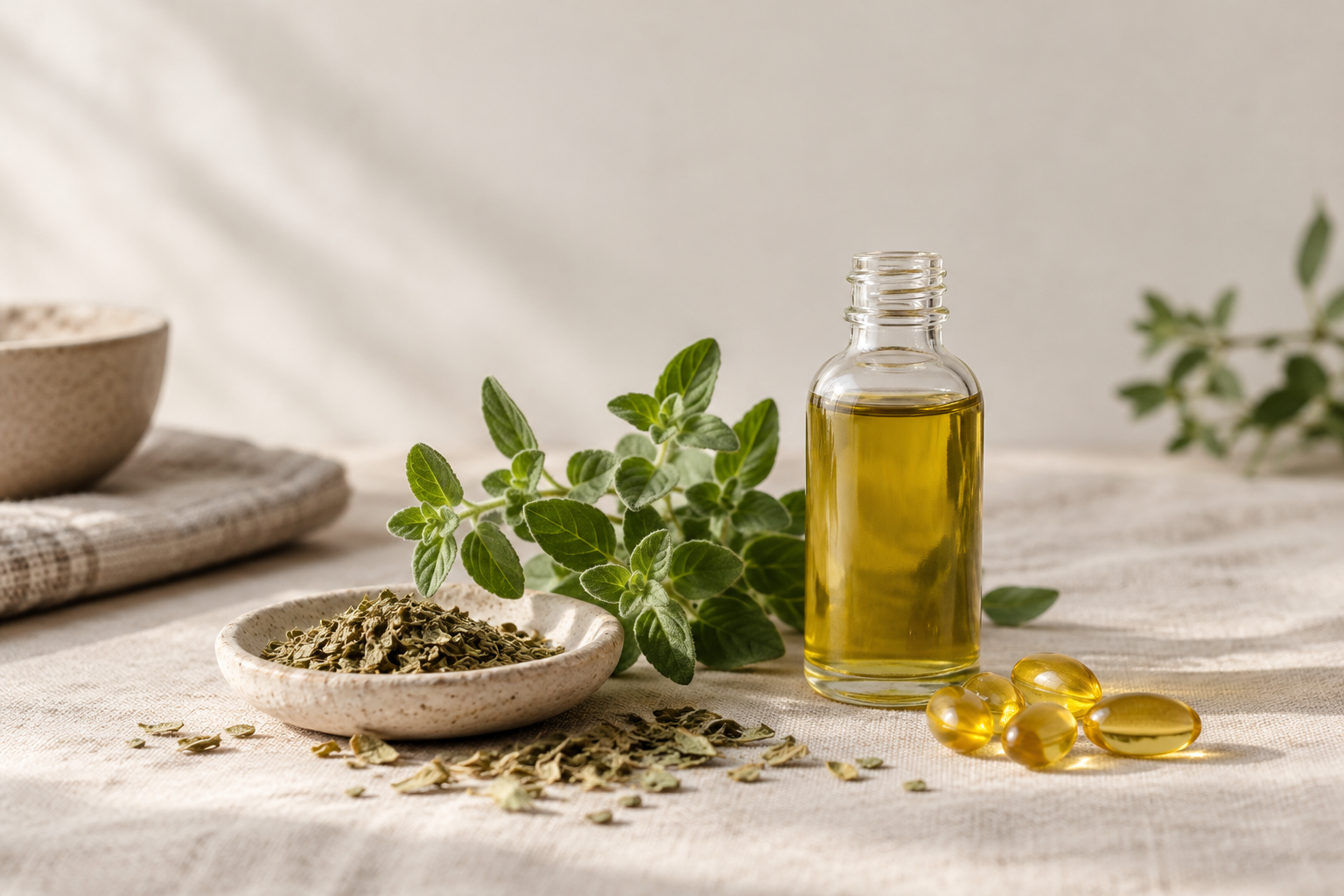
Oregano oil is the essential oil distilled from Origanum plants, and its characteristic compounds are the phenols thymol and carvacrol. Its antibacterial evidence comes mostly from laboratory studies, while human evidence is limited to small trials in specific conditions.
Nirast makes Oil of Oregano Softgels. This article was written by Nirast’s editorial team and reports what the published research does and does not show.
See Nirast Oil of Oregano Softgels → · $29.99 a month · 30-Day Money-Back Guarantee
Published by Thang Phi, founder of Nirast and publisher of the Nirast Journal.
This guide maps the ingredient, the evidence, the forms and the safety lines.
What oregano oil is
The oil comes from plants of the genus Origanum, and Origanum vulgare — common oregano or wild marjoram — is the culinary and traditional-medicine oregano; the genus name goes back to Hippocrates (460–370 BC) (Nurzyńska-Wierdak & Walasek-Janusz, 2025). The genus comprises about 43 species centred on the Mediterranean (Nurzyńska-Wierdak & Walasek-Janusz, 2025), and Origanum minutiflorum — the species named on the Nirast product page — is an endemic taxon of southwestern Türkiye (Efe et al., 2026).
What the oil contains varies. O. vulgare can synthesise at least nine essential-oil chemotypes, and the proportion of the highly active phenols — thymol and carvacrol — is variable (Nurzyńska-Wierdak & Walasek-Janusz, 2025). Chemotypes are chemically distinct groups within the same species, so two oils can differ even when the plants look alike (Freire et al., 2025). In one survey of 36 O. vulgare samples, chemotypes ranged from a linalool type (35–77%) to terpene-phenolic types with thymol at 24–82% and carvacrol at 18–93% (Freire et al., 2025).
The traditional-use record lists digestive complaints, mouth and throat rinses, inhalations and medicinal baths (Nurzyńska-Wierdak & Walasek-Janusz, 2025) — use, not proof of effect.
What the evidence covers — and where it thins out
The evidence is mostly laboratory work. The oil shows antibacterial activity in vitro against a wide range of bacteria, including antibiotic-resistant clinical isolates: in one review, oregano essential oils inhibited 11 multidrug-resistant clinical isolates with minimum inhibitory concentrations from 0.08 to 0.64 mg/mL (Iskandar et al., 2025), and a separate study found MICs of 1.75–3.50 mg/mL against multidrug-resistant Acinetobacter baumannii (Amaral et al., 2020). Antifungal activity is reported across Origanum species too, with carvacrol and thymol among the constituents linked to those effects (Mezzomo et al., 2025).
The mechanism is studied at the cell-membrane level: exposure to oregano oil depolarises and permeabilises bacterial membranes (Barbieri et al., 2026), and in A. baumannii the oil ruptured the membrane (Amaral et al., 2020). A 2026 study of Origanum minutiflorum root oil (not the product’s leaf extract) reported dose-dependent antibacterial activity (MIC 50 µg/mL for all tested strains except one at 100 µg/mL) and antioxidant activity across three assays (Efe et al., 2026).
But the same review says the evidence base is heavily weighted toward in vitro and ex vivo studies, and that well-designed clinical trials are needed before essential oils can be considered clinical options (Iskandar et al., 2025); technical, regulatory and safety hurdles remain, including gaps in bioavailability and safety data (Iskandar et al., 2025). In cystitis research, the oregano-oil work is explicitly preliminary and preclinical (Mattioli et al., 2026). Deeper read: oregano oil and everyday wellness.
The human trials, closely read
Human data exist, but they are small and specific. A 2024 open-label pilot in adults with SIBO tested a botanical regimen of capsules plus a liquid tincture daily for 10 weeks — a pilot with a limited number of participants (Min et al., 2024). It reported possible therapeutic potential in the hydrogen and hydrogen-sulfide SIBO subtypes but inconclusive effects on methanogenic SIBO; the multi-botanical regimen — oregano and berberine among the ingredients — does not isolate oregano oil (Min et al., 2024). A 2026 SIBO review lists oregano oil among the nutraceuticals studied but says these approaches require stronger clinical validation (Furqan et al., 2026).
In bacterial vaginosis, a randomised, triple-blind, non-inferiority trial compared a vaginal tablet made from oregano and lemon balm extracts with metronidazole: no statistically significant differences were found between groups for clinical signs, complaints or Amsel’s criteria (Mesdaghinia et al., 2025). That tablet is a different route and preparation from an oral oregano-oil supplement. None of these trials examined a softgel product like the one discussed below.
How to choose between the forms
Oregano oil supplements come in the same dosage forms as other botanicals — capsules, tablets, tinctures, solutions (Teterovska et al., 2025) — and the usual comparison is liquid oil (drops or tincture) versus encapsulated oil. A softgel is a liquid fill inside a flexible shell, gelatin-based or non-gelatin (Naharros-Molinero et al., 2024).
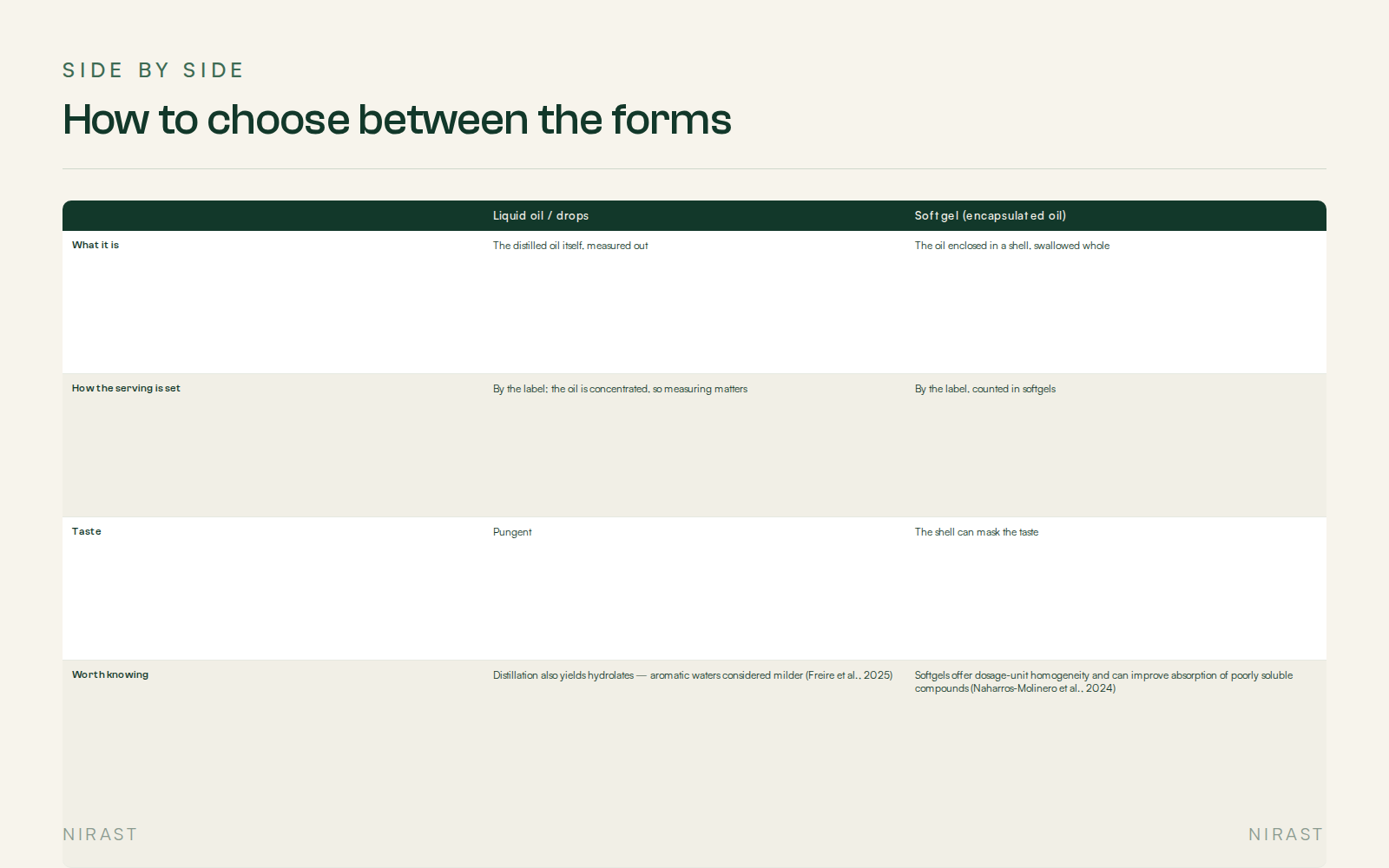
| Liquid oil / drops | Softgel (encapsulated oil) | |
|---|---|---|
| What it is | The distilled oil itself, measured out | The oil enclosed in a shell, swallowed whole |
| How the serving is set | By the label; the oil is concentrated, so measuring matters | By the label, counted in softgels |
| Taste | Pungent | The shell can mask the taste |
| Worth knowing | Distillation also yields hydrolates — aromatic waters considered milder (Freire et al., 2025) | Softgels offer dosage-unit homogeneity and can improve absorption of poorly soluble compounds (Naharros-Molinero et al., 2024) |
Softgels cost more to produce than tablets or liquids, and gelatin shells can bring dietary restrictions (Naharros-Molinero et al., 2024). Neither form is ranked above the other by the measured evidence — absorption factors include form, route and vehicle (Noman et al., 2026).
Five steps to decide:
- Match the form to your routine — pick what you will take consistently.
- Read the serving from the label, not from the form — a drop count and a softgel count are both label-defined servings.
- Check the safety fit first — medication and pregnancy cautions apply (below).
- Judge the product by what it declares — composition varies, and researchers say manufacturer products should be analysed for effectiveness and safety (Nurzyńska-Wierdak & Walasek-Janusz, 2025).
- Ask what the product is not — oregano oil is not an established treatment for an infection.
Deeper read: oil of oregano at home.
What the label tells you — and what it can’t
Supplement labels are not clinical-trial formulations: products often differ from research preparations in plant parts, extract types and dosages, and a 2025 analysis of European supplements advises consumers to interpret labels with caution (Teterovska et al., 2025). The oregano review adds that analysing manufacturer products’ composition to examine effectiveness and safety is an important research direction (Nurzyńska-Wierdak & Walasek-Janusz, 2025). A 2026 pharmacology review calls for chemotype-defined, analytically authenticated formulations with standardised dosing and safety assessment (But et al., 2026).
In practice, read the declared extract ratio and carvacrol or thymol amounts; treat “mg equivalent” figures as label arithmetic. Composition varies batch to batch with origin and season — one reason reviewers call for standardised, authenticated oils (Barbieri et al., 2026; But et al., 2026).
The safety frame
The key compounds have reference ceilings: EFSA considers thymol safe at 1000 mg/kg body weight, and carvacrol — non-toxic at low doses — can cause toxicity above roughly 2480 mg/kg body weight (Noman et al., 2026). A phase I study of carvacrol at 1–2 mg/kg/day in 40 healthy adults found some laboratory-marker changes but no clinical toxicity, with all parameters in the normal range (Noman et al., 2026).
For oregano extracts, EFSA describes them as natural extracts generally recognized as safe, while noting that safety cannot be fully assessed because of data gaps on genotoxicity and long-term toxicity (Nurzyńska-Wierdak & Walasek-Janusz, 2025). And one laboratory study of O. minutiflorum root oil reported genotoxic activity in a plant-based assay — a reminder that concentrated oils are biologically active (Efe et al., 2026).
Reviews add two cautions: essential oils are not without adverse effects, particularly in self-medication or vulnerable populations (Mattioli et al., 2026); and bleeding-liability assessment remains part of what formulations need, with direct evidence concentrated on platelet-related endpoints (But et al., 2026). If you take medication, are pregnant, or manage a health condition, ask a clinician first. Deeper read: oregano oil 101: dosage, safety, and evidence limits.
FAQ
What is oregano oil?
The essential oil distilled from Origanum plants; Origanum vulgare is the culinary and traditional-medicine oregano (Nurzyńska-Wierdak & Walasek-Janusz, 2025). Its chemistry varies, and thymol and carvacrol are the phenols behind its biological activity (Freire et al., 2025).
Is oregano oil safe to take every day?
Reference ceilings exist for the key compounds — thymol at 1000 mg/kg body weight per EFSA (Noman et al., 2026) — but EFSA also notes data gaps for oregano extracts (Nurzyńska-Wierdak & Walasek-Janusz, 2025), and reviews warn about adverse effects and bleeding liability (Mattioli et al., 2026; But et al., 2026). Follow the label; ask a clinician if you take medication.
Can oregano oil treat SIBO, BV, or an infection?
Oregano oil is not an established treatment for these conditions. The SIBO signal comes from a small open-label pilot of a multi-botanical regimen, with inconclusive results on one subtype (Min et al., 2024), and the bacterial-vaginosis trial used a vaginal oregano-extract tablet, not oral oil (Mesdaghinia et al., 2025). Reviews call for stronger clinical validation (Furqan et al., 2026; Iskandar et al., 2025).
What’s the difference between oregano oil drops and softgels?
Both deliver the oil; the difference is the vehicle. A softgel encloses the oil in a flexible shell and can mask the taste, with dosage-unit homogeneity as a design advantage (Naharros-Molinero et al., 2024); liquid drops are the oil itself, measured out by the label. The measured evidence does not rank the forms against each other (Noman et al., 2026).
Is oregano oil the same as the oregano spice?
No. The herb is the culinary spice; the oil is the distillate produced from the plant (Nurzyńska-Wierdak & Walasek-Janusz, 2025).
How do oregano oil and black seed oil compare?
Different botanicals with different evidence bases: oregano’s evidence is dominated by laboratory antimicrobial work (Iskandar et al., 2025), while black seed oil has its own trial literature. For the comparison — and for a formula that combines both — see are oil of oregano and black seed oil interchangeable? and black seed oil benefits.
A softgel option: Nirast Oil Of Oregano Softgels
Nirast Oil Of Oregano Softgels is a softgel supplement. Per 2-softgel serving, the label states 300 mg of a 20:1 fresh oregano oil extract — the equivalent of 6,000 mg — concentrated from Origanum minutiflorum leaf, with naturally occurring carvacrol at 165 mg and black seed oil (Nigella sativa) at 200 mg (product page). The offer is a monthly subscription at $29.99 — 1 pouch, delivered every month — backed by a 30-Day Money-Back Guarantee (product page).
If you want the oregano and black seed oils in one softgel product, see Nirast Oil Of Oregano Softgels here.
These statements have not been evaluated by the Food and Drug Administration. This product is not intended to diagnose, treat, cure, or prevent any disease. Talk to your doctor or pharmacist before starting a supplement, especially if you are pregnant, nursing, take medication or have a medical condition.
Related reading
- Oil of Oregano: What It Is, What the Evidence Shows, and How to Choose
- Oregano Oil 101: Dosage, Safety, and Evidence Limits
- Oregano Oil Capsules Benefits: What the Evidence Actually Shows
- Oregano Oil vs Oil of Oregano: Are They the Same Thing?
Related product: Oil of Oregano Softgels.