
Oregano Oil Benefits: What Human Studies Actually Show
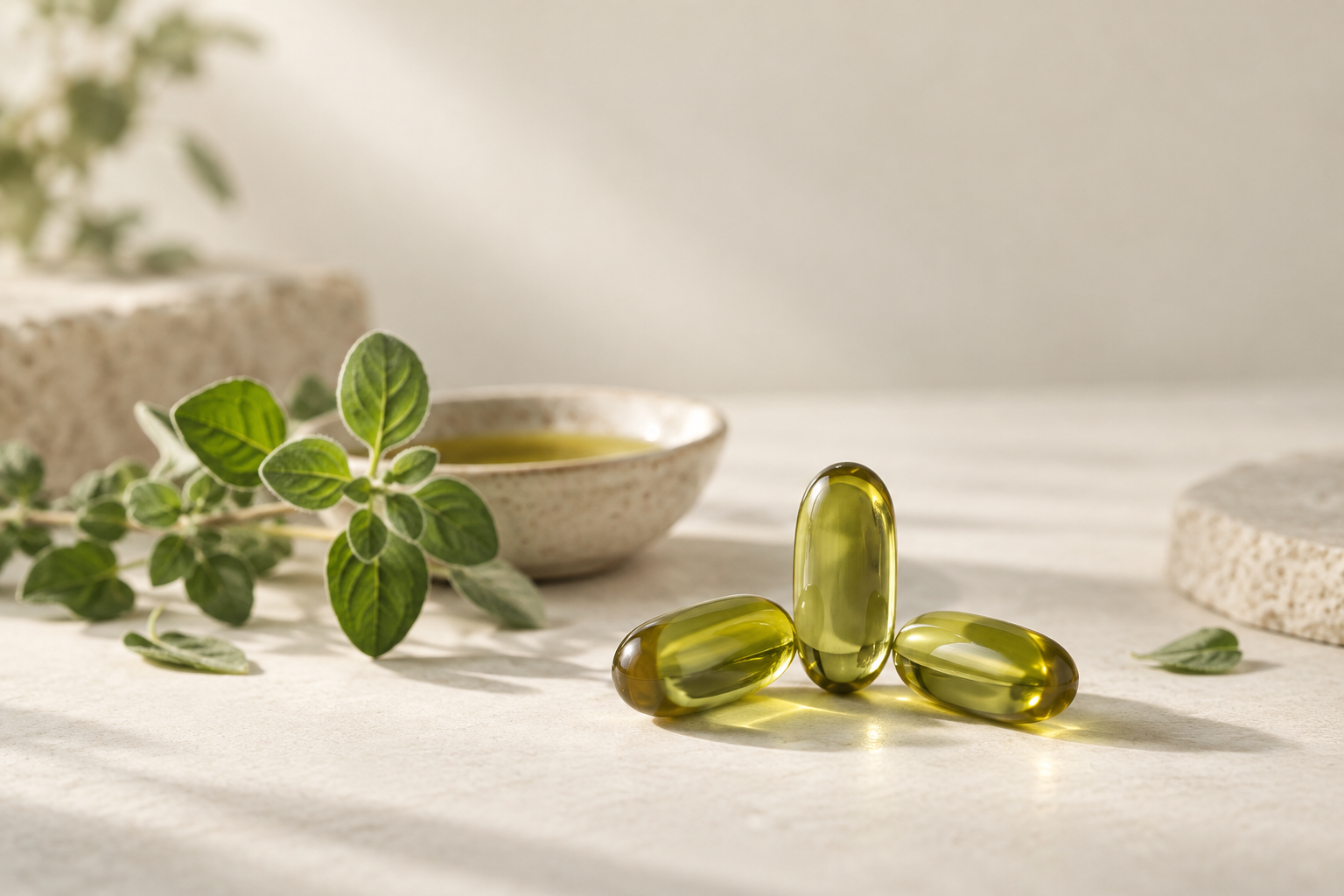
Oregano oil is the concentrated oil of Mediterranean oregano, and its human evidence is narrow: a small study found emulsified oregano oil cleared intestinal parasites in adults, and herbal regimens that include oregano oil did not differ significantly from rifaximin for SIBO in a chart review. Immunity and infection-fighting claims rest mainly on laboratory studies, not human trials.
Nirast makes Oil of Oregano Softgels. This article was written by Nirast’s editorial team and reports what the published research does and does not show.
See Nirast Oil of Oregano Softgels → · $29.99 a month · 30-Day Money-Back Guarantee
Published by Thang Phi, founder of Nirast and publisher of the Nirast Journal.
That short answer is worth unpacking, because “oregano oil benefits” covers two different things: what the oil can do in a laboratory dish, and what it has actually done in people. This page separates the two, walks through the studies behind the claims, and explains how to read an oregano product before you buy one.
What is oil of oregano — and what is in it?
Oil of oregano comes from Origanum vulgare, a Mediterranean plant used as a culinary spice and in traditional medicine (Origanum vulgare review, 2025). The herb is the raw material for two kinds of preparation: a concentrated essential oil, often abbreviated OEO, and extracts, OEX (Origanum vulgare review, 2025). Traditional uses described in the literature include remedies for digestion, mouth and throat rinses, and inhalations for upper respiratory tract inflammation (Origanum vulgare review, 2025).
Oregano oil’s two headline compounds, carvacrol and thymol, are phenolic monoterpenes that laboratory studies credit with antimicrobial activity against many bacteria — the proposed mechanism is disruption of the bacterial membrane, lysis, and leakage of cell contents (Origanum vulgare review, 2025). Carvacrol, specifically, is a monoterpenoid phenol found in oregano as well as thyme, wild bergamot and other plant oils (carvacrol overview, 2025).
What you are buying is not standardised. The 2025 review describes how genetic and environmental factors change the oil’s composition: surveys of Calabrian oregano identified four chemotypes — thymol-dominant, carvacrol-dominant and two mixed types — while a Macedonian oil contained trace thymol and no carvacrol at all (Origanum vulgare review, 2025). The review’s authors conclude that the composition of commercial oregano products — essential oils and supplements alike — should be analysed so that their effectiveness and safety can be examined (Origanum vulgare review, 2025).
What have human studies actually tested?
Not “oregano oil” in general — specific preparations, in specific situations. Four areas have human data worth knowing about, plus one review note on colds.
Intestinal parasites. A small study gave 14 adults with stool-positive enteric parasites 600 mg of emulsified oil of oregano daily for six weeks. Afterwards, Blastocystis hominis had disappeared in eight cases, Entamoeba hartmanni in four and Endolimax nana in one, and digestive symptoms improved in seven of the 11 patients who had tested positive for Blastocystis (Force et al., 2000). The record reports no control group, so this is a signal rather than proof.
SIBO (small intestinal bacterial overgrowth). A 2014 chart review of 104 patients offered either rifaximin 1200 mg daily or a combination herbal regimen for four weeks. The herbal capsules included oregano oil at 0.1 mL, stated as providing 55% to 75% carvacrol, alongside red thyme oil and berberine-containing extracts (Chedid et al., 2014). In the herbal group, 46% normalised their breath test, against 34% with rifaximin — reported as not statistically different (P=.24). The design matters: the authors describe the study as a retrospective chart review, not a randomised controlled trial, with multiple herbs used together and diet not controlled (Chedid et al., 2014). It cannot show what oregano oil alone does.
A 2024 open-label pilot — 16 people with SIBO taking a multi-ingredient botanical regimen whose ingredient list includes oregano oil — reported negative breath tests at week 10 in 42.8% of hydrogen-dominant and 66.7% of hydrogen-sulfide-dominant participants. Its authors describe it as a pilot study with a limited number of participants (open-label pilot, 2024). Again, a combination, and no control arm.
Bacterial vaginosis — a different form. A 2025 triple-blind randomised trial enrolled 130 women and compared a vaginal tablet made from oregano and lemon balm extracts with a metronidazole vaginal tablet; the herbal tablet alleviated symptoms and normalised Amsel’s criteria “to a degree comparable with metronidazole” (randomised trial, 2025). This is genuine randomised evidence — for a vaginal, extract-based product, not for oral oregano oil.
Dental use. A topical gel containing Origanum vulgare essential oil, used as an adjunct in periodontitis care, was followed by significant reductions in Fusobacterium nucleatum and Capnocytophaga species and improvements in probing depth, bleeding on probing and plaque index; the authors say further randomised controlled trials are essential to confirm the findings (adjunctive gel study, 2025). Adjunctive, topical, and not yet confirmed.
Colds and respiratory symptoms. A 2025 review of essential-oil compounds notes that oregano or cinnamon oils can attenuate upper respiratory infection symptoms “in small controlled trials” (Lights and Shadows review, 2025). Small is the operative word.
Which form is which? A quick comparison
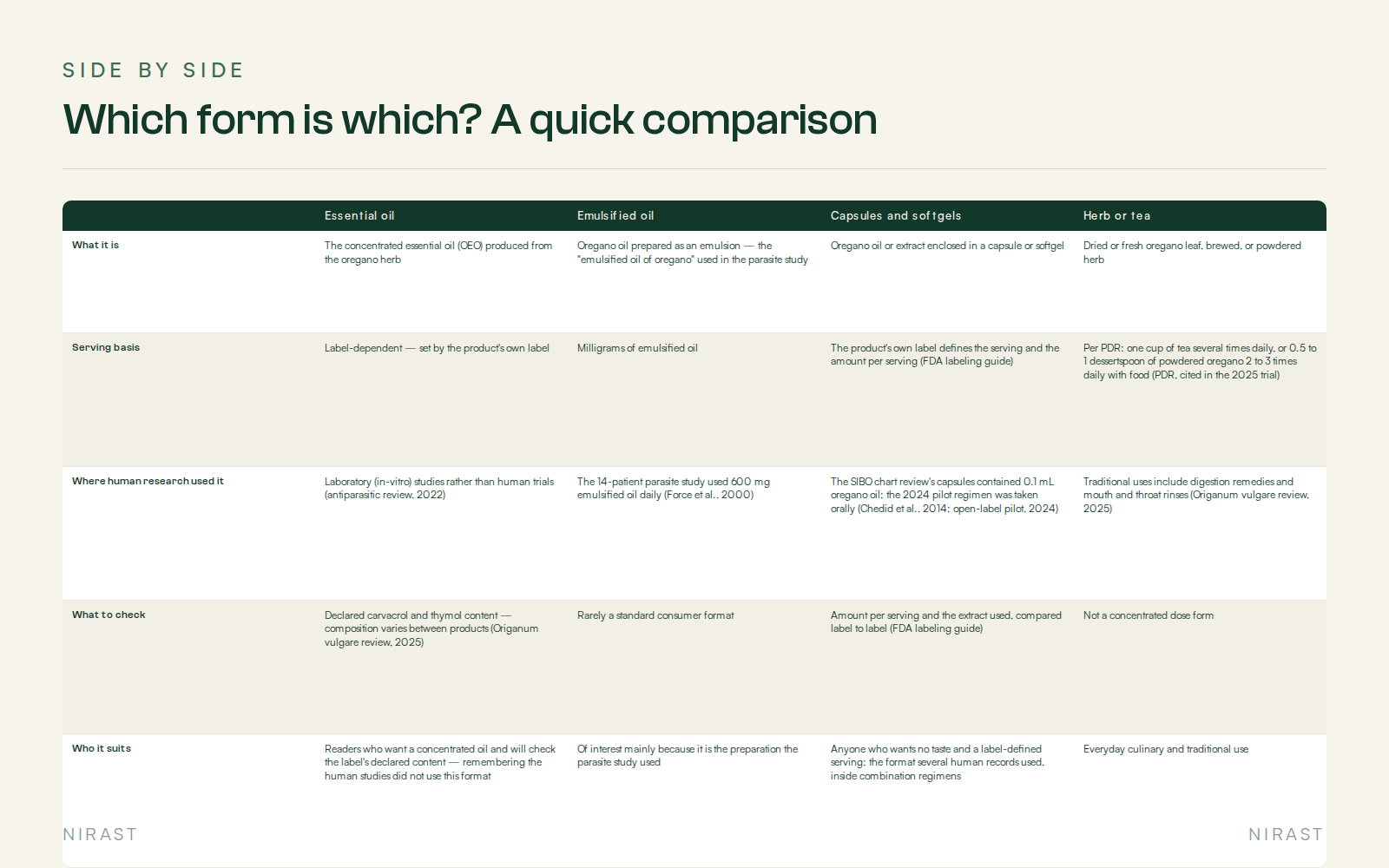
“Oregano oil” on a shelf can mean several different products. Here is how the main forms compare — including what the human research has actually used.
| Essential oil | Emulsified oil | Capsules and softgels | Herb or tea | |
|---|---|---|---|---|
| What it is | The concentrated essential oil (OEO) produced from the oregano herb | Oregano oil prepared as an emulsion — the “emulsified oil of oregano” used in the parasite study | Oregano oil or extract enclosed in a capsule or softgel | Dried or fresh oregano leaf, brewed, or powdered herb |
| Serving basis | Label-dependent — set by the product’s own label | Milligrams of emulsified oil | The product’s own label defines the serving and the amount per serving (FDA labeling guide) | Per PDR: one cup of tea several times daily, or 0.5 to 1 dessertspoon of powdered oregano 2 to 3 times daily with food (PDR, cited in the 2025 trial) |
| Where human research used it | Laboratory (in-vitro) studies rather than human trials (antiparasitic review, 2022) | The 14-patient parasite study used 600 mg emulsified oil daily (Force et al., 2000) | The SIBO chart review’s capsules contained 0.1 mL oregano oil; the 2024 pilot regimen was taken orally (Chedid et al., 2014; open-label pilot, 2024) | Traditional uses include digestion remedies and mouth and throat rinses (Origanum vulgare review, 2025) |
| What to check | Declared carvacrol and thymol content — composition varies between products (Origanum vulgare review, 2025) | Rarely a standard consumer format | Amount per serving and the extract used, compared label to label (FDA labeling guide) | Not a concentrated dose form |
| Who it suits | Readers who want a concentrated oil and will check the label’s declared content — remembering the human studies did not use this format | Of interest mainly because it is the preparation the parasite study used | Anyone who wants no taste and a label-defined serving; the format several human records used, inside combination regimens | Everyday culinary and traditional use |
How to choose an oregano oil product: five checks
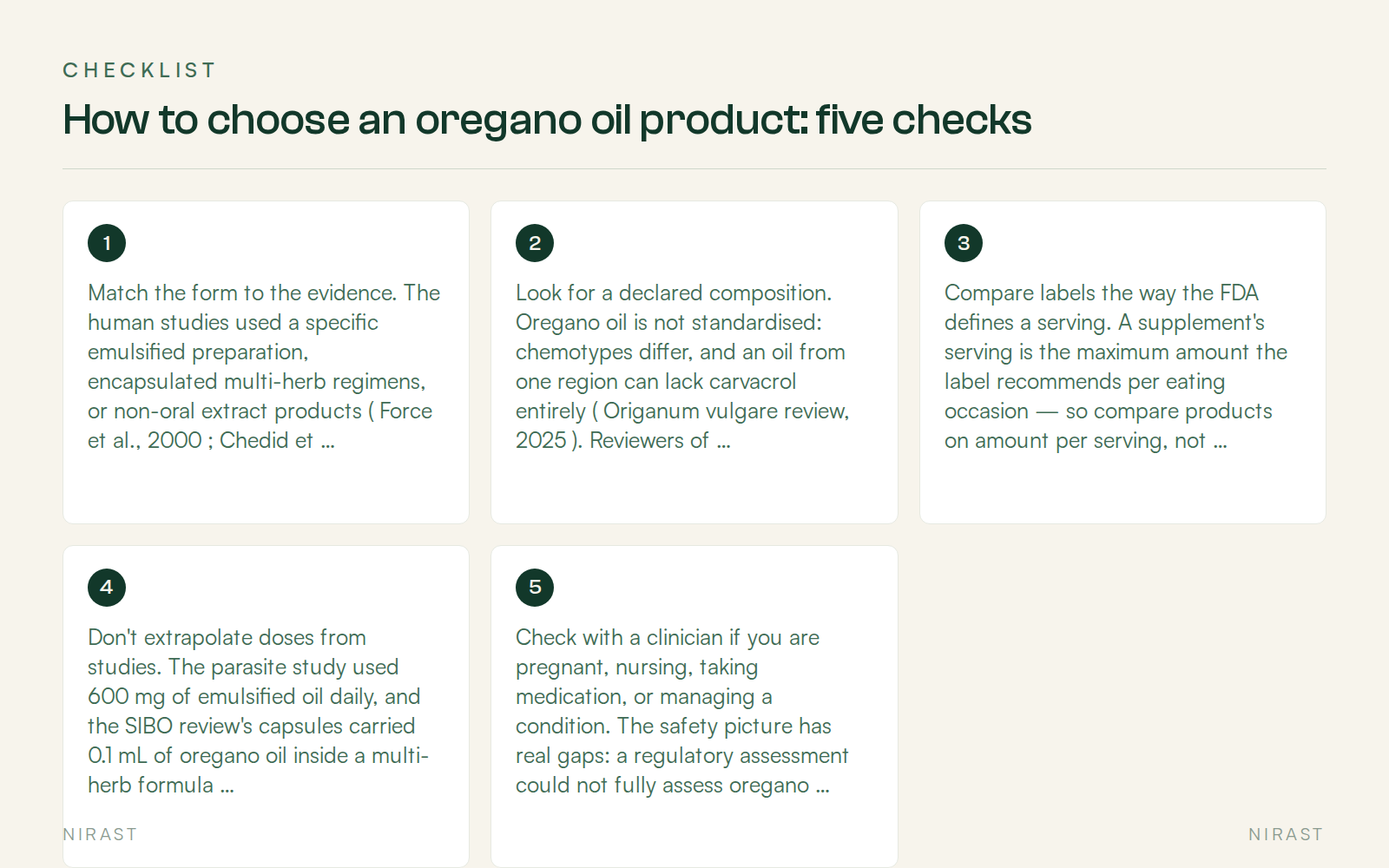
- Match the form to the evidence. The human studies used a specific emulsified preparation, encapsulated multi-herb regimens, or non-oral extract products (Force et al., 2000; Chedid et al., 2014; randomised trial, 2025). If gut health is your goal, treat a concentrated essential oil as a different product category from the preparations that were studied.
- Look for a declared composition. Oregano oil is not standardised: chemotypes differ, and an oil from one region can lack carvacrol entirely (Origanum vulgare review, 2025). Reviewers of the field recommend analysing commercial products’ composition so that their effectiveness and safety can be examined (Origanum vulgare review, 2025).
- Compare labels the way the FDA defines a serving. A supplement’s serving is the maximum amount the label recommends per eating occasion — so compare products on amount per serving, not package size (FDA labeling guide).
- Don’t extrapolate doses from studies. The parasite study used 600 mg of emulsified oil daily, and the SIBO review’s capsules carried 0.1 mL of oregano oil inside a multi-herb formula (Force et al., 2000; Chedid et al., 2014). Neither number transfers to a different product; follow the label of the product you bought.
- Check with a clinician if you are pregnant, nursing, taking medication, or managing a condition. The safety picture has real gaps: a regulatory assessment could not fully assess oregano extracts because of missing toxicity data (Origanum vulgare review, 2025), and concentrated compounds can irritate mucous membranes with prolonged exposure (Lights and Shadows review, 2025).
What the evidence does and does not show
What it shows. In humans, the documented uses are narrow and specific: a small uncontrolled parasite study, combination herbal regimens for SIBO (a chart review and a pilot), a vaginal extract tablet in one randomised trial, and a topical dental gel awaiting confirmation. In the laboratory, oregano oil and its compounds carvacrol and thymol repeatedly show antimicrobial activity against many bacteria (Origanum vulgare review, 2025).
What it does not show. The human records that exist do not show oral oregano oil, on its own, treating or preventing an infection, shortening a cold, or measurably “supporting immunity”. That matters, because the “natural antibiotic” framing is built largely on laboratory results. Reviews of essential-oil compounds describe why the lab-to-human leap is not automatic: poor aqueous solubility and bioavailability, instability of the volatile compounds, variability between batches, and a shortage of large, well-controlled trials (Lights and Shadows review, 2025). In one review of oregano and related herbs tested against parasites, 28 of the 34 experimental studies were in-vitro only (antiparasitic review, 2022). And the oral-health overview of carvacrol states that clinical studies for oral disease are still to be designed (carvacrol overview, 2025).
Do the studies apply to every product? No — and this is the detail the label talk exists for. Two bottles labelled “oregano oil” are not necessarily the same thing: composition varies with genetics and environment, and can differ from region to region (Origanum vulgare review, 2025). A study result belongs to the preparation that was studied; a different bottle is a different question.
Safety: what is known, and what is not
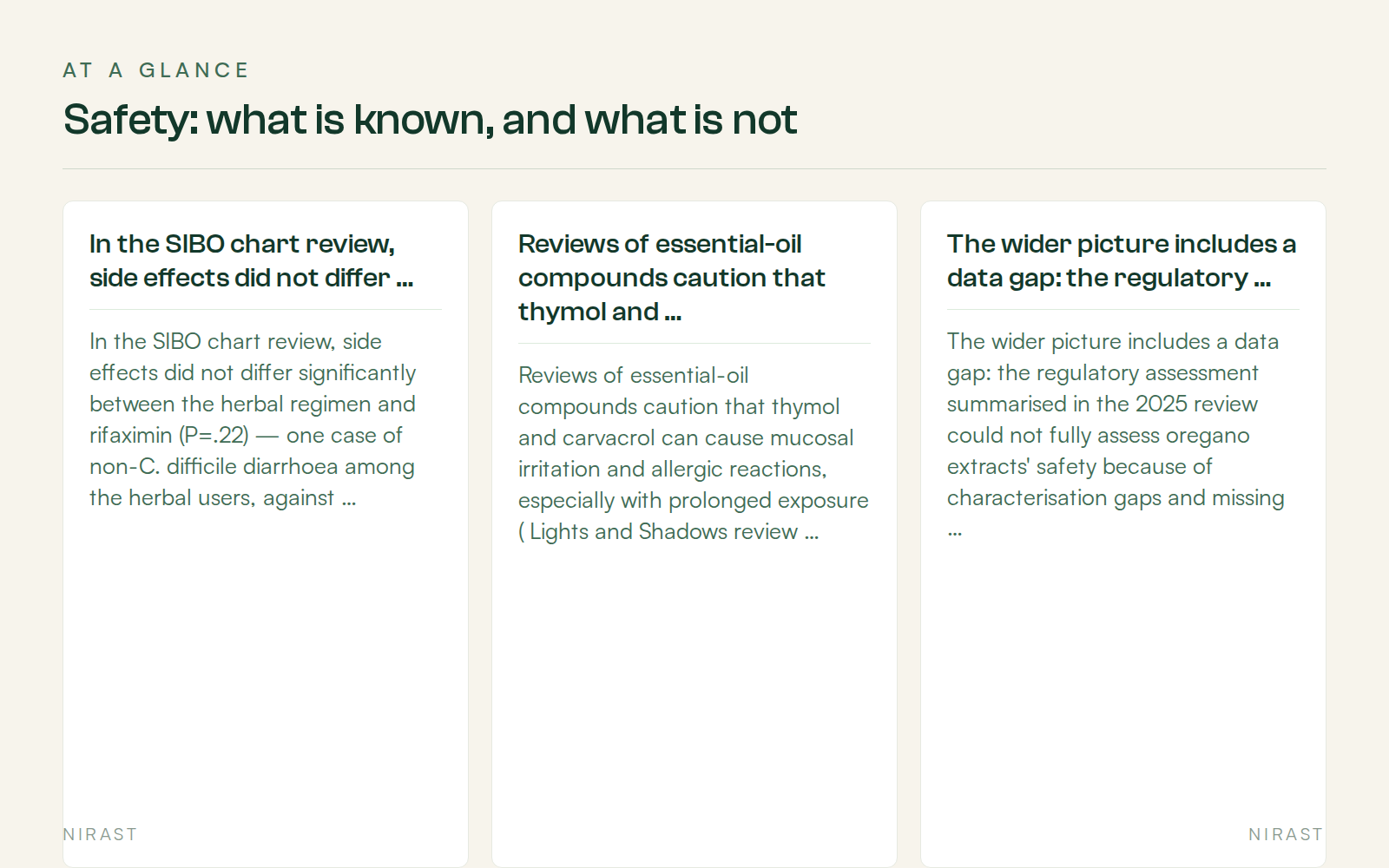
- In the SIBO chart review, side effects did not differ significantly between the herbal regimen and rifaximin (P=.22) — one case of non-C. difficile diarrhoea among the herbal users, against six adverse events among 67 rifaximin users (Chedid et al., 2014).
- Reviews of essential-oil compounds caution that thymol and carvacrol can cause mucosal irritation and allergic reactions, especially with prolonged exposure (Lights and Shadows review, 2025).
- The wider picture includes a data gap: the regulatory assessment summarised in the 2025 review could not fully assess oregano extracts’ safety because of characterisation gaps and missing genotoxicity, reproductive, developmental and long-term toxicity data (Origanum vulgare review, 2025). That is a reason for caution rather than a verdict — and a reason to involve a clinician if you are pregnant, nursing, or taking medication.
FAQ
What are the benefits of oregano oil?
The documented human benefits are narrow. A small uncontrolled study found emulsified oregano oil cleared intestinal parasites and improved digestive symptoms in adults (Force et al., 2000), and combination herbal regimens that include oregano oil have shown breath-test normalisation similar to rifaximin in a chart review, plus promise in an open-label pilot (Chedid et al., 2014; open-label pilot, 2024). Other claims — immunity, colds, “natural antibiotic” — rest mainly on laboratory studies rather than human trials (Lights and Shadows review, 2025).
Does oregano oil work like a natural antibiotic?
In the laboratory, oregano oil and its compounds inhibit many bacteria (Origanum vulgare review, 2025). In people, the records that come closest to an infection treatment used multi-herb combinations under medical supervision (Chedid et al., 2014; open-label pilot, 2024). Reviewers of essential-oil compounds list poor bioavailability and a shortage of large controlled trials among the reasons laboratory activity has not translated into a standard infection treatment (Lights and Shadows review, 2025). If you think you have an infection, see a clinician rather than self-treating.
How much oregano oil should I take?
There is no single number. A supplement’s serving is defined by its own label — the maximum amount recommended per eating occasion (FDA labeling guide). The human studies used specific preparations and amounts: 600 mg of emulsified oil daily in the parasite study, and capsules carrying 0.1 mL of oregano oil within a multi-herb formula in the SIBO review (Force et al., 2000; Chedid et al., 2014). Those amounts belong to those products; follow the label of the product you have.
Can oregano oil help with SIBO?
It has been studied in SIBO only inside combination regimens: a chart review in which herbal capsules that included oregano oil normalised breath tests in 46% of patients, and an open-label pilot in which a botanical regimen produced negative tests in a subset of participants (Chedid et al., 2014; open-label pilot, 2024). Neither tested oregano oil alone, and neither is a randomised controlled trial of a single product. SIBO is a diagnosed condition, and treatment decisions belong with a clinician.
Is oregano oil safe to take every day?
The human records give limited reassurance: in the SIBO chart review, side effects in the herbal arm did not differ significantly from the antibiotic arm (Chedid et al., 2014). But reviews caution that thymol and carvacrol can irritate mucous membranes with prolonged exposure (Lights and Shadows review, 2025), and the regulatory assessment summarised in the 2025 review could not fully assess oregano extracts’ safety because toxicity data are missing (Origanum vulgare review, 2025). Daily use is a decision to make with a clinician’s input, especially if you are pregnant, nursing, or on medication.
What is the difference between “oil of oregano” and oregano essential oil?
The oregano herb is used to make a concentrated essential oil (OEO) and oregano extracts (OEX) (Origanum vulgare review, 2025). Because composition varies between products (Origanum vulgare review, 2025), what a label declares about its content matters more than the name on the front.
If a softgel fits your routine: Nirast Oil Of Oregano Softgels
Nirast Oil Of Oregano Softgels is a softgel supplement that states, per 2-softgel serving: oregano oil concentrated from Origanum minutiflorum leaf — 300 mg of a 20:1 fresh oil extract, delivering the equivalent of 6,000 mg — with naturally occurring carvacrol at 165 mg and 200 mg of black seed oil (Nirast Oil Of Oregano Softgels). The offer is a monthly subscription: one pouch at $29.99, delivered every month, with refills shipping every 30 days; cancel by emailing support@nirast.co at least 24 hours before the next scheduled renewal. Orders carry a 30-Day Money-Back Guarantee.
If you want an oregano product in a swallowable softgel form, with the extract and carvacrol amounts stated up front, you can see Nirast Oil Of Oregano Softgels here.
These statements have not been evaluated by the Food and Drug Administration. This product is not intended to diagnose, treat, cure, or prevent any disease. Talk to your doctor or pharmacist before starting a supplement, especially if you are pregnant, nursing, take medication or have a medical condition.
Related reading
- Oregano Oil: What It Is, What the Evidence Covers, and How to Choose a Form
- Oregano Oil Capsules Benefits: What the Evidence Actually Shows
- Wild Oregano Oil Benefits: What the 'Wild' Label Really Means
- Oil of Oregano: What It Is, What the Evidence Shows, and How to Choose
Related product: Oil of Oregano Softgels.