
Lymphatic Drainage: What It Is, What the Evidence Covers, and How to Choose an Approach

Lymphatic drainage is both a body process — the lymphatic system’s job of collecting excess tissue fluid and returning it to the bloodstream — and the name for hands-on techniques, like manual lymphatic drainage, used to support that flow. Most of the clinical evidence comes from recovery after surgery and from lymphedema care, not from “detox” routines.
Nirast makes Nirast Lymphatic Drainage Drops. This article was written by Nirast’s editorial team and reports what the published research does and does not show.
See Nirast Lymphatic Drainage Drops → · 30-Day Money-Back Guarantee
Published by Thang Phi, founder of Nirast and publisher of the Nirast Journal.
What “lymphatic drainage” actually means
The lymphatic system is part of the circulatory system and plays a crucial role in fluid balance and immune function; when lymphatic function is disrupted, fluid accumulates in the tissues — the hallmark of lymphedema, a chronic and progressive condition (Frontiers in Medicine review, 2026). Vessels continuously remove fluid from between cells and return it to the bloodstream; the system acts as a feedback control offsetting interstitial fluid increases (Comprehensive Physiology review, 2026), and the cells lining the vessels support fluid drainage, lipid transport and immune-cell trafficking (MedComm review, 2026).
The term also names a treatment style: manual lymphatic drainage — gentle skin movements using pump, scoop, rotary and circle strokes — works with the body’s “extrinsic pump”: lymph movement created by muscle contractions, breathing and external pressure (International Journal of Therapeutic Massage & Bodywork, 2026). Manual approaches extend beyond massage: osteopathic treatment includes techniques designed to increase lymphatic flow (osteopathic lymphatic treatments reference, 2026).
What the evidence covers — and where it thins out
The main evidence sits in postoperative and cancer-related care. A 2026 systematic review of seven studies found manual lymphatic drainage — typically started days 2–5 after cosmetic plastic surgery in 6–12 sessions — consistently reduced postoperative swelling, with more variable effects on pain and fibrosis; adverse events were minimal (PRS Global Open systematic review, 2026).
In lymphedema care it is one component of complete decongestive therapy — with compression, skin care and exercise — the cornerstone of conservative management; guidance includes self-management: compression, exercise, skin care, self-MLD and weight management (Asia-Pacific Journal of Oncology Nursing evidence summary, 2026).
A 2026 retrospective cohort in gynecological cancer surgery reported less lower-limb lymphedema with early manual drainage, but notes non-randomised allocation introduces selection bias (PeerJ cohort study, 2026). A clinical article notes the evidence for manual and self-drainage remains limited, with clinical experience pointing to potential benefits (British Journal of Community Nursing, 2026). For lower-limb lymphedema after gynecological cancer, a 2026 systematic review found both single and multimodal physical therapy safe and effective, with multimodal strategies trending superior (Frontiers in Oncology systematic review, 2026).
Movement and compression: what the exercise trials show
A 2026 scoping review of 18 studies concluded exercise is a safe, feasible and effective approach to lower-limb lymphedema; combined with compression it significantly reduces edema volume (Phlebology scoping review, 2026).
For prevention after breast cancer surgery, a 2026 meta-analysis of randomised trials linked progressive resistance exercise to reduced lymphedema incidence — risk ratio 0.68 (95% CI 0.53–0.88) (Biomolecules & Biomedicine meta-analysis, 2026). A randomised trial in 50 women found a 12-week home-based resistance programme added to standard physiotherapy reduced excess limb volume more (about two percentage points), with no adverse events, though the authors call the difference modest (Journal of Clinical Medicine trial, 2026). A 2026 network meta-analysis of 100 randomised trials found combinations such as compression with resistance training and compression with manual lymphatic drainage linked to lower risk; the authors describe compression plus resistance training as the most robust evidence profile, though its top ranking did not survive stricter diagnostic criteria (Frontiers in Oncology network meta-analysis, 2026).
Intermittent pneumatic compression devices reduce dependence on certified therapists at home; a 2025 meta-analysis found the pooled evidence cautious, with heterogeneity limiting robustness (Supportive Care in Cancer meta-analysis, 2025).
How to choose an approach
First, is this a medical situation or a wellness routine? If swelling is persistent, one-sided, or follows surgery or radiotherapy, start with clinical evaluation (Frontiers in Medicine review, 2026). If lymphedema is diagnosed, complete decongestive therapy is the standard framework (Asia-Pacific Journal of Oncology Nursing evidence summary, 2026).
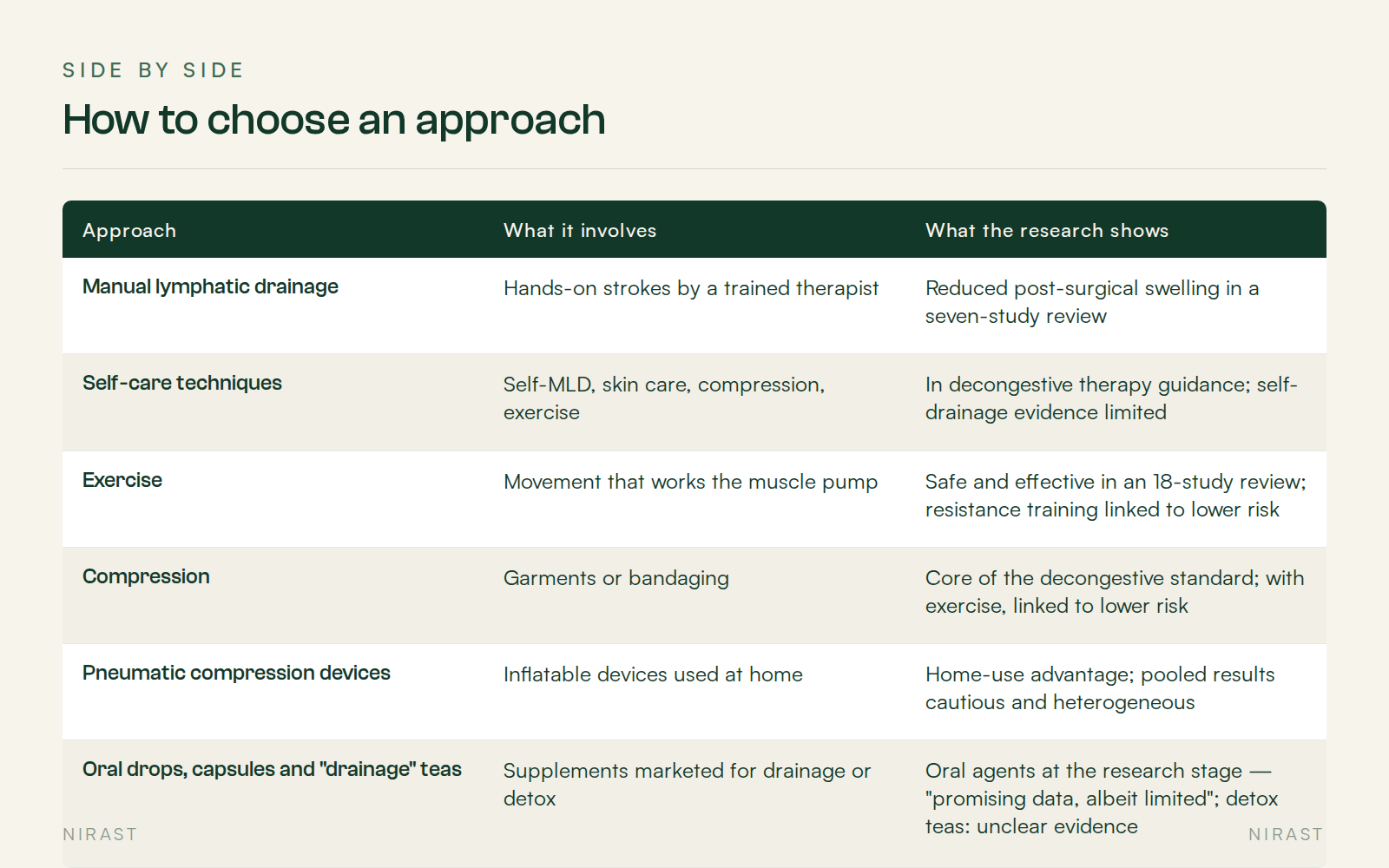
| Approach | What it involves | What the research shows |
|---|---|---|
| Manual lymphatic drainage | Hands-on strokes by a trained therapist | Reduced post-surgical swelling in a seven-study review |
| Self-care techniques | Self-MLD, skin care, compression, exercise | In decongestive therapy guidance; self-drainage evidence limited |
| Exercise | Movement that works the muscle pump | Safe and effective in an 18-study review; resistance training linked to lower risk |
| Compression | Garments or bandaging | Core of the decongestive standard; with exercise, linked to lower risk |
| Pneumatic compression devices | Inflatable devices used at home | Home-use advantage; pooled results cautious and heterogeneous |
| Oral drops, capsules and “drainage” teas | Supplements marketed for drainage or detox | Oral agents at the research stage — “promising data, albeit limited”; detox teas: unclear evidence |
Five decisions:
- Get persistent swelling checked first — a clinical question, not a product question.
- If lymphedema is diagnosed, ask about the multi-component standard — decongestive therapy, not a single technique.
- For prevention and daily management, exercise is well tolerated; combining it with compression was linked to lower risk (Frontiers in Oncology network meta-analysis, 2026).
- Read labels the way researchers do — supplements often differ from clinical-research preparations in plant parts, extract types and dosages (Medicinal Plants in Food Supplements review, 2025).
- Treat “drainage” promises as marketing until they point to human trial evidence.
The “detox” edge of the market
Much of what is sold under the lymphatic banner is a “detox” product. A 2026 mini-review of detox and diet teas found them widely marketed yet unregulated, the evidence supporting their claims unclear, and concluded they do not have sufficient evidence to be regarded as safe and effective; case reports link them to serious harms — hepatotoxicity, hypokalemia, cardiac arrhythmias and acute cardiac dysfunction (Frontiers in Nutrition mini-review, 2026).
Herbal ingredients deserve the same discipline. Cleavers has a traditional-use record that includes use as a diuretic for bloating and for “lymph swellings”, while laboratory work reports antimicrobial and antioxidant activity; tradition is a record of use, not proof of effect (BMC Complementary Medicine and Therapies, 2024; Microorganisms, 2026). Red clover’s controlled-trial evidence concerns its isoflavones and menopausal hot flushes — a 2026 meta-analysis of nine randomised trials found a modest effect on hot-flush frequency — an outcome unrelated to lymphatic drainage (European Journal of Obstetrics & Gynecology and Reproductive Biology, 2026). Prickly ash belongs to the Zanthoxylum genus, used in traditional medicine for centuries, with laboratory-reported anti-inflammatory activity (Foods, 2026).
For everyday support without harsh products, see Everyday Ways to Support a Healthy Inflammatory Balance.
Safety: when swelling is a medical question
Persistent swelling is not a “drainage” problem to solve with a supplement. Lymphedema is progressive and incurable, requiring lifelong management, so early diagnosis matters (Frontiers in Medicine review, 2026); secondary lower-limb lymphedema can follow surgery or radiotherapy in gynecological cancer survivors (Frontiers in Oncology systematic review, 2026). If swelling is new, one-sided, or follows a procedure or cancer treatment, that is a clinician’s question.
For manual techniques, the reviewed studies were reassuring — adverse events minimal, no contraindications identified — but that describes those study populations, not every condition (PRS Global Open systematic review, 2026). For supplements generally, check with a healthcare provider if you are pregnant, nursing or on medication — the guidance printed on the drops described below (product page).
FAQ
What is lymphatic drainage in simple terms?
It is the lymphatic system’s job of returning excess tissue fluid to the bloodstream — and the name for hands-on techniques, such as manual lymphatic drainage, that support that flow (Comprehensive Physiology review, 2026; International Journal of Therapeutic Massage & Bodywork, 2026). The same vessels also handle lipid transport and immune-cell trafficking (MedComm review, 2026).
Does manual lymphatic drainage actually work?
Its evidence is concentrated in clinical settings: a seven-study review found it reduced swelling after cosmetic plastic surgery, and it is part of complete decongestive therapy (PRS Global Open systematic review, 2026; Asia-Pacific Journal of Oncology Nursing evidence summary, 2026). Outside those settings, evidence is more limited (British Journal of Community Nursing, 2026).
Can supplements or drops drain your lymphatic system?
There is no established oral treatment that drains lymph. A 2026 scoping review found promising but limited data on pharmacologic and herbal agents (Frontiers in Oncology scoping review, 2026), and detox teas marketed for drainage have an unclear evidence base with case reports of serious harm (Frontiers in Nutrition mini-review, 2026).
Can you do lymphatic drainage at home?
Yes — as self-care inside a plan, not instead of one. Guidance includes self-MLD, compression, exercise and skin care (Asia-Pacific Journal of Oncology Nursing evidence summary, 2026), and exercise is well tolerated in trials (Phlebology scoping review, 2026; Biomolecules & Biomedicine meta-analysis, 2026). If you suspect lymphedema, build the routine with a clinician.
When should swelling be checked by a doctor?
Swelling has many causes; lymphedema is a specific, diagnosable condition — primary (congenital) or secondary to damage, obstruction or removal of lymph vessels or nodes (Frontiers in Medicine review, 2026). Persistent or one-sided swelling — especially after surgery or radiotherapy — should be evaluated clinically (Frontiers in Medicine review, 2026). For one common cause of bloating, see Why Can Bloating Happen Even With a Balanced Diet?.
How should I read a lymphatic drainage supplement label?
Look at what the label declares — plant parts, extract types and amounts — and read it with caution: supplements often differ from clinical-research preparations (Medicinal Plants in Food Supplements review, 2025). Ingredient-level research describes the ingredient, not the finished product; see Ingredient evidence vs product evidence.
A drops option: Nirast Lymphatic Drainage Drops
If you want a daily lymphatic-support routine in liquid form, Nirast Lymphatic Drainage Drops is a herbal drops product described on its page as “a gentle daily herbal blend made to support your body’s natural lymphatic wellness” — no pills to swallow, just a few drops a day — with four herbs: Cleavers, Stillingia Root, Red Clover and Prickly Ash Bark (product page).
The offer is a monthly subscription starting at $29.99, with larger multi-bottle tiers, a 30-Day Money-Back Guarantee, and free worldwide shipping (orders processed within 4–7 business days; delivery 5–7 business days after shipment). The page recommends consistent daily use and notes that individual results may vary (product page).
To be clear about what this is: a daily wellness blend, not a treatment for lymphedema or any medical condition — persistent or one-sided swelling belongs with a clinician (Frontiers in Medicine review, 2026). If that fits what you are looking for, see the Nirast Lymphatic Drainage Drops here.
These statements have not been evaluated by the Food and Drug Administration. This product is not intended to diagnose, treat, cure, or prevent any disease. Talk to your doctor or pharmacist before starting a supplement, especially if you are pregnant, nursing, take medication or have a medical condition.
Related reading
- Lymphatic Drainage Drops: What They Are and What the Evidence Shows
- Lymphatic Drainage Supplements: What's Actually Studied and How to Read a Label
- Best Supplements for Lymphatic Drainage: How to Judge One Before You Buy
- Lymphatic System Support: What Actually Helps, and Where Supplements Fit
Related product: Nirast Lymphatic Drainage Drops.