
Wild Oregano Oil Benefits: What the ‘Wild’ Label Really Means
Wild Oregano Oil Benefits: What the ‘Wild’ Label Really Means
Wild oregano oil is oregano oil labeled as wild-grown or wild-harvested — a sourcing description, not a measured strength. In one comparison, wild and cultivated oregano accessions gave comparable volatile profiles with few exceptions, and a 110-product study found commercial labels alone cannot verify botanical identity. Human evidence for oregano oil remains narrow.
Nirast makes Oil of Oregano Softgels. This article was written by Nirast’s editorial team and reports what the published research does and does not show.
See Nirast Oil of Oregano Softgels → · $29.99 a month · 30-Day Money-Back Guarantee
Published by Thang Phi, founder of Nirast and publisher of the Nirast Journal.
“Wild oregano oil benefits” bundles two separate questions: what the word “wild” denotes on a label, and whether the human evidence behind oregano oil changes when the label does. This page takes the label question first, then the benefit evidence.
What does “wild oregano” actually mean?
“Wild” describes where the plant material came from — plants growing in natural settings rather than a cultivated field. The oregano herb is collected both ways: the raw material is Origani herba, collected from crops and from natural sites at the beginning of flowering, when it contains the essential oil (Origanum vulgare review, 2025).
The names around it do not map cleanly onto one plant. Origanum vulgare is also called common oregano, wild marjoram or Spanish marjoram, and the genus contains 43 species, 6 subspecies and 18 natural hybrids (Origanum vulgare review, 2025). Named trade types include Greek oregano (O. vulgare subsp. hirtum) and Turkish oregano (O. onites) (Origanum vulgare review, 2025). So “wild” tells you something about where plants grew — not which species is in the bottle, and not how much carvacrol it contains.
One species that carries mountain names is Origanum minutiflorum — “toga kekik” or “dağ kekiği” (mountain thyme) — an endemic taxon of the eastern Mediterranean and southwestern Türkiye (GC-MS analysis, 2026).
Does “wild” make the oil stronger? What the comparison studies show
A comparison of Origanum vulgare subsp. virens plants collected from wild sites in Portugal with plants of the same accessions grown in an experimental field found that “with few exceptions, the wild and the corresponding EF-grown plants provided comparable volatile profiles” (volatile-profile comparison, 2025).
Wild-collected samples did yield more oil — one accession 3.33% of plant material as essential oil against 1.61% for its cultivated counterpart — which the authors connect to water stress from late spring into flowering (volatile-profile comparison, 2025). Yield is not the same as chemistry: in the same study, the 36 samples split into a linalool group (35–77%) and a terpene-phenolic group with thymol (24–82%) and carvacrol (18–93%) (volatile-profile comparison, 2025).
Chemistry is where “wild” stops telling you much. The 2025 review describes four chemotypes among Calabrian oregano — a thymol-dominant type, a carvacrol-dominant one and two mixed types — reports a Macedonian oil with trace thymol and no carvacrol at all, and traces the spread to genetic, ontogenetic and environmental variation (Origanum vulgare review, 2025).
Composition can still swing within a single accession: the cultivated oil of one accession was dominated by γ-terpinene while other samples of the same accession contained thymol as the principal compound (volatile-profile comparison, 2025). A GC-MS analysis of Origanum minutiflorum oil shows the same caution: its composition contrasted with some earlier reports, which the authors attribute to environmental factors or methodological differences (GC-MS analysis, 2026).
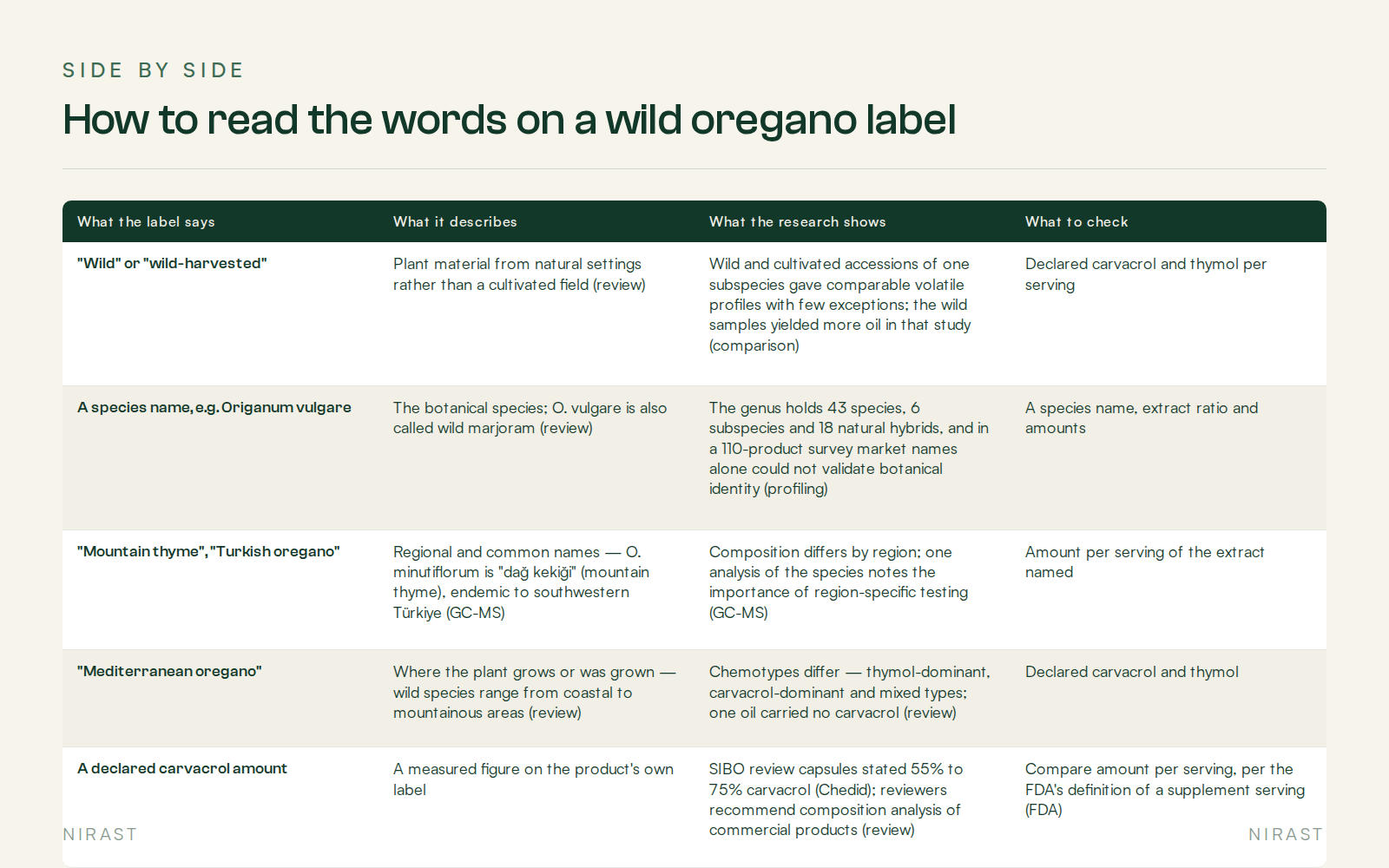
How to read the words on a wild oregano label
| What the label says | What it describes | What the research shows | What to check |
|---|---|---|---|
| “Wild” or “wild-harvested” | Plant material from natural settings rather than a cultivated field (review) | Wild and cultivated accessions of one subspecies gave comparable volatile profiles with few exceptions; the wild samples yielded more oil in that study (comparison) | Declared carvacrol and thymol per serving |
| A species name, e.g. Origanum vulgare | The botanical species; O. vulgare is also called wild marjoram (review) | The genus holds 43 species, 6 subspecies and 18 natural hybrids, and in a 110-product survey market names alone could not validate botanical identity (profiling) | A species name, extract ratio and amounts |
| “Mountain thyme”, “Turkish oregano” | Regional and common names — O. minutiflorum is “dağ kekiği” (mountain thyme), endemic to southwestern Türkiye (GC-MS) | Composition differs by region; one analysis of the species notes the importance of region-specific testing (GC-MS) | Amount per serving of the extract named |
| “Mediterranean oregano” | Where the plant grows or was grown — wild species range from coastal to mountainous areas (review) | Chemotypes differ — thymol-dominant, carvacrol-dominant and mixed types; one oil carried no carvacrol (review) | Declared carvacrol and thymol |
| A declared carvacrol amount | A measured figure on the product’s own label | SIBO review capsules stated 55% to 75% carvacrol (Chedid); reviewers recommend composition analysis of commercial products (review) | Compare amount per serving, per the FDA’s definition of a supplement serving (FDA) |
The labels themselves are part of the problem. In a study of 110 commercial thyme- and oregano-labeled products bought from Turkish herbalists and markets, researchers recorded the market names but did not treat them as verified species identities — “without authenticated plant material, the commercial designations cannot validate botanical identity” — and the two chemical clusters they found were contrasting volatile profiles, not verified species (commercial-product profiling, 2026). Reviewers go further and recommend composition analysis for commercial oregano products — supplements as well as essential oils — so that effectiveness and safety can be examined closely (Origanum vulgare review, 2025). For the wider ingredient picture, see the oregano oil hub guide.
What human studies have actually tested — and what “wild” adds
Here is the part that does not change with the label. The human records are narrow, and each tested a specific preparation:
- Intestinal parasites. Fourteen adults whose stool tested positive for enteric parasites took 600 mg of an emulsified oregano oil daily for six weeks. Blastocystis hominis was cleared in eight patients, Entamoeba hartmanni in four, Endolimax nana in one, and digestive symptoms eased for seven of the 11 with Blastocystis. With no control group, read it as a signal, not proof (Force et al., 2000).
- SIBO. A 2014 chart review of 104 SIBO patients pitted a four-week combination herbal regimen — its capsules packed 0.1 mL of oregano oil with a stated 55% to 75% carvacrol — against rifaximin 1200 mg daily: breath tests normalised for 46% of the herbal arm versus 34% of the rifaximin arm, reported as not statistically different (P=.24) (Chedid et al., 2014). A 2024 open-label pilot of a botanical regimen listing oregano oil saw negative breath tests by week 10 for 42.8% of hydrogen-dominant participants and 66.7% of the hydrogen-sulfide-dominant group (open-label pilot, 2024).
- Bacterial vaginosis. A 2025 triple-blind randomised trial in 130 women compared a vaginal tablet of oregano and lemon balm extracts with metronidazole: symptoms eased and Amsel’s criteria normalised to a comparable degree — a vaginal product, not oral oregano oil (randomised trial, 2025).
- Dental care. A topical Origanum vulgare essential-oil gel, applied alongside standard periodontal treatment, was followed by lower counts of Fusobacterium nucleatum and Capnocytophaga spp. and better readings for plaque index, probing depth and bleeding on probing; the authors call for randomised trials to confirm (adjunctive gel study, 2025).
One review adds that “in small controlled trials”, oregano or cinnamon oils eased upper respiratory infection symptoms (Lights and Shadows review, 2025).
What does “wild” add to that evidence base? None of the studies above uses it as a variable — their designs turn on the preparation (an emulsified oil, multi-herb capsules, a vaginal extract tablet, a topical gel), not the sourcing. For the full study-by-study walkthrough, see Oregano Oil Benefits; for capsule-format evidence, Oregano Oil Capsules Benefits.
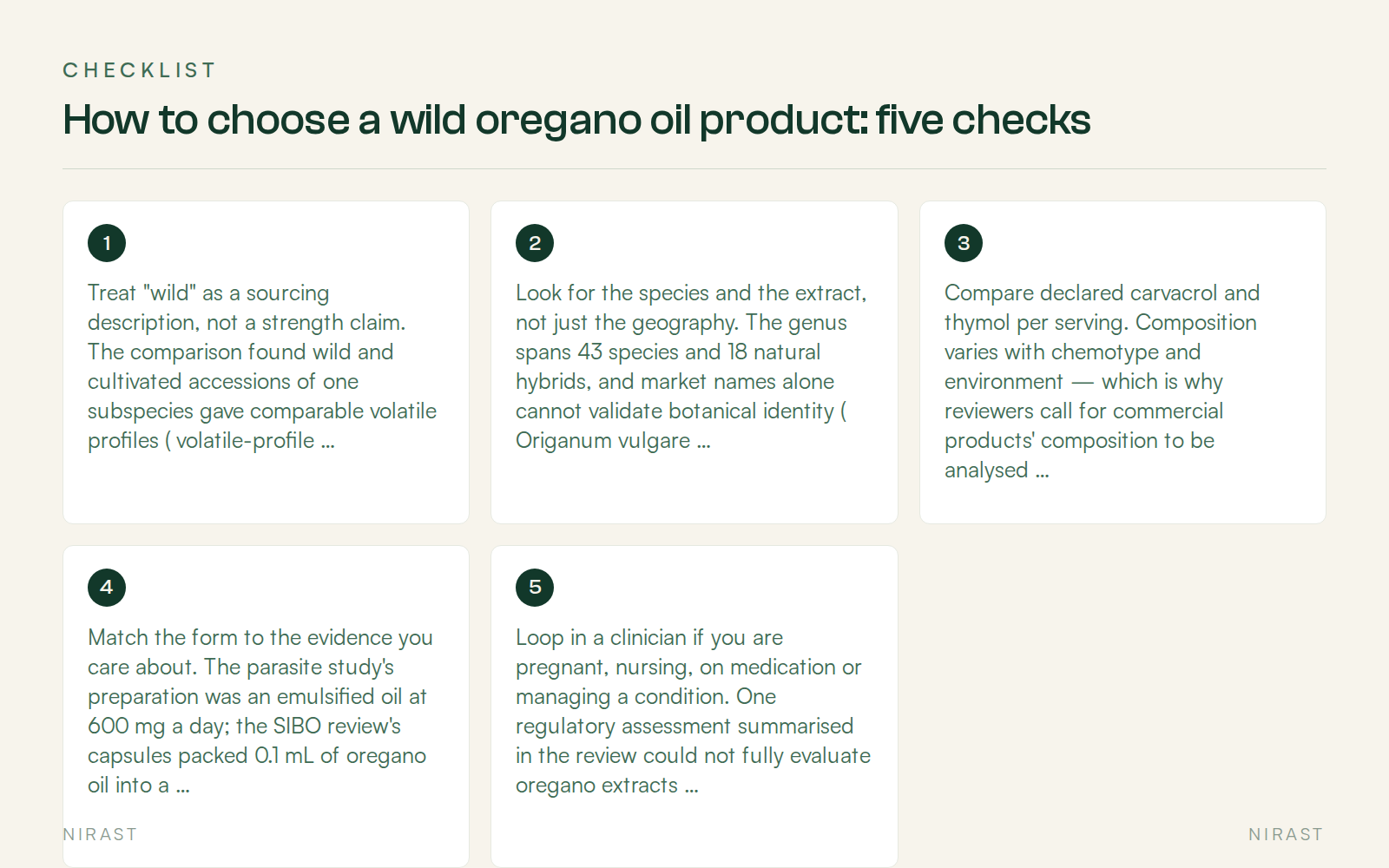
How to choose a wild oregano oil product: five checks
- Treat “wild” as a sourcing description, not a strength claim. The comparison found wild and cultivated accessions of one subspecies gave comparable volatile profiles (volatile-profile comparison, 2025).
- Look for the species and the extract, not just the geography. The genus spans 43 species and 18 natural hybrids, and market names alone cannot validate botanical identity (Origanum vulgare review, 2025; commercial-product profiling, 2026). A label that names its species and extract is checkable.
- Compare declared carvacrol and thymol per serving. Composition varies with chemotype and environment — which is why reviewers call for commercial products’ composition to be analysed (Origanum vulgare review, 2025). Per the FDA, a supplement’s serving is whatever maximum its label recommends for one eating occasion (FDA labeling guide) — compare products on that basis, not package size.
- Match the form to the evidence you care about. The parasite study’s preparation was an emulsified oil at 600 mg a day; the SIBO review’s capsules packed 0.1 mL of oregano oil into a multi-herb blend (Force et al., 2000; Chedid et al., 2014). Each amount was measured in its own preparation. For oregano itself, the PDR reference dosage cited in the 2025 trial is one cup of tea several times a day, or 0.5–1 dessertspoon of powdered oregano, taken 2–3 times a day with food (PDR, cited in the 2025 trial). Follow your product’s label, not a study dose.
- Loop in a clinician if you are pregnant, nursing, on medication or managing a condition. One regulatory assessment summarised in the review could not fully evaluate oregano extracts — imprecise characterisation and missing toxicity data got in the way (Origanum vulgare review, 2025) — and reviews caution that thymol and carvacrol may irritate the mucous membranes when exposure is prolonged (Lights and Shadows review, 2025).
What the evidence covers — and leaves open
Where the human record stands. The tally is short: one small uncontrolled parasite study, SIBO regimens that combined herbs, a single randomised trial of a vaginal tablet, and a dental gel awaiting confirmation. The rest is bench work: carvacrol and thymol keep inhibiting a wide range of bacteria, with membrane disruption as the proposed mechanism (Origanum vulgare review, 2025). On the wild question itself, the virens comparison found wild-collected and field-grown plants of the same accessions produced comparable volatile profiles (volatile-profile comparison, 2025).
Where the claims outrun the data. Nothing above supports a “wild means stronger” reading — the profiles matched and chemotype mattered more (volatile-profile comparison, 2025; Origanum vulgare review, 2025). The “natural antibiotic” idea leans on laboratory work — reviews explain why it does not carry over: poor solubility, limited bioavailability, degrading volatiles, scarce well-controlled trials (Lights and Shadows review, 2025). One survey of oregano and related herbs found 28 of its 34 experimental studies were laboratory-only (antiparasitic review, 2022); and the carvacrol overview says oral-disease studies have yet to be designed (carvacrol overview, 2025). And a “wild” label still proves nothing alone: “without authenticated plant material, the commercial designations cannot validate botanical identity” (commercial-product profiling, 2026).
Would these findings transfer to any bottle? No. A result belongs to the exact preparation that produced it — change the product, change the question.
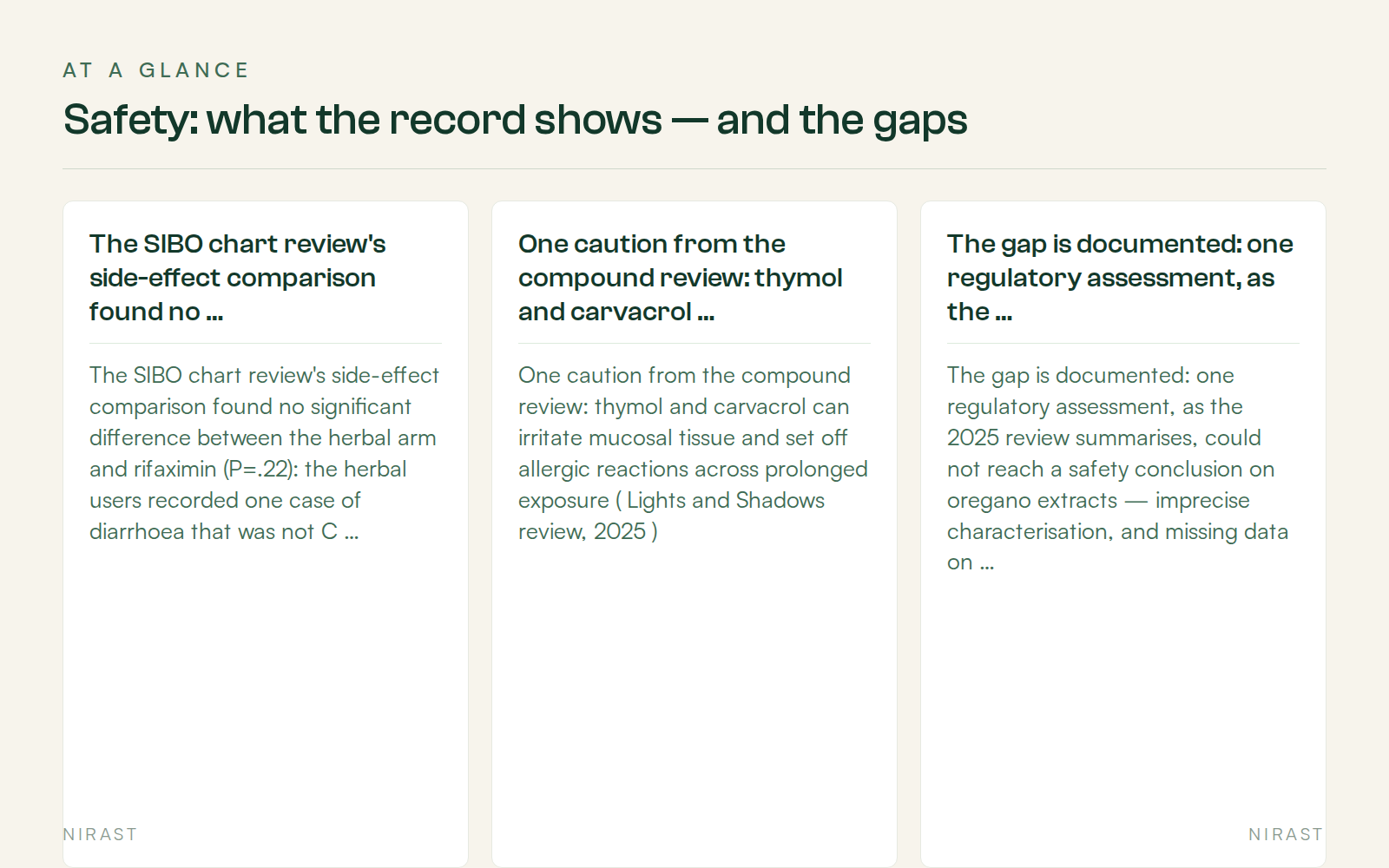
Safety: what the record shows — and the gaps
- The SIBO chart review’s side-effect comparison found no significant difference between the herbal arm and rifaximin (P=.22): the herbal users recorded one case of diarrhoea that was not C. difficile, while 67 rifaximin users logged six adverse events (Chedid et al., 2014).
- One caution from the compound review: thymol and carvacrol can irritate mucosal tissue and set off allergic reactions across prolonged exposure (Lights and Shadows review, 2025).
- The gap is documented: one regulatory assessment, as the 2025 review summarises, could not reach a safety conclusion on oregano extracts — imprecise characterisation, and missing data on genotoxicity, reproductive and developmental toxicity, and long-term toxicity (Origanum vulgare review, 2025). Treat that as a reason for care, not a verdict — and one more reason to involve a clinician if pregnant, nursing or on medication.
FAQ
What does “wild oregano” mean on a supplement label?
It describes sourcing: plant material from plants growing in natural settings rather than a cultivated field. The oregano herb is collected both from crops and from natural sites (Origanum vulgare review, 2025), so “wild” says where plants grew, not what is in the bottle.
Is wild oregano oil better than regular oregano oil?
Not in any way the research has measured. In the comparison of wild-collected and cultivated Origanum vulgare subsp. virens, the volatile profiles were comparable with few exceptions, while the wild plants yielded more oil (volatile-profile comparison, 2025). The differences that decide what is in the oil — chemotype and carvacrol content — track genetics and environment, not the label (Origanum vulgare review, 2025).
Is wild oregano a different plant from regular oregano?
“Wild” can point to several things. Origanum vulgare itself is also called wild marjoram, and the genus includes 43 species and 18 natural hybrids sold under oregano names (Origanum vulgare review, 2025). Origanum minutiflorum, sold as “mountain thyme”, is an endemic species of southwestern Türkiye (GC-MS analysis, 2026). Without a named species and an authenticated test, a market label cannot validate which plant is in the bottle (commercial-product profiling, 2026).
Does wild oregano oil contain carvacrol?
It can — but nothing about the word “wild” fixes a carvacrol figure. Carvacrol counts among oregano oil’s headline compounds, and its share swings widely: one review documents a Macedonian oil whose thymol was a trace and whose carvacrol was absent entirely (Origanum vulgare review, 2025), while the SIBO chart review’s capsules stated 55% to 75% carvacrol (Chedid et al., 2014). Check the amount declared per serving on your bottle.
Can wild oregano oil fight infections?
The “wild” label does not change the split: laboratory versus people. Oregano oil’s compounds inhibit a wide range of bacteria in laboratory dishes (Origanum vulgare review, 2025), but the human records closest to treating an infection are multi-herb regimens taken with medical oversight (Chedid et al., 2014; open-label pilot, 2024). Reviewers trace the gap to limited bioavailability and scarce large trials (Lights and Shadows review, 2025). An infection is a clinician’s call, not a self-treatment.
Is wild oregano oil safe to take every day?
Wild oregano oil’s daily-use evidence is as narrow as any other’s. On one side, the SIBO chart review found the herbal arm’s side effects indistinguishable from the antibiotic’s (Chedid et al., 2014). On the other, safety questions remain: prolonged exposure to thymol and carvacrol may irritate mucous membranes (Lights and Shadows review, 2025), while a regulatory assessment summarised in that review could not reach a safety conclusion on oregano extracts for lack of toxicity data (Origanum vulgare review, 2025). That call is for you and a clinician — particularly in pregnancy or nursing, or on medication.
If a softgel fits your routine: Nirast Oil Of Oregano Softgels
If you want an oregano product that names its species and states its numbers, here is what the Nirast label states: Nirast Oil Of Oregano Softgels is a softgel supplement whose per-2-softgel serving provides oregano oil concentrated from Origanum minutiflorum leaf — 300 mg of a 20:1 fresh oil extract, delivering the equivalent of 6,000 mg — with naturally occurring carvacrol at 165 mg and 200 mg of black seed oil (Nirast Oil Of Oregano Softgels). The offer is a monthly subscription: one pouch at $29.99, delivered every month, with refills shipping every 30 days; cancel by emailing support@nirast.co at least 24 hours before the next scheduled renewal. Orders carry a 30-Day Money-Back Guarantee.
You can see Nirast Oil Of Oregano Softgels here. For the ingredient itself — forms, evidence and safety — see the Oil of Oregano guide.
These statements have not been evaluated by the Food and Drug Administration. This product is not intended to diagnose, treat, cure, or prevent any disease. Talk to your doctor or pharmacist before starting a supplement, especially if you are pregnant, nursing, take medication or have a medical condition.
Related reading
- Oregano Oil: What It Is, What the Evidence Covers, and How to Choose a Form
- Oregano Oil Benefits: What Human Studies Actually Show
- Oregano Oil Capsules Benefits: What the Evidence Actually Shows
- Oil of Oregano: What It Is, What the Evidence Shows, and How to Choose
Related product: Oil of Oregano Softgels.