
Probiotics for Weight Loss: What the Evidence Shows — and What It Can’t Do

Probiotics for Weight Loss: What the Evidence Shows — and What It Can’t Do
Probiotic supplements have produced small average changes in weight across pooled trials — roughly 0.5 to 1.2 kg versus control — and results vary by strain, with some strains showing no significant weight effect at all. The evidence supports a modest adjunct role alongside diet and exercise, not a weight-loss treatment on its own.
Nirast makes Nirast Metabolism + Probiotic. This article was written by Nirast’s editorial team and reports what the published research does and does not show.
See Nirast Metabolism + Probiotic → · 30-Day Money-Back Guarantee
Published by Thang Phi, founder of Nirast and publisher of the Nirast Journal.
This page is the trial record, not the promise: what the studies measured, what they found, and how to judge a product.
What the pooled trials actually show
Two recent meta-analyses anchor the evidence. The first pooled 12 randomized trials in 931 adults with obesity: body weight fell about 0.52 kg, BMI 0.22 points, waist 0.29 cm and body fat percentage 0.59 versus control, with no significant change in cholesterol or triglycerides (Frontiers in Public Health, 2026). The second — 12 trials, 1,058 adults, Lactobacillus strains only — found BMI down 0.40, body weight down 1.16 kg, waist down 1.41 cm and hip down 0.85 cm, with high-quality GRADE ratings for body fat area and weight (Narra J, 2025). Both are small group averages, not personal outcomes.
The picture mixes as you widen the lens: a 10-study review of 633 participants found significant pooled effects for BMI and fat mass but not body weight or lean body mass — and excluding one trial moved the pooled body-weight estimate toward zero (Physical Activity and Nutrition, 2026). A 2024 review found few human randomized trials and mixed results by strain, population and duration (Obesity Science & Practice, 2024); a 2026 metabolic-syndrome synthesis calls the clinical evidence controversial and inconsistent (Frontiers in Nutrition, 2026).
The trials disagree from strain to strain
Effects are strain-specific — even different strains within one genus can act differently — so recommendations stay tied to the strain and product studied (Frontiers in Nutrition, 2026). What they were tested for:
| Trial | Who took part | What they took | What the weight measures showed |
|---|---|---|---|
| L. gasseri SBT2055 (2010) | 87 adults, BMI 24.2–30.7 | Fermented milk, 200 g/day, 12 weeks | Visceral fat −5.8 cm²; weight −1.1 kg; waist −1.7 cm |
| L. rhamnosus CGMCC1.3724 (2014) | Obese adults, 24 weeks | 2 capsules/day (1.6 × 10⁸ CFU each) plus energy restriction | Overall loss not different from placebo; women lost more |
| L. gasseri BNR17 (2026 review) | Obese adults, 12 weeks | 10⁹ CFU/day | Placebo BMI +0.15; probiotic BMI −0.05 |
| B. lactis 420 (2024 review) | Adults, BMI 28–34.8, 24 weeks | 10¹⁰ CFU/day | Fat mass lower; waist −2.4 cm; weight not significant |
| L. sakei CJLS03 (2024 review) | Adults, BMI over 25, 12 weeks | 5 × 10⁹ CFU/day | Fat mass −0.2 kg vs +0.6 kg placebo (p = 0.018) |
| Weissella confusa WIKIM51 (2026) | 61 overweight adults, 12 weeks | One strain; lifestyle guidance both arms | Weight −3.38 kg vs +1.14 kg placebo |
| Pasteurized A. muciniphila MucT (2026) | Metabolic syndrome, 16 weeks | Pasteurized strain | No effect overall; weight fell more only with low baseline Akkermansia |
| Multi-strain drink (2026) | 32 combat athletes, 4-week weight cut | 200 g/day drink vs placebo | Body fat percentage fell significantly more (P = 0.022) |
Two rows deserve context: the SBT2055 trial used fermented milk at 200 g/day, not a capsule (Eur J Clin Nutr, 2010), and the CGMCC1.3724 trial’s significant result was a sex interaction — women on the probiotic lost more and kept it off during maintenance (Br J Nutr, 2014).
How gut bacteria are thought to influence weight
Gut-weight mechanisms are plausible but unproven in humans. Obesity-associated dysbiosis involves altered energy harvesting, impaired short-chain fatty acid (SCFA) production and more pro-inflammatory bacterial components, and reviews frame it as disrupted microbial function rather than particular bacteria (Frontiers in Physiology, 2026; Current Opinion in Clinical Nutrition and Metabolic Care, 2026). The proposed pathways run through energy extraction, SCFAs, gut barrier integrity and gut-brain appetite signaling — SCFAs stimulate gut hormones such as GLP-1, PYY and gastrin (Food Science & Nutrition, 2026; JISSN, 2026). In animals, transfer experiments showed dysbiotic communities can drive weight gain independent of host genetics; in humans, the evidence remains largely correlational, and the proposed mechanisms are hypotheses rather than conclusions (Frontiers in Physiology, 2026; Physical Activity and Nutrition, 2026).
What the evidence does not show
No fat-melting effect. Nothing here describes probiotics dissolving or burning fat; the pooled changes are small and outcome-specific, and one meta-analysis states they are not universally helpful across obesity-related parameters (Frontiers in Public Health, 2026).
No guarantee of a result — for anyone’s product. Non-prescribed weight-loss supplements as a category have inconclusive evidence on actual weight loss, and some jurisdictions bar sellers from guaranteeing outcomes like accelerated weight loss within a timeframe (Health Policy OPEN, 2025).
No replacement for diet and exercise. The syntheses frame probiotics as an adjunct to obesity management, and several trials ran alongside dietary restriction, exercise or lifestyle guidance — masking how much the probiotic itself contributed (Narra J, 2025; Physical Activity and Nutrition, 2026).
No clean study base. Many probiotic trials carry high or unclear risk of bias from poor reporting, limiting how confidently any strain can be recommended (Advances in Nutrition, 2026).
How to read a probiotic label for a weight experiment
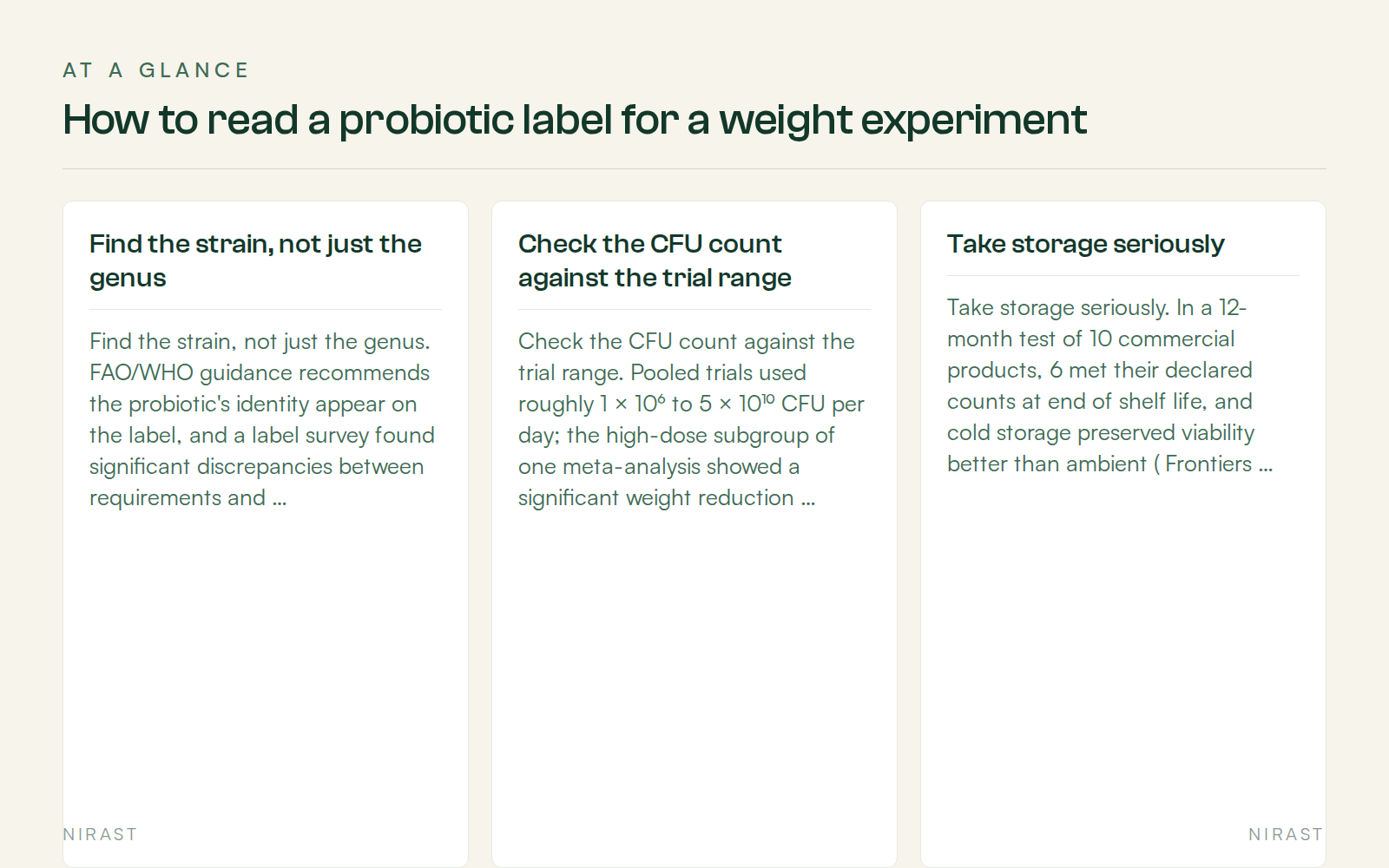
- Find the strain, not just the genus. FAO/WHO guidance recommends the probiotic’s identity appear on the label, and a label survey found significant discrepancies between requirements and actual labels (PLoS ONE, 2025).
- Check the CFU count against the trial range. Pooled trials used roughly 1 × 10⁶ to 5 × 10¹⁰ CFU per day; the high-dose subgroup of one meta-analysis showed a significant weight reduction while the low-dose subgroup did not (Narra J, 2025; Frontiers in Public Health, 2026).
- Take storage seriously. In a 12-month test of 10 commercial products, 6 met their declared counts at end of shelf life, and cold storage preserved viability better than ambient (Frontiers in Nutrition, 2026).
If bloating is part of why you are looking, our explainer on why bloating can happen even with a balanced diet covers it.
Five decisions to make before you buy
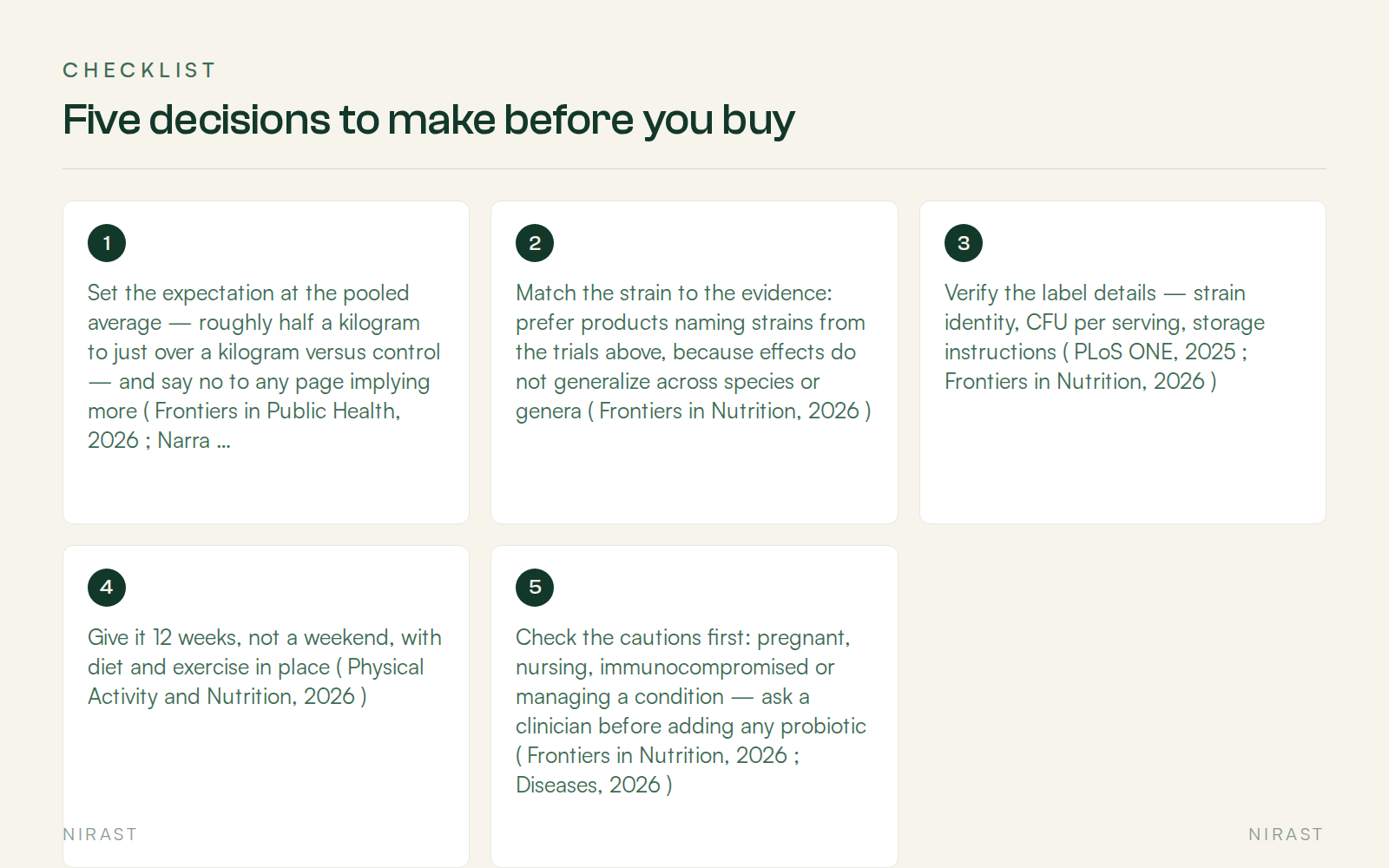
- Set the expectation at the pooled average — roughly half a kilogram to just over a kilogram versus control — and say no to any page implying more (Frontiers in Public Health, 2026; Narra J, 2025).
- Match the strain to the evidence: prefer products naming strains from the trials above, because effects do not generalize across species or genera (Frontiers in Nutrition, 2026).
- Verify the label details — strain identity, CFU per serving, storage instructions (PLoS ONE, 2025; Frontiers in Nutrition, 2026).
- Give it 12 weeks, not a weekend, with diet and exercise in place (Physical Activity and Nutrition, 2026).
- Check the cautions first: pregnant, nursing, immunocompromised or managing a condition — ask a clinician before adding any probiotic (Frontiers in Nutrition, 2026; Diseases, 2026).
Safety: what’s known and who should ask a clinician first
In the weight-focused trials, tolerability was good: Lactobacillus supplementation was well tolerated in adults with non-comorbid obesity (Narra J, 2025). The wider literature is more measured: reviews describe a favorable profile overall but insufficient evidence on rare adverse events and long-term use, and documented fungemia cases with a yeast probiotic occurred predominantly in critically ill patients and other vulnerable groups (Diseases, 2026). For at-risk groups, long-term data remain insufficient for individualized recommendations (Frontiers in Nutrition, 2026).
FAQ
Do probiotics actually help you lose weight?
The average pooled effect is small — roughly 0.5 to 1.2 kg versus control — and not universally significant across all outcomes, though both meta-analyses found significant average weight reductions (Frontiers in Public Health, 2026; Narra J, 2025). Treat them as an adjunct, not a weight-loss method.
How long does it take for probiotics to help with weight?
The pooled data first showed a significant weight reduction at 12 weeks, not 6 or 8; one review suggests at least 8–12 weeks for the more favorable outcomes (Narra J, 2025; Physical Activity and Nutrition, 2026). A trial window, not a promised deadline.
Which probiotic strains have been studied for weight?
Named human-trial strains include L. gasseri SBT2055 and BNR17, L. rhamnosus CGMCC1.3724, B. lactis 420, L. sakei CJLS03 and Weissella confusa WIKIM51 — results range from clear group-average reductions to no significant weight change (Eur J Clin Nutr, 2010; Br J Nutr, 2014). A genus name is not enough.
Do probiotics work without diet and exercise?
The trials do not support expecting much that way: several layered the probiotic on dietary restriction, lifestyle guidance or exercise, and the syntheses frame it as an adjunct, not a replacement (Physical Activity and Nutrition, 2026; Narra J, 2025). Comparing other records, we read black seed oil for weight loss the same evidence-first way.
Are probiotics safe to take every day?
For generally healthy adults, the studied strains have a good tolerability record in the weight trials (Narra J, 2025). Reviews caution that rare adverse events and long-term use are not fully characterized, and at-risk groups need medical guidance (Diseases, 2026; Frontiers in Nutrition, 2026).
Do probiotics for weight loss work differently for women and men?
At least one trial found a sex difference: in the L. rhamnosus CGMCC1.3724 study, women on the probiotic lost significantly more than placebo women, while men showed no difference (Br J Nutr, 2014). It was one trial’s secondary finding — watch for more data rather than expecting a different outcome.
A daily capsule option: Nirast Metabolism + Probiotic
If a trial-length run seems worth attempting, the question is format: getting named strains into a daily habit you will keep.
Nirast Metabolism + Probiotic is a 4-in-1 daily capsule — a 30-vegan-capsule bottle — with three named probiotic strains on its panel: Bifidobacterium lactis (B.lactis Fit™), Lactobacillus gasseri and Akkermansia muciniphila. The formula also includes green coffee bean extract, chromium picolinate (600 mcg) and 100 mg of caffeine per capsule — about a cup of coffee’s worth, so take it earlier in the day. Its green coffee component’s pooled literature is small and heavily heterogeneous (Gastroenterology Research and Practice, 2011).
Two honest notes: a capsule is the adjunct the research describes — diet and exercise still do the main work — and the label says not to use it if pregnant or nursing, and to consult a physician first if you have a medical condition or take medications.
The offer is a subscription with three tiers — $26.99 for 1 bottle, $49.98 for 2, $72.00 for 3 — with free shipping worldwide and a 30-day money-back guarantee; cancel by emailing support@nirast.co at least 24 hours before the next renewal.
For a fair, trial-length run with named strains, here is the format built for it: See Nirast Metabolism + Probiotic.
These statements have not been evaluated by the Food and Drug Administration. This product is not intended to diagnose, treat, cure, or prevent any disease. Talk to your doctor or pharmacist before starting a supplement, especially if you are pregnant, nursing, take medication or have a medical condition.
Related reading
- Best Probiotics for Weight Loss: How to Judge a Probiotic for Gut and Weight Goals
- Amla Capsules: What the Evidence Shows
- Pheromone Cologne: What It Is, What the Evidence Shows, and How to Choose
- Do Libido Gummies Work? What the Evidence Actually Shows
Related product: Nirast Metabolism + Probiotic.