
Best Probiotics for Weight Loss: How to Judge a Probiotic for Gut and Weight Goals

No single probiotic wins at weight loss. What separates products is checkable: named strains with human weight-related trial data, a CFU number with a stated basis, delivery and storage that protect viability, and a label that declares its contents. Judge products by those checks — and expect modest average effects, not a treatment.
Nirast makes Nirast Metabolism + Probiotic. This article was written by Nirast’s editorial team and reports what the published research does and does not show.
See Nirast Metabolism + Probiotic → · 30-Day Money-Back Guarantee
Published by Thang Phi, founder of Nirast and publisher of the Nirast Journal.
That is the short version, and the honest one: the evidence compares strains, doses and populations against placebo, not finished products against each other, so a defensible page cannot rank brands for you. What it can do is hand you the checks that separate one probiotic from another — and the studies behind them.
What the trials actually show
Pooled randomized evidence in adults with overweight or obesity points one way. A 2026 meta-analysis of 12 trials (931 participants) found significant improvements in body weight, BMI, waist circumference and body fat percentage — with no effect on total cholesterol or triglycerides, making the benefit outcome-specific rather than uniform (PMID 41938967). A second meta-analysis, of 12 Lactobacillus trials (1,058 participants), reported average reductions of 0.40 kg/m² in BMI, 1.16 kg in body weight and 1.41 cm in waist circumference (PMID 40951500).
Read the size of those numbers before the direction: they are group averages from small, mostly single-centre trials, and the review rates its own certainty of evidence as moderate (PMID 41938967). A third pooled analysis (10 trials, 633 participants) found significant effects on BMI and fat measures but not body weight or lean mass, with much of the signal tracing to one trial (PMID 42438848).
One structural fact matters for judging any product: the effects appear strain-specific. Different strains act through different mechanisms, and pooling heterogeneous strains attenuates strain-level effects and inflates between-study variance — which is why the pooled weight and BMI analyses carried high heterogeneity (I² of 84% and 87%) (PMID 42438848). Tolerability looked favourable: one meta-analysis reported no adverse events (PMID 41938967), another only mild, single-case effects with no serious reactions (PMID 40951500).
Why no single product wins on evidence alone
There is no head-to-head evidence base comparing finished probiotics for weight outcomes; the trials compare specific strains, doses and populations against placebo. That is why this page does not rank brands — it sets out the facts a product can be held to.
The gap between claims and evidence is measurable: an appraisal of product claims found the supporting evidence variable, with significant results not universal across the products examined (PMID 39828955); reviews likewise conclude that efficacy and safety depend on the strain, indication and person (PMID 42783209).
Which strains have human weight-related data
Strain names are not interchangeable, and the human evidence behind them is uneven. Three examples show what having evidence looks like.
Lactobacillus gasseri BNR17. In a 12-week, double-blind, placebo-controlled trial reported in a 2026 review, participants took 10⁹ CFU a day; placebo-group BMI rose slightly (+0.15 kg/m²) while the probiotic group’s did not (−0.05 kg/m²) (PMID 42438848). That meta-analysis recorded only mild effects — single cases of diarrhoea and nausea — and no serious adverse reactions (PMID 40951500).
Akkermansia muciniphila MucT. A 2026 randomized, double-blind, placebo-controlled trial of the pasteurized strain found no overall difference in body weight or waist versus placebo; benefits concentrated in participants with low baseline Akkermansia levels, and it was well tolerated (PMID 42343233). Its primary outcome, insulin sensitivity, did not differ — a reminder that a strain can have human data without a weight result.
Bifidobacterium animalis subsp. lactis 420. For this strain, the recent weight-related data is animal: in high-fat-diet mice, B420 reduced body-weight gain by 11.6% versus the diet control (PMID 42075007). Mouse data is not human outcome data, and a strain name on a label does not change that.
The takeaway: for each strain, ask what human weight-related trial exists, at what dose and duration, and in whom. Subgroup analyses point the same way — one meta-analysis found a larger reduction in its single-strain subgroup (SMD −0.90) than its multi-strain subgroup (SMD −0.27), a signal treated cautiously, not a rule (PMID 41938967).
CFU reality: what the number on the label does and doesn’t tell you
On a supplement label, the serving is the unit the numbers attach to: one serving equals the maximum amount the label recommends per eating occasion, or one unit — a capsule — absent a recommendation (FDA labeling guide). Before comparing CFU counts, check whether the number is per capsule or per serving; the two are not the same thing.
Then treat the CFU number as a claim to verify. Quality surveys repeatedly find lower-than-declared viable counts: in one 2026 evaluation, counts were significantly lower than declared in the majority of tested products (PMID 41596971), and a genomic survey of 13 products found 5 failing their labelled CFU claims, citing global assessments reporting discrepancies in over 40% of commercial probiotics (PMID 42145944).
Counts can also fall over time. In 12-month testing of 10 products, 9 of 10 met declared counts at purchase, but only 3 of 10 still did at ambient storage by end of shelf life — 6 of 10 under refrigeration, 6 of 10 frozen (PMID 42824401). Two failed under every condition; the study concludes that strain selection, excipients, encapsulation and storage work as one system (PMID 42824401).
Delivery claims, held to a source
“Survives stomach acid” sounds like a binary property; the measured reality is a gradient. In a standardized simulated-digestion study of eight commercial products — all label-matching beforehand — viability fell on average by 1.6 log10 CFU with water, 2.5 log10 with juice and 1.2 log10 with porridge (PMID 39410170). None of the capsules in that set resisted gastric juice, and consumption instructions influenced survival (PMID 39410170).
Delivery is a question you can ask of any product: what format is it, what does the label say about storage, and does any published measurement back the delivery story? Where no measurement exists, that part of the story is unmeasured — and the storage study shows why it matters (PMID 42824401).
The five checks, side by side
Five checks do the heavy lifting when comparing probiotics for weight and gut goals; each is visible on a label or checkable in the literature.
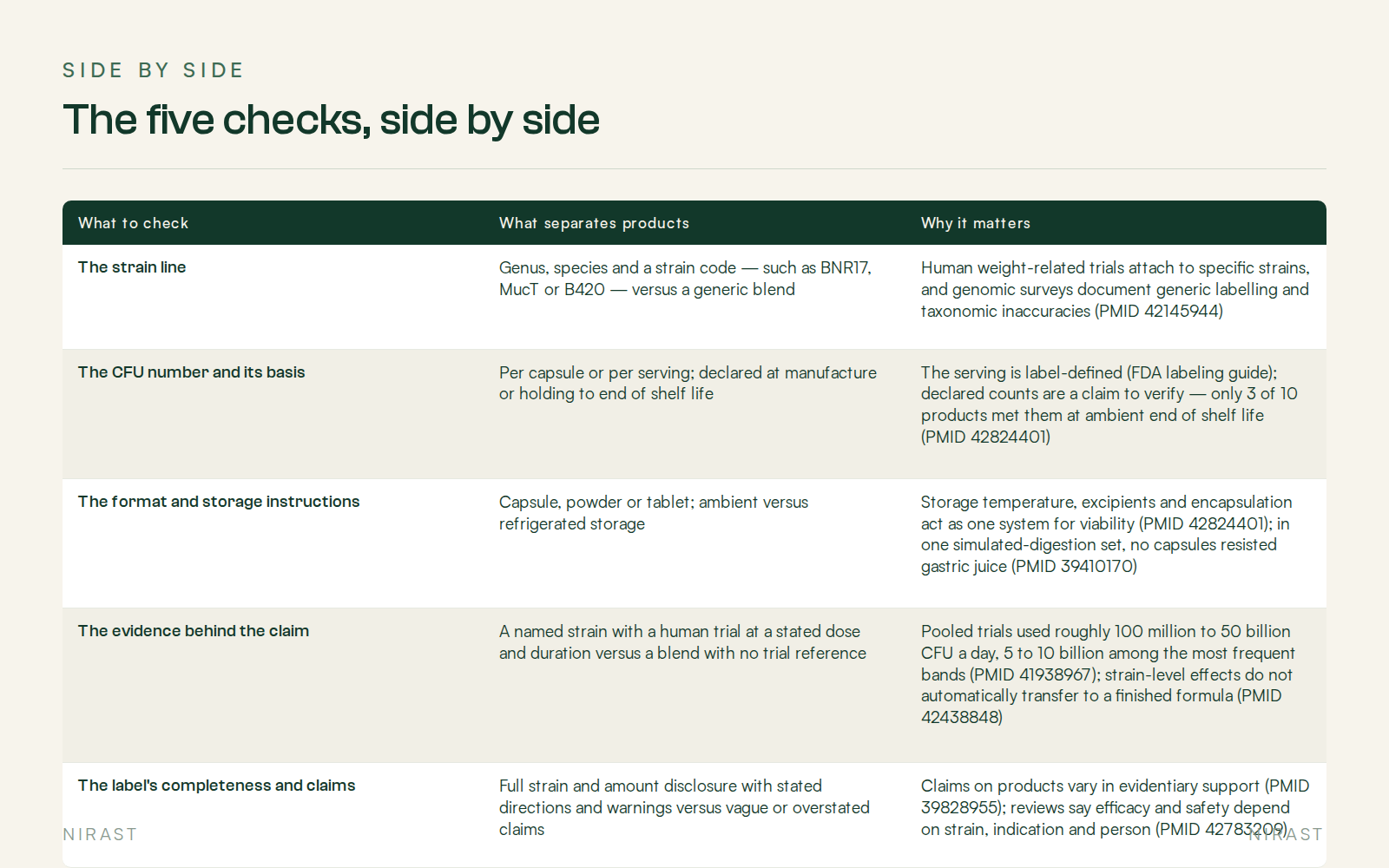
| What to check | What separates products | Why it matters |
|---|---|---|
| The strain line | Genus, species and a strain code — such as BNR17, MucT or B420 — versus a generic blend | Human weight-related trials attach to specific strains, and genomic surveys document generic labelling and taxonomic inaccuracies (PMID 42145944) |
| The CFU number and its basis | Per capsule or per serving; declared at manufacture or holding to end of shelf life | The serving is label-defined (FDA labeling guide); declared counts are a claim to verify — only 3 of 10 products met them at ambient end of shelf life (PMID 42824401) |
| The format and storage instructions | Capsule, powder or tablet; ambient versus refrigerated storage | Storage temperature, excipients and encapsulation act as one system for viability (PMID 42824401); in one simulated-digestion set, no capsules resisted gastric juice (PMID 39410170) |
| The evidence behind the claim | A named strain with a human trial at a stated dose and duration versus a blend with no trial reference | Pooled trials used roughly 100 million to 50 billion CFU a day, 5 to 10 billion among the most frequent bands (PMID 41938967); strain-level effects do not automatically transfer to a finished formula (PMID 42438848) |
| The label’s completeness and claims | Full strain and amount disclosure with stated directions and warnings versus vague or overstated claims | Claims on products vary in evidentiary support (PMID 39828955); reviews say efficacy and safety depend on strain, indication and person (PMID 42783209) |
A five-step comparison routine
Five steps, in the order that does the most work:
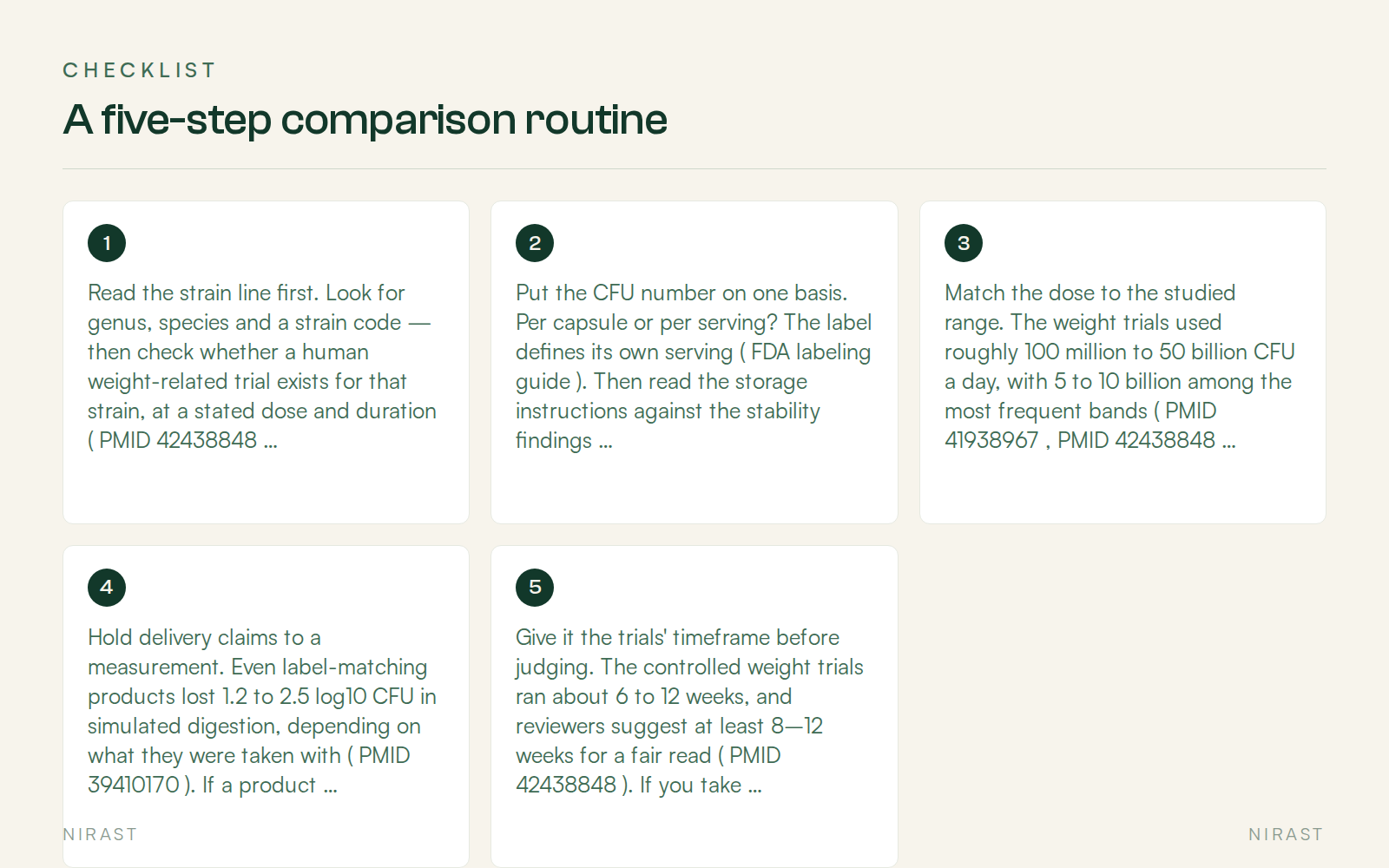
- Read the strain line first. Look for genus, species and a strain code — then check whether a human weight-related trial exists for that strain, at a stated dose and duration (PMID 42438848). A blend without strain codes cannot be checked this way.
- Put the CFU number on one basis. Per capsule or per serving? The label defines its own serving (FDA labeling guide). Then read the storage instructions against the stability findings: refrigeration preserved declared counts better than ambient storage in 12-month testing (PMID 42824401).
- Match the dose to the studied range. The weight trials used roughly 100 million to 50 billion CFU a day, with 5 to 10 billion among the most frequent bands (PMID 41938967, PMID 42438848). A number outside that range is not automatically better or worse — it is simply outside the studied range.
- Hold delivery claims to a measurement. Even label-matching products lost 1.2 to 2.5 log10 CFU in simulated digestion, depending on what they were taken with (PMID 39410170). If a product claims gastric survival, look for a measurement or stated mechanism, and follow the label’s timing guidance.
- Give it the trials’ timeframe before judging. The controlled weight trials ran about 6 to 12 weeks, and reviewers suggest at least 8–12 weeks for a fair read (PMID 42438848). If you take medication, are pregnant or nursing, or manage a health condition, clear any probiotic with a clinician first (PMID 42783209).
What the evidence does not show
What the evidence does not show matters as much as what it does.
It does not show that any probiotic product is a weight-loss treatment. The pooled effects are modest group averages from small, mostly single-centre trials in East Asian populations eating fermented foods — and the authors say generalizability should be interpreted with caution (PMID 41938967).
It does not show that strain-level findings transfer automatically to every product carrying a strain name: trials test specific strains at specific doses, and a finished formula is a different object.
It does not show that a higher CFU number is better: the trials used a wide range, about 100 million to 50 billion CFU a day (PMID 41938967, PMID 40951500), and the number alone says nothing about strain identity, storage or delivery (PMID 42824401, PMID 42145944).
And it does not show that probiotics are risk-free in all circumstances: they are generally well tolerated — safety was rarely a primary endpoint, and reporting varies (PMID 42783209) — while immunocompromised people are the principal risk group for probiotic-associated infections (PMID 42783209).
Two phrases are worth holding loosely. “Fat-burning probiotic” compresses small pooled averages into a promise the trials do not support. “Clinically studied strain” is true for some strains and unverifiable for others (PMID 39828955) — so ask for the strain, dose, duration and outcome.
FAQ
Do probiotics actually help with weight loss?
On average, modestly, in trials. Pooled randomized evidence in adults with overweight or obesity shows small average improvements in body weight, BMI, waist circumference and body fat percentage (PMID 41938967, PMID 40951500). These are group averages from small trials, not a weight-loss treatment; treat any product as an addition to diet and exercise, and check with a clinician if you have a medical condition.
Which probiotic strains have human weight-related evidence?
Several do, including Lactobacillus gasseri BNR17 (a 12-week trial at 10⁹ CFU a day) (PMID 42438848), and Akkermansia muciniphila MucT, whose controlled trial found benefits concentrated in people with low baseline levels (PMID 42343233). For some strains, including B. lactis 420, the recent weight data is animal (PMID 42075007). The check is the same for every strain: a named strain, a human trial, a stated dose and duration.
How many CFU should a weight-loss probiotic have?
There is no single right number; the trials used a wide range — roughly 100 million to 50 billion CFU a day, with 5 to 10 billion among the most frequent bands (PMID 41938967, PMID 42438848). What matters more is the basis — per capsule or per serving (FDA labeling guide) — and whether the count holds to end of shelf life (PMID 42824401). A big number is not, on its own, evidence of a better product: it says nothing about which strain you are getting (PMID 42145944).
Does a probiotic need to survive stomach acid to work?
Survival matters — a strain that does not reach the gut intact cannot act there — but “survives stomach acid” is not a binary label fact. In simulated digestion, eight label-matching products lost 1.2 to 2.5 log10 CFU on average depending on what they were taken with, and none of the capsules in that set resisted gastric juice (PMID 39410170). Ask for a measurement, and follow the label’s timing and storage instructions, which influenced survival in the same study (PMID 39410170).
How long should I take a probiotic before judging it?
Weeks, not days. The controlled weight trials ran about 6 to 12 weeks, and reviewers suggest at least 8–12 weeks before an effect can be fairly judged (PMID 42438848, PMID 41938967). The trial endpoints were instrumented and clinical, so give any product a comparable window — and keep the daily routine the label describes.
What does “clinically studied” mean on a probiotic label?
It means a study exists somewhere — not that the product itself was studied. Claims on probiotic products vary in evidentiary support, and significant results were not universal across the products examined in one appraisal (PMID 39828955). The useful version names the strain, dose, duration and outcome — as with L. gasseri BNR17 at 10⁹ CFU a day for 12 weeks (PMID 42438848).
If the checks point to a gut-and-metabolism formula: Nirast Metabolism + Probiotic
Nirast Metabolism + Probiotic is a capsule formula in the gut-and-weight territory this page has been evaluating, with label facts you can line up against the five checks. The page states it contains 3 unique probiotic strains, plus green coffee bean extract, chromium picolinate and 100 mg of caffeine per capsule — about a cup of coffee (product page). The bottle holds 30 vegan capsules with gluten-free, non-GMO and vegan badges; the Supplement Facts panel uses a 1-capsule serving (30 per container), declaring chromium 600 mcg, vitamin B12 1.2 mcg and a 468 mg blend listing green coffee bean extract, L-theanine and the three strains. Timing guidance: morning or during the day, which fits the caffeine. The page advises against use if pregnant or nursing, with a physician consult for medical conditions or medication (product page).
On the offer: it is a subscription, with tiers displayed at $26.99 (1 bottle), $49.98 (2 bottles) and $72.00 (3 bottles), each with its own delivery cadence. Every delivered order is covered by a 30-Day Money-Back Guarantee — refunds via support@nirast.co within 30 calendar days after delivery, returns neither required nor accepted; cancellation via support at least 24 hours before renewal (product page).
What the product offers is a stated, checkable label — a 3-strain formula with its ingredients and amounts declared.
If the five checks point you to a 3-strain capsule with a stated label, here it is: See Nirast Metabolism + Probiotic here.
These statements have not been evaluated by the Food and Drug Administration. This product is not intended to diagnose, treat, cure, or prevent any disease. Talk to your doctor or pharmacist before starting a supplement, especially if you are pregnant, nursing, take medication or have a medical condition.
Related reading
- Probiotics for Weight Loss: What the Evidence Shows — and What It Can't Do
- Can You Eat Normally During a Cleanse?
- What Can Cause Fatigue and Brain Fog?
- Does a "Digestion Support" Label Line Mean It Helps IBS?
Related product: Nirast Metabolism + Probiotic.