
Black Seed Oil and a Seed, Nut or Sesame Allergy: What to Check Before You Start
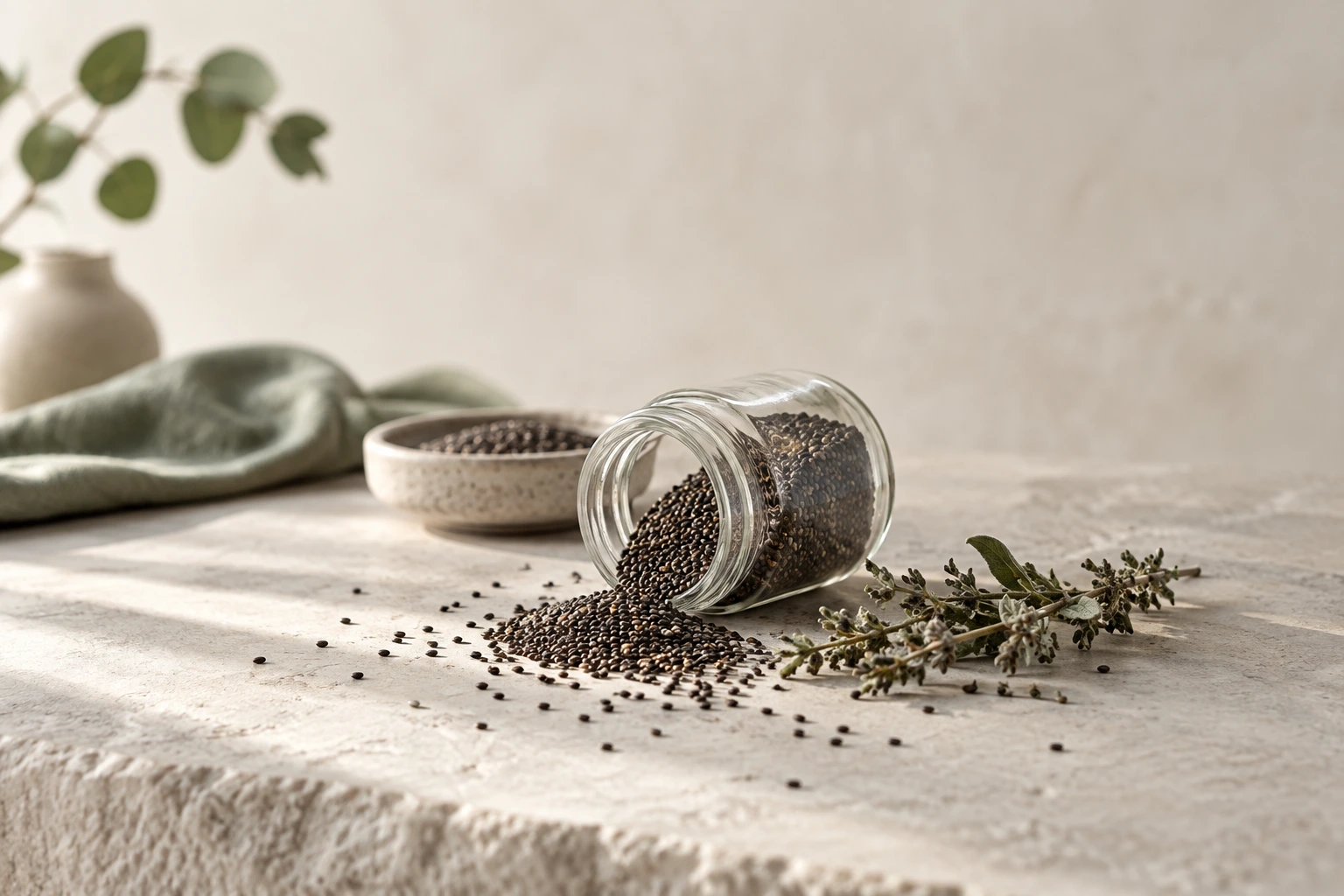
Allergy risk attaches to the specific plant and the person, not to the word “seed”: the oil in a black seed product is pressed from Nigella sativa, which is neither sesame nor a tree nut. Because reactions to Nigella sativa have been reported, a reader with a known food allergy cannot settle the question from the front of the pack — get the full ingredient list from the seller and raise it with your own clinician before starting.
Nirast makes Ethiopian Black Seed Oil. This article was written by Nirast’s editorial team and reports what the published research does and does not show.
See Nirast Ethiopian Black Seed Oil → · $29.99 a month · 30-Day Money-Back Guarantee
Published by Thang Phi, founder of Nirast and publisher of the Nirast Journal.
If you carry a diagnosed seed, nut or sesame allergy, the label word “seed” is the last thing to reason from. Allergies follow botanical relationships and individual proteins, not everyday category words — which is exactly what makes this question answerable, by checking the plant the oil actually comes from and then confirming the details with the seller and your own clinician.
The word “seed” is not a plant
Allergy risk is assigned to real botanical relationships, not to colloquial categories. Spices are “classified based on botanical analogies and taxonomic families”, and the most allergenic spices in children cluster within particular plant families (cumin anaphylaxis and spice allergy, https://pubmed.ncbi.nlm.nih.gov/42519315/). Two foods can both be called a “seed” and belong to entirely unrelated plants, while two foods that share no everyday name can sit in the same family and cross-react. The category word tells you nothing about the protein.
So the first useful step is to name the actual plant. Black seed oil is pressed from Nigella sativa, an annual flowering plant in the Ranunculaceae family — the buttercup family, not the sesame family and not any tree-nut family (narrative review of Nigella sativa extraction and composition, https://pubmed.ncbi.nlm.nih.gov/36140949/).
Nigella sativa is not sesame and not a tree nut
That identity speaks directly to your question. Nigella sativa sits in a plant family distinct from the families that carry sesame and tree-nut allergens, and because an allergy is driven by these botanical relationships and individual proteins rather than a shared English noun, a sesame or tree-nut allergy does not automatically carry over to Nigella sativa (https://pubmed.ncbi.nlm.nih.gov/36140949/).
That is a reason for a diagnosis-specific check, not a green light. “Not automatically the same plant” is not the same statement as “safe for you,” and the difference is what makes the next step necessary.
Reactions to Nigella sativa have been reported
A plant that is neither sesame nor a nut can still provoke a reaction in a particular person, and Nigella sativa is no exception. The Drugs and Lactation Database (LactMed) records that “black seed oil can cause allergic contact dermatitis” (LactMed, black seed monograph, https://pubmed.ncbi.nlm.nih.gov/30000936/). A case series described eight patients with severe skin reactions after topical application of Nigella sativa oil, and stressed the value of patch testing and a careful exposure history for herbal remedies (case report and analysis of cutaneous reactions, https://pubmed.ncbi.nlm.nih.gov/39759250/). A structured review of defined natural products also flags Nigella sativa for an allergy caution at concentrated doses (structured review, adjunctive natural-product therapies, https://pubmed.ncbi.nlm.nih.gov/42653115/).
Read those findings for what they actually say — one conclusion, not two. They show that reactions to this plant do happen, so a person with a prior reaction, a known food allergy, or a clinician-advised restriction should not assume a product is fine because it is “natural.” They do not supply an incidence rate, and the severe reports concerned topical application rather than an oral softgel, so they cannot tell you your own risk.
What actually settles this for you
The honest answer is that a pack is not where this decision is finished. Two things decide it, and both are yours to gather.
The first is the complete ingredient list. A supplement is never just its headline ingredient: the softgel or capsule shell, the carrier oil and any excipients are part of what you swallow, and supplements may contain multiple ingredients whose “labeled and actual ingredients or their amounts” often differ (https://pubmed.ncbi.nlm.nih.gov/30000936/). Ask the seller for the full panel and bring it to your clinician.
The second is your own history. Allergy is a property of the individual as much as of the plant, and no front-of-pack wording — however reassuring — is a clinical assessment of your immune system. Your prior reactions, your other allergens and your clinician’s judgement are what count.
From there the decision resolves into a short, repeatable sequence:
- Get the full ingredient list from the seller — the headline ingredient, the form, the shell material and any excipients, not only the front-of-pack wording.
- Raise it with your own clinician, with your complete allergy history alongside the panel.
- If you have reacted to Nigella sativa before, or carry a diagnosed seed, nut or sesame allergy, do not start without that conversation — a prior reaction is a stop sign, not something to dose around.
- If you do start with a clinician’s agreement, stop and seek advice if you notice any reaction, rather than adjusting the amount on your own.
That sequence works for any brand, because the deciding evidence — the plant’s identity plus your clinical history — is the same everywhere.
Where Nirast’s pack fits
If your check leaves you wanting a black seed oil that states its fundamentals up front, here is what the Nirast pack puts on the page (https://try.nirast.co/black-seed-oil-otp/):
- The plant, named — cold-pressed Nigella sativa oil, not a generic “seed oil.”
- A form that is easy to take — tasteless, easy-to-swallow softgels; the page’s directions are 2 softgels daily with water, preferably with food.
- A stated amount — 1,000 mg of black seed oil per serving.
- A stated free-from list — non-GMO, and free from gluten, dairy, soy, sugar and fillers.
- Terms you can hold it to — one monthly subscription: one pouch for $29.99, a 30-Day Money-Back Guarantee, and cancellation by emailing support@nirast.co at least 24 hours before the next renewal.
What that gives your clinician is the first thing they will ask for: what the product is, which plant it comes from and what form it takes — stated on the pack rather than left for you to infer. And because it is a subscription you can stop by email, with a money-back guarantee behind it, checking the facts before you commit carries little downside.
Next step: read the pack’s stated identity, form and free-from list, and the current subscription terms, at https://try.nirast.co/black-seed-oil-otp/ — then take your questions to your clinician before you start.
References
- Narrative review on oil extraction, encapsulation and composition of Nigella sativa — https://pubmed.ncbi.nlm.nih.gov/36140949/
- Nirast Ethiopian Black Seed Oil product page — https://try.nirast.co/black-seed-oil-otp/
- Drugs and Lactation Database (LactMed), black seed monograph — https://pubmed.ncbi.nlm.nih.gov/30000936/
- Structured review of defined natural products as adjunctive therapies — https://pubmed.ncbi.nlm.nih.gov/42653115/
- Case report and analysis of severe cutaneous reactions to Nigella sativa oil — https://pubmed.ncbi.nlm.nih.gov/39759250/
- Cumin anaphylaxis and allergy to spices: case report and literature review — https://pubmed.ncbi.nlm.nih.gov/42519315/
FAQ
Is black seed oil safe if I am allergic to sesame?
Nigella sativa is not sesame; it belongs to a different plant family, so a sesame allergy does not automatically carry over. “Not the same plant” is not the same as “safe for you,” so confirm the full ingredient list with the seller and your clinician before starting.
Is black seed oil safe if I have a tree-nut allergy?
Same principle: Nigella sativa is not a tree nut, and allergy follows botanical families rather than the word “nut.” Because Nigella sativa reactions have been reported, treat a nut allergy as a reason to check rather than a reason to assume either answer.
Can a “seed allergy” be assumed to include black seed?
No. A seed allergy is really an allergy to one or more specific plants, not to every seed. What matters is whether Nigella sativa is one of your allergens, which is a clinical question rather than a wording one.
What if a pack markets itself as free from common allergens?
Treat it as the maker’s own statement, not as a clinical assessment of your immune system. Ask for the complete ingredient list, including the softgel or capsule shell, and have your clinician review it against your history.
I have reacted to black seed before — can I just take less?
Do not try to manage a prior reaction by dosing down. A previous reaction to Nigella sativa is a reason to stop and speak to a clinician before using it again at all.
Should I rely on the product page to decide this?
No product page can decide an individual’s allergy risk. Use it to collect the facts you need — botanical identity, form and ingredient list — and make the decision with a clinician who knows your history.
Related reading
- Black Seed Oil: What It Is, What the Evidence Covers, and How to Choose a Form
- What Not to Mix With Black Seed Oil: Medicines to Check First
- Are Oil of Oregano and Black Seed Oil Interchangeable?
- Black Seed Oil Before Surgery or With Blood Thinners: What to Tell Your Care Team
Related product: Ethiopian Black Seed Oil.