
What Not to Mix With Black Seed Oil: Medicines to Check First

The combinations to clear with your prescriber first are blood thinners and antiplatelet medicines, blood-pressure medicines, diabetes medicines, and immunosuppressants such as cyclosporine. The warning flags come from laboratory and animal interaction studies and from case reports; human safety trials for these pairings are lacking.
Nirast makes Ethiopian Black Seed Oil. This article was written by Nirast’s editorial team and reports what the published research does and does not show.
See Nirast Ethiopian Black Seed Oil → · $29.99 a month · 30-Day Money-Back Guarantee
Published by Thang Phi, founder of Nirast and publisher of the Nirast Journal.
That is the honest shape of the answer. Black seed oil is a supplement, and the cautions that exist do not read like a “do not combine” sheet; they are a scattered evidence base — reviews that advise close monitoring, enzyme experiments that show plausible mechanisms, animal studies where medicine levels changed, and a few patient case reports. This page sets out what each caution rests on, where the evidence stops, and the questions worth asking before your first softgel. It covers combinations with medicines; if your question is about high intakes, see can you take too much black seed oil?
Why there is no simple “do not mix” list
The drug-interaction studies collected in the literature were not run in people. A 2021 comprehensive review of black cumin reports, in its drug-interaction section, that thymoquinone interactions were investigated in dog, rat or rabbit models — mostly at 5 mg/kg oral or 10 mg/kg intravenous thymoquinone — and its concluding remarks state that most of the research was performed at the preclinical level and that human trials are essential to translate the findings (PMID 34073784).
What human evidence exists is a different shape. There is a direct human enzyme signal: 5 g/day of N. sativa seeds inhibited CYP2D6 and CYP3A4, two cytochrome P450 enzymes, in human liver microsomes and in healthy volunteers (PMID 39769174). There are the patient case reports below — single events, described in full. And there are trials in which people already taking medicines, including oral diabetes agents, took black seed alongside them, with tolerability and glycemic improvements reported rather than interaction harm (PMID 37551386, PMID 40641727).
The reviews take a cautious, non-alarmist line. One 2025 review states that anticoagulants and antihypertensive agents “would need to be monitored closely for any interaction” because of black seed’s potential impact on blood pressure and platelet aggregation, and that people on anticoagulant medication may develop mild blood-thinning effects (PMID 40842670). The authors of a rabbit study of cyclosporine put it more strictly: precaution should be taken to avoid coadministration “until a lack of significant interaction in human is proven by appropriately designed clinical studies” (PMID 23957013).
Set against that, human studies at usual intakes describe tolerability: 5 mL/day of oil for 26 days produced no significant hepatic, renal or gastrointestinal adverse effects in volunteers (PMID 37551386). Tolerability in a 26-day study, however, is not a clearance for combining anything.
Which combinations need a prescriber’s clearance
Six groups of medicines come up in the evidence. The third column is made of questions and checks on purpose — decisions about prescribed medicines belong with the clinician who manages them.
| Medicine class | What the evidence shows | What to do |
|---|---|---|
| Blood thinners (anticoagulants), including warfarin | In laboratory experiments, thymoquinone inhibited warfarin 7-hydroxylation (CYP2C9) with an IC50 of 11.35 ± 0.25 µM; a risk-prediction study concluded that co-use at modelled intakes — above roughly 18 mg/day of thymoquinone or 1 g/day of N. sativa oil — would likely trigger potential drug interactions. A 2025 review reports anticoagulant users may develop mild blood-thinning effects. | Ask the prescriber who manages your anticoagulant before your first dose; unusual bruising or bleeding is worth prompt medical advice. |
| Antiplatelet medicines, including aspirin and clopidogrel | Case reports describe a large subcutaneous hematoma with low platelets in a patient on dual antiplatelet therapy during a black seed oil trial (scored “possible” on the Naranjo scale), and severe post-surgical thrombocytopenia in a patient taking black seed and evening primrose oils (judged multifactorial). Case reports show that events occurred; they cannot show how often they occur. | Same conversation before starting — especially if you take two antiplatelet medicines or have a bleeding disorder. |
| Blood-pressure medicines | In rats, black seed enhanced losartan’s blood-pressure-lowering effect and raised its plasma concentration, attributed to CYP3A4 and CYP2C9 inhibition; a similar rat study found amlodipine’s pharmacokinetics were not significantly altered. Human microsome and volunteer data show CYP2D6 and CYP3A4 inhibition at 5 g/day of seeds. | Ask whether your blood pressure or heart rate should be monitored more closely; don’t change prescribed doses on your own. |
| Diabetes medicines | A 2025 review advises watching for interactions with medicines that regulate blood glucose, “in order to prevent hypoglycemia”. In rats, thymoquinone raised exposure to repaglinide (a CYP2C8 substrate), and glibenclamide concentrations rose with a synergistic effect on glucose reported. A 90-day randomized trial combined thymoquinone with metformin in 60 patients; research on interactions with standard antidiabetic drugs is still listed as needed. | Ask about checking your blood sugar more often while you take it; don’t adjust your medicine doses yourself. |
| Immunosuppressants, including cyclosporine | In rabbits, eight days of N. sativa before a cyclosporine dose cut the drug’s Cmax by 35.5% and its AUC0–∞ by 55.9%; the authors advise avoiding coadministration until human studies prove no significant interaction. A review flags black seed’s immunomodulatory effects as a possible contradiction with immunosuppressive treatment. | Don’t self-manage this one — raise it with the specialist team that manages your immunosuppressant before combining. |
| Other medicines processed by liver enzymes (e.g. phenytoin, sildenafil) | Animal studies summarised in the 2021 review found thymoquinone reduced the bioavailability of phenytoin and sildenafil; the same set of studies recorded no pharmacokinetic change for theophylline or carbamazepine. | Put the supplement on the list your pharmacist sees next time you collect a prescription. |
The bleeding case reports deserve their full context, because context is what a case report supplies. The first describes a 51-year-old man on dual antiplatelet therapy and chemotherapy who developed a large subcutaneous hematoma with clinically significant thrombocytopenia while participating in a black seed oil trial; after escalation to 2000 mg/day, the platelet count fell to 52 × 10³/µL, the Naranjo score was 4 (“possible”), and the hematoma resolved within 10 days once treatment was interrupted (PMID 42682876). In the second, a 69-year-old woman taking black seed oil and evening primrose oil daily developed acute thrombocytopenia after surgery — a more-than-90% drop, from a baseline of 410,000/mL³ to a nadir of 31,000/mL³ — which the authors judged a multifactorial consumptive coagulopathy “exacerbated by the use of herbal supplements” (PMID 32637272). Neither report can calculate a frequency; that is the inherent limit of single-patient evidence, and it is why they are labelled as case reports rather than rates.
Laboratory and animal findings supply the mechanisms behind the other flags: the warfarin enzyme experiments (PMID 35921950), transient coagulation changes and platelet-count decreases in rats over 12 weeks (PMID 37551386), and the heart-drug rat studies (PMID 38928095). The same cardiology review notes that the P450 system is the most frequent site of drug–herb interactions, where slowed metabolism of antihypertensive drugs can raise their plasma concentration and the risk of toxicity. Blood-pressure and blood-sugar medicine pairings are covered in more depth here: black seed oil and blood pressure, blood sugar and medicine.
What the evidence does and does not establish
What it establishes. Mechanisms for interaction exist. Black seed’s compounds inhibit drug-metabolising enzymes in human tissue and volunteers at a studied intake of 5 g/day of seeds (PMID 39769174); medicine levels change in animal models — cyclosporine and phenytoin reduced, repaglinide and losartan exposure raised (PMID 23957013, PMID 42555833, PMID 38928095); reviews independently advise monitoring anticoagulants and antihypertensives and watching glucose-regulating medicines for hypoglycemia (PMID 40842670); and case reports document bleeding events that clinicians judged possibly or partially related (PMID 42682876, PMID 32637272).
What it does not establish. Whether any of these pairings changes outcomes in people. The interaction studies were run in dog, rat or rabbit models and in laboratory systems, and the review that collected them says most of the work was performed at the preclinical level (PMID 34073784). How often the reported events happen — case reports cannot supply an incidence figure. Whether animal doses translate: rabbits received 200 mg/kg of N. sativa with 30 mg/kg of cyclosporine, doses with no direct counterpart in a softgel serving (PMID 23957013). And whether an enzyme signal becomes a clinical effect for any particular medicine, rather than staying theoretical.
The honest reading is two-sided: a plausible mechanism or a single report is not proof that harm will occur, and a quiet record is not proof that a combination is safe. The decisions that matter here are monitoring decisions, which is why every flag on this page routes back to the clinician who manages your prescriptions.
What to ask before you start
Five things to write down and take with you:
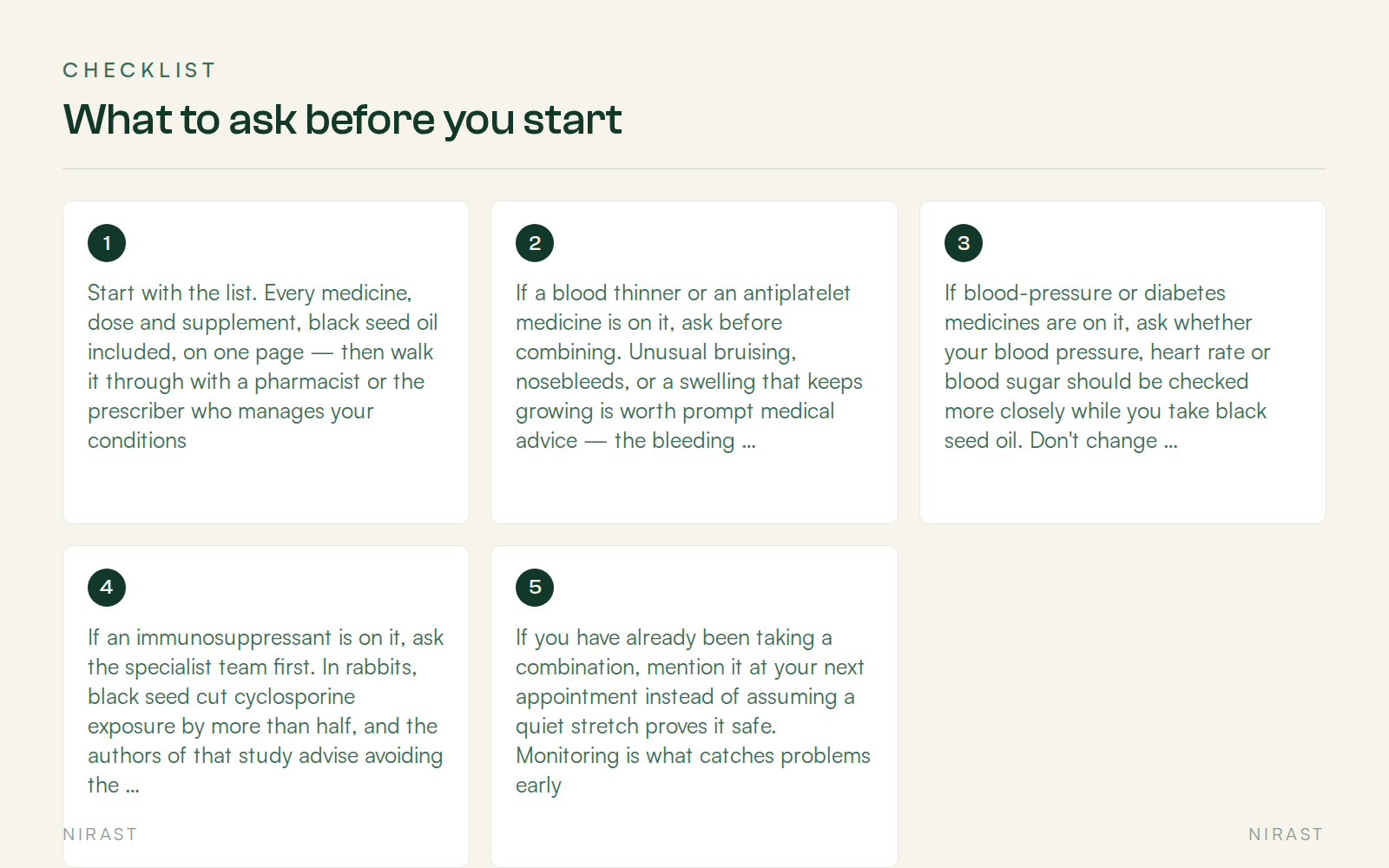
- Start with the list. Every medicine, dose and supplement, black seed oil included, on one page — then walk it through with a pharmacist or the prescriber who manages your conditions.
- If a blood thinner or an antiplatelet medicine is on it, ask before combining. Unusual bruising, nosebleeds, or a swelling that keeps growing is worth prompt medical advice — the bleeding case reports above are the reason this comes first.
- If blood-pressure or diabetes medicines are on it, ask whether your blood pressure, heart rate or blood sugar should be checked more closely while you take black seed oil. Don’t change prescribed doses on your own.
- If an immunosuppressant is on it, ask the specialist team first. In rabbits, black seed cut cyclosporine exposure by more than half, and the authors of that study advise avoiding the combination until human data exist.
- If you have already been taking a combination, mention it at your next appointment instead of assuming a quiet stretch proves it safe. Monitoring is what catches problems early.
FAQ
Can you take black seed oil with blood thinners like warfarin?
The evidence is a lab-and-review picture rather than a human trial. In laboratory experiments, thymoquinone inhibited the enzyme that metabolises warfarin, and a risk prediction concluded that co-use in warfarin-treated patients would likely “trigger off unexpected potential drug interactions” (PMID 35921950). A 2025 review adds that anticoagulant users may develop mild blood-thinning effects and that these medicines need close monitoring (PMID 40842670). Make it a prescriber decision before your first dose, and treat unusual bleeding as something to report promptly.
Can you take black seed oil with blood-pressure medicines?
Human enzyme data show CYP2D6 and CYP3A4 inhibition at 5 g/day of seeds (PMID 39769174); in rats, black seed raised losartan’s plasma concentration and enhanced its effect, while amlodipine’s pharmacokinetics were essentially unchanged (PMID 38928095). The reviews’ answer is monitoring rather than prohibition (PMID 40842670). Ask your prescriber whether anything about your monitoring should change — the fuller picture is in black seed oil and blood pressure, blood sugar and medicine.
Can you take black seed oil with metformin or other diabetes medicines?
Trials have given black seed to people already on oral diabetes medicines, and a 90-day randomized trial combined thymoquinone with metformin in 60 patients (PMID 41302106, PMID 40641727); the same literature still lists interactions with standard antidiabetic drugs as an open research question (PMID 41302106). The reviews’ caution is to watch for interactions with glucose-regulating medicines to prevent hypoglycemia (PMID 40842670), and a rat study found thymoquinone raised exposure to the diabetes medicine repaglinide (PMID 42555833). If you take diabetes medicines, ask about checking your glucose more often.
Can you take black seed oil with immunosuppressants like cyclosporine?
In rabbits, eight days of N. sativa before a cyclosporine dose reduced the drug’s peak concentration by 35.5% and its total exposure by 55.9% — a change in the direction of the medicine working less well — and the study authors advise avoiding the combination until human studies show no significant interaction (PMID 23957013). A review also flags black seed’s immunomodulatory effects as a possible contradiction with immunosuppressive treatment (PMID 40842670). This one belongs with the specialist team, not the supplement label.
What about other prescription medicines?
The general mechanism to raise is enzyme interaction: a cardiology review calls the P450 system the most frequent site of drug–herb interactions (PMID 38928095), and animal studies summarised in the 2021 review found thymoquinone reduced the bioavailability of phenytoin and sildenafil while leaving theophylline and carbamazepine unchanged (PMID 34073784). If your medicine travels that pathway, a pharmacist can check it in minutes.
About Nirast Ethiopian Black Seed Oil
If a once-a-day softgel is the format you want, Nirast Ethiopian Black Seed Oil states 1,000 mg of black seed oil per serving, cold-pressed from Nigella sativa. The directions are simple — take 2 softgels daily with water, preferably with food — and the product page describes the softgels as taste-free, gentle and easy to take. Orders are backed by a 30-day money-back guarantee, as the product page states. It is a dietary supplement, not a medicine, and it does not replace anything your clinician has prescribed; the conversation above comes before your first dose, not after. For the label facts and the current offer terms, the product page is here: Nirast Ethiopian Black Seed Oil.
These statements have not been evaluated by the Food and Drug Administration. This product is not intended to diagnose, treat, cure, or prevent any disease. Talk to your doctor or pharmacist before starting a supplement, especially if you are pregnant, nursing, take medication or have a medical condition.
Related reading
- Black Seed Oil: What It Is, What the Evidence Covers, and How to Choose a Form
- Are Oil of Oregano and Black Seed Oil Interchangeable?
- Black Seed Oil and a Seed, Nut or Sesame Allergy: What to Check Before You Start
- Black Seed Oil Benefits: What the Evidence Shows
Related product: Ethiopian Black Seed Oil.