
Body Oil: How to Choose One That Fits Your Skin, Scent and Routine
A body oil is a leave-on blend of oils that softens skin and slows water loss without adding water of its own. Choose by skin type first — richer textures for very dry skin, lighter ones for everyday wear — then decide on scent, and check the ingredient list before you buy.
Nirast makes Nirast Silk Body Oil. This article was written by Nirast’s editorial team and reports what the published research does and does not show.
See Nirast Silk Body Oil → · 30-Day Money-Back Guarantee
Published by Thang Phi, founder of Nirast and publisher of the Nirast Journal.
More decision points follow: what an oil does, how it differs from lotion and cream, how to match texture and scent, and where safety fits.
What is body oil, exactly?
Body oils are emollients: plant-oil blends whose fatty acids soften the skin, shield its surface and slow moisture loss (PMID 39524627). Moisturizing ingredients divide into three classes — humectants (they attract and hold water), emollients (they soften the surface), and occlusives (they coat the skin with a film that reduces transepidermal water loss, the water that evaporates through the surface) (PMID 27293248, PMID 41906718).
A body oil sits mainly in the third camp: it carries little or no water of its own. That is why the standard instruction for occlusive oils is to apply them to moist skin — they hold on to the water that is already there rather than adding any (PMID 27293248).
How is body oil different from lotion and cream?
The dividing line is water. Lotions carry the most water of the formats; oils sit at the far end — an emollient and occlusive film with no water at all — and sealing and softening power increases in the order ointment, oil-based cream, water-based cream, lotion (PMID 35888607).
That is why “which format wins” has no universal answer — and why humectant-heavy products are usually paired with an occlusive, since applied alone they can increase water loss (PMID 27293248). The full breakdown of all four formats — oil, lotion, cream and body butter — is in How Do Body Oil, Lotion, Cream and Body Butter Differ – and Which Should You Pick?.
How do you choose a body oil? Four things that matter
Four factors decide whether a body oil suits you.
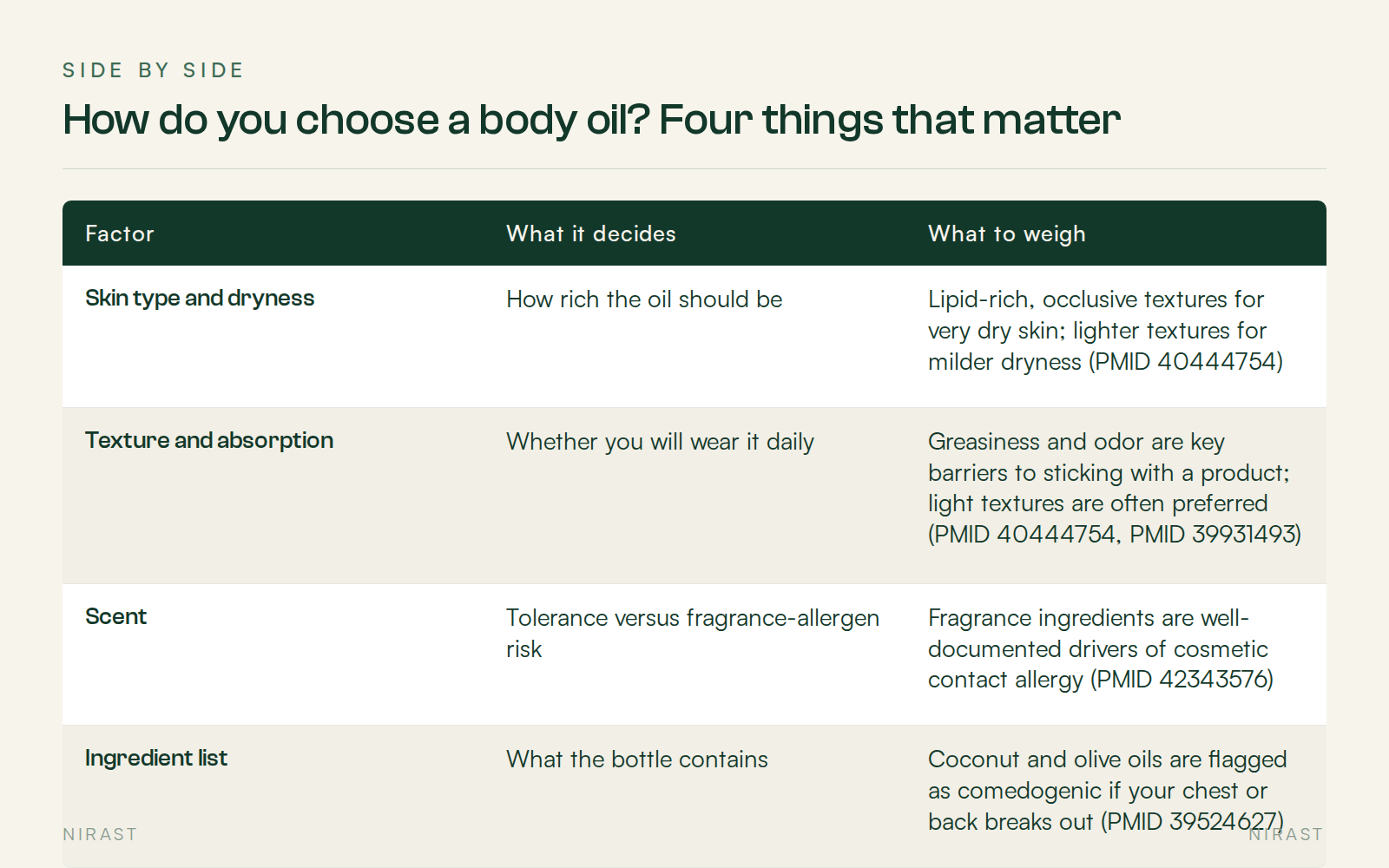
| Factor | What it decides | What to weigh |
|---|---|---|
| Skin type and dryness | How rich the oil should be | Lipid-rich, occlusive textures for very dry skin; lighter textures for milder dryness (PMID 40444754) |
| Texture and absorption | Whether you will wear it daily | Greasiness and odor are key barriers to sticking with a product; light textures are often preferred (PMID 40444754, PMID 39931493) |
| Scent | Tolerance versus fragrance-allergen risk | Fragrance ingredients are well-documented drivers of cosmetic contact allergy (PMID 42343576) |
| Ingredient list | What the bottle contains | Coconut and olive oils are flagged as comedogenic if your chest or back breaks out (PMID 39524627) |
Skin type comes first. Choose the formulation by skin type, season and body area: dry skin points to an ointment or oily cream, oily skin to a lotion or water-based cream (PMID 35888607). Within oils, the same logic works by richness — lipid-rich formulas for very dry skin, lighter textures for milder dryness (PMID 40444754).
Texture decides whether it gets used. Greasiness and odor are named among the key barriers to sticking with a topical product, and there is evidence of a preference for light over oily textures (PMID 40444754, PMID 39931493).
Scent is a deliberate choice. Fragrance ingredients are found in virtually every cosmetic category and are well-documented drivers of allergic contact dermatitis (PMID 42343576). Disclosure is uneven — in the US, individual fragrance ingredients need not be named, while in the EU 80 allergens must be labelled above 10 ppm in leave-on products (PMID 42343576); in one product dataset, 70% of items listed “fragrance” or “parfum” (PMID 42014480). Essential oils count as fragrance for allergy purposes (PMID 41652868), and if your skin is reactive, the guidance is fragrance-free, low-preservative products and a patch test (PMID 40933574).
Read the ingredient list. Jojoba is a liquid wax, over 98% wax esters, and argan is rich in tocopherols at 60–90 mg per 100 g (PMID 39524627); vitamin E is a lipid-soluble antioxidant, though clinical findings for skin are not entirely consistent (PMID 42794826). More practically, coconut and olive oils are flagged as comedogenic (PMID 39524627), and blends are normal — disturbed skin involves several lipid roles, so formulators combine oils (PMID 32547393).
How do you use a body oil?
Timing beats technique. Apply after bathing, while the skin is still damp, and again before bed — the two application slots dry-skin guidance names — and occlusive oils have their most pronounced effect on slightly dampened skin (PMID 40444754, PMID 27293248). Use it as often as needed; twice-daily application is what the evidence supports for hydration and barrier function (PMID 40444754, PMID 41622615). If your skin is reactive, the practical check is the repeated open application test — forearm, twice daily for up to 10 days to two weeks; patch testing remains the standard way to diagnose contact allergy (PMID 42324086). If a product stings or flares, stop (PMID 40330400).
What does the evidence show — and not show?
What it shows. Basic emollient therapy is the mainstay of dry-skin care, and most emollient formulations are safe and effective for dryness (PMID 40444754). A ceramide-and-oils body lotion trial measured real hydration gains and less water loss (PMID 41622615); a meta-analysis of 12 trials in foot xerosis found functional creams reduced severity at two and four weeks, with adverse events rare and mild (PMID 42755659); basic moisturizing alone contributes measurable improvement in placebo-controlled trials (PMID 42222690).
What it does not show. The oil-format evidence base is thin — 27 clinical studies reviewed, mechanisms still limited (PMID 35548366); no clinical studies were identified for emollients containing olive oil, vegetable oils or vitamin E in one review’s dry-skin context (PMID 40265493); and popular claims outrun the data — three olive-oil studies found no significant effect on stretch marks, while one 80-person trial of a specific safflower-olive blend improved skin condition (PMID 35548366). The outcomes measured are hydration, water loss and dryness severity — not “transformation” (PMID 42755659). Results describe formats and preparations, not any particular bottle.
Is body oil safe for sensitive skin?
Contact dermatitis is the cosmetic adverse effect seen most often — about 84.3% of cosmetic adverse reactions, roughly 80% of them irritant (PMID 42343576). A systematic review of nine studies (4,569 participants) found acne (36%), redness (27%), itching (19%) and irritation (18%) among common complaints, with fragrances, preservatives and colorants commonly related (PMID 40330400).
“Natural” is not a safety category: surveys find that most people believe natural ingredients are inherently safer, while botanicals are listed among common cosmetic allergens and botanical oils can cause mild irritation — their oxidation products can sensitize skin (PMID 42057771, PMID 42343576, PMID 32547393). Oils with the lowest oleic acid content carry a lower risk of irritant contact dermatitis (PMID 32547393), and olive oil is described in one review as a “second skin barrier” for dry, cracked winter skin (PMID 39524627). If you are acne-prone on your chest or back, the comedogenic flag on coconut and olive oils matters (PMID 39524627). Patch-test, choose fragrance-free and low-preservative products if you are reactive (PMID 40933574), and treat a persistent rash as a dermatology question.
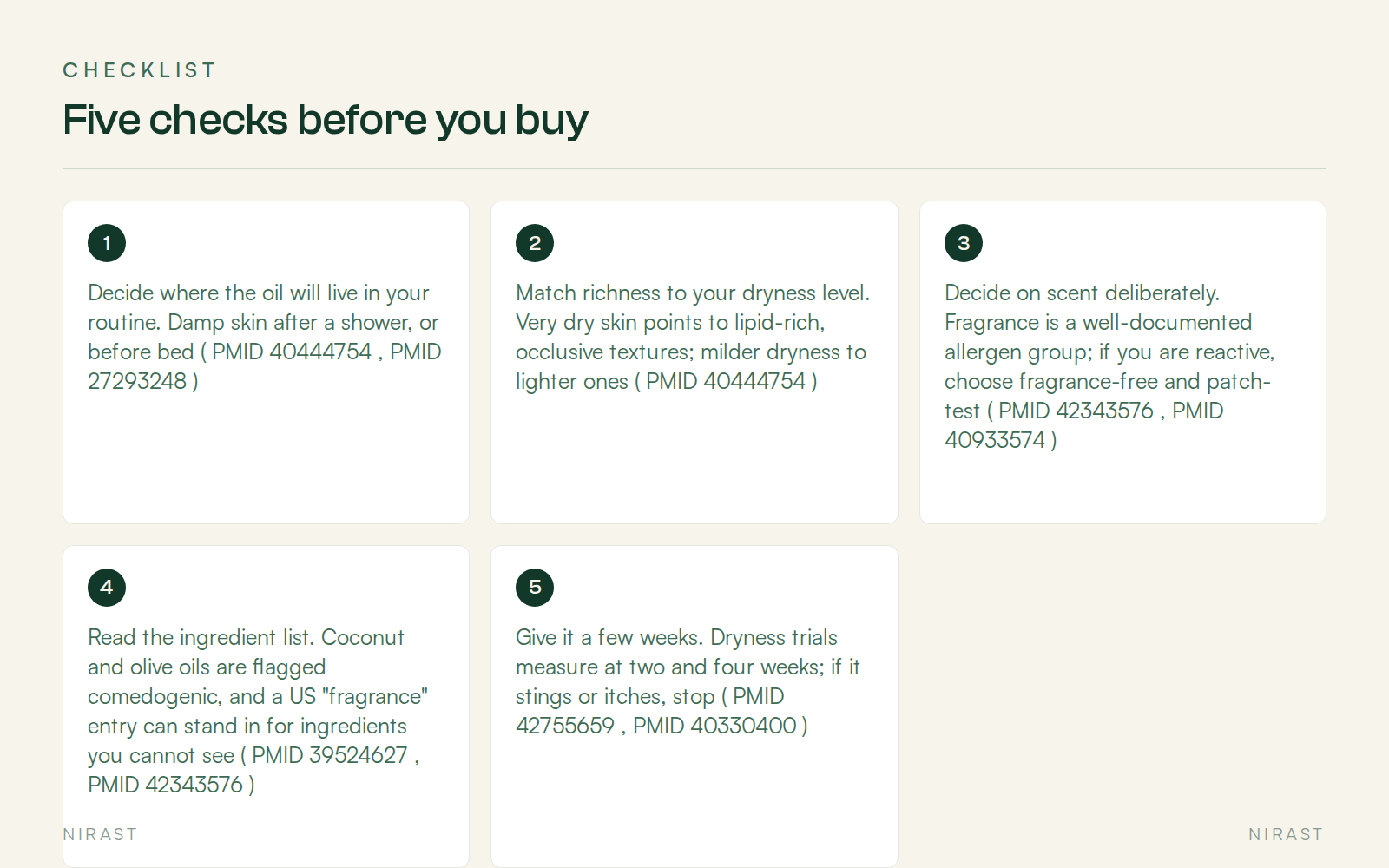
Five checks before you buy
- Decide where the oil will live in your routine. Damp skin after a shower, or before bed (PMID 40444754, PMID 27293248).
- Match richness to your dryness level. Very dry skin points to lipid-rich, occlusive textures; milder dryness to lighter ones (PMID 40444754).
- Decide on scent deliberately. Fragrance is a well-documented allergen group; if you are reactive, choose fragrance-free and patch-test (PMID 42343576, PMID 40933574).
- Read the ingredient list. Coconut and olive oils are flagged comedogenic, and a US “fragrance” entry can stand in for ingredients you cannot see (PMID 39524627, PMID 42343576).
- Give it a few weeks. Dryness trials measure at two and four weeks; if it stings or itches, stop (PMID 42755659, PMID 40330400).
FAQ
Does body oil hydrate your skin?
It seals rather than waters — an oil carries no water of its own and is applied to moist skin to slow water loss (PMID 27293248). If your skin lacks water, pair a humectant-carrying product first with an oil on top (PMID 27293248).
How often should you apply body oil?
As often as needed — up to several times daily for dry skin — particularly after bathing and before bed (PMID 40444754). Twice-daily application is the routine the evidence supports (PMID 41622615).
Should body oil go before or after lotion?
Lotion first, oil on top — the oil supplies the film that slows the water’s exit (PMID 27293248). The full format breakdown is in the comparison of oil, lotion, cream and body butter.
Is body oil good for very dry skin?
Richer formats are what guidance points to for very dry skin — they are occlusive and water-retaining (PMID 40444754). The evidence describes formats and ingredients, not any single bottle (PMID 40265493).
Can body oil cause breakouts?
It can, if the oil is comedogenic for your skin — coconut and olive oils are flagged as able to clog pores in sensitive skin (PMID 39524627). If your chest or back is acne-prone, patch-test first (PMID 40933574).
Do body oils prevent stretch marks?
The evidence is thin and mixed: three olive-oil studies found no significant effect, while one 80-person trial of a specific safflower-olive blend improved skin condition (PMID 35548366). Neither result promises anything for a particular bottle.
About Nirast Silk Body Oil
If the guidance above matches what you want, Nirast Silk Body Oil is a cosmetic body oil the product page describes as a lightweight silk oil melting instantly into skin — no greasy film, no sticky residue — and as a fast-absorbing dry oil (product page). Its scent is described as soft, clean and perfume-like: subtle and warm rather than heavy. The page lists jojoba, almond and shea butter among the oils, alongside vitamin E, and states the formula is free from parabens, sulfates, mineral oil and silicones. It is sold by subscription with a 30-day money-back guarantee and free worldwide shipping — orders are processed within 4–7 business days, and delivery takes 5–7 business days — and subscription changes or cancellations go through support@nirast.co. The current subscription options are here: Nirast Silk Body Oil.
Choosing for a man’s routine, or something scent-forward? See: Body Oil for Men: How to Choose and Use One and Scented Body Oils for Women: How to Choose One That Suits Your Skin.
These statements have not been evaluated by the Food and Drug Administration. This product is not intended to diagnose, treat, cure, or prevent any disease. Talk to your doctor or pharmacist before starting a supplement, especially if you are pregnant, nursing, take medication or have a medical condition.
Related reading
- Body Oil for Men: How to Choose and Use One
- Scented Body Oils for Women: How to Choose One That Suits Your Skin
- Body Oil Benefits for Skin: What Topical Oils Do for Your Barrier
- How Do I Layer Body Oil So a Scent Lasts All Day?
Related product: Nirast Silk Body Oil.