
Astaxanthin for Skin: What Human Trials Actually Measured
Human trials of oral astaxanthin for skin used 4–12 mg a day for 4–16 weeks in healthy middle-aged adults. Pooled results from small trials: skin moisture and elasticity improved versus placebo; wrinkle depth did not significantly decrease. A 4 mg trial reported higher minimal erythema dose and less moisture loss from irradiated skin.
Nirast makes Nirast Extra Strength Astaxanthin. This article was written by Nirast’s editorial team and reports what the published research does and does not show.
See Nirast Extra Strength Astaxanthin → · 30-Day Money-Back Guarantee
Published by Thang Phi, founder of Nirast and publisher of the Nirast Journal.
That short version holds up — the rest of this page is the detail behind it: what the skin studies actually measured, the effect sizes and doses, where the results turned null, and what the evidence can and cannot tell you about wrinkles, dryness and sun-related skin change. For the ingredient-level background, our astaxanthin guide covers what astaxanthin is and how the forms differ.
What do human studies of astaxanthin for skin actually measure?
Photoageing — the skin change driven by prolonged ultraviolet exposure — is described as the prominent mechanism of skin ageing and is associated with wrinkles, dryness, hyperpigmentation, thinning, fragility and elastic-fibre changes, while aged skin is characterised by dryness, deep wrinkling, laxity and increasing transepidermal water loss (TEWL) (PMID 40761858; PMID 34578794).
In the pooled skin-ageing review, randomized trials were grouped by measured outcome — moisture content, skin elasticity and wrinkle depth — with elasticity analysed as gross elasticity (R2) and wrinkles as mean depth of all wrinkles (PMID 34578794). The participants were healthy middle-aged adults, mean age 40–50, with age-related signs such as wrinkles and dryness at baseline (PMID 34578794).
What the pooled skin trials found: moisture and elasticity up, wrinkle depth unchanged
Eight randomized controlled trials — 162 participants in the astaxanthin groups, 131 in the placebo groups — fed the pooled analysis (PMID 34578794). Three results anchor everything else on this page:
- Skin moisture significantly improved versus placebo: SMD 0.53 (95% CI 0.05–1.01; I² 52%; p = 0.03).
- Skin elasticity significantly improved: SMD 0.77 (95% CI 0.19–1.35; I² 75%; p = 0.009).
- Wrinkle depth did not significantly decrease: SMD −0.26 (95% CI −0.58–0.06; I² 0%; p = 0.11).
All three come from the same 2021 systematic review and meta-analysis (PMID 34578794).
SMD means standardized mean difference — a statistical measure of how far apart the two groups moved, not a percentage of change you can read off your own face. The elasticity result also carried substantial between-study variation (I² 75%).
The doses and durations the skin studies used
The randomized trials used 4–12 mg a day of oral astaxanthin capsules, for 4–16 weeks, with 16–65 participants per trial (PMID 34578794). Two of the reviewed studies tested low-dose astaxanthin (2 mg a day) combined with other antioxidants — collagen hydrolysate or tocotrienol (PMID 34578794).
A separate 2025 systematic review of 40 randomized trials (2,119 healthy participants) on oral supplements for skin photoageing identified three astaxanthin trials — 102 participants, 2–4 mg a day in capsule form, 6–12 weeks — two of which reported no adverse events (PMID 40761858).
Higher milligrams have not translated into larger results within this range. In one 2017 trial, 6 mg a day and 12 mg a day produced a very small and similar effect size (0.04) on elasticity, with no dose–response effect (PMID 34578794). And the 16-week study of 65 healthy women that used 6 mg or 12 mg found long-term supplementation could help reduce ageing-induced skin deterioration and maintain skin health, based on wrinkle parameters and skin moisture (PMID 42193197).
What about UV-related endpoints?
One double-blind randomized trial focused on UV-related skin change: 23 healthy participants took a placebo or a 4 mg astaxanthin capsule, with minimum erythema dose (MED — the UV dose at which skin begins to redden) and TEWL measured at baseline and nine weeks. The astaxanthin group had higher MED and decreased skin moisture loss from the irradiation areas, and subjective smoothness and roughness improved (PMID 42193197).
These are instrument endpoints: a higher MED means more UV was needed to redden the skin in that test. The collagen-linked finding often quoted alongside UV research comes from cell culture instead — an in vitro study summarised in the same review found astaxanthin reduced matrix metalloproteinase-1 (MMP-1) production by fibroblasts cultured in media of UV-B-induced keratinocytes (PMID 42193197).
One more data point: 4 mg a day for four weeks is reported to improve skin in people over 40 by lowering corneocyte desquamation and lipid oxidation (PMID 42193197).
Topical or oral? What the evidence supports
The delivery literature describes the topical route as underexplored, with few commercial skin formulations, and notes that oral administration acts systemically while topical application acts primarily locally, particularly in anti-ageing (PMID 42198217). In one clinical study, combined oral astaxanthin (6 mg a day) and a topical solution (2 mL a day of a 78.9 μM solution) improved skin condition across all skin layers in both sexes (PMID 42198217).
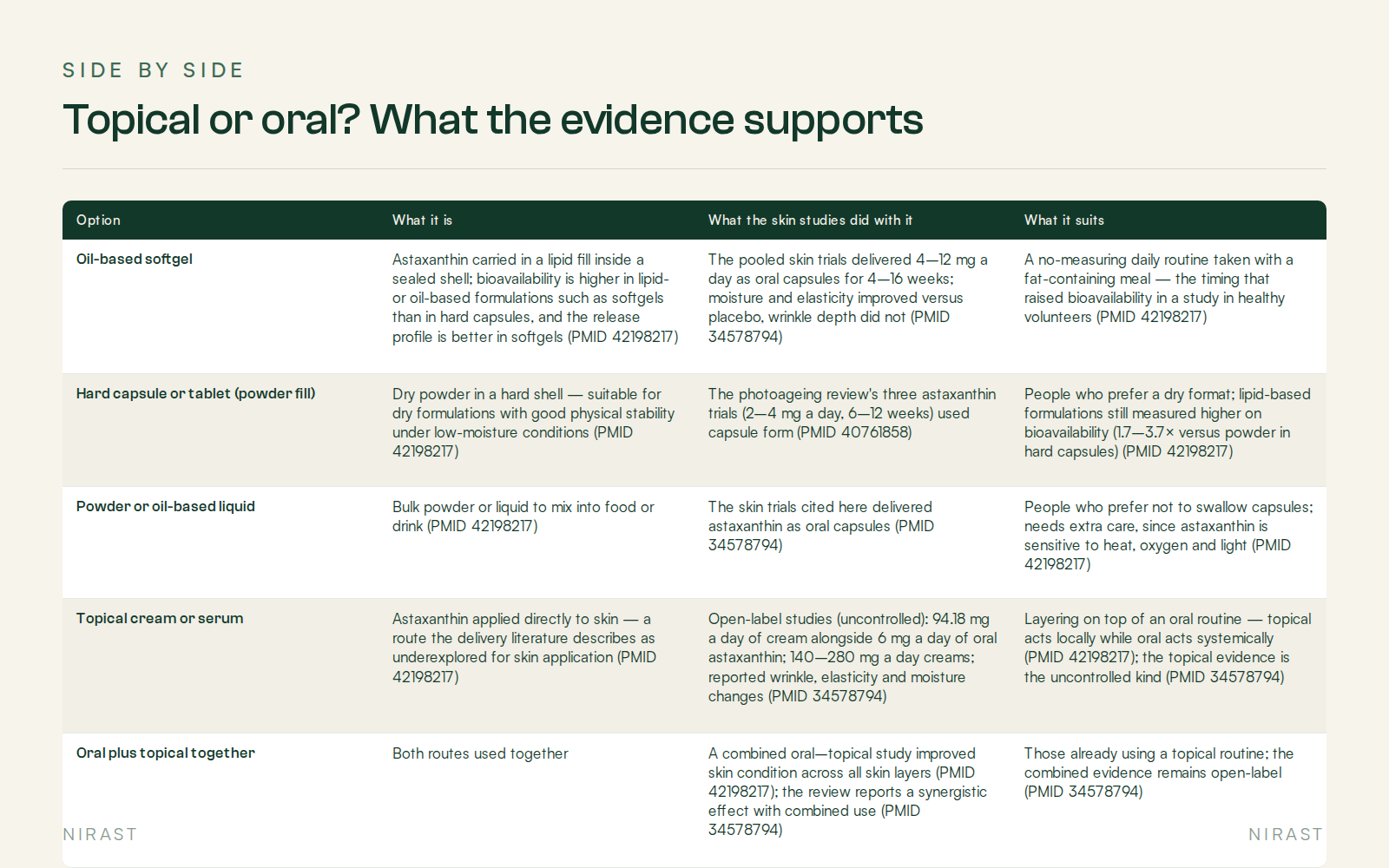
The topical numbers come mostly from open-label, uncontrolled studies: eight weeks of 6 mg a day of oral astaxanthin plus 94.18 mg a day of topical cream produced wrinkle reductions of 2.27% and elasticity improvements of 3.39% at the outer canthus, with increased corneocyte-layer moisture in 10 participants with dry skin (PMID 34578794). Smaller topical studies reported outer-canthus moisture increases of 3.32% after three weeks of a 280 mg a day cream and 106.67% after two weeks of a 140 mg a day cream (PMID 34578794).
The review’s conclusion compares the routes: oral supplementation “might be more sustained and pronounced than topical applications”, and a synergistic skin-protective effect was found with combined use (PMID 34578794).
| Option | What it is | What the skin studies did with it | What it suits |
|---|---|---|---|
| Oil-based softgel | Astaxanthin carried in a lipid fill inside a sealed shell; bioavailability is higher in lipid- or oil-based formulations such as softgels than in hard capsules, and the release profile is better in softgels (PMID 42198217) | The pooled skin trials delivered 4–12 mg a day as oral capsules for 4–16 weeks; moisture and elasticity improved versus placebo, wrinkle depth did not (PMID 34578794) | A no-measuring daily routine taken with a fat-containing meal — the timing that raised bioavailability in a study in healthy volunteers (PMID 42198217) |
| Hard capsule or tablet (powder fill) | Dry powder in a hard shell — suitable for dry formulations with good physical stability under low-moisture conditions (PMID 42198217) | The photoageing review’s three astaxanthin trials (2–4 mg a day, 6–12 weeks) used capsule form (PMID 40761858) | People who prefer a dry format; lipid-based formulations still measured higher on bioavailability (1.7–3.7× versus powder in hard capsules) (PMID 42198217) |
| Powder or oil-based liquid | Bulk powder or liquid to mix into food or drink (PMID 42198217) | The skin trials cited here delivered astaxanthin as oral capsules (PMID 34578794) | People who prefer not to swallow capsules; needs extra care, since astaxanthin is sensitive to heat, oxygen and light (PMID 42198217) |
| Topical cream or serum | Astaxanthin applied directly to skin — a route the delivery literature describes as underexplored for skin application (PMID 42198217) | Open-label studies (uncontrolled): 94.18 mg a day of cream alongside 6 mg a day of oral astaxanthin; 140–280 mg a day creams; reported wrinkle, elasticity and moisture changes (PMID 34578794) | Layering on top of an oral routine — topical acts locally while oral acts systemically (PMID 42198217); the topical evidence is the uncontrolled kind (PMID 34578794) |
| Oral plus topical together | Both routes used together | A combined oral–topical study improved skin condition across all skin layers (PMID 42198217); the review reports a synergistic effect with combined use (PMID 34578794) | Those already using a topical routine; the combined evidence remains open-label (PMID 34578794) |
How long does astaxanthin take to work for skin?
The controlled trials ran 4 to 16 weeks: the 65-woman study ran 16 weeks, and the UV-focused trial measured its endpoints at nine weeks (PMID 34578794; PMID 42193197). Nothing here sets a days-scale expectation — the review calls for future studies with more objective dermatological assessments and original data reporting (PMID 34578794). If you try it, judge it over a comparable window: weeks, not days.
What the evidence does not show
The supplement category compresses complicated studies into single sentences. Four compressions to hold loosely.
1. “Wrinkle eraser.” The pooled analysis did not find a significant wrinkle-depth reduction (PMID 34578794). The positive wrinkle percentages — 2.27% after eight weeks — come from open-label, uncontrolled studies (PMID 34578794).
2. “A measurable collagen boost.” The human endpoints were instrument measures — moisture, elasticity, wrinkle depth, TEWL and MED (PMID 34578794; PMID 42193197) — not collagen content in human skin. The MMP-1 result behind collagen talk is a cell-culture finding (PMID 42193197).
3. “Sunscreen replacement.” The UV result is a higher minimal erythema dose in a 23-participant trial — an instrument endpoint (PMID 42193197). The trials cited on this page measured instrument values, not whether anyone could replace sun protection.
4. “N times stronger than X.” Potency multipliers come from laboratory chemistry: the review literature records astaxanthin as approximately 550 times more effective than alpha-tocopherol at neutralizing singlet oxygen — a chemical-assay measurement (PMID 42193197). That is a fact about how the molecule behaves in a lab system, not a multiplier on skin outcomes.
The study limits belong in the same frame. The reliability and strength of the pooled evidence were limited by small sample sizes, imperfect study design, data-extraction method and potential conflicts of interest; most included studies had unclear risk of bias, and most trials were conducted in healthy Japanese females, restricting generalisation to wider populations (PMID 34578794). The photoageing review likewise calls for more extensive and stringent studies (PMID 40761858).
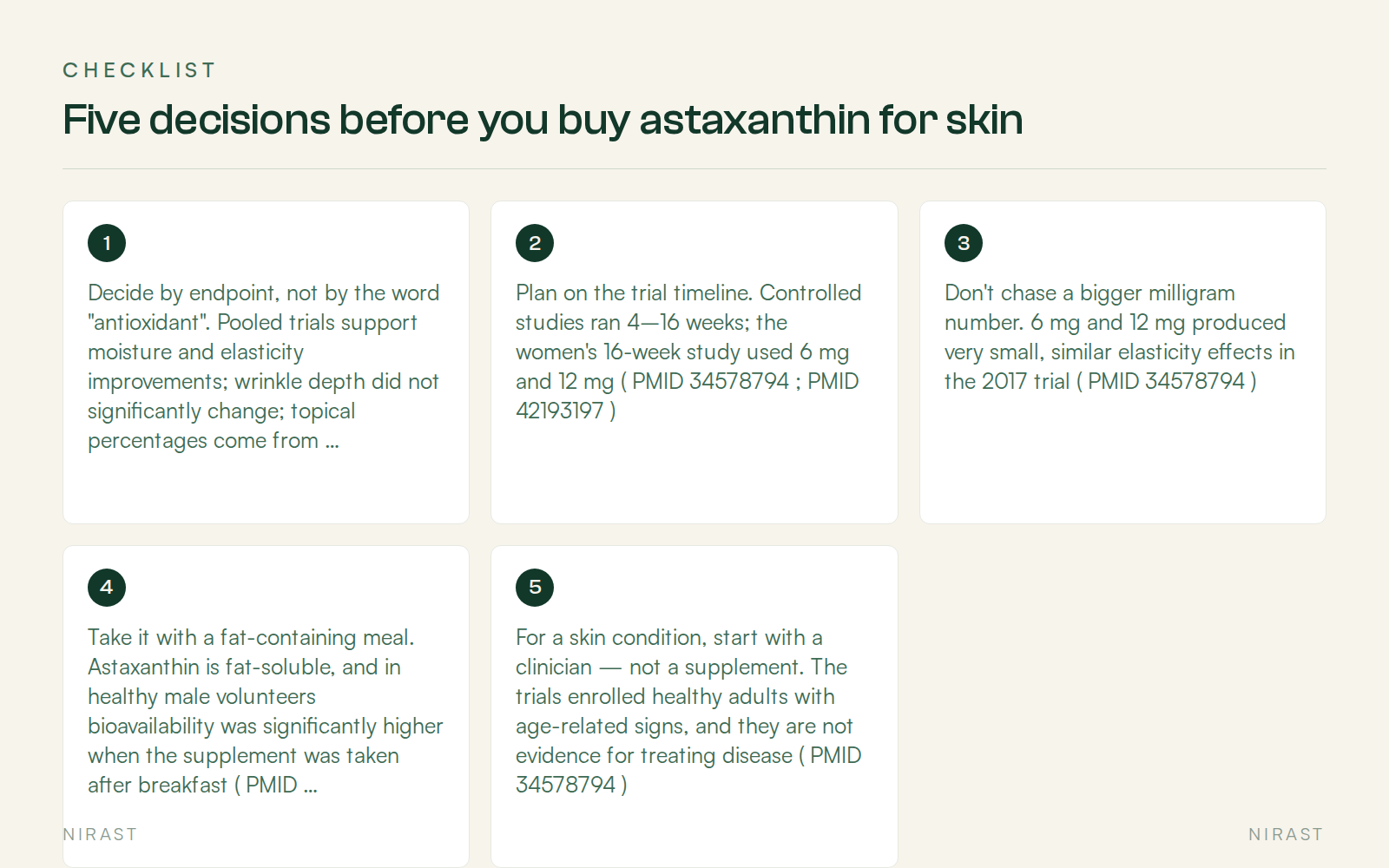
Five decisions before you buy astaxanthin for skin
- Decide by endpoint, not by the word “antioxidant”. Pooled trials support moisture and elasticity improvements; wrinkle depth did not significantly change; topical percentages come from uncontrolled studies (PMID 34578794).
- Plan on the trial timeline. Controlled studies ran 4–16 weeks; the women’s 16-week study used 6 mg and 12 mg (PMID 34578794; PMID 42193197).
- Don’t chase a bigger milligram number. 6 mg and 12 mg produced very small, similar elasticity effects in the 2017 trial (PMID 34578794).
- Take it with a fat-containing meal. Astaxanthin is fat-soluble, and in healthy male volunteers bioavailability was significantly higher when the supplement was taken after breakfast (PMID 42198217). Oil-based softgels are the form the delivery literature places higher on bioavailability than hard capsules (PMID 42198217).
- For a skin condition, start with a clinician — not a supplement. The trials enrolled healthy adults with age-related signs, and they are not evidence for treating disease (PMID 34578794).
When to see a dermatologist instead
Astaxanthin was studied in healthy adults with age-related skin signs — it is not a treatment for skin disease (PMID 34578794). Some skin problems need a clinician’s eyes rather than a supplement aisle:
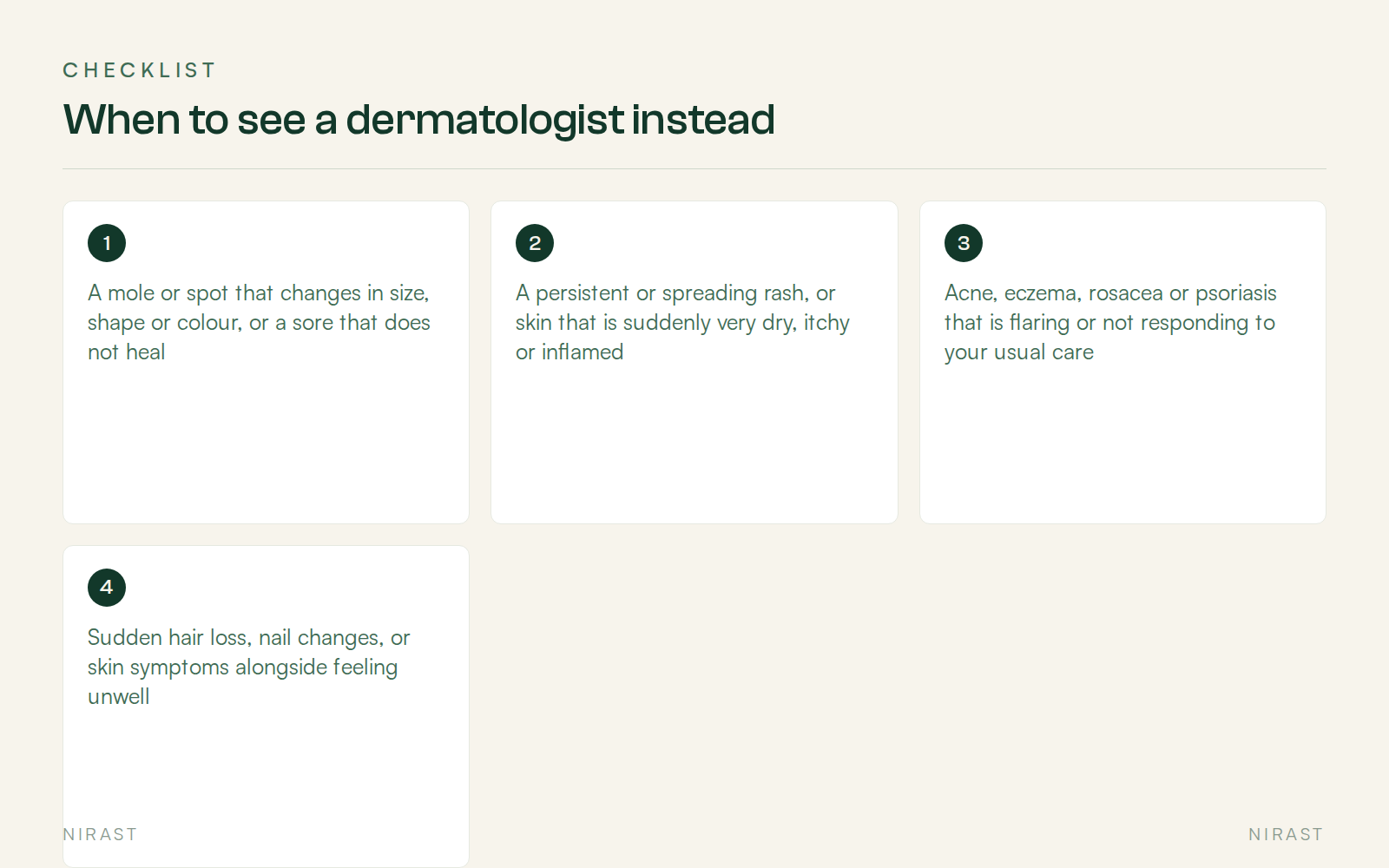
- A mole or spot that changes in size, shape or colour, or a sore that does not heal.
- A persistent or spreading rash, or skin that is suddenly very dry, itchy or inflamed.
- Acne, eczema, rosacea or psoriasis that is flaring or not responding to your usual care.
- Sudden hair loss, nail changes, or skin symptoms alongside feeling unwell.
If any of those apply, see a dermatologist or your clinician first. On the safety side, the compiled record for the doses studied is quiet — no clinically important blood-marker changes at 6 or 20 mg a day, no gastrointestinal distress at 8 mg a day for three months, and no safety concerns reported up to 24 mg a day for 12 weeks (PMID 42193197; PMID 37888449). Long-term data remain thin, so treat that as an observation, not a guarantee. And if you take medication, are pregnant or manage a health condition, check with a clinician before adding any supplement.
FAQ
Is astaxanthin good for your skin?
The evidence covers specific, measured things: pooled randomized trials found significant improvements in skin moisture and elasticity versus placebo, and no significant wrinkle-depth reduction (PMID 34578794). A small UV-focused trial found a higher minimal erythema dose and less moisture loss from irradiated areas (PMID 42193197). “Good for skin” depends on which of those outcomes you mean — the effects are modest and come from small studies.
How much astaxanthin should I take for skin?
The skin trials used 4–12 mg a day of oral capsules, and a photoageing review’s astaxanthin subset used 2–4 mg a day (PMID 34578794; PMID 40761858). Higher doses have not shown larger effects within this range — 6 mg and 12 mg performed similarly in the 2017 elasticity data (PMID 34578794). Follow the product’s own label, and check with a clinician first if you take medication, are pregnant or manage a health condition.
How long does astaxanthin take to work for skin?
The controlled trials ran 4–16 weeks; the longest skin study here ran 16 weeks at 6 mg or 12 mg (PMID 34578794; PMID 42193197). The evidence sets no fixed timeline, and the review asks for future trials with more objective dermatological assessments (PMID 34578794). Judge any supplement against its label directions over weeks, not days.
Does astaxanthin reduce wrinkles?
On the pooled evidence, wrinkle depth did not significantly decrease versus placebo (PMID 34578794). Open-label studies reported small reductions — 2.27% at the outer canthus after eight weeks of combined oral and topical use — but those studies were uncontrolled (PMID 34578794). If wrinkle reduction is the outcome you care about, that distinction is the one to weigh.
Is topical or oral astaxanthin better for skin?
The route with the pooled randomized evidence is oral: 4–12 mg a day of capsules (PMID 34578794). Topical results come from open-label studies, and the delivery literature describes the topical route as underexplored for skin application (PMID 34578794; PMID 42198217). The review’s conclusion suggests oral effects might be more sustained than topical, while combined use showed a synergistic protective effect in the studies it reviewed (PMID 34578794).
Can astaxanthin replace sunscreen?
Not according to this evidence. The UV-related result is a higher minimal erythema dose in one 23-participant trial — an instrument measure of how much UV reddens skin (PMID 42193197). A supplement is not a sunscreen: keep using sun protection as usual, and see a dermatologist about sun-damaged skin or any changing spot.
A 12 mg softgel for a skin-focused routine: Nirast Extra Strength Astaxanthin
Nirast Extra Strength Astaxanthin is a softgel supplement, and each softgel delivers 12 mg of pure natural astaxanthin. The label artwork states the astaxanthin is “from microalgae”, and the pouch reads “120 Softgels | Dietary Supplement”. The directions are to take 2 softgels daily with water, preferably with food — which fits the with-a-meal point above. The softgels are described as clean, tasteless and easy to swallow, and the pouch artwork lists the label’s own lines — “Powerful Antioxidant Support”, “Vision & Skin Health” and “Immune Function”. The offer is a monthly subscription, with tiers displayed at $29.99, $59.99 and $89.99, and every delivered order is covered by a 30-Day Money-Back Guarantee.
The studies above are ingredient-level — the right frame for judging any product in this category — and a 12 mg softgel taken with a meal is the routine that fits the evidence above.
See Nirast Extra Strength Astaxanthin here.
These statements have not been evaluated by the Food and Drug Administration. This product is not intended to diagnose, treat, cure, or prevent any disease. Talk to your doctor or pharmacist before starting a supplement, especially if you are pregnant, nursing, take medication or have a medical condition.
Related reading
- Astaxanthin: What It Is, What the Evidence Covers, and How to Choose a Form
- Astaxanthin Benefits: What Human Trials Show for Skin, Eyes, and Recovery
- Astaxanthin for Eyes: What Human Trials Measured for Digital Eye Strain
- Astaxanthin Dosage per Day: What the Human Trials Used
Related product: Nirast Extra Strength Astaxanthin.