
Can a Thymoquinone Percentage Be Compared Between Two Products?

Nirast makes Ethiopian Black Seed Oil. This article was written by Nirast’s editorial team and reports what the published research does and does not show.
See Nirast Ethiopian Black Seed Oil → · $29.99 a month · 30-Day Money-Back Guarantee
Published by Thang Phi, founder of Nirast and publisher of the Nirast Journal.
The short answer
Only when the two figures are defined the same way. A thymoquinone percentage can be a share of the volatile fraction, a share of the whole oil, or a value produced by a particular analytical method — and a supplement label’s required quantity is a weight per serving, not a percentage at all. Unless both products state the same measurement basis and the same serving, an apparently higher number is not a comparison.
The uncomfortable version of this answer is that most pairs of bottles cannot be ranked from their labels at all. That is not a reason to give up on comparing products; it is a reason to compare the right field, which the rest of this article lays out.
What a supplement label is actually required to state
The regulation that governs supplement labels is specific about the form the number takes. A product must present the names and the quantitative amounts by weight of each declared dietary ingredient under the heading “Amount Per Serving”, and it must state a “Serving Size” using a term appropriate to the form, such as tablets, capsules or packets (21 CFR 101.36, Nutrition labeling of dietary supplements). The required comparable quantity is therefore a weight per serving, not a percentage. That is the first reason a “%” on one page and a “mg” on another are not the same kind of figure, and why a percentage with no serving definition is not a standard label value you can hold up against a milligram amount.
Why the same symbol can mean different quantities
A percentage is only half a statement until you know what it is a percentage of. In one comparison of black cumin oils, thymoquinone was reported at 34.84% in the Ethiopian oil, 27.36% in the Egyptian and 22.59% in the Syrian — but those figures are the share of thymoquinone within the measured volatile fraction, not a share of the whole oil (Assessment of Egyptian, Ethiopian and Syrian black cumin oils, PMID 39519627). Read the same symbol against a different denominator and the quantity it describes changes completely, which is why “34.84%” and a small milligram figure can both be honest descriptions of very different things.
Extraction changes the number as much as anything
The figure also depends on how the oil was made. In a direct laboratory comparison of two extraction methods on the same seed type, thymoquinone measured 6.63 mg/mL for supercritical fluid extraction and 1.56 mg/mL for the cold press — roughly a fourfold difference driven by process alone (Effects of extraction methods on black seed oil, PMID 27642353). The same paper notes that its composition percentages were calculated from GC peak areas, a relative measure and a different basis again from a milligram-per-serving figure. Two oils can therefore share a plant, a species and even a percentage and still not be measuring the same thing.
The method changes the number too
Even holding the sample fixed, the analysis itself introduces spread. A method-validation study quantified thymoquinone in Nigella sativa oil and a supplement sample, and found that three different ways of constructing the calibration curve produced different linear ranges for the same analyte, while the validated method correlated strongly with the long-standing HPLC reference (Voltammetric quantification of thymoquinone, PMID 40442198). The useful conclusion is not that analytical results are unreliable; it is that a figure whose method is not stated has an unstated basis, and two unstated bases are not a comparison.
A printed figure is batch- and time-dependent
One more wrinkle: thymoquinone does not hold still on the shelf. It has weak stability against heat and light, and in one storage experiment free black cumin seed oil lost up to 96.78% of its thymoquinone during storage, against 52.63% for an encapsulated sample (Encapsulation and thymoquinone stability, PMID 31935665). A single number printed on a page therefore describes a batch at a moment, not every bottle of the product forever.
What the Nirast page states
The Nirast product page states its potency figure as a “5% thymoquinone concentration” (Nirast Ethiopian Black Seed Oil). That is a published percentage, and this article’s whole point is that a percentage is a figure you compare carefully rather than a rank you can read at a glance.
What the research cannot tell us
The comparability rule here is built from label law and analytical studies, not from a side-by-side inspection of two real product certificates: no certificate of analysis or specification sheet from any specific product was examined for this piece. The stability findings were read at abstract level, so the degradation percentages are indicative rather than final, and the 5% figure’s own measurement basis is not stated on the page. No conversion from a percentage to a milligram amount has been performed, because without a denominator and a serving such a conversion would be invented.
How to compare two bottles honestly
Work through four questions before you rank anything:
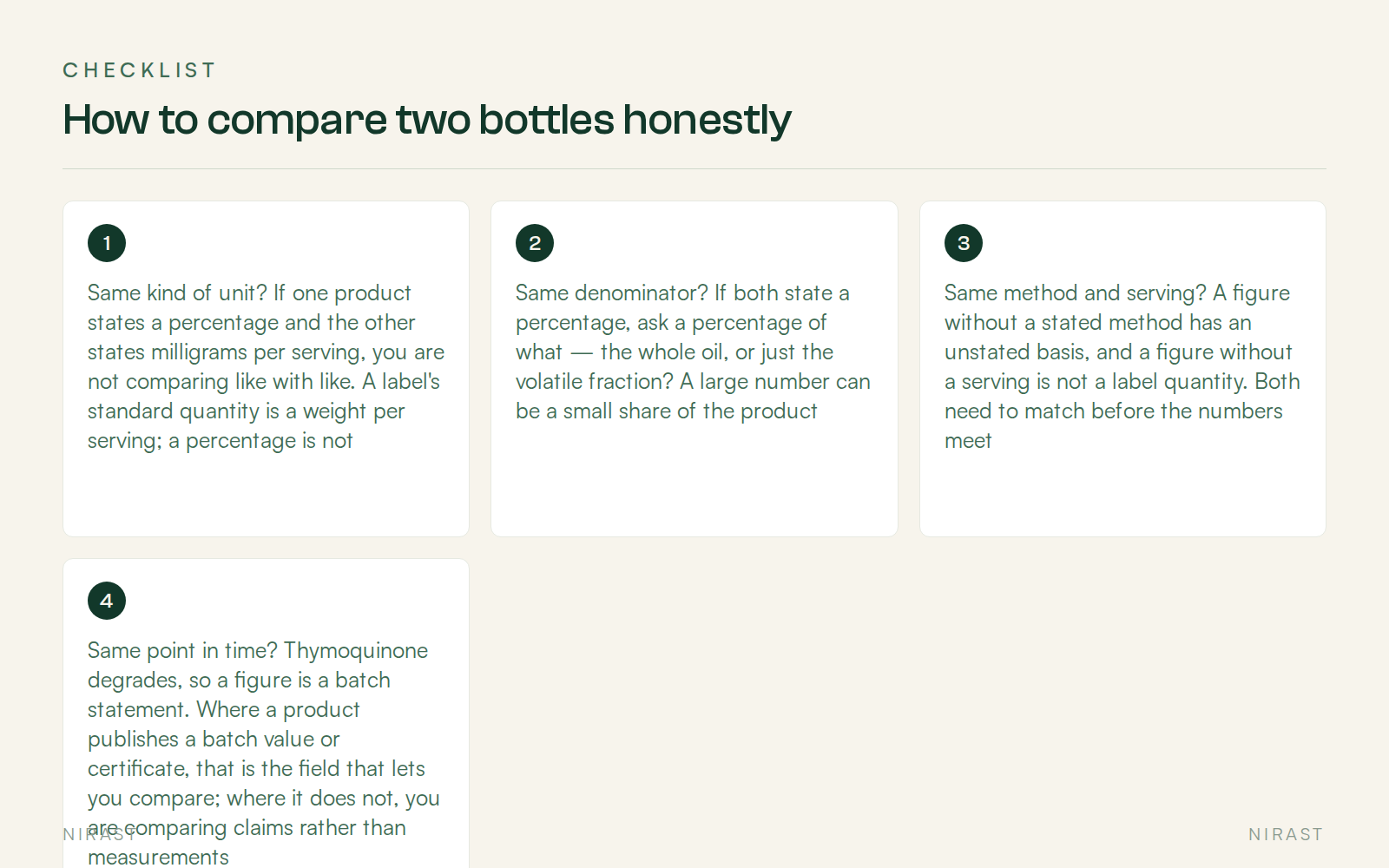
- Same kind of unit? If one product states a percentage and the other states milligrams per serving, you are not comparing like with like. A label’s standard quantity is a weight per serving; a percentage is not.
- Same denominator? If both state a percentage, ask a percentage of what — the whole oil, or just the volatile fraction? A large number can be a small share of the product.
- Same method and serving? A figure without a stated method has an unstated basis, and a figure without a serving is not a label quantity. Both need to match before the numbers meet.
- Same point in time? Thymoquinone degrades, so a figure is a batch statement. Where a product publishes a batch value or certificate, that is the field that lets you compare; where it does not, you are comparing claims rather than measurements.
If the two bottles fail these questions, the honest answer is that the labels do not let you rank them — and choosing on the strength of the bigger-looking number is choosing on the least reliable field available.
Frequently asked questions
Is 5% thymoquinone better than 1,000 mg?
They are not the same kind of figure, so the question has no direct answer. A percentage is a proportion with a denominator that may or may not be stated; a milligram figure is a weight, and only becomes comparable once it is tied to a serving. Until both share a basis, neither can be declared “better” than the other.
What does a thymoquinone percentage actually measure?
It depends entirely on what it is a percentage of. In published work it can be a share of the volatile fraction, as in the 34.84% reported for one oil. Without a stated denominator, a percentage tells you a proportion of something unnamed rather than a quantity of the product.
Why do two products with the same percentage measure differently?
Because the percentage can sit on different denominators, come from different extraction methods and be read by different analytical methods. Extraction alone changed a measured thymoquinone value roughly fourfold between two processes on the same seed.
Does a higher percentage mean a stronger effect?
No such link follows from the label figure. The percentage is a composition number, and thymoquinone is also heat- and light-sensitive and unstable in storage, so content at the moment of analysis does not describe what a person receives over time.
Can I convert a percentage into milligrams?
Not responsibly from the label alone. A conversion needs to know what the percentage is a percentage of and what constitutes a serving; without both, any milligram figure derived from a percentage would be an invention rather than a measurement.
If you want to compare the figure on the page
Nirast Ethiopian Black Seed Oil states its potency figure as a “5% thymoquinone concentration” on its product page — a published percentage you can hold next to any competitor’s and run through the four-question test above. If you want to see exactly how the figure is written and read the page’s own terms before you decide, you can read it and order here: https://try.nirast.co/black-seed-oil-otp/.
Sources
- 21 CFR 101.36 – Nutrition labeling of dietary supplements — https://www.law.cornell.edu/cfr/text/21/101.36 (mirror of 21 CFR 101.36; also ecfr.io/Title-21/Section-101.36)
- A voltammetric approach for the quantification of thymoquinone in Nigella Sativa products (Scientific Reports 2025) — https://pmc.ncbi.nlm.nih.gov/articles/PMC12122879/ (PMID 40442198; doi 10.1038/s41598-025-03347-3)
- The Effects of Different Extraction Methods on Antioxidant Properties, Chemical Composition, and Thermal Behavior of Black Seed (Nigella sativa L.) Oil (Evid Based Complement Alternat Med 2016) — https://pmc.ncbi.nlm.nih.gov/articles/PMC5015008/ (PMID 27642353; doi 10.1155/2016/6273817)
- Assessment of the Quality, Bioactive Compounds, and Antimicrobial Activity of Egyptian, Ethiopian, and Syrian Black Cumin Oils (Molecules 2024) — https://pmc.ncbi.nlm.nih.gov/articles/PMC11547441/ (PMID 39519627; doi 10.3390/molecules29214985)
- Characterization of Saccharomyces cerevisiae based microcarriers for encapsulation of black cumin seed oil: Stability of thymoquinone and bioactive properties (Food Chemistry) — https://pubmed.ncbi.nlm.nih.gov/31935665/ (PMID 31935665; doi 10.1016/j.foodchem.2019.125706)
- Nirast Ethiopian Black Seed Oil product page — https://try.nirast.co/black-seed-oil-otp/
These statements have not been evaluated by the Food and Drug Administration. This product is not intended to diagnose, treat, cure, or prevent any disease. Talk to your doctor or pharmacist before starting a supplement, especially if you are pregnant, nursing, take medication or have a medical condition.
Related reading
- Black Seed Oil: What It Is, What the Evidence Covers, and How to Choose a Form
- How to Read a Thymoquinone Percentage on a Black Seed Oil Label
- How to Work Out and Compare Cost per Serving Across Black Seed Oil Products
- Are Oil of Oregano and Black Seed Oil Interchangeable?
Related product: Ethiopian Black Seed Oil.