
Liquid Black Seed Oil vs Softgels: Which Form Suits Which Person?
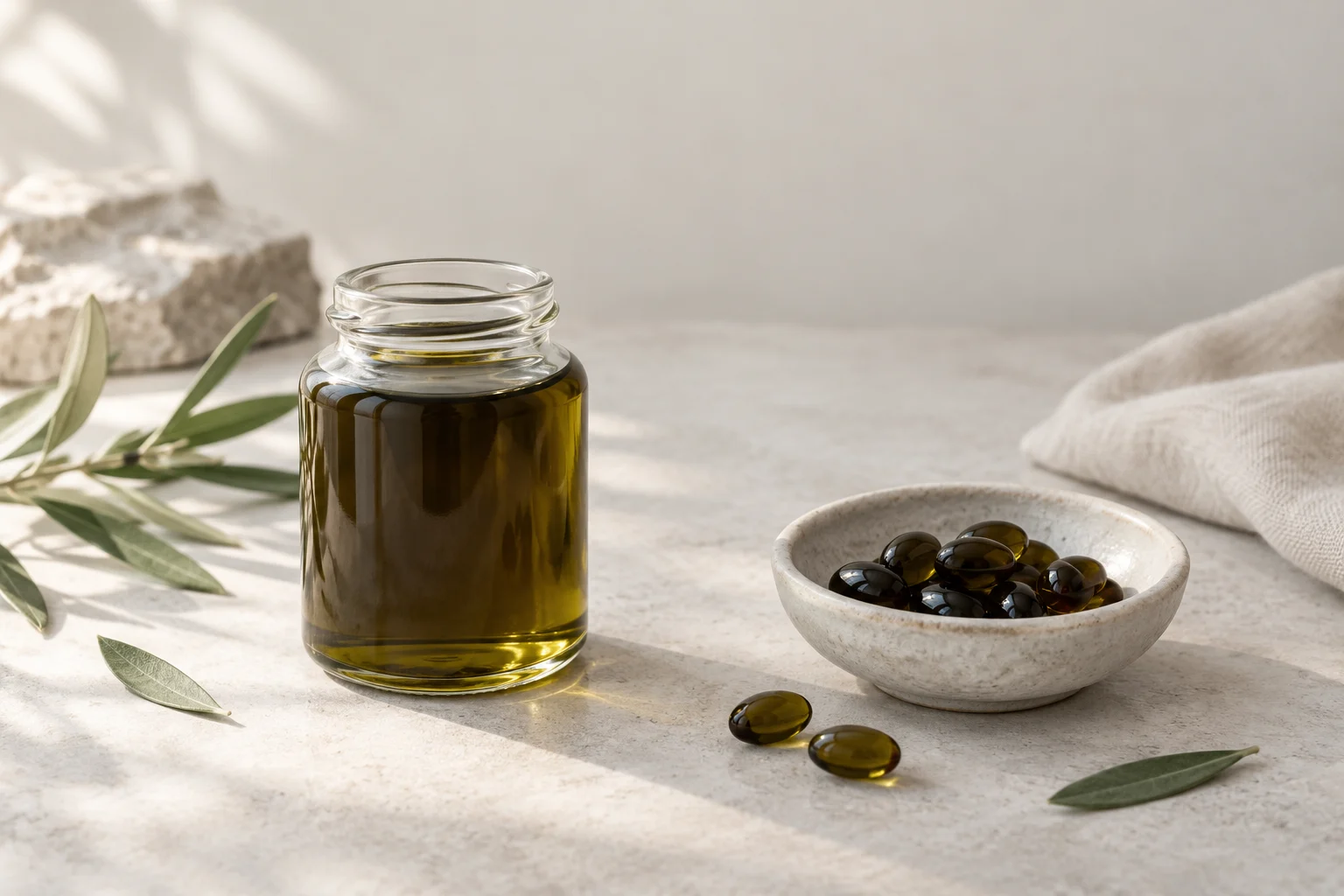
The honest choice turns on tolerance, measurement and routine rather than on potency: liquid black seed oil is measured by spoon and tastes strongly, while a softgel is a fixed, tasteless unit — so the form you will actually take consistently is the better one, unless a label states something specific.
Nirast makes Ethiopian Black Seed Oil. This article was written by Nirast’s editorial team and reports what the published research does and does not show.
See Nirast Ethiopian Black Seed Oil → · $29.99 a month · 30-Day Money-Back Guarantee
Published by Thang Phi, founder of Nirast and publisher of the Nirast Journal.
Most comparisons of black seed oil forms rank them by strength, which is the least useful question to ask first. The measured difference between a bottle of oil and a capsule is not how powerful each one is; it is how each one behaves in your day — how it tastes, how you measure it, and whether you will keep taking it. This is a decision you can make in a few minutes once you know which trade-offs actually belong to each form.
The short answer: form is a fit question, not a potency question
If you can drink a spoonful of pungent oil every day without dread, liquid gives you the flexibility to measure your own serving and to adjust it. If you know you will not tolerate the taste, or you want a serving that is already counted out for you, a softgel removes both problems at once. Neither choice is stronger by default. No study has shown one form delivering a better effect than the other; what the evidence does establish is that each form supplies a defined, measured serving.
Why black seed oil tastes so strong in the first place
The taste problem is not imagined. Black seed oil is characterized by a pungent taste, and that is the palatability problem encapsulated and capsule formats are used to address (Alkhatib et al., 2024, https://journals.iium.edu.my/ktn/index.php/jp/article/view/260). In a sensory panel of 12 healthy volunteers, encapsulating the oil significantly improved its taste and aftertaste compared with the liquid, and added flavours further improved the smell — with vanilla and orange rated the most effective of those tested.
So the plain fact is this: the oil has a strong, distinctive flavour, and a capsule is a way to avoid tasting it. That is a genuine, measurable difference between the two forms and it is worth taking at face value. If the reason you stopped taking an oil was the taste, that is a form problem, and a tasteless unit is a legitimate solution to it.
Does the form change what you actually get?
This is where the comparison usually exaggerates. Encapsulating the oil is not the same as concentrating it. In an in-vitro digestion study comparing two capsule shell materials for black seed oil, the bioaccessibility of the oil’s minor compounds — including thymoquinone, tocopherols and sterols — was not influenced by the shell material, and no significant difference in lipid bioaccessibility appeared between the shells (Antioxidants 2023, https://pubmed.ncbi.nlm.nih.gov/36671054/).
That is a single in-vitro study of two specific commercial capsules, so it should not be read as proof that every softgel and every oil are identical in a person. But it does undercut the common assumption that a capsule is inherently a weaker or stronger way to take the same oil. The shell is a delivery choice; it is not a potency upgrade or downgrade by itself. What it changes reliably is the experience — and the experience is why form matters at all.
What the trials did: softgels and liquid, measured
Human trials of black seed oil have used both forms, and each was dosed as a measured amount rather than as an open-ended “some oil”. A randomized, double-blind, placebo-controlled trial in 43 adults with type 2 diabetes used two 500 mg soft gel capsules per day of Nigella sativa oil extract for 8 weeks (Phytotherapy Research 2021, https://pubmed.ncbi.nlm.nih.gov/34142392/). A separate double-blind randomized trial in 116 patients with knee osteoarthritis used 2.5 mL of Nigella sativa oil taken orally every 8 hours for one month (Complementary Therapies in Clinical Practice 2022, https://pubmed.ncbi.nlm.nih.gov/36150238/).
Both forms, both measured, both defined. That is the fair way to describe the evidence: trials have supplied black seed oil as fixed-milligram capsules and as measured liquid volumes, which tells you each form can deliver a defined serving — not that one beats the other. Neither of those trials compared the two forms against each other, so no head-to-head superiority claim is available from them.
Who the liquid suits
Liquid suits a reader who wants control. You measure your own volume, you can adjust it, and you can mix it into food or a drink if the taste is manageable that way. It also suits someone whose routine already includes a spoon and a drink, and who would rather not add a capsule to a daily pill count.
The costs are real too. A liquid is measured by spoon or dropper, so it takes a moment of attention each time, and it tastes like what it is. Encapsulation is not free of trade-offs either: the in-vitro study that found no bioaccessibility difference also found higher gastric lipid hydrolysis with starch shells and a rise in free oxylipins after intestinal digestion, so encapsulated and unencapsulated oils both carry processing and oxidation considerations. The honest framing is that each form has a housekeeping cost, and you pick the one you will pay.
Who the softgel suits
A softgel suits a reader who wants the serving already measured and the taste removed. A fixed, pre-counted unit means no spoon, no dropper, no aftertaste, and no decision each morning about how much to take. That is the practical case for a fixed unit: it strips out the two friction points — taste and measuring — that any daily oil habit has to survive, and either form only helps if it survives them.
There is one honest caveat worth naming: a tasteless capsule also removes the taste signal you would otherwise use to notice that you took a serving. “Easy to take” and “harder to accidentally over-take” are different, user-specific considerations rather than a universal advantage. If you like a clear sensory cue that you have had your serving, a spoon gives you one that a softgel does not.
A decision rule you can apply in ten seconds
Read down this list and stop at the first line that sounds like you:
- You dislike the taste and skip days because of it → softgel. The form that gets taken beats the form that gets avoided.
- You want to measure and adjust your own volume, or mix it into food → liquid.
- You want zero measuring and no aftertaste → softgel.
- You already take a spoon of oil comfortably and it is part of your routine → stay with liquid.
- A label states something specific about its serving → follow that product’s own directions, because the amount on the label is the only amount tied to the product in your hand.
The rule underneath all of them: pick the form you will actually take on the days you do not feel like thinking about it.
Where Nirast’s softgel fits
Nirast sells this oil in the form that solves the taste and measuring problems together. Ethiopian Black Seed Oil is supplied as softgels the page describes as tasteless and easy to swallow, pressed from Nigella sativa oil it lists as single-origin Ethiopian, with directions of two softgels daily with water and preferably with food and a stated 1,000 mg of black seed oil per serving. It comes as one monthly subscription — one pouch for $29.99, free worldwide shipping, a 30-day money-back guarantee, and cancellation by emailing support@nirast.co at least 24 hours before the next renewal (https://try.nirast.co/black-seed-oil-otp/).
If you are the reader this form suits, the practical benefits line up: no spoon, no measuring, no aftertaste, a fixed daily routine, and subscription terms you can read before you commit. If you are the reader who genuinely prefers the flexibility of a liquid and will keep taking it, that is a perfectly good answer too — the point of this comparison is to send you to the form that works for you, not to argue that one form is superior on the evidence.
What the evidence does not show
No single head-to-head trial has compared a liquid black seed oil with a softgel on the same outcome in the same people, so the useful conclusions come from what each form’s evidence does establish separately. The taste-masking study tested alginate beads in 12 volunteers and used a commercial softgel only as a comparator, the encapsulation study was in vitro using two specific 500 mg capsules, and the two clinical trials each tested one form in one condition. Palatability and dosing convenience are not health outcomes, and none of this establishes a benefit from either form. What it does establish is narrow and useful: liquid and softgels differ reliably in taste and in how you measure a serving, and unreliably — if at all — in the amount you get per unit.
References
- Alkhatib et al., “Evaluating the taste-masking ability and sensory attributes of alginate-encapsulated black seed oil”, Journal of Pharmacy 2024 — https://journals.iium.edu.my/ktn/index.php/jp/article/view/260
- “Effect of Encapsulation Material on Lipid Bioaccessibility and Oxidation during In Vitro Digestion of Black Seed Oil”, Antioxidants 2023 — https://pubmed.ncbi.nlm.nih.gov/36671054/
- “Effect of Nigella sativa oil extract on cardiometabolic risk factors in type 2 diabetes”, Phytotherapy Research 2021 — https://pubmed.ncbi.nlm.nih.gov/34142392/
- “Efficacy and safety of oral Nigella sativa oil for symptomatic treatment of knee osteoarthritis”, Complementary Therapies in Clinical Practice 2022 — https://pubmed.ncbi.nlm.nih.gov/36150238/
- Nirast Ethiopian Black Seed Oil product page — https://try.nirast.co/black-seed-oil-otp/
FAQ
Is liquid black seed oil stronger than softgels?
Not on the evidence. Trials have used both fixed-milligram capsules and measured liquid volumes, and the form-level studies do not show one delivering a better effect. The reliable difference is taste and how the serving is measured.
Do softgels absorb as well as oil from a spoon?
That is a separate question with its own evidence, and it is not settled by a form comparison. What this page can say is that a capsule and a spoonful are not interchangeable by assumption; treat an absorption claim as unverified unless it comes from a study of that specific product.
Why does black seed oil taste so strong?
The oil is naturally pungent, which is exactly why encapsulated and capsule formats exist. In a sensory panel, encapsulation significantly improved taste and aftertaste compared with the liquid oil.
Can I mix liquid black seed oil into food or a drink?
Many people do, which is one advantage of the liquid form — you control the volume and the vehicle. If masking the taste that way still leaves it unpleasant, a tasteless softgel removes the problem entirely.
Which form is better if I keep forgetting to take it?
Whichever has the fewest steps for you. If the spoon and the taste are what break the habit, a fixed, tasteless softgel removes both obstacles; if the capsule is what you forget, a spoon already in your routine may be easier.
Related reading
- Black Seed Oil: What It Is, What the Evidence Covers, and How to Choose a Form
- How to Compare Black Seed Oil Servings Across Liquid and Softgels
- Black Seed Oil Capsules: How They Compare With the Liquid Oil
- Are Oil of Oregano and Black Seed Oil Interchangeable?
Related product: Ethiopian Black Seed Oil.