
Black Seed Oil Overdose: How Much Is Too Much and What Happens

Can You Take Too Much Black Seed Oil? What an Overdose Would Actually Look Like
Nirast makes Ethiopian Black Seed Oil. This article was written by Nirast’s editorial team and reports what the published research does and does not show.
See Nirast Ethiopian Black Seed Oil → · $29.99 a month · 30-Day Money-Back Guarantee
Published by Thang Phi, founder of Nirast and publisher of the Nirast Journal.
The short answer
There is no established human dose at which black seed oil becomes dangerous, but taking far more than the label serving has been reported to cause loose stools, stomach discomfort, nausea and bloating rather than a stronger benefit — so more oil is not more useful, and anyone who has taken a large amount and feels unwell should stop and seek advice.
If you arrived here because you took several extra softgels or a few spoonfuls and now feel off, that is the answer: stop the extra, drink water, and if your symptoms are severe or do not settle, treat it as a medical matter and get advice. The rest of this article explains where that boundary comes from, what the upper end of intake actually looks like, and why the label’s serving amount is the number to work from rather than a floor to climb above.
Why an oil’s “too much” is a different question from a drug’s
For a prescription drug, an upper limit is often a published number with a legal definition behind it. For a botanical oil such as black seed, the published safety picture is built from studies that tested ordinary doses, not from studies that deliberately pushed people past them. The honest way to read it is in three layers: the side effects people report at ordinary-to-high intakes, what controlled human trials actually recorded, and what animal toxicity numbers can and cannot tell you about a person.
There is a second reason the label matters here. A dietary supplement is required to declare a serving size, expressed in a term that suits its form — tablets, capsules, packets or teaspoonfuls (21 CFR 101.36 nutrition labeling of dietary supplements, via the Cornell Legal Information Institute). That serving is the only repeatable, written amount a reader has. It exists so there is a reference point, not so it can be treated as an opening bid.
What actually gets reported at the upper end of ordinary intake
The effects that show up when people take black seed or its oil are overwhelmingly gastrointestinal. A 2024 systematic review and meta-analysis of eight randomised allergic-rhinitis trials recorded adverse effects including nausea, dry mouth, drowsiness, malaise, headache and stomach discomfort, and its practical advice is to take the oil after meals to reduce the risk of gastrointestinal discomfort (Nigella sativa for allergic rhinitis, Frontiers in Pharmacology 2024). A comprehensive safety review reports nausea, bloating and a burning sensation after Nigella sativa oil in functional-dyspeptic patients, with a slight rise in liver and kidney enzyme markers after consuming the oil and crushed seed (Black Cumin: A Comprehensive Review, Nutrients 2021). And in a small H. pylori study that gave ground seed with honey, the only participant who left the study did so because of mild diarrhoea (Nigella sativa and honey for H. pylori, Iranian Red Crescent Medical Journal 2016).
Loose stools, an unsettled stomach, nausea and bloating are, in other words, the signature of pushing this oil past your comfort point. They are not a signal that a benefit is arriving.
Does a bigger serving give a stronger effect? The evidence says no
The single most useful sentence in the ingredient literature for this question is that higher doses did not significantly increase efficacy and were more likely to cause mild adverse effects (Frontiers in Pharmacology 2024). That is the clinical version of “more is not better”: inside the studied range, adding more mostly adds the mild effects above rather than more effect. The same evidence base notes that clinical use of thymoquinone — the headline compound in black seed — is limited by its poor bioavailability (Nutrients 2021 review). The body does not simply absorb proportionally more because you swallow more oil.
What the controlled trials actually recorded at ordinary doses
At the doses people actually study, the picture is reassuring. Across controlled human studies running from roughly 250 mg to 2 g per day over 15 days to a year, serious adverse events were rare and the reported problems were mild and transient. In a randomised, double-blind, placebo-controlled trial of a 5% thymoquinone Nigella sativa oil taken as 250 mg twice a day after food for 15 days, no clinically significant changes appeared in vital signs, liver function, kidney function, lipid profile, blood count, fasting blood sugar or urine analysis (Standardised Nigella sativa oil for seasonal allergy, Medicine 2024). A systematic review of six knee-osteoarthritis trials found oral or topical Nigella sativa well tolerated with no serious adverse events (Nigella sativa in knee osteoarthritis, Health Science Reports 2024). And a one-year trial in type-2 diabetic patients receiving oral hypoglycaemic agents used 500 mg capsules at a dose of 2 g/day without reporting serious harm (Nigella sativa over one year in type-2 diabetes, Annals of Saudi Medicine 2017).
The word to keep in view is “rare, not impossible”. Serious reactions appear as single case reports rather than as patterns inside trial populations — including one case of a severe blistering skin eruption in a woman who both applied the oil to her skin and ingested it for two weeks, with strongly positive patch tests and histopathology consistent with toxic epidermal necrolysis (Bullous drug eruption with Nigella sativa oil, Annales de Dermatologie 2012). One case cannot give you a rate, and because the exposure was both topical and oral the cause is not certain. It is simply why the honest word is “rare” rather than “never”.
What the animal toxicity numbers mean, and what they don’t
Reviews sometimes quote animal LD50 values for thymoquinone — about 870.9 mg/kg by mouth in mice and 794.3 mg/kg in rats (Nutrients 2021 review). It is tempting to convert those into a human ceiling, and it is wrong to. They are animal data, from a purified single compound rather than a diluted oil, and the same review frames toxicity around the route of administration, with intraperitoneal values far lower than oral ones. They demonstrate that risk, not benefit, is what rises with dose. They do not hand you a person’s safety number.
Why no precise overdose threshold exists for you to read
No study retrieved here deliberately gave people a large single serving, so there is no measured human overdose syndrome to point at. The adverse-event record is also explicitly incomplete: an umbrella review of herbal medicines used for blood-sugar control in type 2 diabetes found few mild adverse effects but flagged the data as incomplete and the certainty of the underlying reviews as low to very low (Herbal medicines for glycaemic control, BMC Complementary Medicine and Therapies 2025). When the safety database is patchy — and rare events are easy to miss — the responsible thing is a practical stopping rule rather than an invented milligram limit.
What to do if you have already taken too much
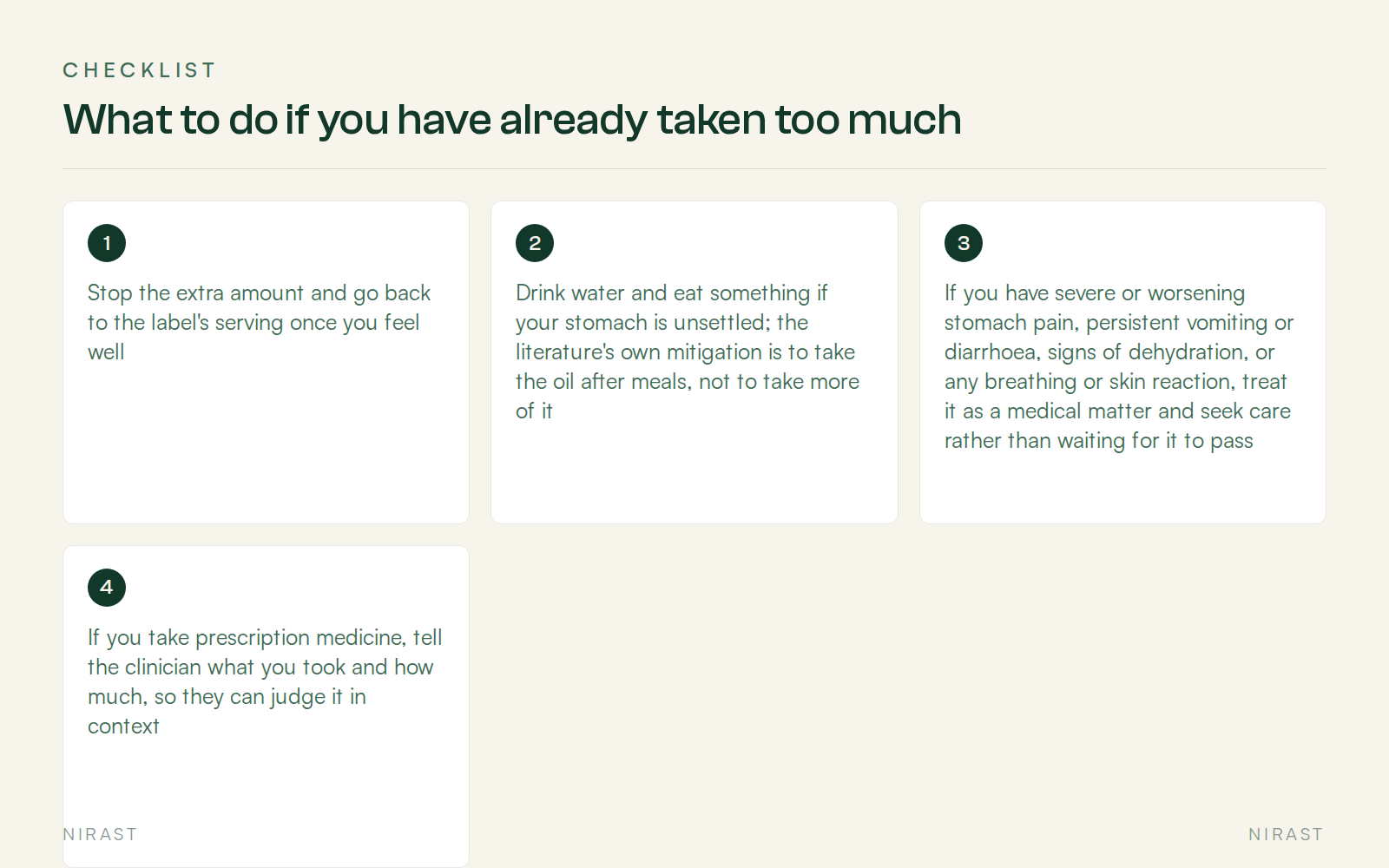
- Stop the extra amount and go back to the label’s serving once you feel well.
- Drink water and eat something if your stomach is unsettled; the literature’s own mitigation is to take the oil after meals, not to take more of it.
- If you have severe or worsening stomach pain, persistent vomiting or diarrhoea, signs of dehydration, or any breathing or skin reaction, treat it as a medical matter and seek care rather than waiting for it to pass.
- If you take prescription medicine, tell the clinician what you took and how much, so they can judge it in context.
What the research cannot tell us
The upper-end description here is assembled from ordinary-dose human studies plus animal toxicity data; no human overdose trial exists to define a threshold, and the trials behind the safety statements were small, short and often of low quality, so rare events stay easy to miss. That means nobody — not this article, not a forum post — can hand you a precise amount at which this oil becomes dangerous. What the evidence does support is the shape of the reaction at the top of normal intake, and the practical response if you have already gone past it.
A fixed daily serving, taken the way the label intends
Nirast Ethiopian Black Seed Oil is a Nigella sativa black seed oil in tasteless, easy-to-swallow softgels. The product page states 1,000 mg of black seed oil per serving and gives directions to “Take 2 softgels daily with water, preferably with food.” For this particular question the format is the whole point: a softgel is a pre-measured, fixed serving, so “how much did I take” has a written answer instead of a guess, and there is no bottle to free-pour from when the urge to take a little extra appears. That is exactly the discipline this evidence rewards — a counted serving you can stop or resume, not a spoonful you estimate.
It is offered as a plain monthly subscription: one pouch, $29.99 per month, with a 30-day money-back guarantee and cancellation through support@nirast.co at least 24 hours before the next renewal. If a fixed, countable daily serving is what you are after, you can read the label and terms and order it here: https://try.nirast.co/black-seed-oil-otp/.
Frequently asked questions
Can you overdose on black seed oil?
Not in the way you would overdose on a drug with a published toxic dose. Large amounts are reported to cause loose stools, stomach upset, nausea and bloating, and the safety record is too incomplete to name a precise harmful amount. The practical rule is to stay at the label serving and stop if you feel unwell.
How much black seed oil is too much?
The literature itself reports that higher doses did not add benefit and were more likely to cause mild adverse effects, so going above the studied range buys no extra effect and adds stomach risk. There is no established human threshold beyond which harm is guaranteed.
What does a black seed oil overdose feel like?
The reported picture is gastrointestinal — diarrhoea or loose stools, stomach and abdominal discomfort, nausea, bloating, and sometimes headache, drowsiness or a burning sensation. Serious reactions are described as rare single case reports, so they are not the expected experience.
Can black seed oil cause diarrhoea?
Yes; loose stools and diarrhoea are among the most consistently reported effects at higher intakes, and in one small study a participant left because of mild diarrhoea. Taking the oil after meals is the mitigation the literature itself suggests.
What should I do if I took too much black seed oil?
Stop the extra, drink water, and take food if your stomach is unsettled. Seek medical advice if you have severe or worsening symptoms, signs of dehydration, or any breathing or skin reaction.
Is it safe to take black seed oil every day?
Controlled studies have used it daily from 15 days to a year with few serious events and mostly mild, transient problems, but the trials were small and low quality. Daily use at the label serving is the studied pattern; escalating the serving is not.
Sources
- Meta-analysis of Nigella sativa for allergic rhinitis, Frontiers in Pharmacology 2024 — https://pmc.ncbi.nlm.nih.gov/articles/PMC11449843/
- Black Cumin (Nigella sativa L.): phytochemistry, health benefits and safety, Nutrients 2021 — https://pmc.ncbi.nlm.nih.gov/articles/PMC8225153/
- Nigella sativa and honey in H. pylori eradication, Iranian Red Crescent Medical Journal 2016 — https://pmc.ncbi.nlm.nih.gov/articles/PMC5292131/
- Standardised 5% thymoquinone Nigella sativa oil for seasonal allergy, Medicine 2024 — https://pmc.ncbi.nlm.nih.gov/articles/PMC11315530/
- Nigella sativa in knee osteoarthritis: a systematic review, Health Science Reports 2024 — https://pmc.ncbi.nlm.nih.gov/articles/PMC11033494/
- Nigella sativa over one year in type-2 diabetes, Annals of Saudi Medicine 2017 — https://pmc.ncbi.nlm.nih.gov/articles/PMC6148980/
- Bullous drug eruption with Nigella sativa oil, Annales de Dermatologie 2012 — https://pubmed.ncbi.nlm.nih.gov/22482483/
- Herbal medicines for glycaemic control: an umbrella review, BMC Complementary Medicine and Therapies 2025 — https://pmc.ncbi.nlm.nih.gov/articles/PMC12481776/
- 21 CFR 101.36, nutrition labeling of dietary supplements, via the Cornell Legal Information Institute — https://www.law.cornell.edu/cfr/text/21/101.36
- Nirast Ethiopian Black Seed Oil product page — https://try.nirast.co/black-seed-oil-otp/
These statements have not been evaluated by the Food and Drug Administration. This product is not intended to diagnose, treat, cure, or prevent any disease. Talk to your doctor or pharmacist before starting a supplement, especially if you are pregnant, nursing, take medication or have a medical condition.
Related reading
- Black Seed Oil: What It Is, What the Evidence Covers, and How to Choose a Form
- How Much Black Seed Oil Should I Take Each Day?
- What "Cold-Pressed" Actually Tells You About a Black Seed Oil
- Ethiopian vs Egyptian Black Seed Oil: What Actually Differs
Related product: Ethiopian Black Seed Oil.