
Should Black Seed Oil Be Taken With Food or on an Empty Stomach?
Nirast makes Ethiopian Black Seed Oil. This article was written by Nirast’s editorial team and reports what the published research does and does not show.
See Nirast Ethiopian Black Seed Oil → · $29.99 a month · 30-Day Money-Back Guarantee
Published by Thang Phi, founder of Nirast and publisher of the Nirast Journal.
The short answer. For this product the label itself answers the question: Nirast’s directions say to take the softgels with water and preferably with food, and taking an oil with food is the practical default because the human trials reviewed gave black seed oil with a meal or a liquid vehicle and reported only mild, transient stomach complaints. None of the located research proves that food improves absorption or prevents symptoms, and if your own product’s label directs otherwise, follow that label.
What this product’s label actually says
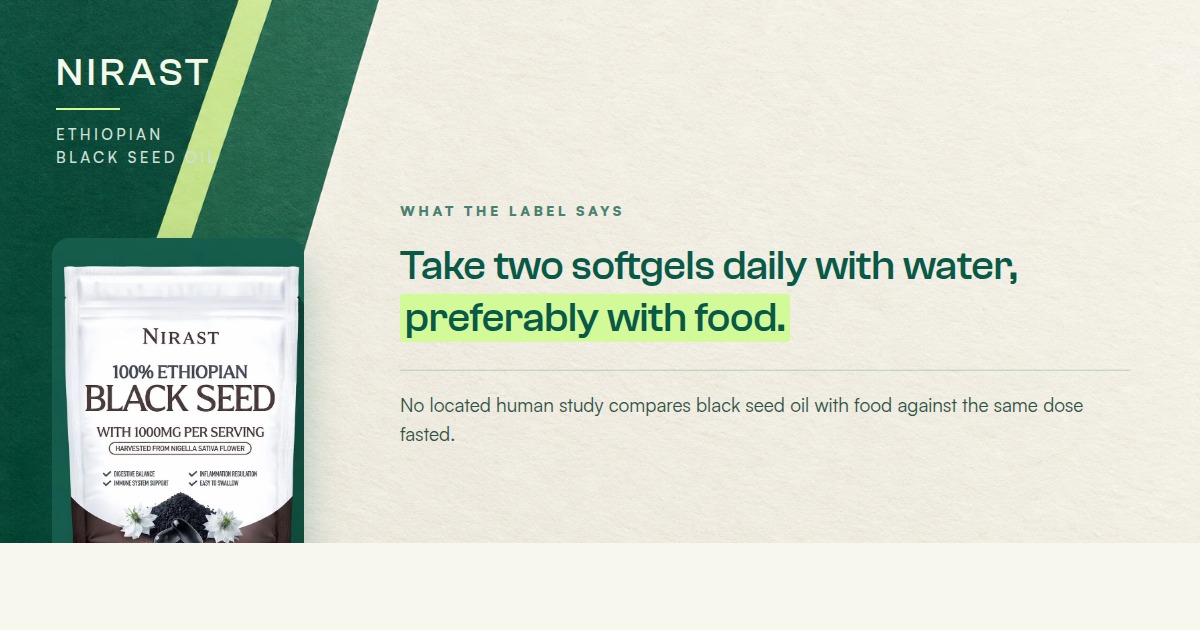
The Recommended Use text on Nirast’s own product page reads: “Take 2 softgels daily with water, preferably with food. Consistent daily use leads to the best results.” That is what the page at Nirast Ethiopian Black Seed Oil states, and it is a label instruction rather than a claim that with-food improves any health outcome. It is, however, the governing direction for this specific product. The same page states 1,000 mg of black seed oil per serving; it does not print a serving-size line or a milligram-per-softgel figure, so there is no per-softgel with-food calculation to build from its numbers.
Where the “empty stomach for absorption” advice comes from
The reasoning behind fasting dosing is general oral-absorption physiology. According to the Merck Manual’s clinical pharmacology reference, food — especially fatty food — slows gastric emptying, which is often the rate-limiting step, and slows the rate of absorption; that is the mechanism by which an empty stomach can speed absorption for some substances. It also means food changes the rate of absorption, not reliably the amount: the same reference is explicitly careful that the direction of the food effect depends on the substance: food “may enhance the extent of absorption for poorly soluble drugs … reduce it for drugs degraded in the stomach … or have little or no effect.” So “an empty stomach absorbs better” is not a general rule; it is a substance-specific question that has to be tested for the specific thing you are swallowing. The Merck reference is a tertiary clinical guide, and it does not test black seed oil or softgels. Drug Absorption, Merck Manual Professional Edition
What the human black-seed-oil studies actually did
When black seed oil (Nigella sativa) has been studied in people, it has mostly not been studied on an empty stomach. In the human trials summarised in a 2023 review of Nigella sativa in gastrointestinal disease, one cohort received 5 mL of NS oil mixed with honey and water, and another received 450 mg NS oil capsules three times a day after meals for three months. The review notes the feeding vehicle was not neutral: the honey-and-water mix can itself affect gastric symptoms. Effect of Nigella sativa on Selected Gastrointestinal Diseases
Tolerability in those studies looks reassuring at the ingredient level. The same review reports that human studies rarely show severe side effects and that the functional-dyspepsia trial saw only mild adverse events — nausea, bloating and a burning sensation — in the treatment group. Two further human trials of a proprietary thymoquinone-rich black cumin oil extract support that picture: a 90-day phase I safety trial of 200 mg/day in healthy volunteers found no serious adverse effects and no significant changes in blood, liver or kidney parameters, and a 90-day randomised trial in people with non-refreshing sleep reported no side effects over the same period. A phase I clinical trial of thymoquinone-rich black cumin oil (BlaQmax) A proprietary black cumin oil extract modulates the stress-sleep-immunity axis safely
What none of this establishes is a fasting-versus-fed comparison. No located human study compares black seed oil taken with food against the same dose taken on an empty stomach; the identified trials fixed a daily dose with no fed-versus-fasted arm.
What the research cannot tell us
The strongest honest statement is a bounded one. The located human work supports a default, not a proof:
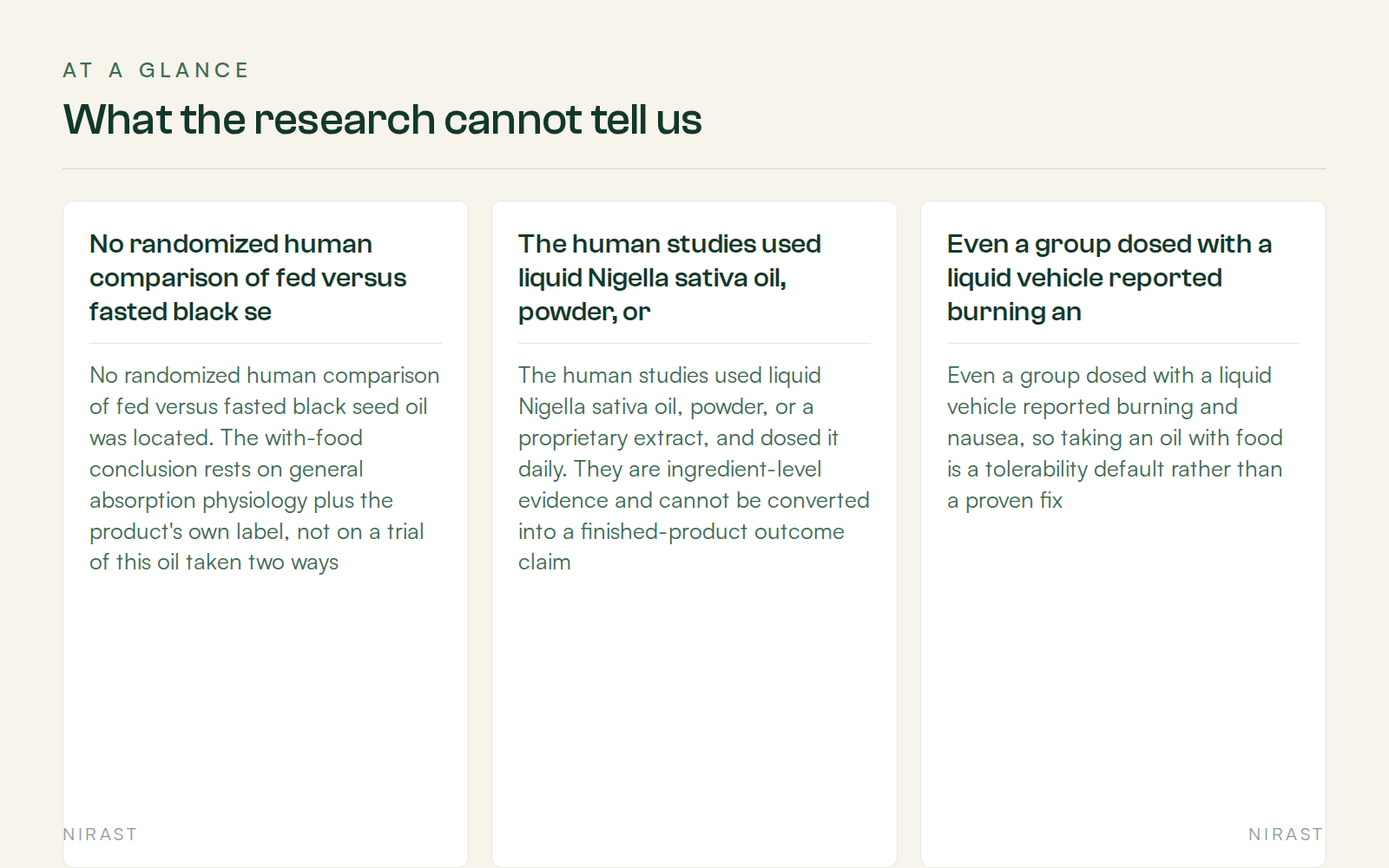
- No randomized human comparison of fed versus fasted black seed oil was located. The with-food conclusion rests on general absorption physiology plus the product’s own label, not on a trial of this oil taken two ways.
- The human studies used liquid Nigella sativa oil, powder, or a proprietary extract, and dosed it daily. They are ingredient-level evidence and cannot be converted into a finished-product outcome claim.
- Even a group dosed with a liquid vehicle reported burning and nausea, so taking an oil with food is a tolerability default rather than a proven fix.
How to decide
The practical default is to follow the product’s own label: with food. Taking the oil with food is a reasonable way to reduce the chance of the stomach upset readers report, but with-food is not proven to prevent it. If your own bottle or pouch directs otherwise, that label is the honest guide rather than any general rule.
Nirast Ethiopian Black Seed Oil is a black seed oil (Nigella sativa) softgel product; its page states 1,000 mg per serving and directs “Take 2 softgels daily with water, preferably with food.” You can read those terms at https://try.nirast.co/black-seed-oil-otp/. Nothing here should be read as evidence of a finished-product outcome: the trials above did not examine this product, and its per-softgel amount and serving size are not stated on the page or label. What this article can honestly offer is the label instruction, the general absorption physiology, and the ingredient-level tolerability reports — not a promise that food changes any specific result for you.
Sources
- Nirast Ethiopian Black Seed Oil product page — https://try.nirast.co/black-seed-oil-otp/
- Drug Absorption, Merck Manual Professional Edition — https://www.merckmanuals.com/professional/clinical-pharmacology/pharmacokinetics/drug-absorption
- Effect of Nigella sativa on Selected Gastrointestinal Diseases (Jarmakiewicz-Czaja et al., Curr Issues Mol Biol, 2023) — https://pmc.ncbi.nlm.nih.gov/articles/PMC10136991/
- A phase I clinical trial to evaluate the safety of thymoquinone-rich black cumin oil (BlaQmax) on healthy subjects (Thomas et al., Toxicol Rep, 2022) — https://pmc.ncbi.nlm.nih.gov/articles/PMC9742867/
- A proprietary black cumin oil extract (Nigella sativa) (BlaQmax) modulates stress-sleep-immunity axis safely (Front Nutr, 2023) — https://pubmed.ncbi.nlm.nih.gov/37139438/
These statements have not been evaluated by the Food and Drug Administration. This product is not intended to diagnose, treat, cure, or prevent any disease. Talk to your doctor or pharmacist before starting a supplement, especially if you are pregnant, nursing, take medication or have a medical condition.
Related reading
- Black Seed Oil: What It Is, What the Evidence Covers, and How to Choose a Form
- Black Seed Oil Upsetting Your Stomach: With Food or Empty, and What to Do Next
- Are Oil of Oregano and Black Seed Oil Interchangeable?
- Black Seed Oil Benefits: What the Evidence Shows
Related product: Ethiopian Black Seed Oil.