
What Is Black Seed Oil, and Is It the Same as the Black Cumin in Your Spice Rack?
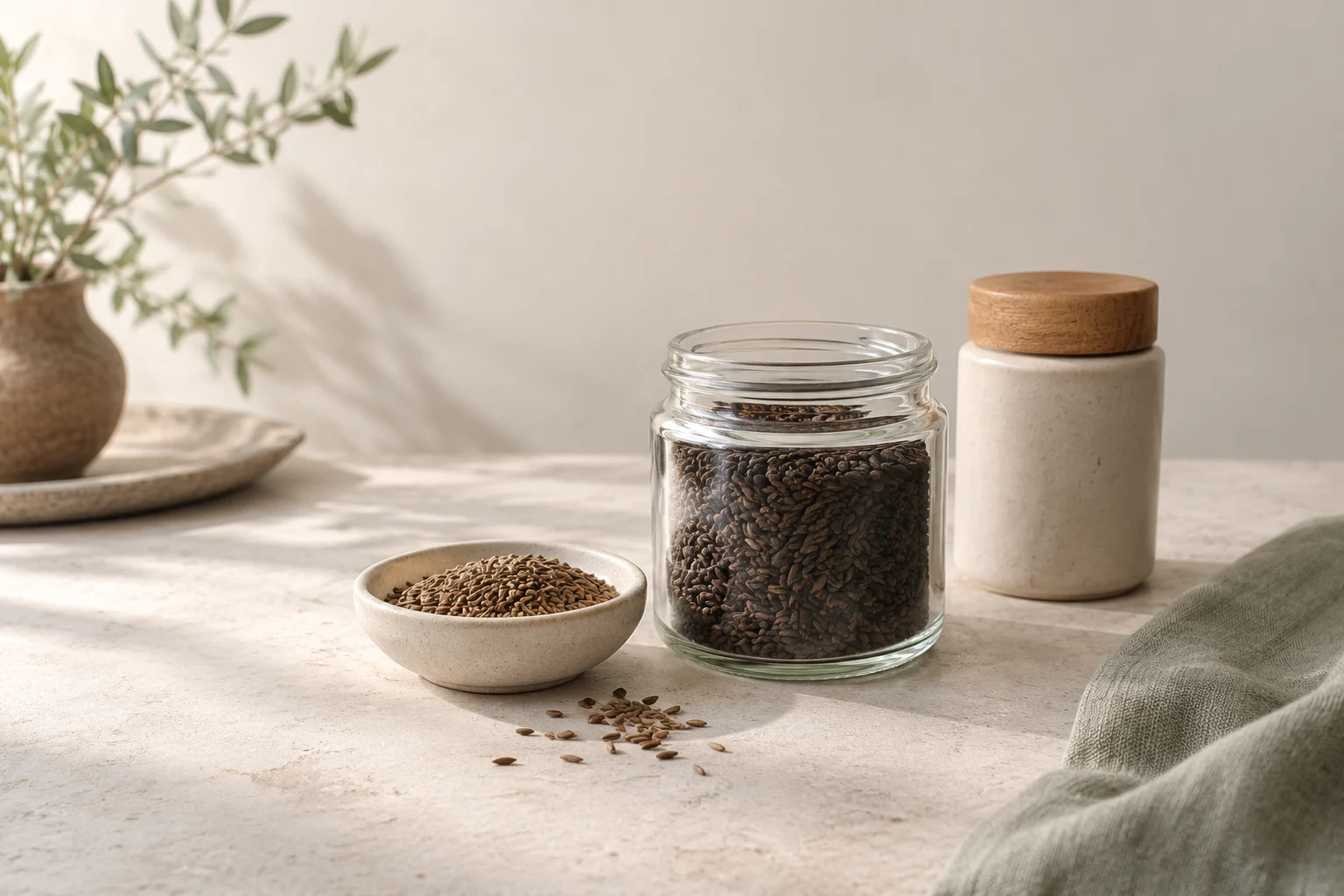
The short answer
Black seed oil is pressed from the seed of Nigella sativa, a plant in the buttercup family (Ranunculaceae). The black cumin in a typical spice rack is Cuminum cyminum, a different plant in a different family, so the two are not the same thing. The confusion lives in the names: ‘black cumin’, ‘black seed’ and ‘black caraway’ are all everyday names applied to Nigella sativa, so the botanical name on the label — not the common name — is the identity check to look for.
Nirast makes Ethiopian Black Seed Oil. This article was written by Nirast’s editorial team and reports what the published research does and does not show.
See Nirast Ethiopian Black Seed Oil → · $29.99 a month · 30-Day Money-Back Guarantee
Published by Thang Phi, founder of Nirast and publisher of the Nirast Journal.
So there are two separate questions here, and they have different answers. Is black seed oil the culinary cumin you cook with? No. Is it the nigella you might also cook with? Yes — same plant, different form. Once you know that, most of the name confusion dissolves.
The plant behind the bottle
Black seed oil comes from Nigella sativa, a flowering plant whose seed is sold as “black cumin” and “black-caraway” in trade, and which sits in the family Ranunculaceae (NCBI Taxonomy: Nigella sativa, ID 555479). A peer-reviewed review describes the same species as “Nigella sativa L. (Ranunculaceae), also called black cumin or black seeds,” and an independent primary study opens with the same identification: “The seeds of Nigella sativa (family Ranunculaceae) are commonly known worldwide as black seed or black cumin” (Hannan et al. 2021, Nutrients; Al-Gayyar et al. 2016, Redox Report).
The cumin on your shelf is a different plant
Culinary cumin is Cuminum cyminum, in the family Apiaceae — a different genus and a different family from Nigella sativa’s Ranunculaceae (NCBI Taxonomy: Cuminum cyminum, ID 52462). This is the crux of the whole question: two unrelated plants share a common name, and the name alone cannot tell you which one is in front of you.
Why the names collide
Common names are trade names, not labels. The taxonomy record for Nigella sativa lists “black cumin” as its GenBank common name and “black-caraway” among its other names, and the review repeats the same everyday names (NCBI ID 555479; Hannan et al. 2021). Because “black cumin” is applied to Nigella sativa, a recipe or product that uses the phrase can point at either plant depending on the author’s habit — and “black caraway” adds a third everyday term without removing the ambiguity.
The one label check that removes the ambiguity
The reliable identifier is the botanical, Latin name printed on the label. That is not a stylistic preference; it exists because seeds that look alike are not interchangeable. A DNA-barcoding study of market seed samples bought as black seed found that “adulteration and substitution by morphologically similar seeds are the primary concern in commercially available Nigella sativa seed,” and it used molecular markers to tell Nigella sativa apart from substituting species (Sudhir et al. 2016, Am J Life Sci). In practice, the botanical name is the field that survives that substitution problem: “Nigella sativa” on a label is an identity statement, while “black cumin” is a nickname.
What the product in question actually claims to be
Against that backdrop, the label identity is easy to state. The Nirast pouch is labelled as a black seed oil that is cold-pressed from Nigella sativa (Nirast Ethiopian Black Seed Oil) — the same spelling of the species the sources above use, and the field this article says to look for.
Why this matters when you are shopping
Name confusion is not trivia; it changes what you put in your body. If you buy a product expecting culinary cumin and receive Nigella sativa, or the reverse, you have bought a different plant with a different composition. The botanical name is the one line a nickname cannot substitute for, which is why this article treats it as the decision-relevant field rather than a footnote.
It also explains why so much of what you read sounds as if “black seed” and “black cumin” are interchangeable: many pages repeat the common names without ever naming the species, so a reader browsing them never learns that the identity check exists at all. The fix is small — read the Latin name — but it has to be stated before it can be used.
What the research cannot tell us
The identity answer here works at the level of the species; it does not inspect any particular bottle. Two of the naming sources are reference-database taxonomy records, which the database itself flags as name-and-classification entries rather than authoritative composition or safety evidence. The barcoding study examined whole market seeds, not bottled oils, and the two adulterants it caught were onion seed and a legume, not cumin. And knowing a product’s species still does not establish that the contents match the label in any deeper sense — identity is a naming question, not a proof of quality.
How to decide
If you came here because you were about to buy or take something and wanted to know what it is, the decision is short. If you only wanted the cooking spice, recognising the plant is enough to conclude that you do not need a black seed oil supplement — nigella seed is a spice you can buy in the spice aisle. If you already cook with kalonji, you already have the plant; the oil is a different, extracted form of it, not a stronger version of the same spice. That is a complete answer without a purchase, and for many readers it is the right one.
Frequently asked questions
Is black seed oil the same as cumin?
No. Black seed oil is pressed from Nigella sativa (Ranunculaceae), while culinary cumin is Cuminum cyminum (Apiaceae). They are different plants that happen to share a common name.
Is nigella the same as black seed?
Yes. “Nigella” and “black seed” both refer to Nigella sativa, and the seed is also sold as “black caraway” and “black cumin” in various markets. A spice jar of nigella is the seed of the same plant the oil is pressed from.
What is black caraway, then?
“Black caraway” is another everyday name applied to the seed of Nigella sativa. It is a nickname for the same plant, not a separate botanical identity, which is exactly why the Latin name is the field to check.
How do I know a product really contains Nigella sativa?
The botanical name on the label is the identity check to look for. Because similarly shaped seeds are easily substituted, the Latin name is the field that distinguishes the intended species from an impostor; a common name such as “black cumin” cannot do that job on its own.
I already cook with kalonji — do I need the oil?
No. If you cook with the seed, you already use the same plant; the oil is an extracted form of it rather than a different, stronger ingredient. A supplement is a separate decision about a daily oil, not a requirement for cooking with nigella.
Is kalonji the same as black seed?
Yes. “Kalonji” is another market name for the seed of Nigella sativa, the same plant the oil is pressed from. It is a nickname for the species, so a jar of kalonji and a bottle of black seed oil share an origin plant.
Why is black seed called “black cumin” if it is not cumin?
Because common names travel by resemblance and tradition rather than by taxonomy. The name “black cumin” attached to Nigella sativa’s seed, but the actual cumin genus is Cuminum, a different plant. The nickname survived the botanical relationship did not follow it.
Does the oil contain the same plant material as the seed?
The oil is pressed from the same seed, so the source plant is identical; the difference is the form. The oil is an extracted fraction of the seed rather than the whole seed, which is why a spice measurement and an oil serving are different units rather than two ways of writing one amount.
If you want the species printed on the label
Nirast Ethiopian Black Seed Oil is labelled as a black seed oil cold-pressed from Nigella sativa — the exact botanical name this article says to look for when the common names are ambiguous. If you want a black seed oil that states its species rather than trading on the black-cumin nickname, you can read its label and terms and order it here: https://try.nirast.co/black-seed-oil-otp/. And if you only came to work out whether the oil in front of you is your kitchen cumin, you already have your answer: it is not, and you do not need a supplement to cook with nigella.
Sources
- NCBI Taxonomy Browser: Nigella sativa (Taxonomy ID 555479) — https://www.ncbi.nlm.nih.gov/Taxonomy/Browser/wwwtax.cgi?id=555479
- NCBI Taxonomy Browser: Cuminum cyminum (Taxonomy ID 52462) — https://www.ncbi.nlm.nih.gov/Taxonomy/Browser/wwwtax.cgi?id=52462
- Hannan et al. (2021), ‘Black Cumin (Nigella sativa L.): A Comprehensive Review on Phytochemistry, Health Benefits, Molecular Pharmacology, and Safety’, Nutrients 13(6):1784 — https://pmc.ncbi.nlm.nih.gov/articles/PMC8225153/
- Al-Gayyar et al. (2016), ‘Nigella sativa oil attenuates chronic nephrotoxicity induced by oral sodium nitrite…’, Redox Report 21(2):50-60 — https://pmc.ncbi.nlm.nih.gov/articles/PMC6837667/
- Sudhir S.P. et al. (2016), ‘Identification of Nigella sativa Seed and Its Adulterants Using DNA Barcode Marker’, American Journal of Life Sciences 4(5):118-128 — https://www.sciencepublishinggroup.com/article/10017400
- Nirast Ethiopian Black Seed Oil product page — https://try.nirast.co/black-seed-oil-otp/
Related reading
- Black Seed Oil: What It Is, What the Evidence Covers, and How to Choose a Form
- Pressed Black Seed Oil vs the Whole Seed and the Spice: What Actually Differs
- Are Oil of Oregano and Black Seed Oil Interchangeable?
- Black Seed Oil Benefits: What the Evidence Shows
Related product: Ethiopian Black Seed Oil.