
Libido Gummies: What They Are, What the Evidence Shows, and How to Choose
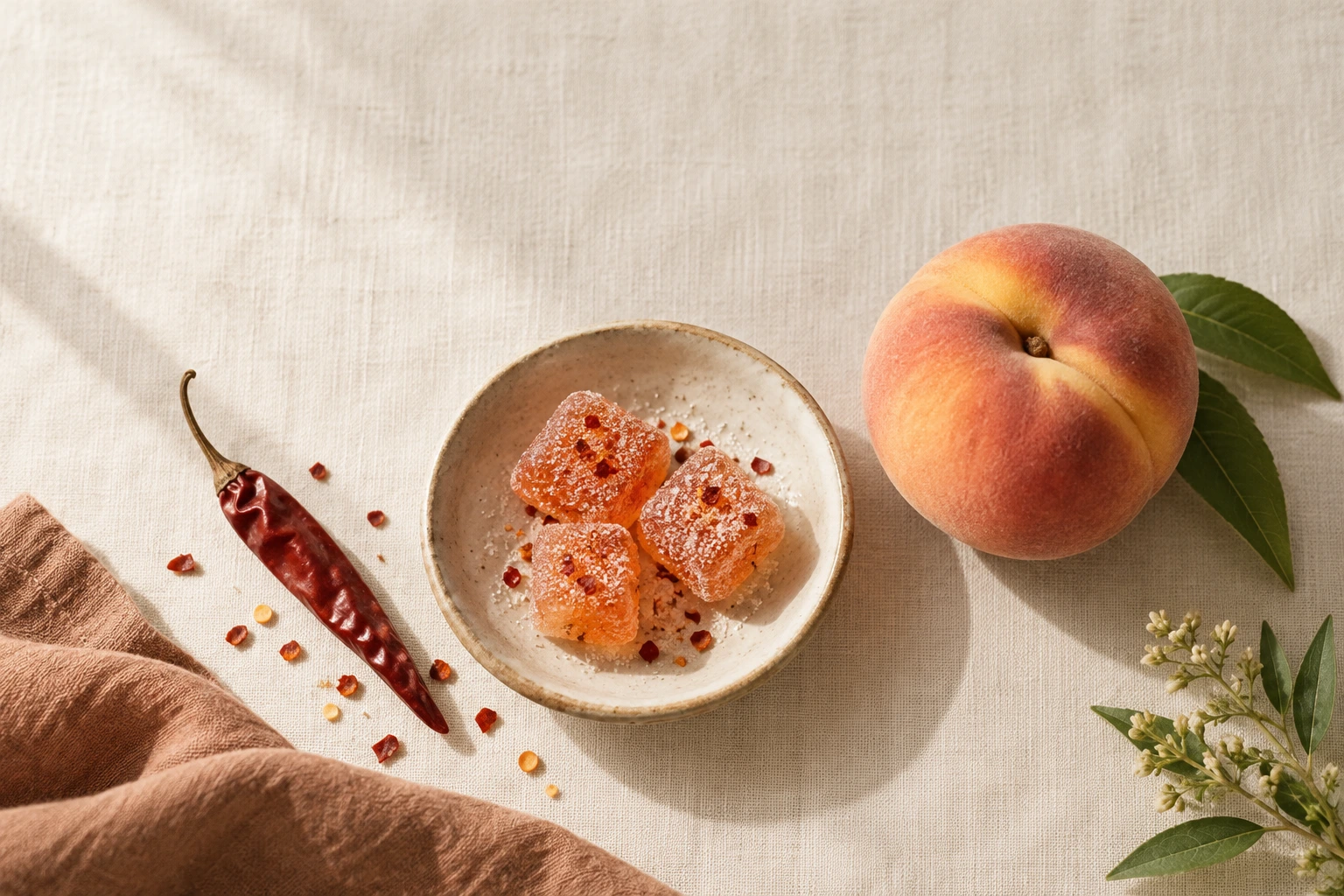
Libido gummies are dietary supplements in gummy form, marketed to support sexual desire with botanicals such as maca, horny goat weed, muira puama or ginkgo. The trials behind those ingredients are small and mixed, gummy products themselves are largely untested, and persistent low desire can have medical causes worth checking.
Nirast makes Nirast Hot Peach Edition. This article was written by Nirast’s editorial team and reports what the published research does and does not show.
See Nirast Hot Peach Edition → · 30-Day Money-Back Guarantee
Published by Thang Phi, founder of Nirast and publisher of the Nirast Journal.
This guide covers what these products contain, what the ingredient research can and cannot show, and how to read a label.
What are libido gummies?
Gummies are a fast-growing supplement format — a convenient, palatable alternative to tablets and capsules — but the format brings formulation, manufacturing and testing challenges, and makers still work against stability, texture and shelf-life limits (Hu et al., 2026; Vásquez-Senador et al., 2026).
Libido gummies are the sexual-wellness corner of that market: products sold online are advertised as “natural” and “safer” alternatives to prescription erectile-dysfunction medicines, and the ingredients claimed across the products one review monitored included yohimbine, ginseng, Ginkgo biloba, maca, horny goat weed and L-arginine (Corazza et al., 2014). A 2023 analysis found marketed erectile-dysfunction supplements vary in ingredients and concentrations, raising concerns about dosage, raw-material quality, drug interactions and real effectiveness (Petre et al., 2023).
One structural fact frames everything below: in the US and some European countries, herbal supplements skip the premarket testing drugs undergo, and claims about their effectiveness may be exaggerated or false (Ho et al., 2026).
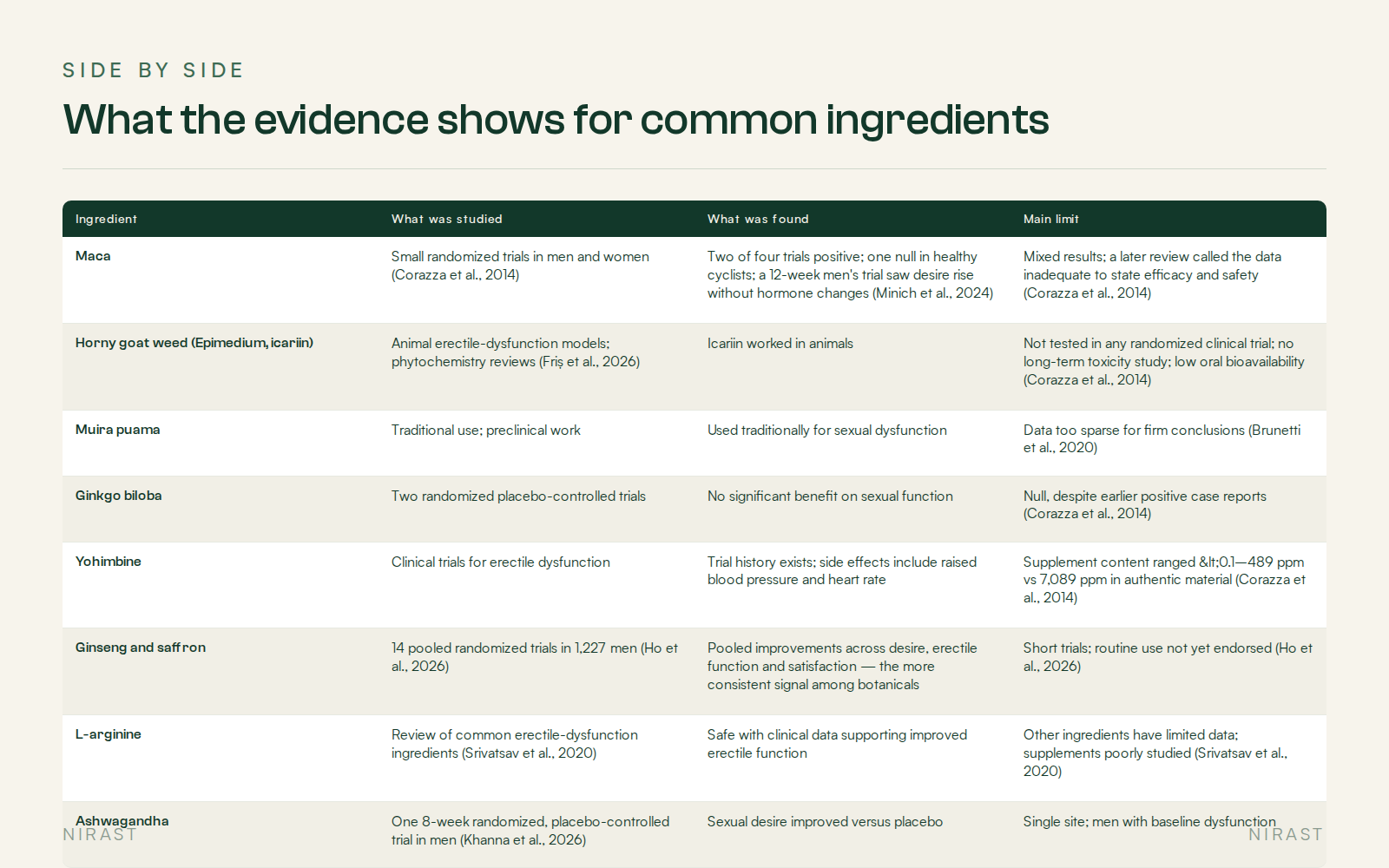
What the evidence shows for common ingredients
| Ingredient | What was studied | What was found | Main limit |
|---|---|---|---|
| Maca | Small randomized trials in men and women (Corazza et al., 2014) | Two of four trials positive; one null in healthy cyclists; a 12-week men’s trial saw desire rise without hormone changes (Minich et al., 2024) | Mixed results; a later review called the data inadequate to state efficacy and safety (Corazza et al., 2014) |
| Horny goat weed (Epimedium, icariin) | Animal erectile-dysfunction models; phytochemistry reviews (Friș et al., 2026) | Icariin worked in animals | Not tested in any randomized clinical trial; no long-term toxicity study; low oral bioavailability (Corazza et al., 2014) |
| Muira puama | Traditional use; preclinical work | Used traditionally for sexual dysfunction | Data too sparse for firm conclusions (Brunetti et al., 2020) |
| Ginkgo biloba | Two randomized placebo-controlled trials | No significant benefit on sexual function | Null, despite earlier positive case reports (Corazza et al., 2014) |
| Yohimbine | Clinical trials for erectile dysfunction | Trial history exists; side effects include raised blood pressure and heart rate | Supplement content ranged <0.1–489 ppm vs 7,089 ppm in authentic material (Corazza et al., 2014) |
| Ginseng and saffron | 14 pooled randomized trials in 1,227 men (Ho et al., 2026) | Pooled improvements across desire, erectile function and satisfaction — the more consistent signal among botanicals | Short trials; routine use not yet endorsed (Ho et al., 2026) |
| L-arginine | Review of common erectile-dysfunction ingredients (Srivatsav et al., 2020) | Safe with clinical data supporting improved erectile function | Other ingredients have limited data; supplements poorly studied (Srivatsav et al., 2020) |
| Ashwagandha | One 8-week randomized, placebo-controlled trial in men (Khanna et al., 2026) | Sexual desire improved versus placebo | Single site; men with baseline dysfunction |
A 2026 meta-analysis of 14 randomized trials in 1,227 men with erectile dysfunction found positive effects versus control on erectile function, orgasm, desire (SMD 1.02, 95% CI 0.45–1.60) and satisfaction, with saffron and ginseng carrying the more consistent signal. For other botanicals, evidence is limited by small numbers, short duration and variable quality, and routine clinical use cannot yet be endorsed (Ho et al., 2026).
Epimedium extracts themselves are chemically variable — more than 270 compounds are described, with standardization a recurring limitation (Friș et al., 2026). In 67 women with self-reported low libido at one site in India, shatavari root extract 300 mg once daily outperformed placebo on arousal quality, orgasmic response and encounter satisfaction (Satla et al., 2026). Energy ingredients are studied for a different job: L-theanine for cognition and relaxation (Cotter & Kilpatrick, 2026), caffeine-plus-theanine for attention (Payne et al., 2025) — not desire.
What the evidence does not show
Nothing here is evidence that a libido gummy raises libido. The trials above are ingredient-level, and the supplement category remains poorly studied (Srivatsav et al., 2020). For the botanicals used in low-desire products, a 2025 review states that clear evidence of an effect superior to placebo on sexual functions is lacking (Ågmo, 2025). A positive animal study, or one extract trial at one dose, is not an outcome for a finished product: ingredient evidence vs product evidence, how to tell.
Placebo, expectation and self-report
Desire is measured largely by asking people how they feel, which shapes what trials can show. Placebo-controlled designs are the standard in low-desire research (Ashour, 2026), and the placebo arm is not a formality: one 2025 review describes the measured effect of approved low-desire drugs beyond placebo as small — a meta-analysis it cites found flibanserin increased satisfactory sexual events per month by about 0.69 in premenopausal women (Ågmo, 2025). The same review argues that relying on self-reported outcomes means the FDA’s evaluation guidelines may lead to false conclusions (Ågmo, 2025).
How to read a libido gummy label
Five decisions:
- Look for amounts, not just names. Proprietary-blend rules require the blend weight and ingredient names, but not individual amounts — label amounts can’t be used to calculate exposures or trial doses (Saldanha et al., 2023).
- Check whether the studied material matches the label. Standardization of extract constituents is a recurring research limitation (Friș et al., 2026), and half of maca’s clinical trials didn’t report which type of maca was used (Minich et al., 2024).
- Treat “natural” as positioning, not a safety guarantee. Yohimbine’s side effects include raised blood pressure and heart rate (Corazza et al., 2014), and drug interactions are a documented concern (Petre et al., 2023).
- Ask what the testing story is. Of 776 adulterated supplements reported by the FDA from 2007–2016, 353 (45.5%) were marketed for sexual enhancement and 20.2% contained more than one pharmaceutical ingredient (Tucker et al., 2018); testing documentation is what a batch certificate is for: what a batch certificate of analysis documents.
- Treat confident numbers as claims. A 2025 analysis found 12% of legal-supply-chain melatonin samples violated legislation (unauthorized claims or at least triple the permitted amount), with flavored gummy formulations in child ingestion incidents (Vanhee et al., 2025). Percentage claims deserve the same scepticism as any statistic: how to read a “93% of users said” claim.
Who should see a clinician
Low desire is common and sometimes medical. Sexual complaints among women run 40–50% across assessment methods (Kamrul-Hasan et al., 2024), and persistent low desire with distress has a clinical frame — hypoactive sexual desire disorder (HSDD), defined by deficient desire causing marked distress, with prevalence estimated at 8–19% and higher in postmenopausal women (Edinoff et al., 2022). HSDD management is explicitly biopsychosocial (Rowen et al., 2026).
Medication is one reason to see a clinician: many prescription drugs — antidepressants, antihypertensives, antipsychotics, opioids — can negatively impact sexual desire (Brunetti et al., 2020), and antidepressant-induced sexual dysfunction is common and under-recognized, with management including dose reduction, switching or augmentation (Zini & Turecki, 2026). Women commonly seek alternatives for relief (Dording & Sangermano, 2018). The product’s own page draws the same line: not for anyone under 18, and consult a healthcare provider if pregnant, breastfeeding, on medication or managing a condition (product page). If low desire is persistent or distressing, that visit is the higher-value first step.
FAQ
Do libido gummies work?
No trial has tested a libido-gummy product itself. Ingredient trials are small and mixed, and for the botanicals commonly used for low desire, clear evidence of an effect superior to placebo is lacking (Ågmo, 2025). Signals exist — saffron and ginseng pooled (Ho et al., 2026), ashwagandha in one men’s trial (Khanna et al., 2026) — but none is an outcome for a finished gummy.
What is usually in libido gummies?
The claimed ingredients across products sold online include yohimbine, ginseng, Ginkgo biloba, maca, horny goat weed and L-arginine (Corazza et al., 2014). Because proprietary-blend rules let labels hide individual amounts (Saldanha et al., 2023), two products with the same names can be very different formulas.
Are libido gummies safe?
“Natural” is positioning, not a safety result. Yohimbine’s side effects include raised blood pressure and heart rate (Corazza et al., 2014), supplement–drug interactions are a documented concern (Petre et al., 2023), and gummies bring their own testing challenges (Hu et al., 2026). Ask a clinician if you take medication or are pregnant or breastfeeding.
How long do libido gummies take to work?
The trials that measured desire ran for weeks — 12 weeks for the maca trial (Minich et al., 2024), 8 weeks for ashwagandha (Khanna et al., 2026). Those were extract trials; no trial has measured how fast a gummy product acts.
Do libido gummies work for women?
Women’s trials are thin: the shatavari trial — 67 women, one site — found improvements versus placebo on self-reported measures (Satla et al., 2026). Low desire is common — 40–50% of women report sexual complaints (Kamrul-Hasan et al., 2024) — and HSDD has recognized biopsychosocial options (Rowen et al., 2026), so persistent low desire is worth a clinical conversation.
Can I take libido gummies with medication?
Many prescription drugs can negatively impact sexual desire (Brunetti et al., 2020), and drug interactions are a documented concern for sexual-enhancement supplements (Petre et al., 2023). The product’s page says to consult a healthcare provider if you are on medication (product page).
A gummy option: Nirast Hot Peach Edition
Nirast Hot Peach Edition is a cube-shaped, sugar-coated aphrodisiac gummy with a hot peach flavor and a chili coating. Its label’s Supplement Facts panel declares, per gummy, 30 mg caffeine (from green tea extract), 60 mg L-theanine, and an 810 mg proprietary blend naming muira puama (6:1 extract), horny goat weed (Epimedium 10:1 extract), maca root (4:1 extract) and ginger root (4:1 extract) (product page).
Directions: about 30 minutes before intimacy, limited to one gummy per person per day; not for anyone under 18; consult a healthcare provider if pregnant, breastfeeding, on medication or managing a condition. The offer is backed by a 30-Day Money-Back Guarantee, with support@nirast.co for returns and subscription changes (product page).
For a gummy whose label declares its caffeine, theanine and blend amounts — and whose directions and guarantee are stated up front — see Nirast Hot Peach Edition.
These statements have not been evaluated by the Food and Drug Administration. This product is not intended to diagnose, treat, cure, or prevent any disease. Talk to your doctor or pharmacist before starting a supplement, especially if you are pregnant, nursing, take medication or have a medical condition.
Related reading
- Do Libido Gummies Work? What the Evidence Actually Shows
- Sleep Gummies: What They Are, What the Evidence Shows, and How to Choose
- Pheromone Cologne: What It Is, What the Evidence Shows, and How to Choose
- Lymphatic Drainage Drops: What They Are and What the Evidence Shows
Related product: Nirast Hot Peach Edition.