
Vaginal Dryness: What It Is, What Helps, and When to See a Clinician
Vaginal dryness is a common symptom of the genitourinary syndrome of menopause — a chronic, progressive condition linked to estrogen decline — and it can also follow childbirth, breastfeeding or certain medications. Moisturizers and lubricants are the first-line options, prescription treatments exist, and persistent symptoms deserve a clinician’s assessment.
Nirast makes Nirast Vaginal Moisture & Mood. This article was written by Nirast’s editorial team and reports what the published research does and does not show.
See Nirast Vaginal Moisture & Mood → · 30-Day Money-Back Guarantee
Published by Thang Phi, founder of Nirast and publisher of the Nirast Journal.
What vaginal dryness is
Vaginal dryness is a genitourinary symptom grouped under the term genitourinary syndrome of menopause, or GSM (Cureus review, 2026). Vulvovaginal atrophy, a component of GSM, affects about 40% of postmenopausal individuals (Cureus review, 2026).
Estrogen depletion alters vaginal vascularity, collagen, musculature, epithelium and microbiome, producing dryness, epithelial fragility, higher pH and reduced elasticity and lubrication (Cureus review, 2026).
Unlike hot flashes, genitourinary signs and symptoms progress without treatment, and GSM is chronic: ongoing treatment is required to maintain relief (Cureus review, 2026; Clinics and Practice review, 2026).
Why it happens
Menopause and perimenopause. Falling estrogen changes vaginal tissue, lubrication and pH — dryness is the classic genitourinary symptom of the transition (Cureus review, 2026).
Childbirth and breastfeeding. The postpartum period is a state of relative estrogen depletion — prolactin suppresses ovarian estrogen production — and postpartum vaginal atrophy and dyspareunia are common in breastfeeding women: 67.6% and 80% respectively in cited cohorts (Acta Obstetricia et Gynecologica Scandinavica review, 2026). A 2026 review groups these symptoms under “genitourinary syndrome of lactation” and notes they are often dismissed as a normal part of having a baby (Women’s Health review, 2026).
Medications. Sexual dysfunction symptoms can include decreased libido and difficulty with arousal that results in vaginal dryness, and antidepressants can exacerbate arousal difficulty (Cureus review, 2025). If a medication is involved, the adjustment decision belongs with the prescriber.
Other causes. Vaginal dryness is also common in Sjögren’s disease — 53% of individuals with the condition versus 28% of controls in one comparison (Journal of Clinical Medicine review, 2026).
When to see a clinician
GSM is diagnosed mainly clinically — bothersome symptoms plus characteristic examination findings — using evaluation methods that include pelvic examination, vaginal pH, cytology and questionnaires (Gynecology and Pelvic Medicine review, 2026; Cureus review, 2026). Yet it remains underdiagnosed and undertreated, and the reviewed literature says women should be screened and educated about their options (Maturitas review, 2026).
Persistent, painful or bothersome symptoms are therefore a clinical question, not something to quietly live with — especially after childbirth, where symptoms are often dismissed (Women’s Health review, 2026).
What helps: moisturizers, lubricants and prescription options
Vaginal lubricants and moisturizers are recommended as first-line treatments for GSM, alone or alongside vaginal hormone therapy (Clinics and Practice review, 2026). They do different jobs: lubricants are used during sex to reduce friction; moisturizers are used regularly, outside sex, to restore tissue hydration and elasticity (Clinics and Practice review, 2026).
The evidence is meaningful, but bounded. In a 12-week, three-arm trial of 302 women, moisturizers showed comparable efficacy to low-dose vaginal estrogen and placebo gel (Clinics and Practice review, 2026). A 100-woman randomised trial in breast-cancer survivors found a non-hormonal moisturizer improved vaginal and vulvar health versus a lubricant (Maturitas trial, 2026). A 50-woman, single-arm study of a hyaluronic-acid moisturizer recorded dryness scores falling 69.3% by day 22 and dyspareunia improving in 93% of participants — though the design limits attribution (Healthcare study, 2026); a meta-analysis rated that evidence moderate-certainty for dryness and low for safety (International Journal of Gynecology & Obstetrics meta-analysis, 2026).
Lubricant use during sex has numerous benefits and minimal harms; silicone- or water-based products within recommended osmolality and pH ranges are advised for condom users or recurrent irritation (Canadian Family Physician, 2025).
When non-hormonal options are not enough, prescription treatments — a clinician’s decision — enter the picture. Vaginal estrogen is generally considered the cornerstone of GSM treatment, with minimal systemic absorption (Gynecology and Pelvic Medicine review, 2026), and guidelines recommend it for urinary-tract-infection prevention, with reductions of up to 50–75% in some trials (Gynecologic and Obstetric Investigation review, 2026). Vaginal DHEA and oral ospemifene are the other prescription options with guideline support (Clinics and Practice review, 2026).
For postpartum symptoms, data on topical estrogens are scarce — likely safe, not firmly established (Acta Obstetricia et Gynecologica Scandinavica review, 2026) — and low-dose vaginal estrogen is positioned as reasonable for persistent moderate-to-severe symptoms after shared decision-making (Women’s Health review, 2026). Pelvic floor relaxation exercises are part of treatment when hypertonic pelvic floor muscles contribute to deep dyspareunia (Clinics and Practice review, 2026).
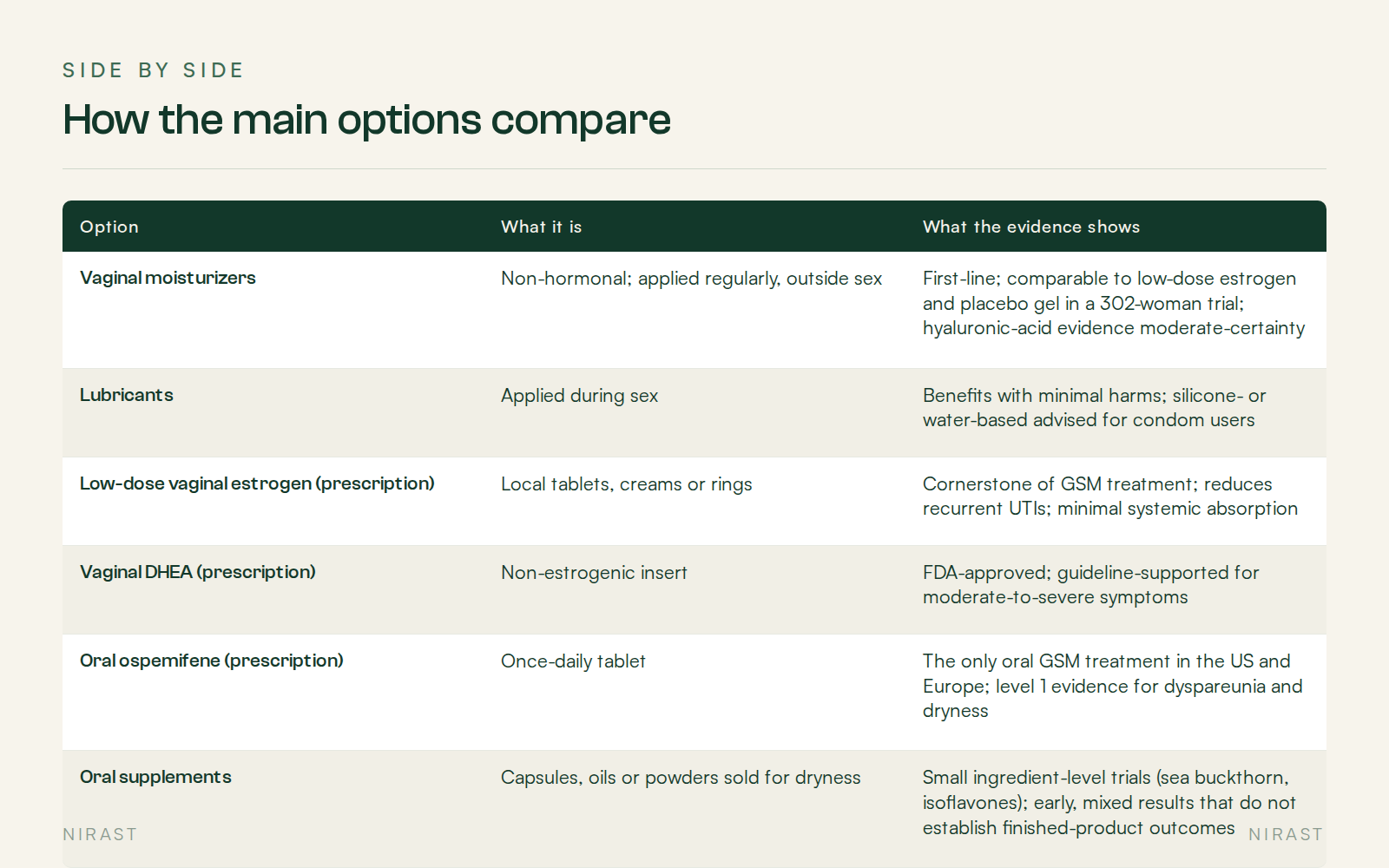
How the main options compare
| Option | What it is | What the evidence shows |
|---|---|---|
| Vaginal moisturizers | Non-hormonal; applied regularly, outside sex | First-line; comparable to low-dose estrogen and placebo gel in a 302-woman trial; hyaluronic-acid evidence moderate-certainty |
| Lubricants | Applied during sex | Benefits with minimal harms; silicone- or water-based advised for condom users |
| Low-dose vaginal estrogen (prescription) | Local tablets, creams or rings | Cornerstone of GSM treatment; reduces recurrent UTIs; minimal systemic absorption |
| Vaginal DHEA (prescription) | Non-estrogenic insert | FDA-approved; guideline-supported for moderate-to-severe symptoms |
| Oral ospemifene (prescription) | Once-daily tablet | The only oral GSM treatment in the US and Europe; level 1 evidence for dyspareunia and dryness |
| Oral supplements | Capsules, oils or powders sold for dryness | Small ingredient-level trials (sea buckthorn, isoflavones); early, mixed results that do not establish finished-product outcomes |
Five decisions:
- If symptoms persist or interfere with daily life, make it a clinical conversation (Gynecology and Pelvic Medicine review, 2026).
- Match the product to the moment — a moisturizer for regular hydration, a lubricant for sex (Clinics and Practice review, 2026).
- If non-hormonal options are not enough, ask about prescription options (Gynecology and Pelvic Medicine review, 2026).
- Treat oral-supplement claims as early signals, not settled effects (Cureus review, 2025).
- Do not accept “it’s just aging” as the answer — ongoing treatment maintains symptom relief (Clinics and Practice review, 2026).
What oral supplements can and cannot show
Some oral options have been studied, with promising but early signals:
- Sea buckthorn oil. In a 116-woman trial, the oil group had a significantly better rate of improvement in vaginal epithelial integrity (OR 3.1, 95% CI 1.11–8.95) (Maturitas trial, 2014).
- Isoflavones. A meta-analysis found a significant pooled change in vaginal dryness (mean difference −1.29, 95% CI −2.53 to −0.04) with very high heterogeneity (I² = 93%) (Obstetrics & Gynecology Science meta-analysis, 2025).
- Collagen peptides. A pilot combining radiofrequency treatment with an oral supplement improved outcomes versus radiofrequency alone, but with no placebo or supplement-only group the supplement’s effect cannot be isolated (Journal of Clinical Medicine, 2025).
- Ashwagandha. A 60-woman randomised trial measured the Menopause Rating Scale over 56 days; the mean score fell from 31.37 to 18.53 in the treatment arm (Frontiers in Reproductive Health, 2025).
Reviews of this literature list recurring limitations: few studies, small samples, short durations and a lack of control groups (Cureus review, 2025). Ingredient-level findings describe an ingredient and a study preparation, not a finished product — see Ingredient evidence vs product evidence. And when a page leads with a satisfaction percentage instead of a trial, here is how to read that claim.
The bottom line: the options with guideline support are the local and prescription treatments above; oral supplements sit outside that framework — worth discussing with a clinician, not a replacement for clinical care.
The safety frame
If you take medication, are pregnant or nursing, or manage a health condition, ask a clinician before adding any supplement (Cureus review, 2025). Prescription options carry their own safety profiles to discuss, including the 2025 reconsideration of boxed warnings for low-dose vaginal estrogen (Gynecologic and Obstetric Investigation review, 2026). Postpartum symptoms deserve a proper assessment rather than reassurance that they are normal (Women’s Health review, 2026).
FAQ
What causes vaginal dryness?
Falling estrogen around menopause and perimenopause is the dominant cause: it changes vaginal tissue, lubrication and pH (Cureus review, 2026). It can also follow childbirth and breastfeeding (Acta Obstetricia et Gynecologica Scandinavica review, 2026), and some medications contribute through arousal-related side effects (Cureus review, 2025); it is also common in Sjögren’s disease (Journal of Clinical Medicine review, 2026).
How common is vaginal dryness?
About 40% of postmenopausal individuals are affected by vulvovaginal atrophy, with a wider GSM range of 27–84% in one review — yet GSM remains underdiagnosed and undertreated (Cureus review, 2026; Journal of Women’s Health review, 2026).
Do vaginal moisturizers and lubricants actually work?
For many women, yes: they are recommended first-line, and in a 302-woman trial moisturizers performed comparably to low-dose vaginal estrogen and placebo gel (Clinics and Practice review, 2026). A trial in breast-cancer survivors found a moisturizer outperformed a lubricant (Maturitas trial, 2026), and lubricants used during sex have numerous benefits and minimal harms (Canadian Family Physician, 2025).
Can supplements help vaginal dryness?
Some have been tested, with early signals: sea buckthorn oil in a 116-woman trial (Maturitas trial, 2014) and isoflavones in a meta-analysis with very high heterogeneity (Obstetrics & Gynecology Science meta-analysis, 2025). Reviews describe small, short, uncontrolled studies as the norm (Cureus review, 2025) — a choice to discuss with a clinician, not an established treatment.
When should I see a doctor about vaginal dryness?
If symptoms are persistent, painful or affecting daily life. GSM is diagnosed mainly clinically (Gynecology and Pelvic Medicine review, 2026), progresses without treatment (Cureus review, 2026), and is frequently under-recognized — women should be screened and educated about their options (Maturitas review, 2026).
What’s the difference between a vaginal moisturizer and a lubricant?
Timing and purpose: a lubricant is applied during sexual activity; a moisturizer is used regularly, outside it, to restore tissue hydration and elasticity (Clinics and Practice review, 2026).
A daily capsule option: Nirast Vaginal Moisture & Mood
For a daily capsule option, Nirast Vaginal Moisture & Mood is a vegan capsule supplement taken as 2 capsules once daily with water. The label’s Supplement Facts list Ashwagandha KSM-66® (Withania somnifera) Root Extract at 600 mg per serving, and the label states its ingredients support healthy sexual function, healthy vaginal moisture, and mood & relaxation. The label also says not to use it if pregnant or nursing, and to consult a physician if you have a medical condition or take medications — including hormone therapy and birth control pills. The product carries a 30-Day Money-Back Guarantee (product page).
To be clear: a daily supplement, not a treatment for GSM or any medical condition — persistent or bothersome symptoms belong with a clinician (Gynecology and Pelvic Medicine review, 2026). If it fits your routine and your health situation, see Nirast Vaginal Moisture & Mood here.
These statements have not been evaluated by the Food and Drug Administration. This product is not intended to diagnose, treat, cure, or prevent any disease. Talk to your doctor or pharmacist before starting a supplement, especially if you are pregnant, nursing, take medication or have a medical condition.
Related reading
- Vaginal Dryness Supplements: What Oral Options Have Been Studied — and Where They Fit
- Natural Testosterone Booster: What the Evidence Shows and When to See a Clinician
- Lymphatic System Support: What Actually Helps, and Where Supplements Fit
- Aged Garlic Extract: What Aging Changes, What the Evidence Covers, and How to Choose
Related product: Nirast Vaginal Moisture & Mood.