
Ethiopian vs Egyptian Black Seed Oil: What Actually Differs
Nirast makes Ethiopian Black Seed Oil. This article was written by Nirast’s editorial team and reports what the published research does and does not show.
See Nirast Ethiopian Black Seed Oil → · $29.99 a month · 30-Day Money-Back Guarantee
Published by Thang Phi, founder of Nirast and publisher of the Nirast Journal.
The short answer
Ethiopian and Egyptian black seed oil are the oil of the same plant, Nigella sativa; the country name describes where the seed was grown, not a different botanical. Origin can legitimately change growing conditions, seed lot and supplier chain, and some studies do measure composition differences between origins — but a claimed difference in a specific bottle’s constituents needs a batch value and a stated method, which the origin word alone does not provide.
That is the whole comparison in one paragraph. The rest of this article shows where origin-linked differences are real, where they are overstated, and why the country name on a label is not the same thing as a measured value.
They are the same species, from different places
“Ethiopian” and “Egyptian” name where a Nigella sativa seed lot was grown, not a different plant. Both comparisons cited here analyse the oil of the same species collected from different countries: one study sets Egyptian, Ethiopian and Syrian black cumin oils against each other, and another profiles 27 oils from Egypt, Ethiopia and Syria (Assessment of Egyptian, Ethiopian and Syrian black cumin oils, PMID 39519627; Fingerprint profile for geographical origin determination, PMID 29730530). Origin is therefore a variable inside one species, and an honest comparison has to compare measurements rather than the country word.
What one comparison actually measured
Origin is not pure noise. In the three-country comparison, the share of thymoquinone within the measured volatile fraction was highest in the Ethiopian oil (34.84%), then Egyptian (27.36%), then Syrian (22.59%), and the Ethiopian oil also had the highest phenolics, flavonoids, phytosterols and tocochromanols and the longest oxidative-stability induction period, 7.89 hours (PMID 39519627). A separate study of 27 oils from the same three countries found significant differences in measured antimicrobial, cytotoxic, anti-inflammatory and analgesic activity, and identified thymoquinone and free fatty acids as compounds that could distinguish origin (PMID 29730530).
Those are real laboratory findings, and they are compositional or in-vitro results rather than clinical ones. They show that origin can correlate with what is in the oil. They do not show that one origin is better for a person.
The evidence is not as settled as a marketing line suggests
A single study is not a settled field, and the origin literature contradicts itself in useful ways:
- A 13-sample study reported no discernible link between the observed variation and seed origin or expiry date; fatty-acid and sterol composition were relatively stable, while tocol content swung widely, from 140 to 631 mg/kg (Variation in composition and quality, PMID 38542995).
- Which origin “wins” depends on what you measure. In one dataset thymoquinone ranked Saudi Arabia, then Pakistan, then India, while elemental content from the same samples ranked Saudi Arabia, then India, then Pakistan (Thymoquinone in commercial black seeds by origin, PMID 31711807).
- Even within one country the composition varies: 64 Ethiopian Nigella sativa genotypes differed in their essential-oil composition, thymoquinone included (Diversity of Ethiopian black cumin genotypes, PMID 40330625).
Why “Ethiopian” is not a specification
The country word spans a range, not a value. Measured thymoquinone content across commercial black seed products has run from about 3.08 to 809.4 mg per 100 g, roughly a 250-fold spread, and the variation is attributed to geography, harvest time, storage and extraction (Screening of thymoquinone in commercial products, PMID 36079759). A pharmacology review lists geographical location as one factor among extraction and oxidative status (The role of thymoquinone, PMID 34297870). A bottle’s content therefore depends on far more than the flag on its label.
What an origin line on a label actually is
Under the relevant guidance, a country-of-origin declaration is a legal marking of where an imported article came from, not a rating of quality or composition (FDA dietary supplement labelling guide, chapter I). That is exactly how to read “single-origin Ethiopian” on a product page: a sourcing statement about where the material is said to come from, and not a potency claim.
What the research cannot tell us
The strongest origin comparison here used oils supplied by a single local company, so the origin effect is tangled up with supplier, seed lot and processing; no cited study isolated origin as the only variable. Every measured difference is compositional or in-vitro, and none of the cited work establishes a different human outcome between origins. Much of it was read at abstract level, so the numbers are directional rather than final.
How to decide whether origin should decide your purchase
Use origin as a sourcing preference, not a quality score:
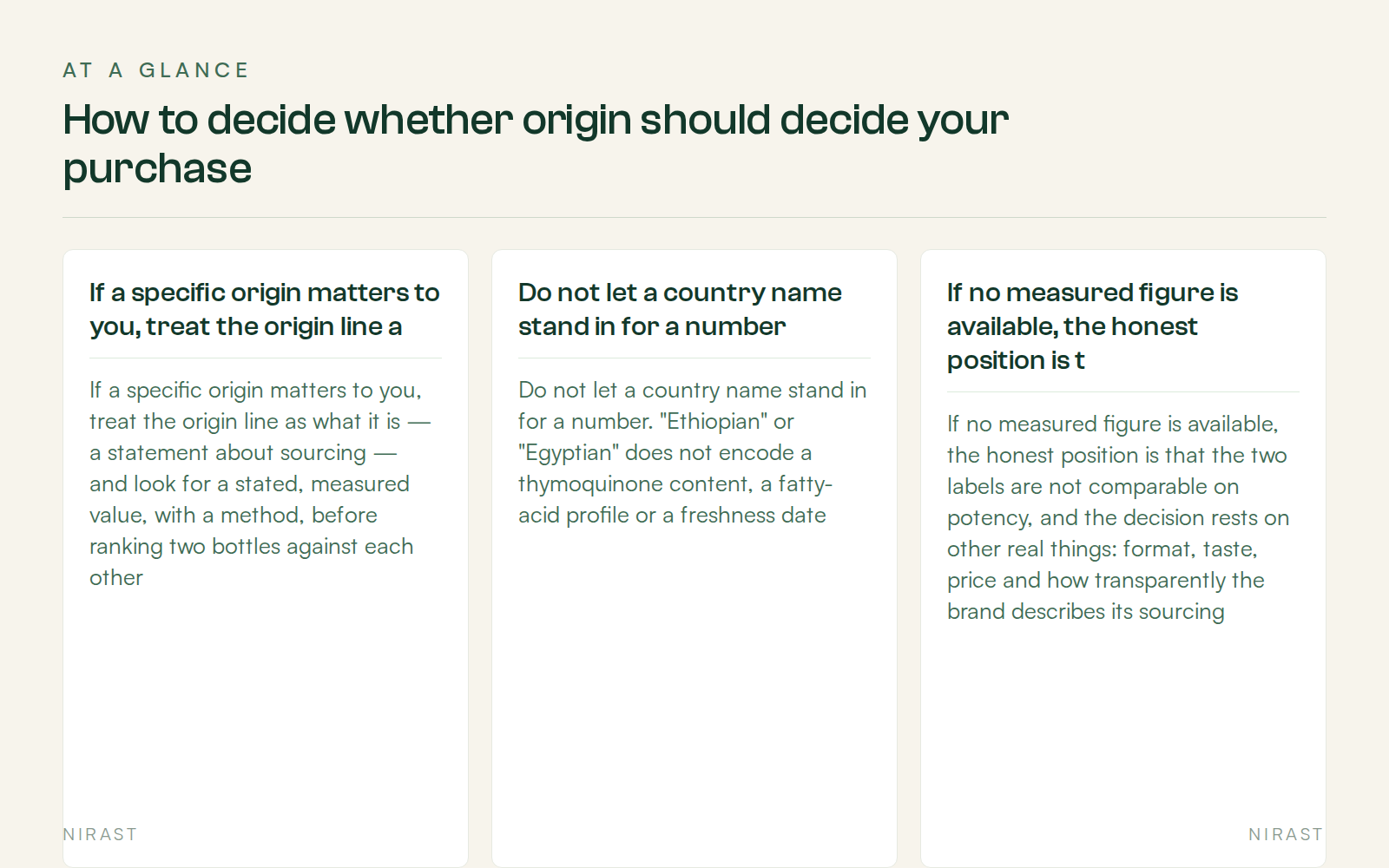
- If a specific origin matters to you, treat the origin line as what it is — a statement about sourcing — and look for a stated, measured value, with a method, before ranking two bottles against each other.
- Do not let a country name stand in for a number. “Ethiopian” or “Egyptian” does not encode a thymoquinone content, a fatty-acid profile or a freshness date.
- If no measured figure is available, the honest position is that the two labels are not comparable on potency, and the decision rests on other real things: format, taste, price and how transparently the brand describes its sourcing.
Frequently asked questions
Is Ethiopian black seed oil better than Egyptian?
Not on the strength of the origin word alone. In one comparison, Ethiopian oil measured the highest thymoquinone share and the highest phenolics and tocochromanols; in another study origin showed no discernible link to composition at all. Origin correlates with composition in some datasets and not others, so it is a sourcing fact rather than a quality verdict.
Does the country on the label tell me the thymoquinone content?
No. The country word explains where the seed was grown, while thymoquinone content varies with cultivar, harvest, storage and extraction as well as geography, and has to be measured. Only a stated, measured figure tells you a content.
Why do some videos claim one origin has several times more thymoquinone?
Those claims usually repeat a vendor’s marketing framing rather than a published measurement. Where origin differences have been measured, they are real but specific to the study, the supplier and the batch; a fixed multiple applied to “Ethiopian oil” in general is not something the published comparisons support.
Does origin affect anything at all?
It can. Origin is one of several factors that shift the measured composition of the oil, alongside harvest time, storage and extraction method. What the evidence does not support is the leap from “origin can affect composition” to “one origin is the best”.
If I want single-origin Ethiopian oil, what should I check?
Check that the page states the origin as a sourcing fact, and then look for anything measured: a batch value, a method, a specification. Without a measured figure, “Ethiopian” tells you where the seeds were grown and nothing about what is in the bottle.
Is Ethiopian black seed oil different from regular black seed oil?
Not as a different oil. “Regular” black seed oil and Ethiopian black seed oil are both pressed from the seed of the same plant, Nigella sativa; the word Ethiopian states where that seed was grown. A bottle labelled Ethiopian can differ from another bottle in measured composition, but so can two unlabelled bottles, because cultivar, harvest, storage and extraction all move the numbers. Treat “Ethiopian” as a sourcing fact and judge the oil on anything measured for the batch.
If single-origin sourcing is what you want
Nirast Ethiopian Black Seed Oil is a Nigella sativa black seed oil declared as single-origin Ethiopian, sourced from highland farms, and sold as a softgel product. If a stated, single-origin source is a preference for you rather than a potency shortcut, this product’s page puts its origin on the label directly rather than burying it — and you now have the honest frame for it: the origin line is a sourcing fact, and the rest of the decision should rest on real, checkable attributes. You can read the product’s own origin statement and terms and order it here: https://try.nirast.co/black-seed-oil-otp/.
Sources
- Nirast Ethiopian Black Seed Oil product page — https://try.nirast.co/black-seed-oil-otp/
- Assessment of the Quality, Bioactive Compounds, and Antimicrobial Activity of Egyptian, Ethiopian, and Syrian Black Cumin Oils (Molecules, 2024; PMID 39519627) — https://pubmed.ncbi.nlm.nih.gov/39519627/
- Fingerprint profile and efficacy-associated markers of Nigella sativa oil for geographical origin determination using targeted and untargeted HPTLC-multivariate analysis (J Chromatogr B, 2018; PMID 29730530) — https://pubmed.ncbi.nlm.nih.gov/29730530/
- Variation in the Composition and Quality of Nigella sativa L. Seed Oils—The Underestimated Impact on Possible Health-Promoting Properties (Molecules, 2024; PMID 38542995) — https://pubmed.ncbi.nlm.nih.gov/38542995/
- Solvent and temperature effects of accelerated solvent extraction coupled with UHPLC-DAD for determination of thymoquinone in commercial food samples of black seeds (Nigella sativa) (Food Chem, 2020; PMID 31711807) — https://pubmed.ncbi.nlm.nih.gov/31711807/
- Diversity of Ethiopian Black Cumin (Nigella sativa L.) Genotypes Based on Essential Oil Compositions (Biochem Res Int, 2025; PMID 40330625) — https://pubmed.ncbi.nlm.nih.gov/40330625/
- Screening of Thymoquinone Content in Commercial Nigella sativa Products to Identify a Promising and Safe Study Medication (Nutrients, 2022; PMID 36079759) — https://pubmed.ncbi.nlm.nih.gov/36079759/
- The role of thymoquinone, a major constituent of Nigella sativa, in the treatment of inflammatory and infectious diseases (Clin Exp Pharmacol Physiol, 2021; PMID 34297870) — https://pubmed.ncbi.nlm.nih.gov/34297870/
- Dietary Supplement Labeling Guide: Chapter I. General Dietary Supplement Labeling (U.S. FDA, April 2005; nonbinding guidance) — https://www.fda.gov/food/dietary-supplements-guidance-documents-regulatory-information/dietary-supplement-labeling-guide-chapter-i-general-dietary-supplement-labeling
These statements have not been evaluated by the Food and Drug Administration. This product is not intended to diagnose, treat, cure, or prevent any disease. Talk to your doctor or pharmacist before starting a supplement, especially if you are pregnant, nursing, take medication or have a medical condition.
Ethiopian vs Egyptian black seed oil at a glance
This table puts the measured findings from the studies cited in this article side by side. Every figure links to the study it comes from.
| Question | Ethiopian oil | Egyptian oil |
|---|---|---|
| Is it a different plant? | No. Both are oil from the seed of the same species, Nigella sativa; the country names where the seed was grown (PMID 29730530). | |
| Thymoquinone share of the measured volatile fraction (one three-country study) | 34.84% | 27.36% (Syrian oil: 22.59%) (PMID 39519627) |
| Oxidative-stability induction period (same study) | 7.89 hours, the longest of the three oils | Shorter than the Ethiopian oil (PMID 39519627) |
| Phenolics, flavonoids, phytosterols, tocochromanols (same study) | Highest of the three oils | Lower than the Ethiopian oil |
| Does origin always show up in the numbers? | No. A 13-sample study found no discernible link between composition and seed origin; tocol content ranged from 140 to 631 mg/kg (PMID 38542995). | |
| Does one country mean one composition? | No: 64 Ethiopian genotypes differed in essential-oil composition, thymoquinone included (PMID 40330625) | Not established for Egyptian seed in the cited work |
| What tells you a bottle’s thymoquinone content? | Only a measured batch value with a method. Across commercial products it has ranged from about 3.08 to 809.4 mg per 100 g (PMID 36079759). | |
| What does the origin line on a label mean? | A legal country-of-origin marking, not a quality or potency rating (FDA labeling guide, ch. I). | |
All of these are laboratory and compositional findings. None of the cited studies compared how people respond to oil from one origin versus the other.
Related reading
- Black Seed Oil: What It Is, What the Evidence Covers, and How to Choose a Form
- Pressed Black Seed Oil vs the Whole Seed and the Spice: What Actually Differs
- What "Cold-Pressed" Actually Tells You About a Black Seed Oil
- What Human Trials of Black Seed Oil Have Actually Measured
Related product: Ethiopian Black Seed Oil.