
Should You Use Black Seed Oil for a Diagnosed Condition Like OCD or Diabetes?
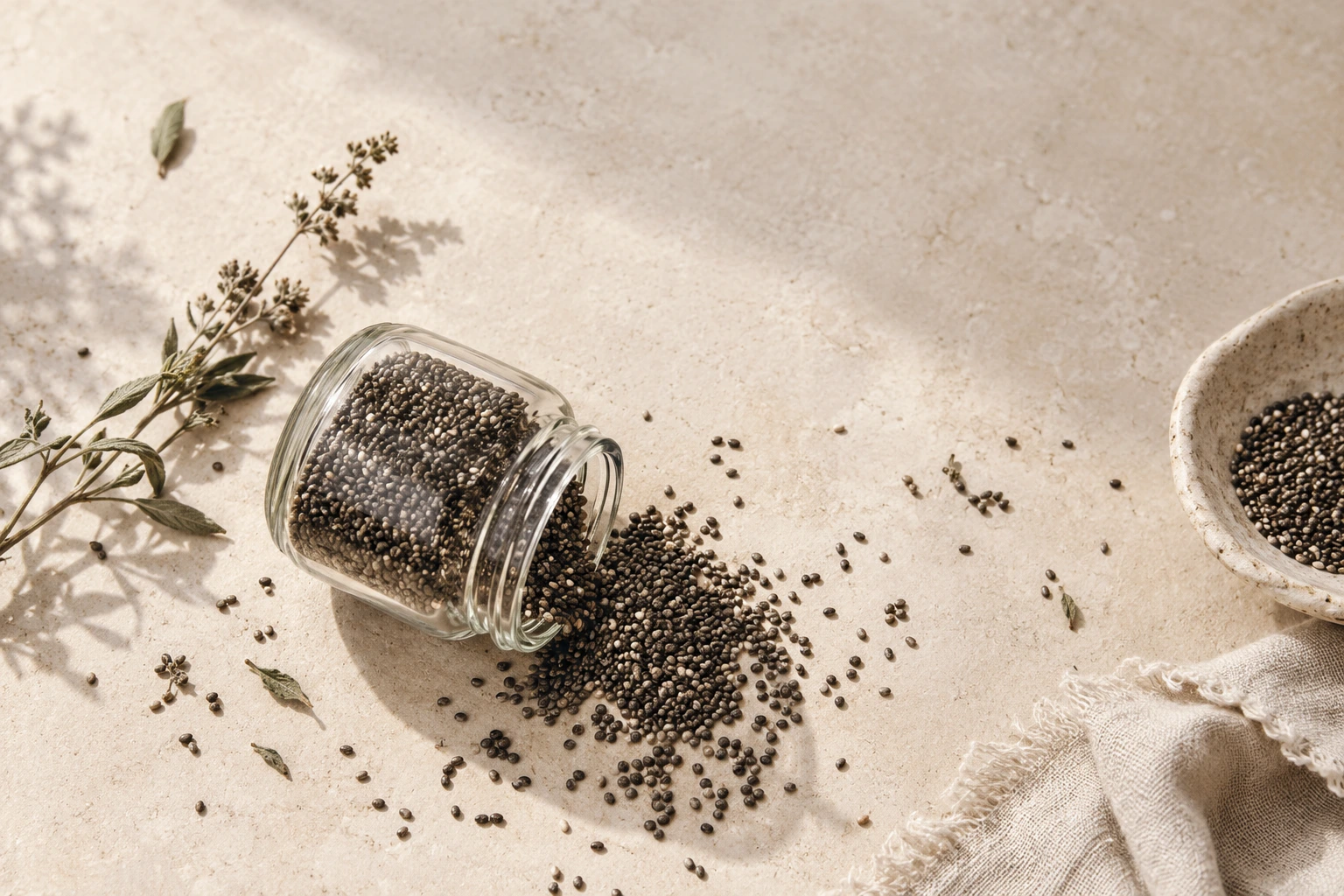
Using black seed oil for a diagnosed condition such as OCD or diabetes is a clinical decision rather than a self-treatment choice: the evidence available supports discussing it with the clinician who manages that diagnosis before you start, and treating any supplement as an addition to prescribed care rather than a replacement for it.
Nirast makes Ethiopian Black Seed Oil. This article was written by Nirast’s editorial team and reports what the published research does and does not show.
See Nirast Ethiopian Black Seed Oil → · $29.99 a month · 30-Day Money-Back Guarantee
Published by Thang Phi, founder of Nirast and publisher of the Nirast Journal.
If you arrived here because you found black seed oil while searching your own diagnosis, the useful next step is not a larger serving — it is a specific conversation. This page explains why a diagnosis changes who decides, what the human trials behind black seed actually measured, and what to verify before any botanical joins a plan you already manage.
Why a diagnosis changes who decides
An ingredient and a treatment plan are different things. Black seed oil (Nigella sativa) is studied as a supplement, and dietary supplements sit in a different regulatory category from drugs: manufacturers do not have to prove safety and effectiveness before marketing, and differences are often found between the ingredients and amounts a label declares and what a product actually contains. Because of that, one product’s clinical testing results may not carry over to another product — a trial of “black seed oil” in general is not a trial of the specific softgel or oil in front of you. (Black seed monograph, LactMed)
For a diagnosed condition there are two more reasons to slow down. First, the condition already has a plan — medication, monitoring, follow-up — and a botanical is being considered alongside that plan, not instead of it. Second, complementary approaches can only be judged inside it: a narrative review of integrative medicine for people living with both diabetes and mental-health disorders argues that complementary therapies should be delivered as part of conventional care, not substituted for it. (Integrative medicine review) A critical review of adjunctive natural products reaches the same conclusion from the other direction — “natural” does not carry a presumption of efficacy or safety, and the most credible examples are always product- and condition-specific. (Adjunctive natural products review)
What the human trials actually measured
Take the strongest single result in this evidence base. In a randomized, double-blind, placebo-controlled trial, 60 women with polycystic ovary syndrome (PCOS) took Nigella sativa oil at 1,000 mg per day for 12 weeks. After baseline adjustment, serum IL-6 and fasting blood glucose were significantly lower than placebo (both p < 0.001), while fasting insulin, HOMA-IR, QUICKI, luteinizing hormone and total testosterone showed no significant between-group difference. The authors frame the oil’s role as adjunctive and call for larger, adequately powered trials before clinical conclusions. (PCOS trial, 60 women, 12 weeks)
That pattern — significance on some laboratory markers, nothing on others, in one small population — is the honest shape of this literature. A critical review of antidiabetic botanicals rated the clinical relevance of its included Nigella sativa oil trial “uncertain,” noting the sample size and exposure were insufficient for durable efficacy or uncommon harms, and stresses that positive signals remain product-specific. (Antidiabetic critical review) The only diabetes-composition study retrieved here was in alloxan-induced diabetic rats given seed powder combined with fenugreek at 100 mg/kg for 28 days — animal evidence that cannot be read as a human result. (Diabetic rat study)
For a mental-health diagnosis such as OCD
Here the evidence is thinner still. The published trial record does not, at this point, include a randomized controlled trial of Nigella sativa for OCD; the reader questions that circulate online pair black seed oil with outcomes those questions cannot establish. When a diagnosis such as OCD is involved, the ingredient is even further from a self-treatment decision: OCD has established, clinician-managed treatments, and a supplement discussion belongs inside that care rather than in place of it.
Safety boundaries worth raising with a clinician first
A few specifics make the conversation concrete. A monograph on black seed records that it has been used traditionally as a galactagogue but that no scientifically valid clinical trials support that use in humans, and that no data exist on its safety in infants — relevant if you are pregnant or breastfeeding. (LactMed monograph) A review of herb–drug interactions describes a single, multifactorial case of thrombocytopenia in a patient chronically taking evening primrose oil together with black seed oil, and advises taking cumulative effects of prescription drugs and combined herbal treatments into account. (Herb–drug interaction review) A systematic review and meta-analysis of Nigella sativa in children found no statistically significant side effects across its included trials, but concluded that efficacy, effective dose and form are not yet settled and that more high-quality studies are needed. (Pediatrics meta-analysis)
None of that is a verdict on any one product; it is the list of questions a clinician will want answered. It is also why “how much should I take for my condition?” has no safe generic answer from a search engine.
What to verify before a botanical joins a plan
If you and your clinician decide a bounded botanical trial is reasonable, the same label-reading standard applies as for any supplement: what the serving definition is, how many units make a serving, the amount per serving, the printed directions, and the testing the maker can actually document. The review of adjunctive natural products makes that standard explicit — before a botanical’s benefit for a diagnosis is assumed, the evidence has to be product- and indication-specific. (Adjunctive natural products review)
If you and your clinician agree to try a botanical
Then the remaining question is form and fit, not efficacy. Nirast Ethiopian Black Seed Oil is a tasteless, easy-to-swallow softgel — the format people reach for when the taste of liquid oil is the sticking point — made from cold-pressed Nigella sativa oil, single-origin Ethiopian, with 1,000 mg of black seed oil per serving printed on the page and the directions “Take 2 softgels daily with water, preferably with food.” It ships as a single pouch on a monthly refill, and the subscription is straightforward to stop: cancel by emailing support@nirast.co at least 24 hours before the next scheduled renewal. Every order carries a 30-Day Money-Back Guarantee. You can read the full offer, directions and terms here: https://try.nirast.co/black-seed-oil-otp/
If what you actually need is a clinical dose for a diagnosed condition, that figure belongs to your clinician, not to a bottle — and this page exists to help you reach that conversation with better questions.
References
- PCOS trial of Nigella sativa oil (60 women, 1,000 mg/day, 12 weeks): https://pubmed.ncbi.nlm.nih.gov/42601227/
- Critical review of antidiabetic botanicals: https://pubmed.ncbi.nlm.nih.gov/42738647/
- Systematic review and meta-analysis of Nigella sativa in pediatrics: https://pubmed.ncbi.nlm.nih.gov/41112345/
- Alloxan-induced diabetic rat study (fenugreek and black seed powders): https://pubmed.ncbi.nlm.nih.gov/42618886/
- Narrative review of integrative medicine for diabetes and mental-health disorders: https://pubmed.ncbi.nlm.nih.gov/40658313/
- Critical review of defined natural products as adjunctive therapies: https://pubmed.ncbi.nlm.nih.gov/42653115/
- Black seed monograph (LactMed): https://pubmed.ncbi.nlm.nih.gov/30000936/
- Herb–drug interaction review in inflammatory diseases: https://pubmed.ncbi.nlm.nih.gov/35329893/
- Nirast Ethiopian Black Seed Oil product page: https://try.nirast.co/black-seed-oil-otp/
Related reading
- Black Seed Oil: What It Is, What the Evidence Covers, and How to Choose a Form
- Are Oil of Oregano and Black Seed Oil Interchangeable?
- Can You Take Too Much Black Seed Oil? What an Overdose Would Actually Look Like
- Black Seed Oil Benefits: What the Evidence Shows
Related product: Ethiopian Black Seed Oil.