
Black Seed Oil Benefits for Men: What the Evidence Shows
Black seed oil’s benefits for men are modest and specific: pooled trials show small average reductions in blood pressure, blood sugar and weight in adults with metabolic conditions, and one trial in infertile men found improved sperm count, motility and morphology after two months of daily oil. Testosterone, erectile and hair-growth claims exceed what human trials have shown.
Nirast makes Ethiopian Black Seed Oil. This article was written by Nirast’s editorial team and reports what the published research does and does not show.
See Nirast Ethiopian Black Seed Oil → · $29.99 a month · 30-Day Money-Back Guarantee
Published by Thang Phi, founder of Nirast and publisher of the Nirast Journal.
That is the honest reading of the research on Nigella sativa — the botanical behind “black seed” — once you sort the evidence by what actually applies to men. The men-specific finding comes from fertility research. The heart and metabolic results come from adult populations with existing conditions. And several claims men’s-health products make sit outside what any of these trials measured. Below: what the evidence covers for men, where it stops, and how to choose without wasting money.
What does the evidence cover for men?
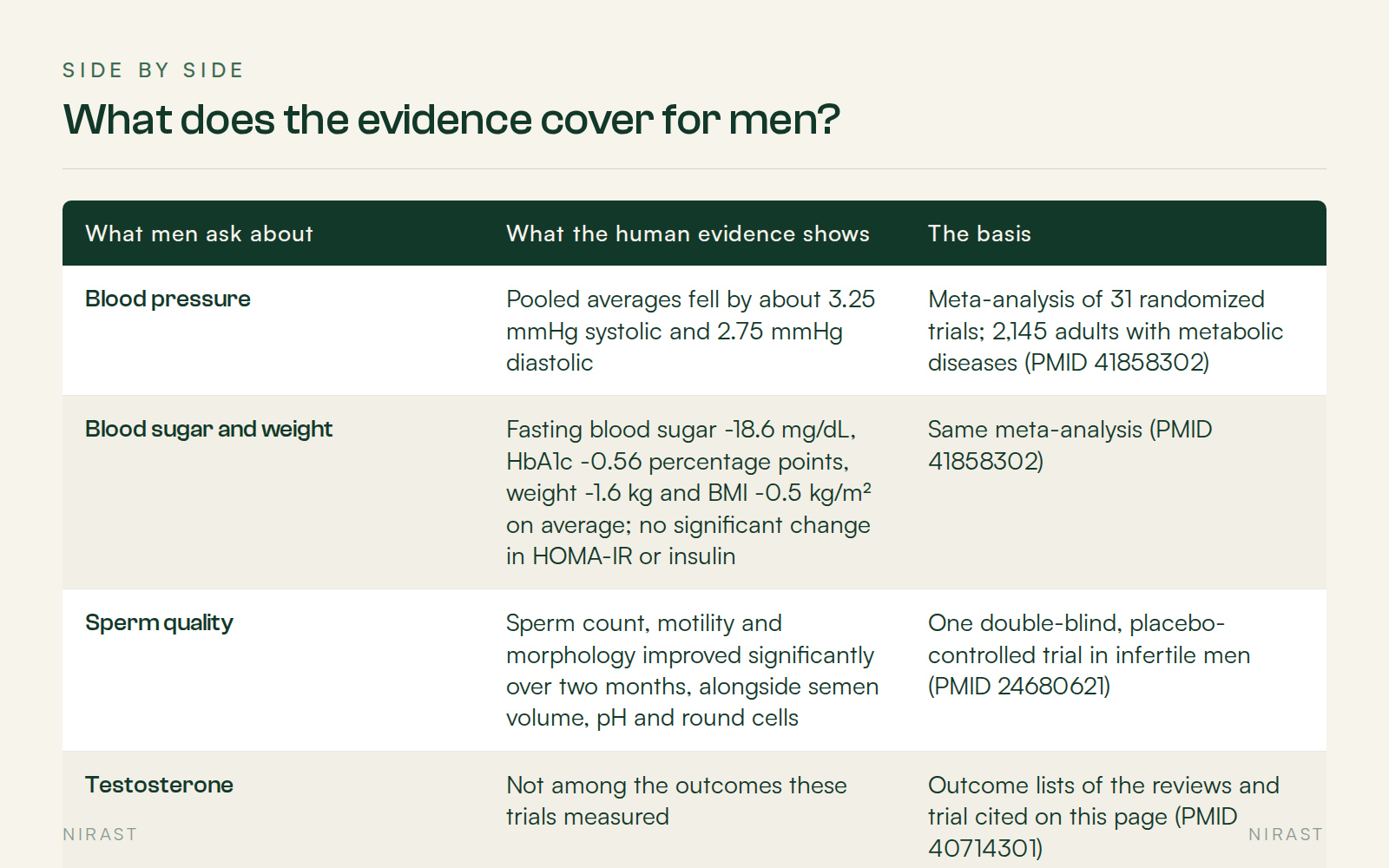
| What men ask about | What the human evidence shows | The basis |
|---|---|---|
| Blood pressure | Pooled averages fell by about 3.25 mmHg systolic and 2.75 mmHg diastolic | Meta-analysis of 31 randomized trials; 2,145 adults with metabolic diseases (PMID 41858302) |
| Blood sugar and weight | Fasting blood sugar -18.6 mg/dL, HbA1c -0.56 percentage points, weight -1.6 kg and BMI -0.5 kg/m² on average; no significant change in HOMA-IR or insulin | Same meta-analysis (PMID 41858302) |
| Sperm quality | Sperm count, motility and morphology improved significantly over two months, alongside semen volume, pH and round cells | One double-blind, placebo-controlled trial in infertile men (PMID 24680621) |
| Testosterone | Not among the outcomes these trials measured | Outcome lists of the reviews and trial cited on this page (PMID 40714301) |
| Erectile function | A three-herb formula containing black seed oil showed no benefit for the trial’s ejaculation measures | Systematic review of ejaculatory-disorder trials (PMID 37763726) |
| Hair growth | Traditional use in hair care; not an outcome of these trials | Hair-loss review of herbal remedies (PMID 40536553) |
What does the men-specific fertility trial show?
Fertility is where the evidence turns men-specific. In a randomized, double-blind, placebo-controlled study, 34 infertile men took 2.5 mL of black seed oil twice a day — 5 mL daily — and 34 took a liquid-paraffin placebo, for two months. Every participant started with abnormal semen quality: sperm morphology below 30%, or sperm counts below 20×10(6)/ml, or type A/B motility below 25% and 50% respectively. After two months, sperm count, motility and morphology improved significantly in the oil group compared with placebo, as did semen volume, pH and round cells; the authors conclude that daily intake of 5 mL of the oil for two months improves abnormal semen quality in infertile men without adverse effects (PMID 24680621).
Two independent reviews line up behind that result. A systematic review of herbal interventions for male infertility reports that in the Kolahdooz trial “a significant increase in sperm parameters was observed in the treatment group” (PMID 36406986). A urology review of lifestyle and complementary therapies lists Nigella sativa among supplements that “demonstrated positive effects on male fertility on small randomized controlled trial (RCT)” (PMID 26952957).
The limits matter here more than anywhere. This is a single small trial in men who were already infertile, and it did not measure pregnancy or birth outcomes. It is one promising data point about sperm parameters — not a fertility treatment, and not evidence that healthy men’s sperm improve on black seed oil.
What do the pooled trials find for blood pressure, blood sugar and weight?
The pooled evidence concentrates on cardiometabolic outcomes: a GRADE-assessed meta-analysis of 31 randomized trials followed 2,145 adults with metabolic diseases such as type 2 diabetes, obesity, metabolic syndrome, fatty liver disease and high blood pressure (PMID 41858302). Pooled against control, systolic blood pressure fell by about 3.25 mmHg and diastolic by about 2.75 mmHg; fasting blood sugar fell by about 18.6 mg/dL and HbA1c by about 0.56 percentage points; body weight fell by about 1.6 kg and BMI by about 0.5 kg/m². Waist circumference, hip circumference, waist-to-hip ratio, HOMA-IR and insulin showed no significant change.
The authors themselves urge caution. They describe the effects as modest, note that most included trials ran only 4–24 weeks, and point out that about 2 kg of weight change or 2–3 mmHg of blood-pressure change can sit below the 5% body-weight and 5 mmHg thresholds used to mark meaningful change in clinical practice. Their publication-bias and sensitivity analyses, they add, suggest the findings for weight, waist circumference, waist-to-height ratio, fasting blood sugar and HOMA-IR should be interpreted with caution.
A broader 2025 review of 82 studies (5,026 participants) reports improvements across a wide set of cardiometabolic markers, with doses ranging from 200 to 4,600 mg/day over 1 to 48 weeks (PMID 40714301). For a man reading this: the average effect is small, and it was measured in people who already had metabolic conditions — not in healthy men.
What does the evidence not show?
Benefit lists in this category tend to leave out the limits. These are the ones that matter for men:
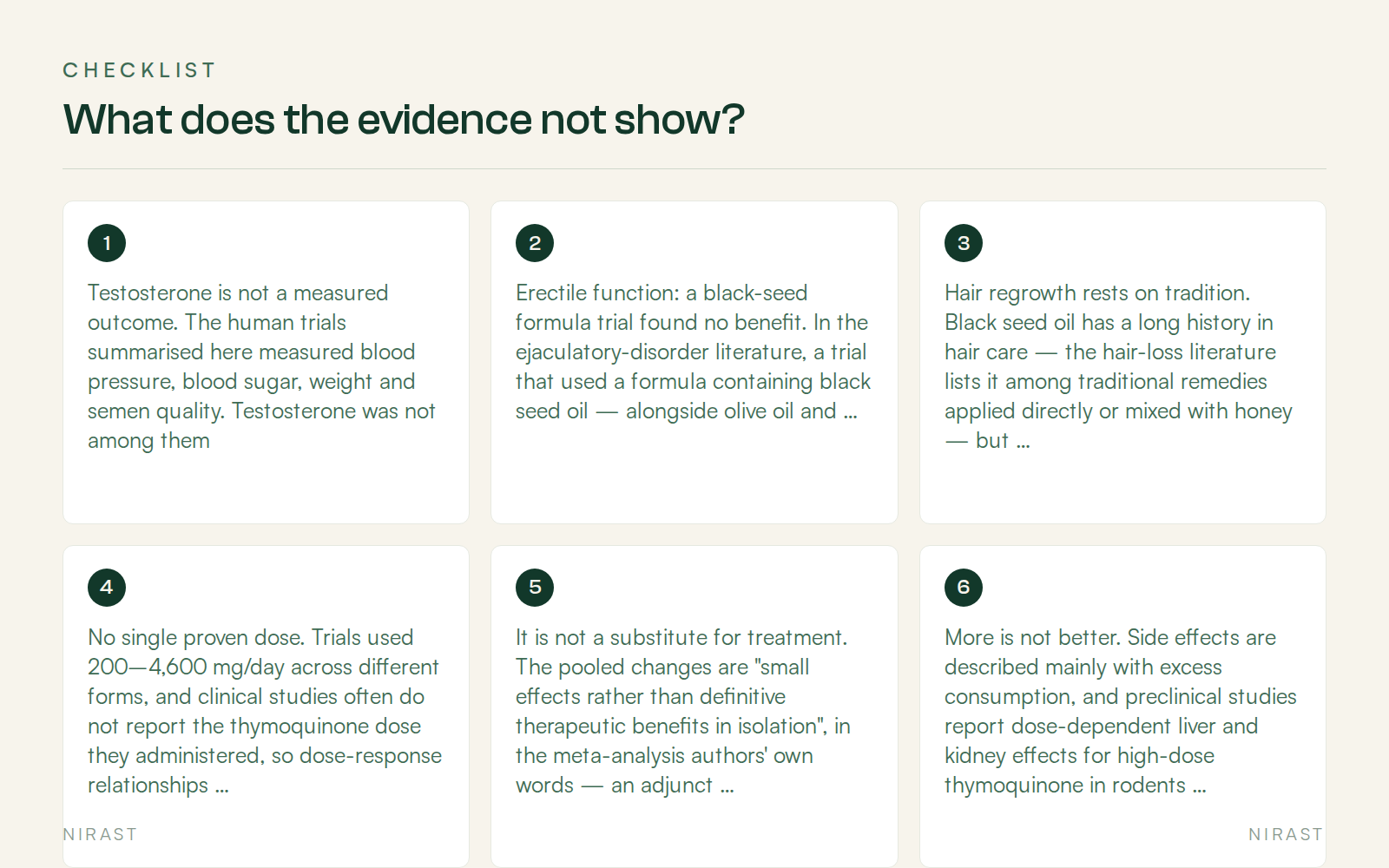
- Testosterone is not a measured outcome. The human trials summarised here measured blood pressure, blood sugar, weight and semen quality. Testosterone was not among them.
- Erectile function: a black-seed formula trial found no benefit. In the ejaculatory-disorder literature, a trial that used a formula containing black seed oil — alongside olive oil and boswellia — showed no benefit, within the group or against placebo, on its measures of ejaculation (PMID 37763726).
- Hair regrowth rests on tradition. Black seed oil has a long history in hair care — the hair-loss literature lists it among traditional remedies applied directly or mixed with honey — but hair growth was not an outcome of the human trials summarised here (PMID 40536553).
- No single proven dose. Trials used 200–4,600 mg/day across different forms, and clinical studies often do not report the thymoquinone dose they administered, so dose-response relationships cannot be established (PMID 42729546).
- It is not a substitute for treatment. The pooled changes are “small effects rather than definitive therapeutic benefits in isolation”, in the meta-analysis authors’ own words — an adjunct at most, not a replacement for medical care (PMID 41858302).
- More is not better. Side effects are described mainly with excess consumption, and preclinical studies report dose-dependent liver and kidney effects for high-dose thymoquinone in rodents (PMID 41302106).
How should you choose and use black seed oil?
A practical checklist based on what the trials and reviews actually support:
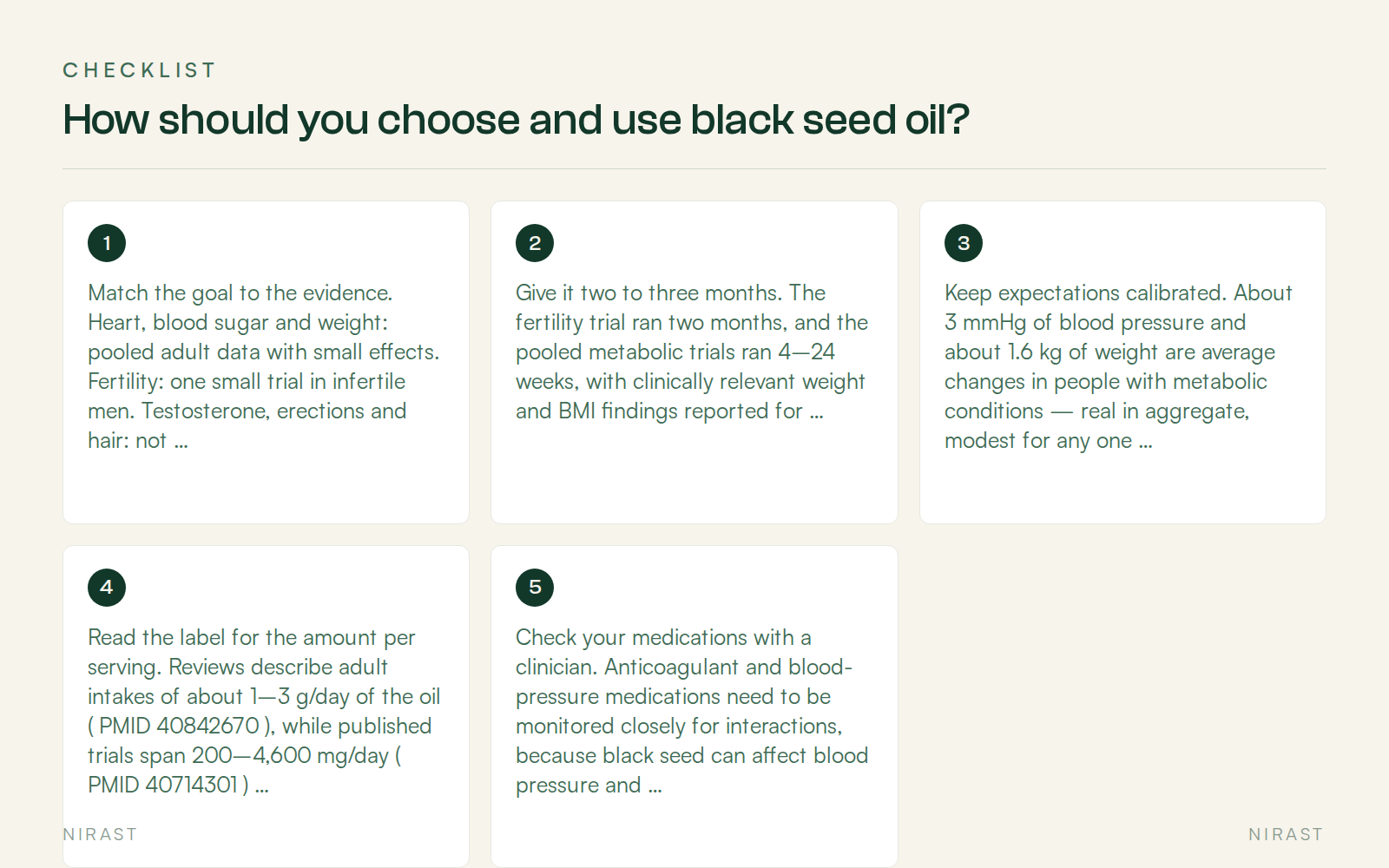
- Match the goal to the evidence. Heart, blood sugar and weight: pooled adult data with small effects. Fertility: one small trial in infertile men. Testosterone, erections and hair: not outcomes of the human trials cited here. Decide which result you actually care about before you buy.
- Give it two to three months. The fertility trial ran two months, and the pooled metabolic trials ran 4–24 weeks, with clinically relevant weight and BMI findings reported for supplementation beyond 12 weeks (PMID 41858302).
- Keep expectations calibrated. About 3 mmHg of blood pressure and about 1.6 kg of weight are average changes in people with metabolic conditions — real in aggregate, modest for any one person, and not a substitute for medical care.
- Read the label for the amount per serving. Reviews describe adult intakes of about 1–3 g/day of the oil (PMID 40842670), while published trials span 200–4,600 mg/day (PMID 40714301). Thymoquinone content varies widely between products — 0.07% to 1.88% wt/wt in one market survey — and one composition study recommends that only oils with confirmed composition, or at least confirmed thymoquinone content, be used in research (PMID 38542995). The oil amount per serving printed on the label is the number you can check.
- Check your medications with a clinician. Anticoagulant and blood-pressure medications need to be monitored closely for interactions, because black seed can affect blood pressure and platelet aggregation (PMID 40842670).
Is black seed oil safe for daily use?
The tolerability picture is favorable. Most research on black seed supplementation has produced no significant negative effects, and reviews of clinical and experimental evaluations describe a favorable safety profile for the oil and standardized extracts (PMID 40842670, PMID 41302106). Side effects are described mainly with excess consumption; gastrointestinal complaints — diarrhea, bloating and nausea — are among the ones most often reported (PMID 40842670).
Two cautions stand out. If you take anticoagulant or blood-pressure medication, interactions need close monitoring (PMID 40842670). And while the oil is well tolerated at normal intakes, high-dose thymoquinone showed liver and kidney effects in animal studies — one more reason not to escalate the dose (PMID 41302106).
FAQ
Does black seed oil boost testosterone?
The human trials summarised here measured blood pressure, blood sugar, weight and semen quality — testosterone was not among their outcomes. If testosterone is a concern, have it measured and discuss the result with a clinician rather than relying on a supplement.
Can black seed oil improve sperm count and fertility?
One controlled trial in infertile men found sperm count, motility and morphology improved after two months of daily oil, and independent reviews list Nigella sativa among supplements with small-trial support for male fertility (PMID 24680621, PMID 26952957). It was a single small trial in men who already had abnormal semen quality, and it did not measure pregnancy or birth outcomes. If you are trying to conceive, treat it as a conversation to have with a fertility clinician, not a substitute for evaluation.
Is black seed oil good for blood pressure and blood sugar?
Pooled across 31 trials in adults with metabolic conditions, it lowered systolic blood pressure by about 3.25 mmHg, diastolic by about 2.75 mmHg, fasting blood sugar by about 18.6 mg/dL and HbA1c by about 0.56 percentage points on average (PMID 41858302). Those averages sit below the thresholds clinicians use to mark meaningful change, and they come from people with existing conditions. They do not replace blood-pressure or diabetes treatment.
How much black seed oil should a man take per day?
There is no single proven dose. Trials ranged from 200 to 4,600 mg/day, and reviews describe adult intakes of about 1–3 g/day of the oil (PMID 40714301, PMID 40842670). The fertility trial used 5 mL of liquid oil daily. The amount per serving printed on the label is your starting point.
Does black seed oil help with hair loss?
Black seed oil has a long history in traditional hair care, and the hair-loss literature lists it among remedies applied directly or mixed with honey (PMID 40536553). Hair regrowth was not an outcome of the human trials summarised here, so the claim rests on tradition rather than controlled results.
Is black seed oil safe to take every day?
Reviews describe it as well tolerated, with gastrointestinal upset reported mainly with excess intake (PMID 40842670). The cautions that matter: anticoagulant and blood-pressure medications need close monitoring for interactions, and high-dose thymoquinone showed liver and kidney effects in animal studies (PMID 41302106). If you take medication, check with a clinician first.
About Nirast Ethiopian Black Seed Oil
If a daily softgel is the form that fits your routine, Nirast Ethiopian Black Seed Oil is built for exactly that: a softgel supplement stating 1,000 mg of black seed oil per serving, cold-pressed from Nigella sativa. The label directions are simple — take 2 softgels daily with water, preferably with food — and the softgels are described as taste-free, gentle and easy to take, so there is no oil to measure and no aftertaste to work around. It is a straightforward way to take a stated amount of black seed oil every day.
The offer is a monthly subscription: 1 pouch for $29.99, delivered every month, backed by a 30-day money-back guarantee; you can cancel by emailing support@nirast.co at least 24 hours before the next renewal. If you want to check the label facts yourself and subscribe, the full product page is here: Nirast Ethiopian Black Seed Oil.
These statements have not been evaluated by the Food and Drug Administration. This product is not intended to diagnose, treat, cure, or prevent any disease. Talk to your doctor or pharmacist before starting a supplement, especially if you are pregnant, nursing, take medication or have a medical condition.
Related reading
- Black Seed Oil: What It Is, What the Evidence Covers, and How to Choose a Form
- Black Seed Oil Benefits: What the Evidence Shows
- Black Seed Oil Benefits for Women: What the Evidence Shows
- Black Seed Oil Side Effects: What the Evidence Reports
Related product: Ethiopian Black Seed Oil.