
Scented Body Oils for Women: How to Choose One That Suits Your Skin
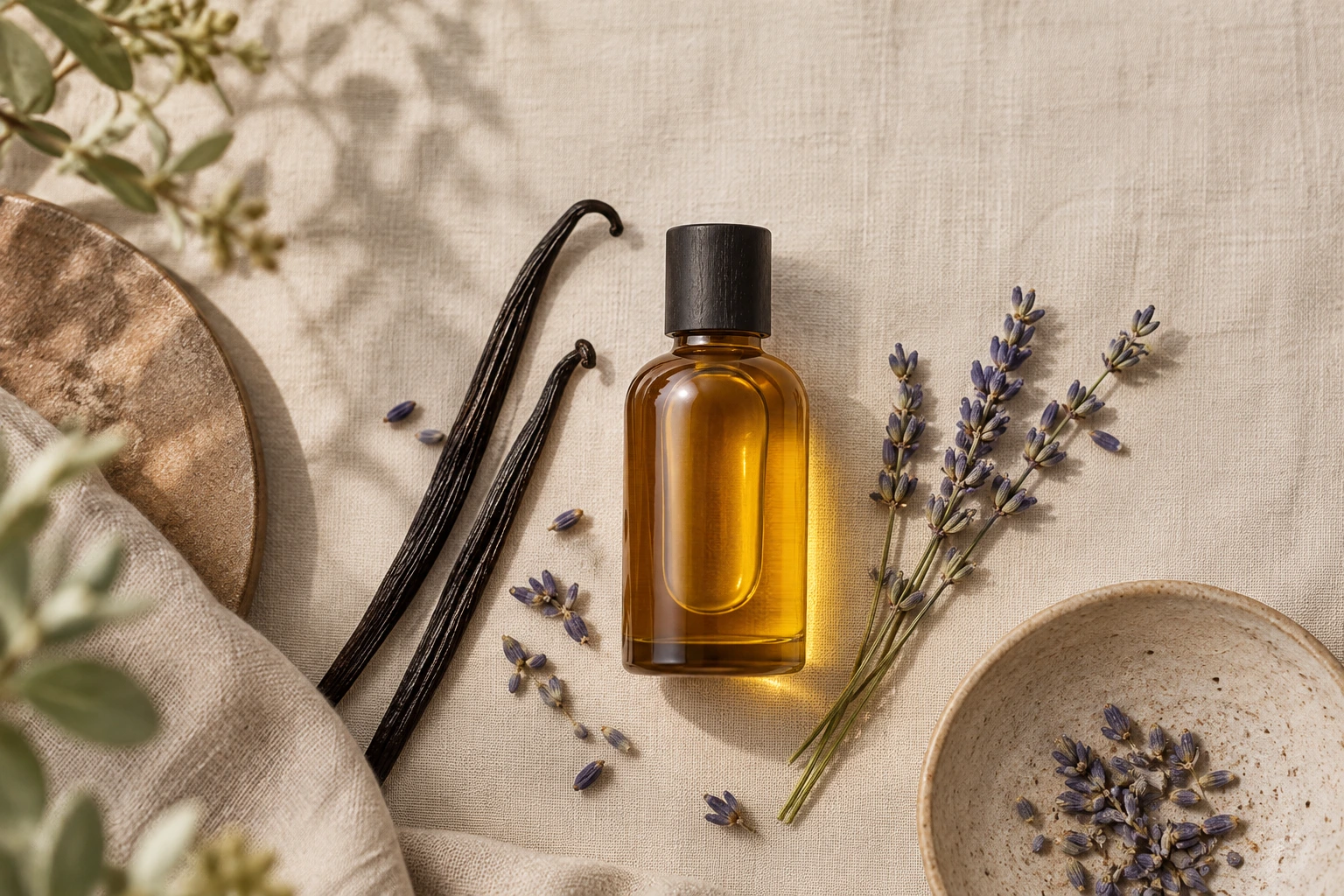
Scented body oils do two jobs: an emollient base softens the skin, and a fragrance leaves scent on it. Fragrance ingredients are well-documented drivers of cosmetic contact allergy, so patch-test before full-body use, check what the label discloses about the scent, and expect the scent to follow its layers — top notes fade first, base notes linger longest.
Nirast makes Silk Body Oil. This article was written by Nirast’s editorial team and reports what the published research does and does not show.
See Nirast Silk Body Oil → · 30-Day Money-Back Guarantee
Published by Thang Phi, founder of Nirast and publisher of the Nirast Journal.
That two-part structure is the whole story of choosing one. The oil half is skincare; the fragrance half is where most of the decision risk sits. Below: how the scent layers behave on skin, what a label can and cannot tell you, how to check a new oil against your own skin, and the five things worth doing before you buy.
What is a scented body oil, exactly?
A scented body oil is two products in one: a carrier-oil blend that softens the skin, and a fragrance that leaves scent on it. Fragrance ingredients are found in virtually every category of cosmetic product, and they are well-documented drivers of allergic contact dermatitis — for people who develop a fragrance allergy, cosmetics are often the primary exposure (PMID 42343576). A 2026 label review found cosmetics carry significantly more fragrance ingredients than household cleaning products; scent is a core part of cosmetic formulation, not an afterthought (PMID 42324175).
The oil half is simpler than it looks. Reviews of clinical studies describe basic emollients — the oils, butters and waxes that hold moisture in the skin — as safe, effective and accessible for managing dry skin over the long term (PMID 40265493). Which one suits you is mostly about weight: lipid-rich formulas are recommended for very dry skin because they are occlusive and water-retaining, while lighter, fast-absorbing textures are often favoured for everyday use (PMID 40444754).
Scented products are already part of most women’s routines — in one survey of 461 women, 91.5% of users applied scented products daily (PMID 42057771) — so the useful question isn’t whether to use them, but how to choose one that treats your skin well.
How long does the scent last on the skin?
Perfumery has a useful model for this: a scent is built in three layers. Top notes give the first, fresh impression — typically citrus and green materials — and last about 15–30 minutes on the skin. Middle (heart) notes carry the scent’s character — floral, spicy or leathery — for around 3–4 hours. Base notes, typically amber or musk, give the lasting trail and hold for more than 4 hours (PMID 34067262).
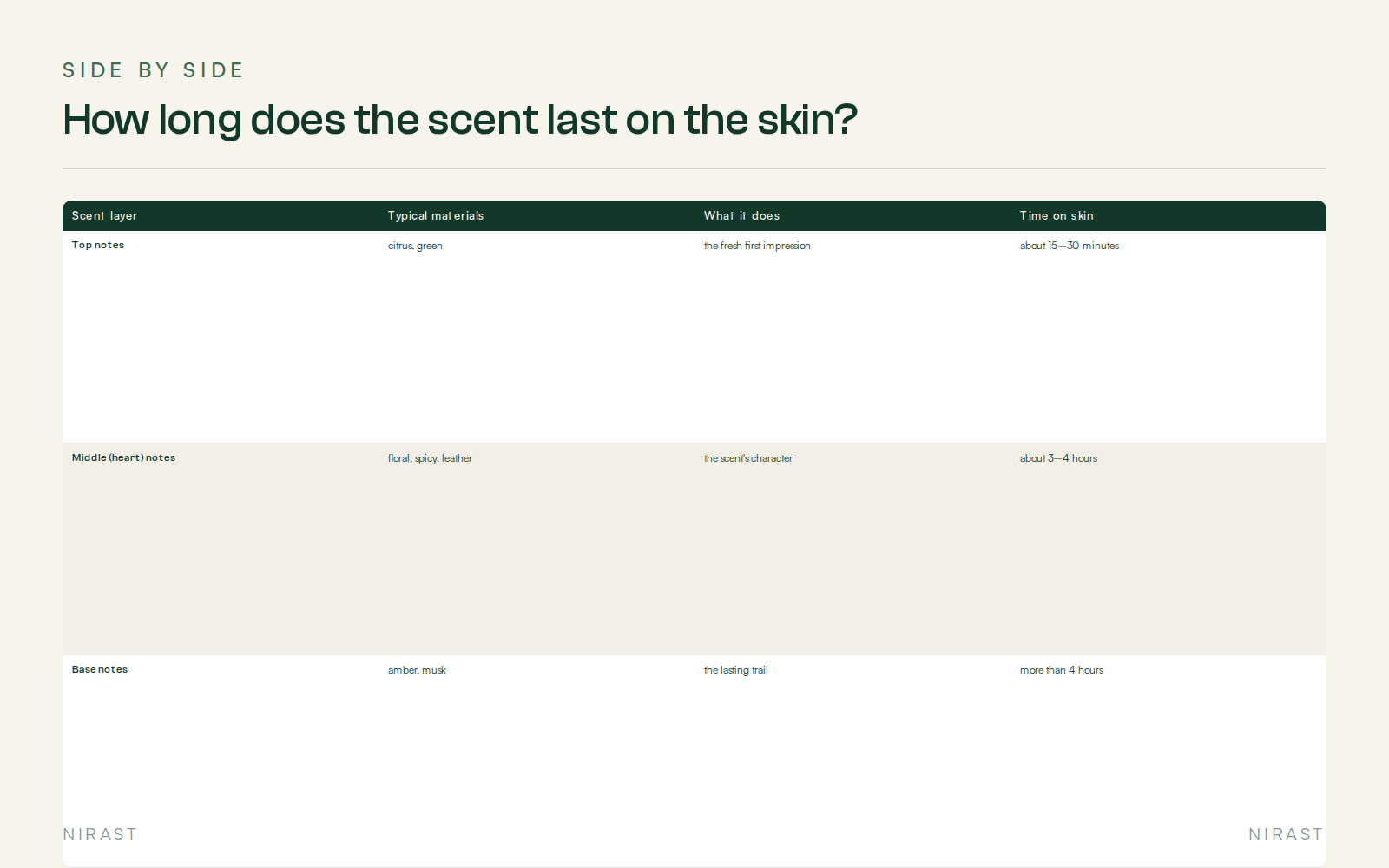
| Scent layer | Typical materials | What it does | Time on skin |
|---|---|---|---|
| Top notes | citrus, green | the fresh first impression | about 15–30 minutes |
| Middle (heart) notes | floral, spicy, leather | the scent’s character | about 3–4 hours |
| Base notes | amber, musk | the lasting trail | more than 4 hours |
Those figures describe how the layers typically behave — not a promise about any one bottle. Two more factors move them. The molecules: lighter molecules with higher vapour pressure and weaker intermolecular forces evaporate faster, while heavier ones linger (PMID 40524649). And your skin: skin is not an inert surface — it significantly slows fragrance evaporation compared with a glass surface — and release is influenced by skin hydration, water loss and surface roughness, with volatile compounds tracking roughness, while the heavier, oil-loving compounds’ evaporation tracks water loss and runs inverse to hydration (PMID 40524649). The oil base itself is part of the equation: in one matrix comparison, fragrance released quickly from a lotion at first, then dropped sharply, while some components were retained over time (PMID 34067262).
The practical takeaway: a body oil opens at full strength, settles into its heart, and leaves the base notes behind. The same oil can smell — and last — differently from one person to the next.
What the label does and doesn’t tell you about the scent
Fragrance disclosure is uneven by design. In the United States, manufacturers are not required to name individual fragrance ingredients — “fragrance” or “flavour” on the list is enough — while in the EU, 80 fragrance allergens must be individually labelled when they exceed 10 ppm in a leave-on product (PMID 42343576). If you have a known fragrance allergen, that difference decides whether a label can even tell you what you need. And the umbrella term is common: in one product dataset, 70% of items listed “fragrance” or “parfum” as an ingredient (PMID 42014480).
The allergens worth recognising: across product surveys, limonene, linalool and benzyl alcohol appear most frequently, and in one review of fragranced cosmetics, linalool and limonene were in about half of products (PMID 42343576). A 2026 label review of 245 products found linalool, limonene and hexyl cinnamal most frequent — and, notably, fragrance-free or preservative-free claims conflicted with the ingredient labels in 21.2% of cases (PMID 42324175).
One more label fact: essential oils are fragrance as far as allergy is concerned. They are distilled botanical fractions that contain fragrance allergens and are categorised as fragrance in contact-allergy practice, so a product scented with lavender or jasmine oil is not automatically in a different category from one scented with a synthetic blend (PMID 41652868).
Are scented body oils safe for sensitive skin?
For most people, yes — scented cosmetics are used daily without incident. But reactions are real enough to plan for: contact dermatitis is the adverse effect of cosmetics seen most often, affecting an estimated 1–5% of the general population, and women report cosmetic-related dermatitis more often than men (PMID 42343576). In a 2025 survey of 461 women, 36.4% reported an adverse reaction to a cosmetic product in the previous two years, with reported symptoms including skin redness, pimples, itching and dryness (PMID 42057771).
If you have a diagnosed fragrance allergy, the guidance is direct: caution with fragranced products is encouraged, and avoidance should be complete (PMID 42343576). If you don’t know your allergens, patch testing is how you find out — it remains the standard procedure for identifying contact allergy, with readings taken up to a week later so late-appearing reactions are not missed (PMID 42324086). The practical version for a leave-on product like a body oil is the repeated open application test: apply it to a small area of the forearm twice daily for up to 10 days to two weeks and watch for a reaction (PMID 42324086). Keep watching for a day or two after you stop — allergic contact dermatitis can appear 24–72 hours after exposure — and know that a negative result doesn’t fully rule out sensitivity (PMID 40949028, PMID 42324086).
Here’s where the risk concentrates: the fragrance compounds themselves, not the carrier oils. In a 2026 study of 356 fragrance-allergic patients, no clinically meaningful cross-reactivity was found between fragrance allergens and common non-essential-oil botanicals — the researchers conclude that fragrance-allergic patients don’t need to avoid carrier ingredients such as shea butter or coconut oil (PMID 41652868).
Which carrier oils suit your skin?
Carrier oils are emollients, and the reviews are reassuring: basic emollients are safe and effective for dry skin, and lipid-rich formulas are recommended where skin is very dry, while lighter textures suit milder dryness and everyday wear (PMID 40265493, PMID 40444754). The feel hours after application matters more than the first impression — the lasting sensation on the skin is what people notice — and there is evidence of a preference for light over oily textures (PMID 39931493).
Named oils do appear in the clinical literature. In a 50-patient study, emollients containing 10% refined almond oil (alongside 5% lactic acid) applied twice daily for 14 days were associated with improvements in itching severity, skin moisture and lipid content (PMID 40265493).
What should you check before you buy?
Five checks, in order of how much they’ll save you:
- Use-test before full-body wear. Apply a little to your inner forearm twice daily for up to 10 days to two weeks — the same method used to check leave-on cosmetics — and keep watching for a day or two after the last application, because late reactions happen (PMID 42324086, PMID 40949028).
- Read how the scent is disclosed. In the US, “fragrance” can hide the ingredient names; in the EU, the 80 allergens must be listed individually. If you know your allergens, verify them against the list before buying (PMID 42343576).
- Match the base to your skin and the season. Very dry skin does better with richer, occlusive formulas; lighter oils suit everyday use and warmer months. Judge it by how it feels an hour in, not in the first minute (PMID 40444754, PMID 39931493).
- Set expectations from the scent’s structure. A blend built on amber or musk will sit longer than a bright citrus top; your skin’s hydration and roughness shift the timing too, so treat any fixed hour-count as a rough guide for one product on one person (PMID 34067262, PMID 40524649).
- Treat label badges as clues, not verdicts. Fragrance-free and preservative-free claims conflicted with labels in 21.2% of one 245-product review, and “clean”-style labels are unregulated — used with different definitions from one product to another. The ingredient list and the disclosed allergens are the facts you can check (PMID 42324175, PMID 42014480).
What the evidence does — and doesn’t — show
Here is the split that marketing pages in this category tend to blur.
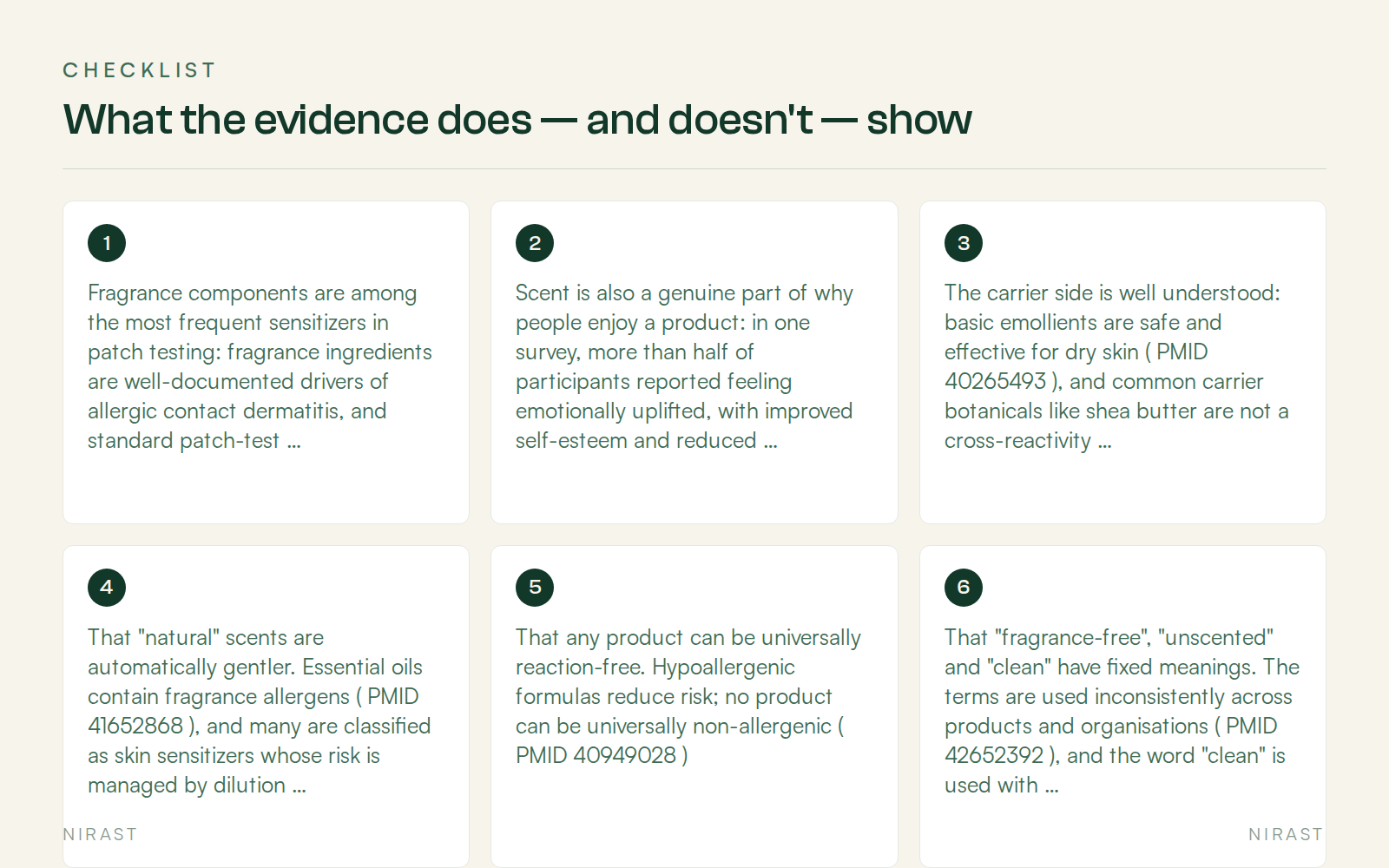
What it shows:
- Fragrance components are among the most frequent sensitizers in patch testing: fragrance ingredients are well-documented drivers of allergic contact dermatitis, and standard patch-test series include them for that reason (PMID 42343576).
- Scent is also a genuine part of why people enjoy a product: in one survey, more than half of participants reported feeling emotionally uplifted, with improved self-esteem and reduced stress, after applying perfumes and cosmetics (PMID 42057771), and fragrance research links properly scented products with greater liking and perceived texture (PMID 39931493).
- The carrier side is well understood: basic emollients are safe and effective for dry skin (PMID 40265493), and common carrier botanicals like shea butter are not a cross-reactivity concern for fragrance-allergic patients (PMID 41652868).
What it doesn’t show:
- That “natural” scents are automatically gentler. Essential oils contain fragrance allergens (PMID 41652868), and many are classified as skin sensitizers whose risk is managed by dilution — being natural does not make them hypoallergenic (PMID 42797719).
- That any product can be universally reaction-free. Hypoallergenic formulas reduce risk; no product can be universally non-allergenic (PMID 40949028).
- That “fragrance-free”, “unscented” and “clean” have fixed meanings. The terms are used inconsistently across products and organisations (PMID 42652392), and the word “clean” is used with different definitions from one product to another (PMID 42014480).
- That a fixed scent-duration figure holds for all wearers. Release depends on the molecules and on your skin, so two people wearing the same oil can experience different durations (PMID 40524649).
FAQ
Are scented body oils safe for sensitive skin?
Most people use scented products daily without problems. But fragrance is a well-documented cause of contact allergy, caution is advised if you have reacted before, and complete avoidance is the guidance if you have a diagnosed fragrance allergy. If your skin is reactive and you don’t know your allergens, use-test first (PMID 42343576).
How long does the scent of a body oil last on the skin?
It follows the blend’s structure: top notes fade within about 15–30 minutes, middle notes carry for roughly 3–4 hours, and base notes linger beyond 4 hours. Your skin’s hydration and roughness shift the timing, so expect the scent to open fully early and to settle into its base later (PMID 34067262, PMID 40524649).
Do essential oils make a body oil gentler than synthetic fragrance?
No — “natural” and “gentle” are not the same thing. Essential oils contain fragrance allergens, and many are classified as skin sensitizers whose risk is managed by dilution. They belong on the same patch-test list as any other fragrance (PMID 41652868, PMID 42797719).
What does “fragrance-free” or “unscented” actually mean?
Less than it sounds. The terms are used inconsistently across products and brands (PMID 42652392), and in one label review, fragrance-free or preservative-free claims conflicted with the ingredient labels in 21.2% of cases (PMID 42324175). Check the ingredient list and the disclosed allergens rather than the badge.
Where should I patch-test a new body oil?
A small area of the inner forearm works well: apply the oil there twice daily for up to 10 days to two weeks — the method used to check leave-on cosmetics — and keep watching for a day or two after the last application, since late reactions are common (PMID 42324086, PMID 40949028). If you get a strong reaction, stop and see a clinician.
How should a scented body oil feel on the skin?
Light beats heavy for most people: there is evidence of a preference for light over oily topical products, and the lasting feel matters more than the first impression — soft and comfortable rather than sticky (PMID 39931493). Fragrance also shapes texture perception, and the response is most positive when the scent and the texture match.
About Nirast Silk Body Oil
If a lightweight, scent-forward body oil is what you’re after, Nirast Silk Body Oil is a cosmetic body oil for her. The product page describes it as “a lightweight silk oil that melts instantly into skin – no greasy film, no sticky residue” and as a “fast-absorbing dry oil”. The scent is described as “a soft, clean, luxury perfume-like scent”, with vanilla and lavender notes in a gourmand aromatic family. The page lists shea butter, jojoba, almond, cocoa butter, argan oil and vitamin E among its ingredients, and lists the formula as free from parabens, sulfates, mineral oil and silicones.
It’s sold by subscription, shipping is free worldwide, and there’s a 30-day money-back guarantee; returns, subscription changes and cancellations go through support@nirast.co. If the description matches what you’re looking for, the full details are here: Nirast Silk Body Oil.
These statements have not been evaluated by the Food and Drug Administration. This product is not intended to diagnose, treat, cure, or prevent any disease. Talk to your doctor or pharmacist before starting a supplement, especially if you are pregnant, nursing, take medication or have a medical condition.
Related reading
- Body Oil: How to Choose One That Fits Your Skin, Scent and Routine
- Body Oil for Men: How to Choose and Use One
- Body Oil Benefits for Skin: What Topical Oils Do for Your Barrier
- Why Does Neck and Chest Skin Age Faster Than Facial Skin?
Related product: Nirast Silk Body Oil.