
Black Seed Oil for Weight Loss: What the Human Trials Actually Measured
Black seed oil trials show a small average change in weight — about 1.6 kg greater than control across 31 studies in people with metabolic conditions — and several trials found no significant change. Doses tested were roughly 1–3 g a day for 6–12 weeks. It is not a weight-loss treatment or a substitute for diet and exercise.
Nirast makes Ethiopian Black Seed Oil. This article was written by Nirast’s editorial team and reports what the published research does and does not show.
See Nirast Ethiopian Black Seed Oil → · $29.99 a month · 30-Day Money-Back Guarantee
Published by Thang Phi, founder of Nirast and publisher of the Nirast Journal.
If you arrived here from a forum thread or a supplement listing, this page is the trial record rather than the promise: which human studies measured weight, what they found, and which ones found nothing.
What the human trials found
Start with a 2026 GRADE-assessed meta-analysis: 31 randomized trials, 2,145 participants with metabolic conditions such as type 2 diabetes and obesity, and interventions lasting 4 to 24 weeks. Pooled across the trials, black seed supplementation lowered body weight by about 1.59 kg and BMI by about 0.51 points versus control (Musazadeh et al., 2026).
The fine print matters as much as the headline:
- The average change is about 2 kg — below the ≥5% of body weight that clinical practice generally treats as the threshold for meaningful weight loss (Musazadeh et al., 2026).
- Central adiposity did not move: waist circumference, hip circumference and waist-to-height ratio showed no significant change, and neither did insulin resistance or insulin (Musazadeh et al., 2026).
- Heterogeneity was very high (I² between 74.1% and 99.5%), the authors’ publication-bias checks mean the weight finding should be read with caution, and a trim-and-fill adjustment still left a significant reduction of about 2.7 kg — so the signal is not an artefact; it is small (Musazadeh et al., 2026).
- The clearer results were in people with type 2 diabetes or metabolic syndrome, in those with baseline BMI ≤ 30, and in supplementation running longer than 12 weeks (Musazadeh et al., 2026).
A second broad synthesis — 82 studies, 5,026 participants, doses from 200 to 4,600 mg/day, durations from 1 to 48 weeks — reports significant improvements in body fat percentage, BMI, waist circumference and weight (Jafari et al., 2025). It disagrees with the 2026 meta-analysis about waist circumference, which is a fair reminder that pooled results shift with which trials get included.
A bodyweight-focused review of 14 clinical trials, in populations ranging from prediabetes to hypothyroidism to obesity, counted 10 trials with significant effects on body weight, BMI or waist circumference — and judged the effect more consistent for the oil preparation than for the powder (Al Asoom, 2022).
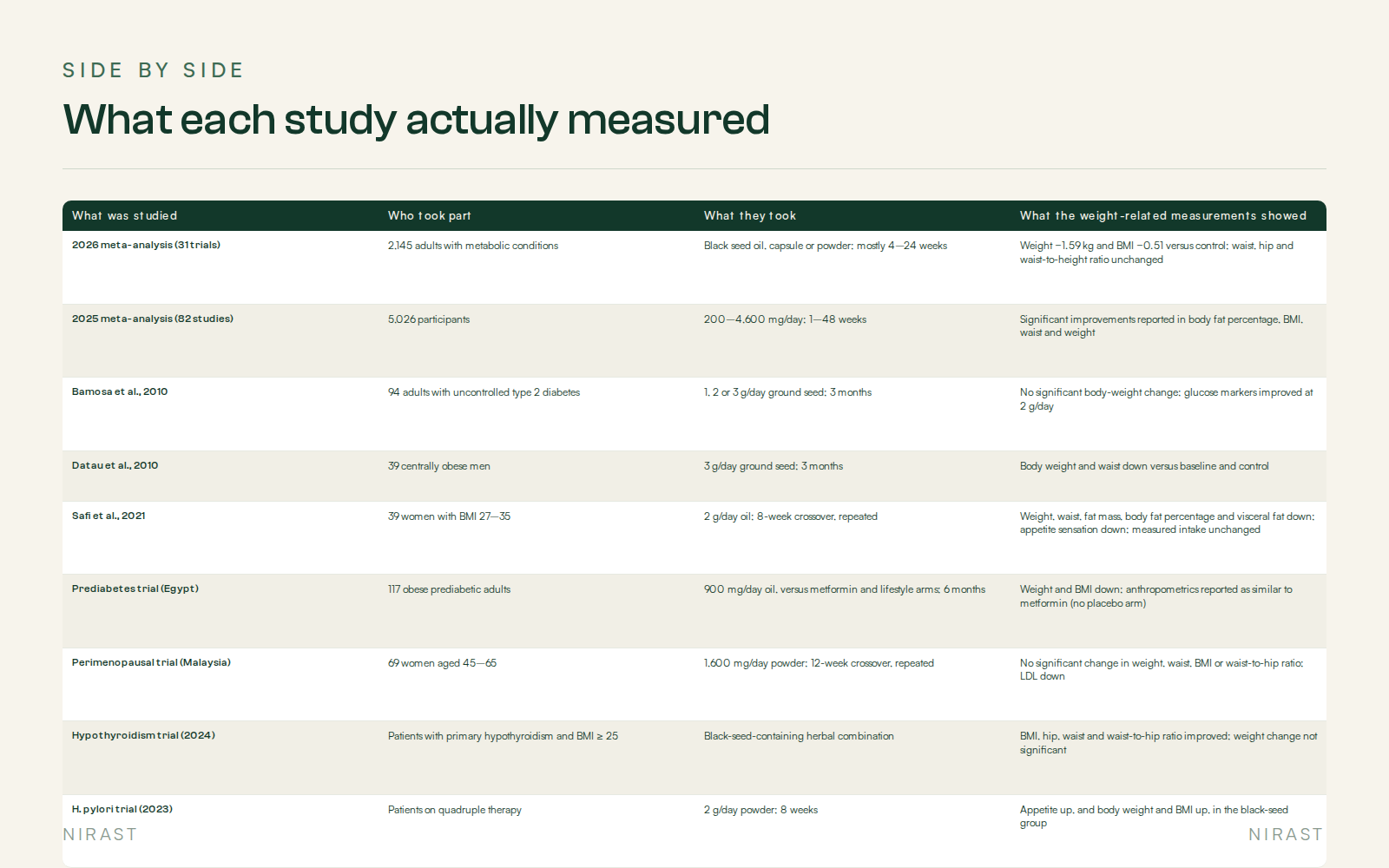
What each study actually measured
The table covers the syntheses and the individual trials most often cited in weight conversations — including the ones that found nothing. The pattern to notice: small group averages, and genuine disagreement between trials at similar doses.
| What was studied | Who took part | What they took | What the weight-related measurements showed |
|---|---|---|---|
| 2026 meta-analysis (31 trials) | 2,145 adults with metabolic conditions | Black seed oil, capsule or powder; mostly 4–24 weeks | Weight −1.59 kg and BMI −0.51 versus control; waist, hip and waist-to-height ratio unchanged |
| 2025 meta-analysis (82 studies) | 5,026 participants | 200–4,600 mg/day; 1–48 weeks | Significant improvements reported in body fat percentage, BMI, waist and weight |
| Bamosa et al., 2010 | 94 adults with uncontrolled type 2 diabetes | 1, 2 or 3 g/day ground seed; 3 months | No significant body-weight change; glucose markers improved at 2 g/day |
| Datau et al., 2010 | 39 centrally obese men | 3 g/day ground seed; 3 months | Body weight and waist down versus baseline and control |
| Safi et al., 2021 | 39 women with BMI 27–35 | 2 g/day oil; 8-week crossover, repeated | Weight, waist, fat mass, body fat percentage and visceral fat down; appetite sensation down; measured intake unchanged |
| Prediabetes trial (Egypt) | 117 obese prediabetic adults | 900 mg/day oil, versus metformin and lifestyle arms; 6 months | Weight and BMI down; anthropometrics reported as similar to metformin (no placebo arm) |
| Perimenopausal trial (Malaysia) | 69 women aged 45–65 | 1,600 mg/day powder; 12-week crossover, repeated | No significant change in weight, waist, BMI or waist-to-hip ratio; LDL down |
| Hypothyroidism trial (2024) | Patients with primary hypothyroidism and BMI ≥ 25 | Black-seed-containing herbal combination | BMI, hip, waist and waist-to-hip ratio improved; weight change not significant |
| H. pylori trial (2023) | Patients on quadruple therapy | 2 g/day powder; 8 weeks | Appetite up, and body weight and BMI up, in the black-seed group |
The trial rows are drawn from the 2022 bodyweight review (Al Asoom), the 2025 obesity review (Ghasemzadeh Rahbardar et al.) and the 2023 obesity review (Adam et al.); the hypothyroidism and H. pylori rows come from their own trial reports (Javidi et al., 2024; Yousefnejad et al., 2023).
Two caveats change how much the results mean: several positive black seed trials elsewhere in the literature ran alongside a low-calorie diet or lifestyle programme, so the oil’s own contribution there is unclear, and the Egyptian prediabetes trial shown above had no placebo arm at all (Ghasemzadeh Rahbardar et al.; Al Asoom).
What did the trials actually give people?
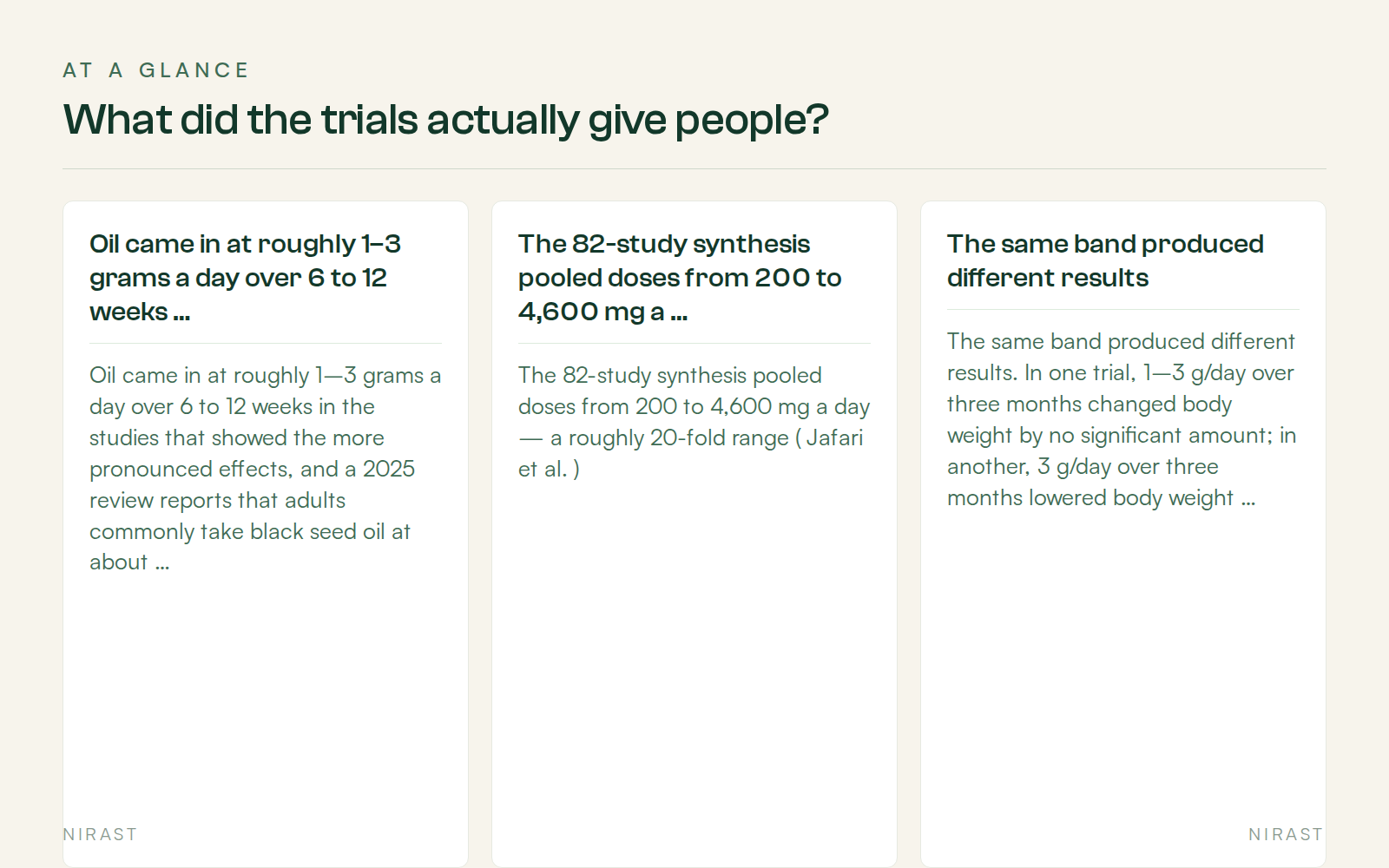
- Oil came in at roughly 1–3 grams a day over 6 to 12 weeks in the studies that showed the more pronounced effects, and a 2025 review reports that adults commonly take black seed oil at about 1–3 g a day (Al Asoom; Arshad et al.).
- The 82-study synthesis pooled doses from 200 to 4,600 mg a day — a roughly 20-fold range (Jafari et al.).
- The same band produced different results. In one trial, 1–3 g/day over three months changed body weight by no significant amount; in another, 3 g/day over three months lowered body weight and waist. A 1.6 g/day powder over 12 weeks changed no anthropometric measure; 2 g/day of oil over 8 weeks changed several (Al Asoom).
That is the dose conversation in one sentence: the evidence does not identify a dose that reliably produces weight loss, which is why any number should be read as “what a trial used”, not “what will work”.
What the evidence does not show
It does not show a fat-burning effect. No fat-burning mechanism is established in this trial literature. The proposed explanations — appetite suppression, lower calorie intake, reduced intestinal glucose absorption — are described by the reviewers as still needing experimental support, and the trials that measured calorie intake found no difference between groups (Al Asoom).
It does not show a dose that reliably produces weight loss. Multi-gram daily doses appear in both the positive and the null trials; the pooled average hides that split (Al Asoom).
It does not show a replacement for diet, exercise or medical care. The reviews frame black seed as an adjunct taken alongside diet, exercise or other interventions rather than instead of them, and the meta-analysis says the modest average reductions are unlikely to independently yield large clinical benefit (Musazadeh et al.; Ghasemzadeh Rahbardar et al.; Adam et al.). In one trial where appetite was the target — restoring it during infection treatment — body weight moved up rather than down (Yousefnejad et al.).
It does not show “days” effects. The trial windows that produced measurable changes ran 6–12 weeks and longer; the pooled trials ran 4–24 weeks (Al Asoom; Musazadeh et al.). A listing that promises a visible difference in days is going beyond anything the trials measured.
How to read a black seed oil label for a weight experiment
Whatever form you choose, the number to compare is the amount of oil per serving. A supplement’s serving is the maximum amount its label recommends for one eating occasion, and labels may state amounts as “Amount Per 2 Capsules” or use units such as capsule or teaspoonful (FDA labeling guide). For a step-by-step walkthrough of daily amounts and what the label lines mean, see How much black seed oil should I take each day?.
Five decisions to make before you buy
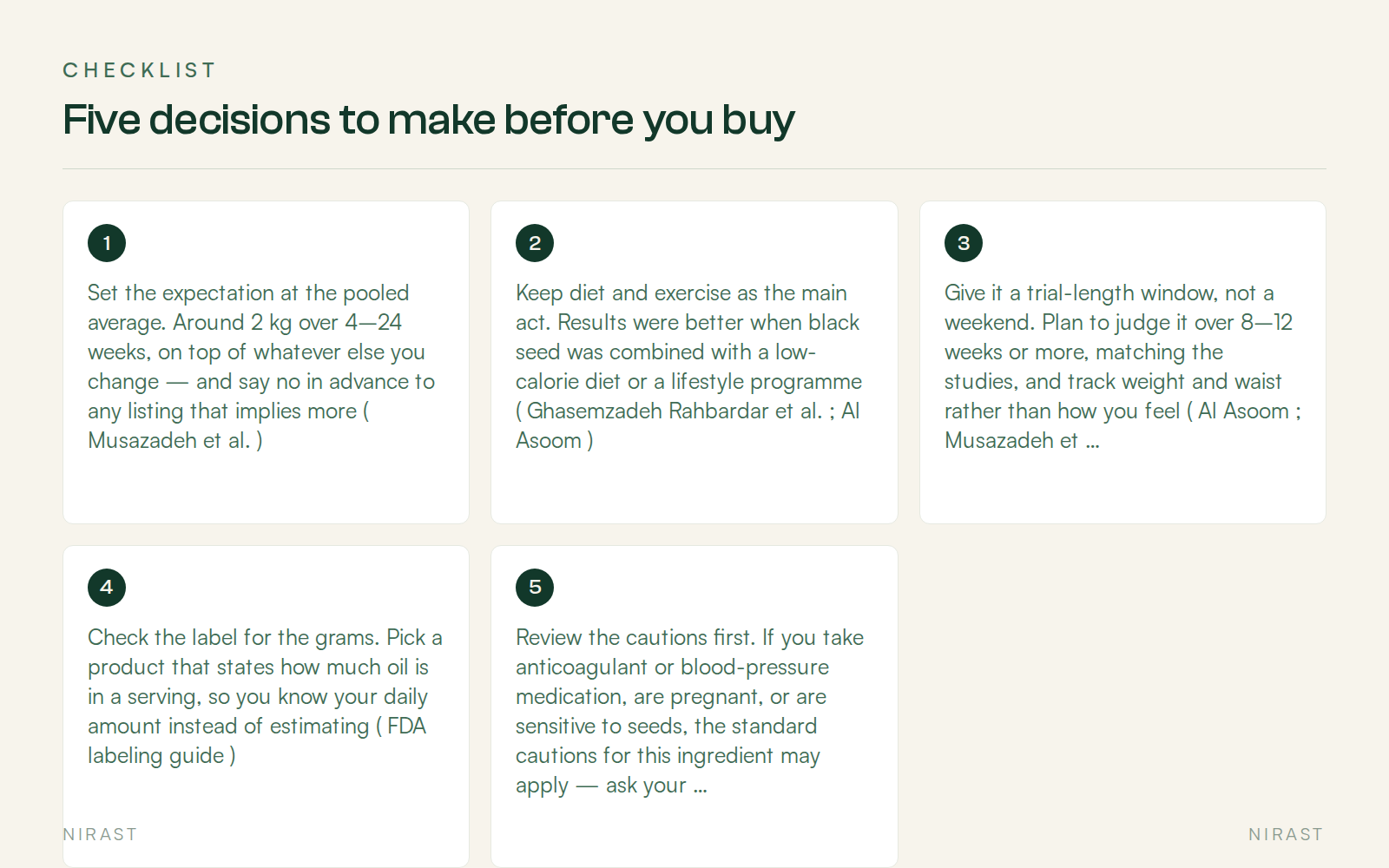
- Set the expectation at the pooled average. Around 2 kg over 4–24 weeks, on top of whatever else you change — and say no in advance to any listing that implies more (Musazadeh et al.).
- Keep diet and exercise as the main act. Results were better when black seed was combined with a low-calorie diet or a lifestyle programme (Ghasemzadeh Rahbardar et al.; Al Asoom).
- Give it a trial-length window, not a weekend. Plan to judge it over 8–12 weeks or more, matching the studies, and track weight and waist rather than how you feel (Al Asoom; Musazadeh et al.).
- Check the label for the grams. Pick a product that states how much oil is in a serving, so you know your daily amount instead of estimating (FDA labeling guide).
- Review the cautions first. If you take anticoagulant or blood-pressure medication, are pregnant, or are sensitive to seeds, the standard cautions for this ingredient may apply — ask your clinician before starting (Arshad et al.).
FAQ
Does black seed oil actually cause weight loss?
Across 31 trials in people with metabolic conditions, the average difference versus control was about 1.59 kg of weight and 0.51 points of BMI — statistically significant, but below the ≥5% threshold clinicians use for meaningful weight loss. Individual trials disagreed: several found no significant change at all (Musazadeh et al.). For the wider outcome picture — blood pressure, blood sugar, osteoarthritis — see what the evidence shows for black seed oil benefits.
How much black seed oil did the weight trials use?
The studies associated with clearer effects used about 1–3 g/day of oil over 6–12 weeks, and the 82-study synthesis pooled 200–4,600 mg/day (Al Asoom; Jafari et al.). That describes trial doses, not a recommendation — and because the same band produced both positive and null results, no dose has been shown to reliably produce weight loss. For translating a label into a daily amount, see how much black seed oil to take each day.
Does black seed oil burn fat?
No fat-burning mechanism is established in this trial literature. The mechanisms the researchers discuss are appetite, calorie intake and how the intestine handles glucose — and those explanations still need experimental support. The trials that actually measured food intake found no difference between groups (Al Asoom).
Can I take black seed oil without dieting and still lose weight?
The trial data does not support expecting much. Most trials studied people with metabolic conditions, several trials elsewhere in the literature added the oil on top of a low-calorie diet, and the pooled average reduction is small enough that the authors call it unlikely to deliver large benefit on its own (Musazadeh et al.; Ghasemzadeh Rahbardar et al.).
Is black seed oil safe to take every day?
In the trials reviewed here, side-effect reporting was mostly mild: in the 8-week H. pylori trial, mild to moderate effects such as headache, dizziness and taste changes appeared at comparable rates in the black seed and placebo groups and resolved, and a 2025 review describes side effects mainly with surplus intake, most commonly gastrointestinal complaints (Yousefnejad et al.; Arshad et al.). If you are on medication, pregnant, or managing a health condition, check with a clinician before adding any supplement.
If you want the daily habit without the taste: Nirast Ethiopian Black Seed Oil
Everything above points to one practical question: if you decide a trial-length window is worth a try, how do you actually keep the daily habit? Bottled black seed oil is pungent and needs measuring. Nirast Ethiopian Black Seed Oil is the softgel version — 1,000 mg of black seed oil per serving, cold-pressed from Nigella sativa, in softgels the product page describes as taste-free, gentle and easy to take without reflux or discomfort. No drops, no spoon; the directions are simply to take 2 softgels daily with water, preferably with food.
The offer is a monthly subscription — 1 pouch, delivered every month, $29.99 — backed by a 30-day money-back guarantee. Subscriptions can be cancelled by emailing support@nirast.co at least 24 hours before the next scheduled renewal.
If you want to give the daily black seed oil habit a fair, trial-length run, here is the format built for it: See Nirast Ethiopian Black Seed Oil.
These statements have not been evaluated by the Food and Drug Administration. This product is not intended to diagnose, treat, cure, or prevent any disease. Talk to your doctor or pharmacist before starting a supplement, especially if you are pregnant, nursing, take medication or have a medical condition.
Related reading
- Black Seed Oil: What It Is, What the Evidence Covers, and How to Choose a Form
- What Human Trials of Black Seed Oil Have Actually Measured
- What "Cold-Pressed" Actually Tells You About a Black Seed Oil
- Ethiopian vs Egyptian Black Seed Oil: What Actually Differs
Related product: Ethiopian Black Seed Oil.