
How Do I Read a “93% of Users Said” Claim on a Body-Oil Page?
How Do I Read a “93% of Users Said” Claim on a Body-Oil Page?
Nirast makes Nirast Silk Body Oil. This article was written by Nirast’s editorial team and reports what the published research does and does not show.
See Nirast Silk Body Oil → · 30-Day Money-Back Guarantee
Published by Thang Phi, founder of Nirast and publisher of the Nirast Journal.
A ‘93% of users said’ figure is uninterpretable until you know five things: the sample size, the exact question asked, who was asked, the method used, and the date. Where those are missing, the number cannot be checked either way – not proved, not disproved – so it should be read as advertising, not as evidence that the product works.
Percentages are persuasive precisely because they look like data. A single number like 93% carries the authority of a study without requiring the reader to see one. This article gives you the five questions that turn that figure back into something you can actually judge – and then the one test that matters most when the numbers will not cooperate.
The short answer
Treat a bare percentage as a claim, not a finding. Ask: how many people, asked what, selected how, measured when? If the page cannot answer those, the figure is unfalsifiable – impossible to verify or to refute. That is the standard you would apply to any advertisement, and it is the correct one here.
Why a percentage feels like proof
A percentage borrows credibility from a format we associate with measurement. It looks like a result. But a result is a number plus its conditions: who was measured, against what, by what method, at what time. Strip those away and what remains is the shape of a finding with none of its substance – persuasive, but not checkable.
The tell is easy to miss because the eye reads the format, not the content. A figure set beside a percentage sign and a superscript looks sourced even when the source is nowhere on the page. Learning to slow down for two seconds at exactly that point is most of the skill.
The five questions that turn a number back into evidence
Next time you meet a percentage on any product page, run it through this:
- Sample size – 93% of 30 people and 93% of 3,000 are very different claims.
- Exact question – “looked smoother” to whom, judged by what standard, and against what baseline?
- Population – were these random users, or people who opted in after buying?
- Method – a self-reported impression, a blinded assessment, or an instrument reading?
- Date and source – when was it collected, and is there a dataset or report to inspect?
If a page cannot answer questions 1 and 5, stop there. The number cannot be checked, so its persuasive value should drop to near zero.
Why the denominator changes everything
The first missing piece is the denominator. The same relative figure can mean wildly different things depending on the baseline. An intervention that reduces risk by 50% looks very different in absolute terms if the baseline risk is 2% rather than 20% – 2% to 1% versus 20% to 10% (PMC13271422). Absolute risk also varies with the underlying prevalence in the population studied (PMC13271422).
“93% said their texture looked smoother” is not a risk reduction, but the principle transfers exactly. Ninety-three per cent of whom, starting from what baseline? If the people who answered were a self-selected group of happy customers, the denominator is not a general population at all – it is a fan club.
A p-value teaches the same lesson
Even a formal statistic is easy to misread. A p-value cannot be interpreted as a measure of the size or clinical relevance of an effect, and using it that way is highly misleading (PMC13271422).
The lesson inverts neatly for advertising. If even a proper significance test does not tell you how big or how meaningful an effect is, then a naked percentage – with no test at all – tells you even less. The number is a prompt to ask more, never an answer by itself.
What you would need instead is a measure that actually lets you weigh benefit against cost. The statistics literature names the ones that do. Number needed to treat and number needed to harm, both derived from absolute risk differences, give an intuitive way to balance benefits and risks (PMC13271422).
A cosmetic page is not a clinical trial, so you will not see these numbers there. But that is the shape of what a credible figure looks like: it comes with a base, a comparison and a method. A percentage with none of those is missing the information the format was invented to convey.
What a properly reported figure looks like
For contrast, imagine a page had written: “In a survey of 412 customers who used the product daily for eight weeks, 93% agreed with the statement ‘the texture of my skin looked smoother.'” That one sentence supplies the denominator, the question, the population, the method and the timing. You still could not verify the result without the raw data, but you could at least judge whether the claim was specific and falsifiable – which is exactly what a bare percentage prevents.
The distance between those two versions is the whole problem. The first is a claim you can evaluate; the second is a mood. Notice that nothing in the second version promises a different result – it simply removes your ability to check.
The footnote tell
The single strongest clue on a page that shows a percentage is not any one number but the little superscript after it – the “(1)”. A footnote marker exists to point somewhere. When it points nowhere visible, it is performing the appearance of sourcing while withholding the source. That is worth naming because it is easy to miss: the eye registers the superscript and reads credibility, even though the reference is absent.
If you take one habit from this article, make it this: whenever you see a percentage with a citation mark, spend five seconds looking for where that mark leads. If there is no destination, the credibility the mark borrowed was never real.
“No trial” is not proof a claim is false
It is tempting to assume that a percentage on a label must rest on a clinical trial. It does not. Benefit and safety claims are expected to be truthful, not misleading, and supported by science, but – contrary to a common misconception – there is no specific legal requirement for randomised controlled trials to substantiate claims, and regulators weigh the totality of evidence (PMC12265102).
That source concerns dietary supplements, so the legal tests for cosmetics are analogous rather than identical. But the practical consequence is worth stating plainly: “no trial” is not by itself proof that a claim is false. The defect a reader should watch for is narrower and more specific – the missing denominator, question and method.
The same source frames the purpose of claim rules as ensuring consumers are given truthful and accurate information so they can make informed purchasing decisions (PMC12265102). An unsourced percentage frustrates exactly that purpose, because it lets you form a belief you cannot check.
Framing does work, so read carefully
Language is not neutral. Regulatory oversight of consumer products extends beyond the formulation to labelling and claims, and marketing language alone can shift whether a product is perceived as therapeutic or cosmetic (PMC13151276).
The same commentary notes that product placement and framing can reinforce the perception that a cosmetic serves a health-promoting or medically relevant function, despite the absence of evidence supporting that function (PMC13151276). A “what our users reported” heading does this: it borrows the structure of a survey result – reported figures, a percentage, a footnote – without supplying the survey. Seeing the borrowed structure, rather than the number, is the trick.
Where the honest line is
Two mistakes are worth avoiding. The first is believing a figure because it appears on a page you like. The second is dismissing a product entirely because the figure is unsourced. A claim can be unsupported and the product can still be perfectly good; a real, small effect that was never measured properly and an invented number look identical from the outside, and both deserve the same neutral treatment until evidence arrives.
So here is the useful pivot. When the numbers will not let you judge, stop judging by the numbers and judge by the thing you can actually verify yourself – the product in your hand.
Where Nirast Silk Body Oil fits
Nirast Silk Body Oil is a cosmetic body oil, and the honest way to choose it is the honest way to choose any body oil: on what you can feel, not on a percentage you cannot check. Three things about it are verifiable in use, and they are the ones worth deciding on:
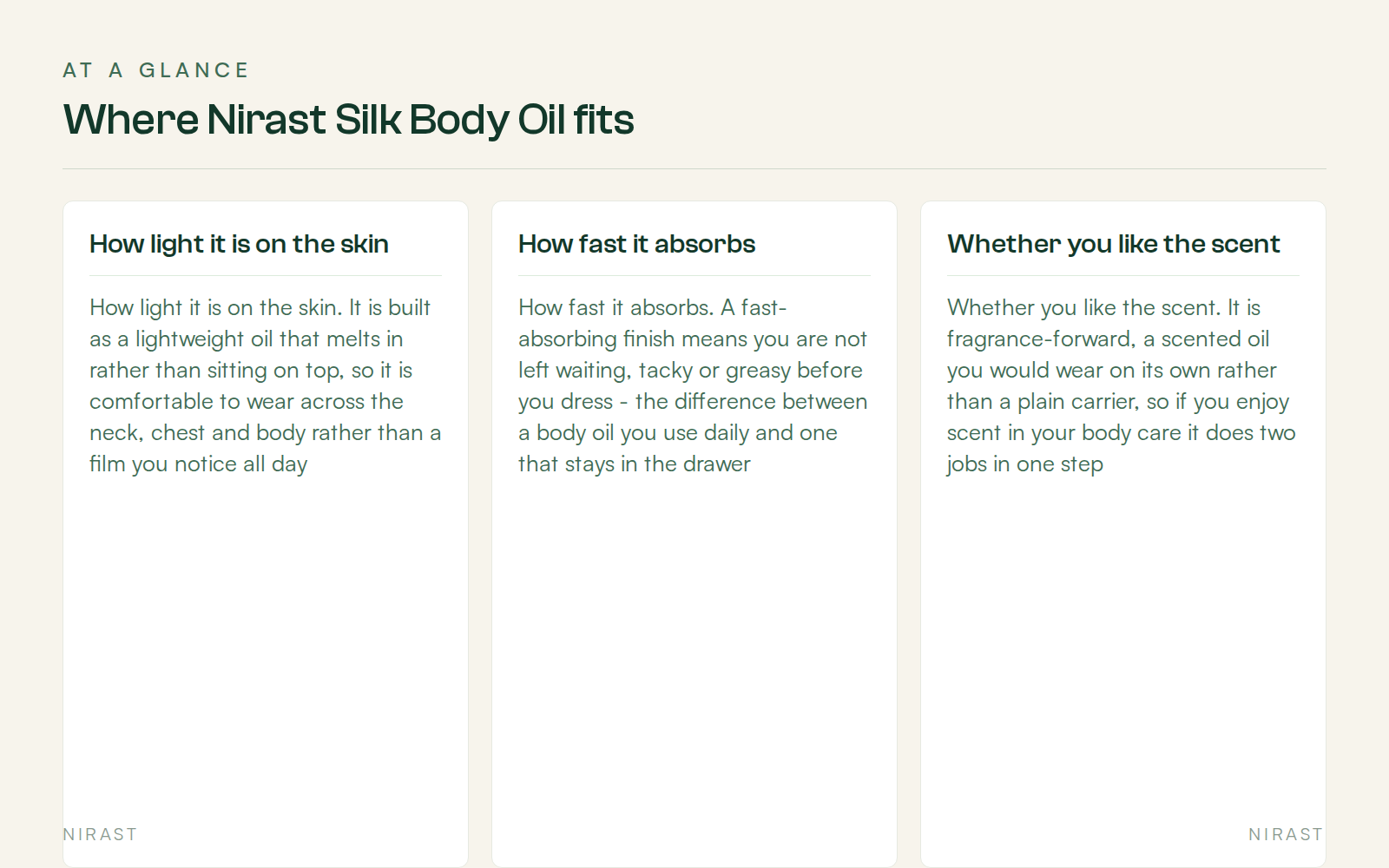
- How light it is on the skin. It is built as a lightweight oil that melts in rather than sitting on top, so it is comfortable to wear across the neck, chest and body rather than a film you notice all day.
- How fast it absorbs. A fast-absorbing finish means you are not left waiting, tacky or greasy before you dress – the difference between a body oil you use daily and one that stays in the drawer.
- Whether you like the scent. It is fragrance-forward, a scented oil you would wear on its own rather than a plain carrier, so if you enjoy scent in your body care it does two jobs in one step.
None of that needs a percentage to be true – it is the product doing its job, which is the only evidence that ever really counts. If you want a body oil you can judge on feel rather than on a figure, you can see Nirast Silk Body Oil here:
See Nirast Silk Body Oil here.
The bottom line
A percentage without a denominator, a question, a population, a method and a date is not evidence – it is atmosphere. Learn the five questions, apply them in ten seconds, and the next “93% of users said” line will read for what it is: an invitation to believe, wearing the costume of a measurement. Then make your decision on what you can test for yourself, because that is the claim no page can fake.
See the Nirast Silk Body Oil here.
These statements have not been evaluated by the Food and Drug Administration. This product is not intended to diagnose, treat, cure, or prevent any disease. Talk to your doctor or pharmacist before starting a supplement, especially if you are pregnant, nursing, take medication or have a medical condition.
Related reading
- Body Oil: How to Choose One That Fits Your Skin, Scent and Routine
- Is "Apply Moisturizer to Damp Skin" Actually Doing What People Think?
- Body Oil Benefits for Skin: What Topical Oils Do for Your Barrier
- Body Oil for Men: How to Choose and Use One
Related product: Nirast Silk Body Oil.