
Best Supplements for Lymphatic Drainage: How to Judge One Before You Buy
Judging lymphatic drainage supplements means evaluating each one, not picking from a ranking: the controlled evidence tests techniques and single agents, not competing brands. Check a candidate’s named herbs and amounts, each herb’s evidence record, quality testing, and safety for you; the category’s oral evidence is inconsistent.
Nirast makes Nirast Lymphatic Drainage Drops. This article was written by Nirast’s editorial team and reports what the published research does and does not show.
See Nirast Lymphatic Drainage Drops → · 30-Day Money-Back Guarantee
Published by Thang Phi, founder of Nirast and publisher of the Nirast Journal.
That is the honest shape of this question, and it is more useful than a listicle. Below: why a shortlist cannot be built from the trial literature, what the oral-agent studies found, the ingredient-by-ingredient evidence record, five checks to run on any product before buying, and the claims worth ignoring.
Why there is no ranked shortlist of lymphatic supplements
Start with what the trials actually studied. In lymphatic care, the controlled evidence belongs to physical interventions: a network meta-analysis of prevention trials lists manual lymphatic drainage, compression therapy, intermittent pneumatic compression, resistance training, supervised exercise, acupoint massage, moxibustion and combinations of these — with no oral supplement among them (PMC13634858).
The oral record is separate, smaller and mixed. A scoping review of pharmacologic and herbal agents for breast cancer-related lymphedema examined 21 treatment studies: NSAIDs/steroids, anti-hypertensives, synbiotic supplements and doxycycline showed no benefit, and the data for flavonoid-derived venoactive agents and herbal products were inconsistent; immune-modulating therapies were the exception, improving signs and symptoms in three studies (PMID 41858365).
None of that lets a page rank products against each other — the reviews compare intervention classes and single agents, not competing products — but it does define what you can check: the product’s own label, and the evidence record of each herb inside it.
What the oral-agent evidence actually shows
A randomized, placebo-controlled, double-blind crossover trial in this literature tested a citrus flavonoid, not a lymphatic blend. It gave healthy adults 300 mg per day of monoglucosyl hesperidin and measured the thoracic duct — the main trunk of the lymphatic system — by ultrasound. It reported no effect in the full cohort; a signal appeared only in the subgroup of participants with no exercise habit, whose thoracic duct diameter increased or trended upward (PMC13253825). The authors describe verifying, for the first time in humans, that the compound affects lymphatic circulatory function — and they are clear about the boundary: all participants were healthy volunteers, and none of those with exercise habits had swelling symptoms (PMC13253825).
The rest of the record is small, too. In the scoping review above, the herbal data were inconsistent, and the review notes that variation in study design, patient population and outcome measures limits generalizability (PMID 41858365). That is what the evidence looks like for this category: a handful of small studies of single compounds, mostly in healthy volunteers — not a shelf of tested products. When a label promises outcomes, hold it to this record.
The ingredient record: what each herb can and cannot support
Lymphatic blends draw on long traditions, and the modern research on those herbs is uneven. Here is the record for the herbs you will meet in these blends — including the four in our own drops.
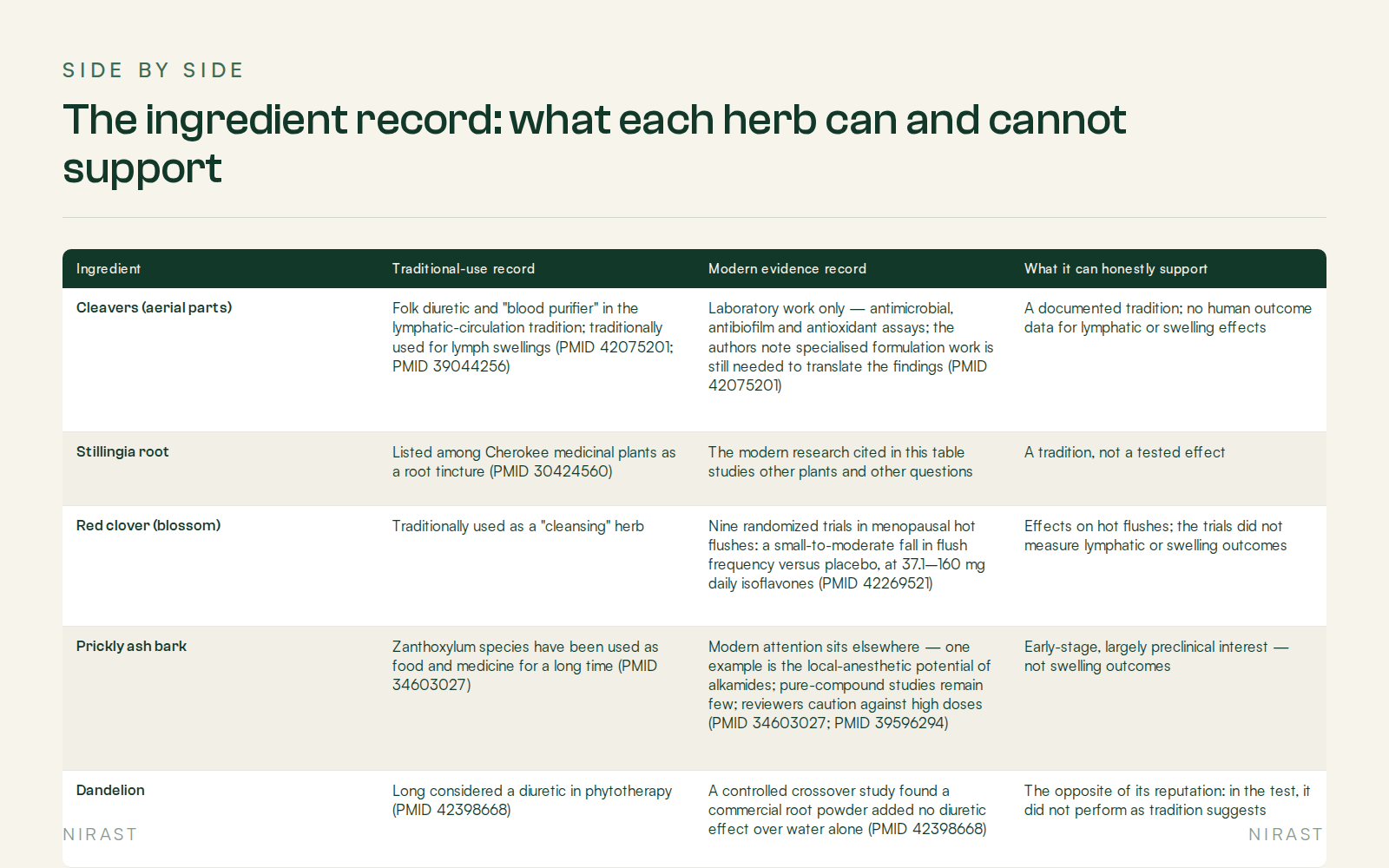
| Ingredient | Traditional-use record | Modern evidence record | What it can honestly support |
|---|---|---|---|
| Cleavers (aerial parts) | Folk diuretic and “blood purifier” in the lymphatic-circulation tradition; traditionally used for lymph swellings (PMID 42075201; PMID 39044256) | Laboratory work only — antimicrobial, antibiofilm and antioxidant assays; the authors note specialised formulation work is still needed to translate the findings (PMID 42075201) | A documented tradition; no human outcome data for lymphatic or swelling effects |
| Stillingia root | Listed among Cherokee medicinal plants as a root tincture (PMID 30424560) | The modern research cited in this table studies other plants and other questions | A tradition, not a tested effect |
| Red clover (blossom) | Traditionally used as a “cleansing” herb | Nine randomized trials in menopausal hot flushes: a small-to-moderate fall in flush frequency versus placebo, at 37.1–160 mg daily isoflavones (PMID 42269521) | Effects on hot flushes; the trials did not measure lymphatic or swelling outcomes |
| Prickly ash bark | Zanthoxylum species have been used as food and medicine for a long time (PMID 34603027) | Modern attention sits elsewhere — one example is the local-anesthetic potential of alkamides; pure-compound studies remain few; reviewers caution against high doses (PMID 34603027; PMID 39596294) | Early-stage, largely preclinical interest — not swelling outcomes |
| Dandelion | Long considered a diuretic in phytotherapy (PMID 42398668) | A controlled crossover study found a commercial root powder added no diuretic effect over water alone (PMID 42398668) | The opposite of its reputation: in the test, it did not perform as tradition suggests |
Across the list the pattern repeats: each tradition is documented, while the modern research answers other questions. One row even runs against the tradition — dandelion, long considered a natural diuretic, did not beat water in the controlled test of a commercial root powder (PMID 42398668). None of this makes a blend useless; it means the honest way to read an ingredient list is as a set of traditions and early-stage findings, not as a set of demonstrated outcomes.
Five checks before you buy any lymphatic supplement
- Match every named herb to its evidence record. Use the table above as the pattern. If an ingredient’s modern record is laboratory work (cleavers) or another field entirely (red clover’s hot-flush trials), the label is selling a tradition, not an outcome.
- Look for amounts, not just names. Supplements often differ from the preparations used in clinical research in plant parts, extract types and dosages, and a claims analysis of food supplements found that many label statements are not sufficiently supported by clinical evidence — its advice is to interpret label information with great caution (PMID 41373965). A label that states how much of each herb a serving contains gives you something to compare; one that does not gives you nothing to check.
- Treat claim wording as intent, not evidence. By law, structure/function claims — “supports lymphatic wellness” and the like — should describe a nutrient’s role in the body and should not state that the supplement treats disease (PMID 40982278). Surveys find consumers often read them as disease promises anyway, and an experiment found people treat structure/function claims and health claims as equivalent despite their different regulatory treatment (PMID 40982278; PMID 42704234). In the United States, supplements also do not need pre-market approval — oversight is post-market, and disease-treatment claims are barred (PMID 42190612).
- Check the quality signals. US manufacturers must follow GMP, with testing for identity, purity, strength and composition and limits on contaminants — but adulteration remains a continuous problem, and third-party testing is an important additional safeguard (PMID 40700739). Certification programmes reduce the likelihood of contamination without eliminating risk, so verify certification status and batch numbers rather than trusting a logo (PMID 42639281). Most countries lack harmonized, enforceable safety frameworks for supplements (PMID 41468235).
- Screen it against your own safety profile. In a 16-year cohort of older adults, 4.8% had potential drug–supplement interactions, most often involving vitamin E with aspirin and magnesium or potassium with antihypertensives (PMID 41714537). Pregnant women, children, older adults and people with a chronic illness face a higher risk of harmful herb–drug interactions (PMID 42500535). If any of that is you, run the product past a pharmacist or clinician first.
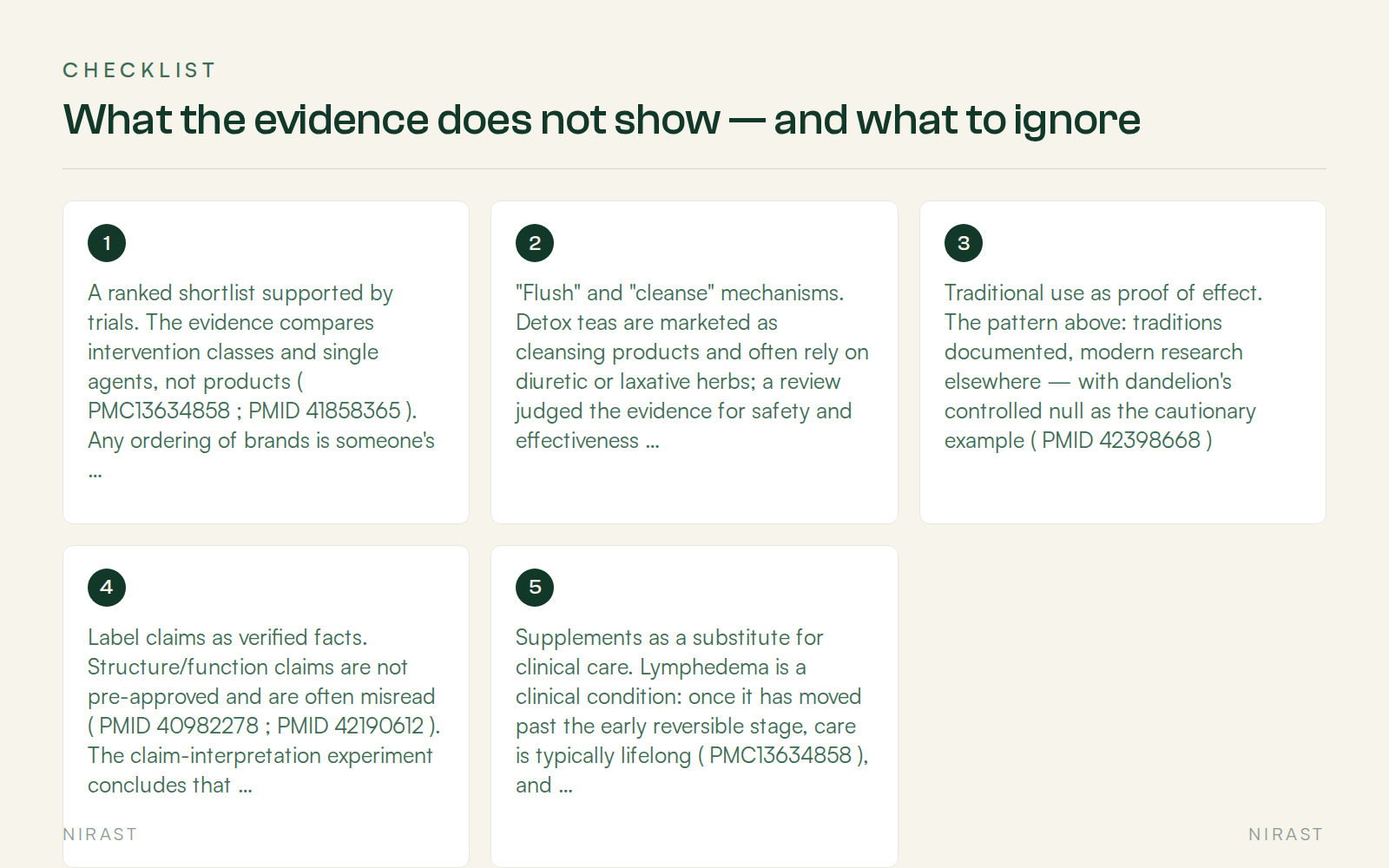
What the evidence does not show — and what to ignore
- A ranked shortlist supported by trials. The evidence compares intervention classes and single agents, not products (PMC13634858; PMID 41858365). Any ordering of brands is someone’s criteria, not a study result.
- “Flush” and “cleanse” mechanisms. Detox teas are marketed as cleansing products and often rely on diuretic or laxative herbs; a review judged the evidence for safety and effectiveness insufficient, and a content analysis found 91.7% of sampled diet teas contained senna leaf, a laxative (PMID 42039908). “Flushing” is marketing language, not a tested mechanism.
- Traditional use as proof of effect. The pattern above: traditions documented, modern research elsewhere — with dandelion’s controlled null as the cautionary example (PMID 42398668).
- Label claims as verified facts. Structure/function claims are not pre-approved and are often misread (PMID 40982278; PMID 42190612). The claim-interpretation experiment concludes that, without reform, supplement regulation can give “only the illusion of consumer protection” (PMID 42704234).
- Supplements as a substitute for clinical care. Lymphedema is a clinical condition: once it has moved past the early reversible stage, care is typically lifelong (PMC13634858), and complete decongestive therapy — manual drainage, compression, skin care, exercise — is described as the cornerstone of conservative management (PMID 42621244).
Are lymphatic drainage supplements safe?
The category is generally safe, but the harms that are documented cluster in two places: adulterated products, and interactions with prescription medicines (PMID 42500535). Pregnant women, children, older adults and people with a chronic illness face a higher risk of harmful herb–drug interactions (PMID 42500535). If you use prescription medicine, are pregnant or live with a chronic condition, ask a pharmacist or clinician before adding any herbal product to your routine — drops included (PMID 41714537).
What to do alongside a supplement
Keep the levers with direct trial support. A systematic review in lower-limb lymphedema after gynecological cancer reports exercise as safe and beneficial, with no rise in adverse events and small gains in health-related quality of life, physical function and pain (PMID 42199716). For the full picture of what actually helps — movement, manual drainage, compression when prescribed, hydration and nutrition — see our lymphatic system support guide. The lymphatic drainage overview covers the head term, and the drops format page covers the liquid-dropper option specifically.
About Nirast Lymphatic Drainage Drops
If a daily herbal drop fits your routine, here is the product, plainly — and how it reads against the checks above. Nirast Lymphatic Drainage Drops is a liquid herbal drops product in an amber glass dropper bottle — no pills to swallow, just a few drops a day. Its ingredient list names four herbs: cleavers (aerial parts), stillingia root, red clover (blossom) and prickly ash bark — the four records in the table above, each with a documented tradition and a modern evidence record you can weigh. The directions describe a 1 mL dropper dose taken with water, tea or juice, or under the tongue.
The offer is a monthly subscription with three quantity tiers — one, two or three bottles — at $29.99, $59.98 or $89.97 per month, with an “Add To Cart” checkout. Shipping is free worldwide: orders are processed within 4–7 business days, and delivery takes 5–7 business days after shipment. Every order carries a 30-Day Money-Back Guarantee — refund requests go to support@nirast.co within 30 calendar days after delivery — and you can cancel by emailing support@nirast.co at least 24 hours before the next renewal.
One boundary, stated plainly: these drops are a supportive daily herbal supplement, not a treatment for lymphedema or other causes of swelling — the clinical work belongs with your care team, and the daily ritual is where a product like this fits. If that is what you are after, you can see the full product and subscribe here: Nirast Lymphatic Drainage Drops.
FAQ
How do you pick a lymphatic drainage supplement?
There is no trial-backed shortlist to pick from: the evidence compares techniques and single agents, not products (PMC13634858; PMID 41858365). Pick by checking the label — named herbs and amounts, each herb’s evidence record, quality testing, and your own safety profile. A product that makes those checks possible is the most you can ask of this category.
Is there any human trial evidence for oral lymphatic supplements?
The controlled study described above tested a citrus flavonoid (monoglucosyl hesperidin, 300 mg per day) in healthy adults and measured the thoracic duct: no effect in the full cohort, with a signal only in participants who did not exercise (PMC13253825). A scoping review of pharmacologic and herbal agents found the herbal data inconsistent (PMID 41858365). The controlled human record is single compounds in healthy volunteers, not finished products.
How do I compare two lymphatic supplement labels?
Put them side by side on four things: the herbs named and their amounts per serving; whether each herb has human outcome data or only a tradition and laboratory studies; whether the maker mentions third-party testing or certification; and whether anything in the product interacts with your medications (PMID 41373965; PMID 40700739; PMID 41714537). The one with more checkable statements wins, even if its claims are quieter.
Which label phrases should I ignore?
“Flush”, “cleanse” and “detox” language describes a marketing segment, not a tested mechanism — the review of detox and diet teas found insufficient evidence for their safety or effectiveness (PMID 42039908). Structure/function claims like “supports lymphatic wellness” are legally intended to describe a role in the body, not to promise disease outcomes, and surveys show they are often read as promises anyway (PMID 40982278). Treat both as intent, not evidence.
Are lymphatic drainage supplements safe to take with medication?
The category is generally safe, but the interaction risk is real, and it falls hardest on pregnant women, children, older adults and people with a chronic illness (PMID 42500535). In a 16-year cohort of older adults, 4.8% had potential drug–supplement interactions, involving common medication pairs (PMID 41714537). If you take prescription medicine, check with a pharmacist or clinician before adding any herbal product.
When should swelling be a medical appointment instead of a supplement purchase?
Persistent or one-sided swelling is a clinical question. Lymphedema follows an identifiable disruption of lymph drainage — surgery or radiation, for example — and once past the early reversible stage it is typically managed long-term (PMC13634858). Complete decongestive therapy is described as the cornerstone of conservative lymphedema care (PMID 42621244). Start with a clinician, and treat any supplement as an add-on to the plan you are given.
These statements have not been evaluated by the Food and Drug Administration. This product is not intended to diagnose, treat, cure, or prevent any disease. Talk to your doctor or pharmacist before starting a supplement, especially if you are pregnant, nursing, take medication or have a medical condition.
Related reading
- Lymphatic Drainage: What It Is, What the Evidence Covers, and How to Choose an Approach
- Lymphatic Drainage Supplements: What's Actually Studied and How to Read a Label
- Lymphatic Drainage Drops: What They Are and What the Evidence Shows
- Lymphatic System Support: What Actually Helps, and Where Supplements Fit
Related product: Nirast Lymphatic Drainage Drops.