
Black Seed Oil Capsules: How They Compare With the Liquid Oil
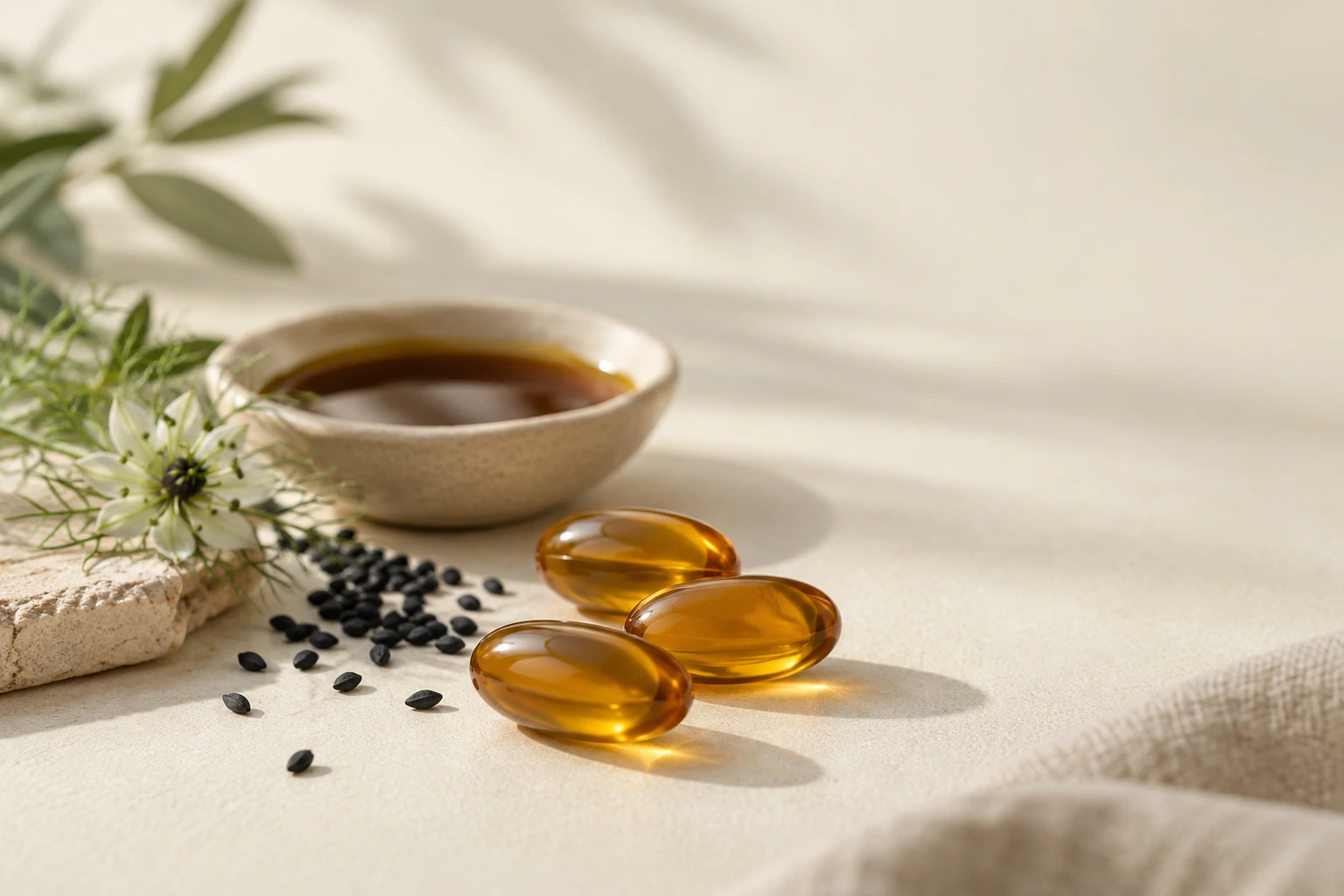
Black seed oil capsules put the pressed oil inside a shell, so you get it without tasting it. The label sets the serving — the number of capsules the directions recommend — and states how much oil each serving contains. Bottled oil is the same ingredient measured by the spoonful; which you pick is about taste and habits.
Nirast makes Ethiopian Black Seed Oil. This article was written by Nirast’s editorial team and reports what the published research does and does not show.
See Nirast Ethiopian Black Seed Oil → · $29.99 a month · 30-Day Money-Back Guarantee
Published by Thang Phi, founder of Nirast and publisher of the Nirast Journal.
That short version holds up. The two forms differ in how the oil is packaged and measured, not in what the human trials behind black seed oil say about them. This page walks through what each form is, what a supplement label actually establishes, what the trials did — and didn’t — test, and the honest way to choose between them.
What black seed oil capsules are — and what the liquid is
Black seed oil is the pressed oil of Nigella sativa seeds, sold commercially in two forms: bottled liquid and capsules that contain the oil (Alkhatib et al., 2020). In research practice, a capsule is handled by piercing it and pressing out its oily contents — the capsule is a container for the oil, not a different ingredient (Khaikin et al., 2022).
Structurally, a softgel is a liquid fill enclosed by a shell. The shell is made from gelatin, or from plant-derived and synthetic alternatives (Naharros-Molinero et al., 2024). Softgels sit among the most widely used oral dosage forms in pharmaceutical practice, with the literature crediting good patient compliance and dosage-unit homogeneity (Naharros-Molinero et al., 2024). Liquid oil is the same pressed oil, poured from a bottle or dropper.
Capsules vs liquid oil: form for form
This comparison covers what each form is, what its label establishes, how its serving is defined, and who each suits. It is not a potency ranking — the sections below show what the evidence can and cannot say about that.
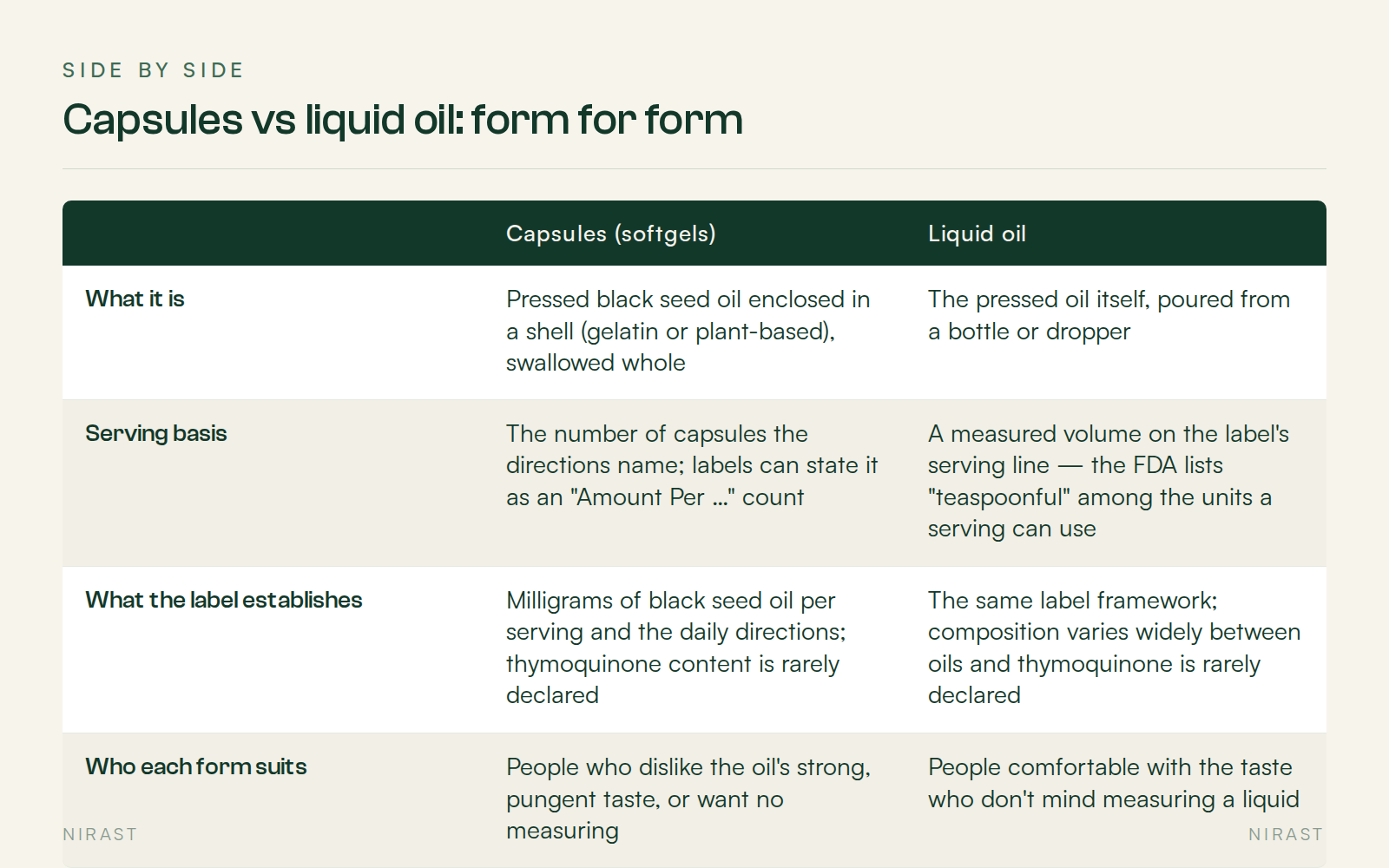
| Capsules (softgels) | Liquid oil | |
|---|---|---|
| What it is | Pressed black seed oil enclosed in a shell (gelatin or plant-based), swallowed whole | The pressed oil itself, poured from a bottle or dropper |
| Serving basis | The number of capsules the directions name; labels can state it as an “Amount Per …” count | A measured volume on the label’s serving line — the FDA lists “teaspoonful” among the units a serving can use |
| What the label establishes | Milligrams of black seed oil per serving and the daily directions; thymoquinone content is rarely declared | The same label framework; composition varies widely between oils and thymoquinone is rarely declared |
| Who each form suits | People who dislike the oil’s strong, pungent taste, or want no measuring | People comfortable with the taste who don’t mind measuring a liquid |
The middle rows are governed by one rule: a supplement’s serving equals the maximum amount its label recommends for one eating occasion — if directions say to take 1–3 tablets with breakfast, the serving is 3 tablets (FDA labeling guide). Labels may phrase amounts as “Amount Per 2 Tablets,” and may use terms such as capsule or teaspoonful (FDA labeling guide). A capsule count and a spoonful are two ways of declaring a serving, not a quality difference.
What a label establishes — and what it does not
The label is where a black seed oil product makes its case, and it has two jobs: define the serving and state the amount per serving. That is the comparable information across products, whether you are holding a bottle or a pouch of softgels.
What labels usually don’t carry is thymoquinone (TQ), the compound that black seed oil marketing leans on hardest. TQ content is rarely reported on commercial black seed oil and is not regulated (Alkhatib et al., 2020) — and the researchers who measured TQ across products recommend that it be declared, so shoppers can choose products of known content (Khaikin et al., 2022).
That recommendation exists because the measured spread is enormous. Across ten products in Malaysia, TQ ranged from 0.07% to 1.88% by weight — roughly a 27-fold difference between the highest and lowest (Alkhatib et al., 2020). Across eleven products in Switzerland — six bottled oils and five oil capsules — TQ ranged from 3.08 to 809.4 milligrams per 100 grams (Khaikin et al., 2022).
Two details from those same surveys narrow the question of what you are choosing between:
- The spread is not about the form. Bottled products ranged 0.14%–1.88% and capsule products 0.07%–1.86%, and the authors found TQ “was not directly related to packaging” (Alkhatib et al., 2020). In the Swiss survey, one manufacturer used the same oil to fill a capsule, and the oil/capsule pair measured a similar concentration (Khaikin et al., 2022).
- The spread comes from the oil itself. Growing region, harvest timing, seed storage and the extraction process all affect TQ content (Khaikin et al., 2022), and an independent analysis of oils from 13 seed batches found wide variation in phytochemical content and quality (Dąbrowski et al., 2024). TQ can also decline in a fresh oil during storage, with heat, light and oxygen as the stressors (Khaikin et al., 2022).
So when a page or a front label leads with a number, the number describes one product’s oil — it is not a category-wide standard. The practical move is to check what the label actually declares.
What the trials actually tested — and what they didn’t
Black seed oil has been studied in humans, mostly in specific clinical populations. A recent review covered 14 randomized controlled trials in people with metabolic conditions — diabetes, prediabetes, hypothyroidism, fatty liver disease, or excess weight — dosed with black seed oil or powder in capsule form at roughly 1–3 grams a day for 6–12 weeks (Derosa et al., 2024).
Individual trials show both forms carrying the dose:
- 43 adults with type 2 diabetes took two 500-mg softgel capsules daily for 8 weeks in a placebo-controlled trial; the authors call for further long-term trials to confirm the findings (Hadi et al., 2021).
- 116 patients with knee osteoarthritis took 2.5 mL of black seed oil every 8 hours for a month against placebo (Huseini et al., 2022).
Those designs show that a capsule and a measured spoonful can each deliver a study dose. The comparisons inside the trials were against placebo, not between forms. And the evidence keeps evolving: a 2025 systematic review of pediatric trials found limited studies with varied doses and forms, and concluded that more high-quality work is needed to establish effective dosing (Abumadini et al., 2025).
Where the forms have been compared is the lab and the palate, not the clinic:
- In an in-vitro digestion study of encapsulated black seed oil, the bioaccessibility of minor compounds — tocopherols, sterols and thymoquinone — was not influenced by the shell material (Alberdi-Cedeño et al., 2023).
- In a 12-volunteer sensory study, encapsulating black seed oil significantly improved its taste and aftertaste compared with the raw oil (Alkhatib et al., 2024).
Three category claims to treat carefully
1. “One form is stronger than the other.” The measured pieces don’t support a form ranking: TQ content didn’t track the packaging, an oil/capsule pair from the same oil measured similarly, and in the in-vitro digestion study the shell material did not change TQ bioaccessibility (Alkhatib et al., 2020; Khaikin et al., 2022; Alberdi-Cedeño et al., 2023). The form is the delivery; the oil inside is the variable.
2. “The thymoquinone number is a standardized dose.” Most products don’t declare TQ at all, the measured spread between products runs roughly 27-fold in one market and wider in another, and researchers recommend declaration precisely because you can’t compare what isn’t stated (Alkhatib et al., 2020; Khaikin et al., 2022).
3. “It’s proven for whatever it’s sold alongside.” The trials are specific: particular populations, about 1–3 g per day, 6–12 weeks — and the reviews ask for longer confirmatory work, while pediatric evidence stays thin (Derosa et al., 2024; Abumadini et al., 2025). One survey calculated that reaching TQ doses used in animal studies would take impractical amounts of some products — at least 277.71 grams of one product per day (Alkhatib et al., 2020).
How to choose between capsules and liquid oil
Five checks, in the order that matters:
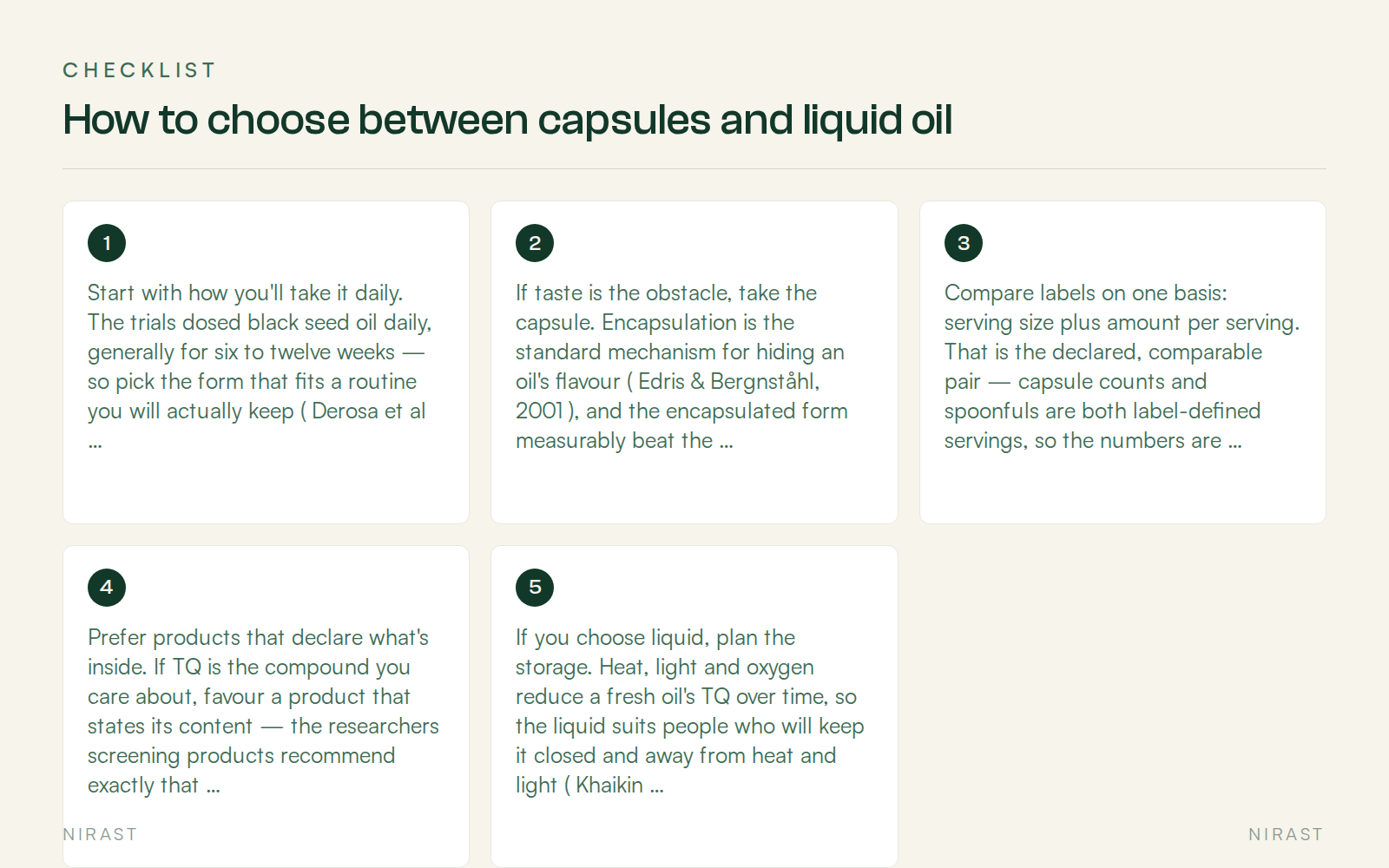
- Start with how you’ll take it daily. The trials dosed black seed oil daily, generally for six to twelve weeks — so pick the form that fits a routine you will actually keep (Derosa et al., 2024).
- If taste is the obstacle, take the capsule. Encapsulation is the standard mechanism for hiding an oil’s flavour (Edris & Bergnståhl, 2001), and the encapsulated form measurably beat the raw oil on taste and aftertaste in a sensory panel (Alkhatib et al., 2024).
- Compare labels on one basis: serving size plus amount per serving. That is the declared, comparable pair — capsule counts and spoonfuls are both label-defined servings, so the numbers are directly readable (FDA labeling guide).
- Prefer products that declare what’s inside. If TQ is the compound you care about, favour a product that states its content — the researchers screening products recommend exactly that (Khaikin et al., 2022).
- If you choose liquid, plan the storage. Heat, light and oxygen reduce a fresh oil’s TQ over time, so the liquid suits people who will keep it closed and away from heat and light (Khaikin et al., 2022).
Who each form suits
Capsules suit readers who dislike the oil’s taste — the oil is pungent by nature (Alkhatib et al., 2024), and encapsulation exists to solve exactly that (Edris & Bergnståhl, 2001). The pharmacy literature also credits softgels with compliance-friendly qualities (Naharros-Molinero et al., 2024).
Liquid suits readers who don’t mind the taste and want to measure by spoon, or who plan to add it to food — with a caveat from the food studies, which accepted black seed oil only at low levels (0.3%–0.5% in one cheese study; a 10% substitution as the tuned optimum in sausages) because the flavour dominates at higher amounts (Abdel-Latif et al., 2021; Halagarda et al., 2025).
Both have carried study doses in human trials, so neither column is “the research form.” The choice is a fit question — taste, measurement, storage, habit.
FAQ
Are black seed oil capsules as effective as the liquid oil?
The research doesn’t rank the two forms. The human trials gave black seed oil against a placebo — some dosed capsules, some dosed measured liquid — so the form was how the dose was delivered, not the thing being compared (Hadi et al., 2021; Huseini et al., 2022). When researchers checked content across products, TQ “was not directly related to packaging” (Alkhatib et al., 2020). Choose on taste, measurement and routine, and follow the label’s serving either way.
How many black seed oil capsules should I take a day?
Follow the product’s own directions. A supplement’s serving is the maximum amount its label recommends for one eating occasion, and labels may state it as an “Amount Per 2 Tablets”-style count (FDA labeling guide). Read the label you actually bought rather than chasing a universal number.
Do black seed oil capsules taste like black seed oil?
That’s what the shell is for. Black seed oil is characterized by a pungent taste (Alkhatib et al., 2024), and encapsulation masks objectionable flavours — the same mechanism used for other strong-tasting oils (Edris & Bergnståhl, 2001). In a 12-volunteer sensory panel, encapsulated black seed oil significantly improved on the raw oil’s taste and aftertaste (Alkhatib et al., 2024).
Why do black seed oil products differ so much?
Thymoquinone content ranged from 0.07% to 1.88% across ten products in one survey, and from 3.08 to 809.4 mg per 100 g across eleven in another (Alkhatib et al., 2020; Khaikin et al., 2022). The differences track the seed’s origin, harvest, storage and extraction — and can widen further if the oil is stored badly (Khaikin et al., 2022; Dąbrowski et al., 2024).
Is black seed oil well tolerated?
In the studies cited here, side effects were minimal: one trial reported none except mild gastrointestinal complaints, a product-quality survey cites clinical studies with no adverse or toxic effects at 5 mL per day over eight weeks, and a pediatric meta-analysis found no statistically significant side effects (Derosa et al., 2024; Khaikin et al., 2022; Abumadini et al., 2025). If you take medication, are pregnant, or manage a health condition, check with a clinician before adding any supplement.
If capsules are your form: Nirast Ethiopian Black Seed Oil
Nirast Ethiopian Black Seed Oil is a softgel — the encapsulated form this page has described — with 1,000 mg of black seed oil per serving, cold-pressed from Nigella sativa, and directions to take 2 softgels daily with water, preferably with food. The softgels are described as taste-free, gentle and easy to take, so the taste question doesn’t come up at all. The offer is a monthly subscription at $29.99, and orders are backed by a 30-day money-back guarantee.
If taste is what has kept black seed oil off your shelf, the capsule is the version built for that: See Nirast Ethiopian Black Seed Oil here.
These statements have not been evaluated by the Food and Drug Administration. This product is not intended to diagnose, treat, cure, or prevent any disease. Talk to your doctor or pharmacist before starting a supplement, especially if you are pregnant, nursing, take medication or have a medical condition.
Related reading
- Black Seed Oil: What It Is, What the Evidence Covers, and How to Choose a Form
- How to Compare Black Seed Oil Servings Across Liquid and Softgels
- Liquid Black Seed Oil vs Softgels: Which Form Suits Which Person?
- Are Oil of Oregano and Black Seed Oil Interchangeable?
Related product: Ethiopian Black Seed Oil.