
Black Seed Oil Side Effects: What the Evidence Reports
Black seed oil side effects are mostly digestive — diarrhea, bloating, nausea — reported mainly with higher intakes. Trials at usual doses report good tolerability. Less common: allergic skin reactions that can be severe, bleeding cautions with blood thinners, interactions with blood-pressure and diabetes medicines, and high-dose cautions in pregnancy.
Nirast makes Ethiopian Black Seed Oil. This article was written by Nirast’s editorial team and reports what the published research does and does not show.
See Nirast Ethiopian Black Seed Oil → · $29.99 a month · 30-Day Money-Back Guarantee
Published by Thang Phi, founder of Nirast and publisher of the Nirast Journal.
That summary comes from the published evidence: controlled trials, systematic reviews, dedicated safety reviews and individual case reports. In the trials, most participants took black seed without serious problems; the reports of harm come from specific patient groups and from case reports. This page collects the fuller picture — which side effects are common, which are rare but documented, who should not take it without medical advice, and what the safety literature still cannot tell you. If you are here for what black seed oil can do rather than what it can cause, the trial evidence for benefits is covered separately: what the research shows on black seed oil benefits.
What are the most common black seed oil side effects?
Gastrointestinal complaints top the list. A 2025 review of black seed’s properties states that “side effects have been described in most cases, mainly when consuming the herb in surplus”, and that “gastrointestinal disorders such as diarrhea, bloating, and nausea are some of the most common side effects experienced by patients” (PMID 40842670). The same review notes that the safety profile at therapeutic doses is usually favorable, that adults commonly take about 1–3 g of the oil per day, and that consuming extreme quantities may lead to minor toxicity or gastrointestinal turbulence.
Set against that, human studies are largely reassuring at ordinary doses. An independent safety overview reports that N. sativa oil at 5 mL/day for 26 days produced no significant hepatic, renal or gastrointestinal adverse effects in volunteers; that 3 g/day of seeds for three months in 39 centrally obese subjects produced no marked side effects; and that diabetic patients taking 1–3 g/day of seeds for three months showed no significant alterations in renal or hepatic function (PMID 37551386).
The reports concentrate in people who already have gut problems. In functionally dyspeptic patients treated with N. sativa oil, trials observed “bloating, nausea, and burning sensation”, and a slight increase in kidney and liver enzymes was seen after use of the oil and crushed seeds — a signal the same review records alongside counter-signals in hepatitis C patients: epigastric pain and hypoglycemia in those given oil capsules, and enzyme-marker increases (a marked rise in AST and ALT with total oil; significantly increased γ-GT and ALP with the oil and crushed seeds) (PMID 37551386).
In the knee-osteoarthritis trials, a 2024 systematic review found that either topical or oral black seed oil was well tolerated with no serious adverse events, though three of the six trials reported treatment-related adverse events. One trial documented contact dermatitis in 7.1% of topical users and 13.4% of oral users; capsule use was associated with a higher risk of increased appetite versus placebo (p = 0.02) (PMID 38650731).
Common versus rare: a side-effect map
| Reported effect | How often the evidence describes it | Where the signal comes from |
|---|---|---|
| Digestive upset — diarrhea, bloating, nausea, stomach burning | The most commonly reported effects; described mainly with higher or “surplus” intake, and observed in patients with functional dyspepsia | Reviews of clinical trials and patient reports |
| Contact dermatitis | 7.1% of topical users and 13.4% of oral users in one osteoarthritis trial; allergic contact dermatitis in human case reports | Trial data within a systematic review; case reports |
| Increased appetite | Associated with capsule use versus placebo in one trial (p = 0.02) | Trial summarised in a systematic review |
| Liver and kidney enzyme changes | “Slight” increases reported in some patient groups; specific preparations linked to higher AST, ALT, γ-GT and ALP; other human studies show no significant changes | Safety review of human studies |
| Severe cutaneous reactions (SJS-like bullous rash, DRESS) | Individual case reports and one eight-patient case series — frequency cannot be estimated from reports like these | Case reports and case series |
| Rhabdomyolysis, acute kidney injury and liver involvement | One case report after ingestion | Case report |
| Bleeding-related signals | Mild blood-thinning effects flagged for anticoagulant users; one multifactorial low-platelet case report; coagulation changes in rats | Review cautions, a case report, animal studies |
Can black seed oil cause bleeding or interact with medicines?
This is the category of side effect that matters most for anyone already on medication, and the sources are direct about it. The 2025 review says that people on anticoagulant medication “may develop mild blood-thinning effects due to black seed oil”, and that “anticoagulants and antihypertensive agents, among other drugs, would need to be monitored closely for any interaction as a result of the drug’s potential impact on blood pressure as well as on platelet aggregation” (PMID 40842670).
The supporting signals come from mixed evidence types, and each should be read for what it is. A case report describes thrombocytopenia (a low platelet count) after hysterectomy in a patient chronically taking evening primrose oil and black seed oil; the reviewing authors treat the event as multifactorial, with the surgery and both oils contributing (PMID 35329893). In rats, oral N. sativa seed powder transiently altered both anticoagulant and coagulant profiles — prolonging prothrombin time, causing hyperfibrinogenemia, and reducing activated partial thromboplastin time and thrombin time (PMID 37551386). And on the drug-metabolism side, a comprehensive review reports that 5 g/day of N. sativa seeds inhibited CYP2D6 and CYP3A4 in human liver microsomes and healthy human volunteers (PMID 39769174) — the same enzyme family that a cardiology review identifies as the most frequent site of drug–herb interactions, where slowed metabolism of antihypertensive drugs can raise their plasma concentration and the risk of toxicity (PMID 38928095).
Animal studies pull in both directions. In rats, black seed enhanced the blood-pressure-lowering effect of losartan and raised its plasma concentration — a potential herb–drug interaction attributed to CYP3A4 and CYP2C9 inhibition — while in a similar rat study it did not significantly alter amlodipine’s pharmacokinetics (PMID 38928095). The evidence sketch matches the reviews’ advice: a mechanism for interaction exists, and their answer is close monitoring rather than dismissal. If you take blood thinners, blood-pressure medicine or diabetes medicine, this is a conversation to have with the clinician who manages that treatment before your first dose; the same review advises checking for interactions with medicines that regulate blood glucose, to prevent hypoglycemia (PMID 40842670). The blood-pressure and blood-sugar medication interactions are covered in more depth here: black seed oil and blood pressure, blood sugar and medicine.
One more medication-related flag: the review notes that black seed’s immunomodulatory effects “can be a contradiction with immunosuppressive drugs or treatments in individuals with autoimmune diseases” (PMID 40842670). If you take immunosuppressants, ask before you add black seed oil.
Who should be careful with black seed oil?
Pregnancy. High doses “are typically not recommended for pregnant women, as they may induce uterine contractions” (PMID 40842670). The trial record in pregnancy is narrow: one randomized human trial, testing N. sativa oil for managing missed abortion — 70 nulliparous women under 12 weeks of gestation received 5 g/day for up to 3 days under a clinical protocol, with misoprostol as back-up, and side-effect frequency was not significantly different between groups (8.6% versus 2.9%; the authors describe short-term use in that setting as safe) (PMID 38633734). That is a specific clinical context, not evidence of safety for healthy pregnancies or longer use; the trial’s own discussion also notes traditional emmenagogue use and that high doses can induce abortion. If you are pregnant, planning a pregnancy or breastfeeding, treat black seed oil as a clinician decision.
Allergies. “Despite being rare, allergic reactions can occur, especially in sensitive individuals, to plants within the Ranunculaceae family” — the same botanical family as Nigella sativa — and people sensitive to seeds or plants are advised to be cautious with black seed products (PMID 40842670). The severe skin reactions described below sit at the far end of this spectrum.
Children. A 2025 systematic review and meta-analysis of pediatric trials reported no severe adverse effects and no statistically significant occurrence of side effects, but also that limited studies are available and further work is needed to fully understand pediatric safety (PMID 41112345). Thin evidence is not the same as a green light; treat a child’s use as a clinician decision too.
The rare but serious reports — and what they do and do not tell you
Severe reactions to Nigella sativa are documented in the case-report literature, for both topical and oral use, and they deserve to be stated plainly:
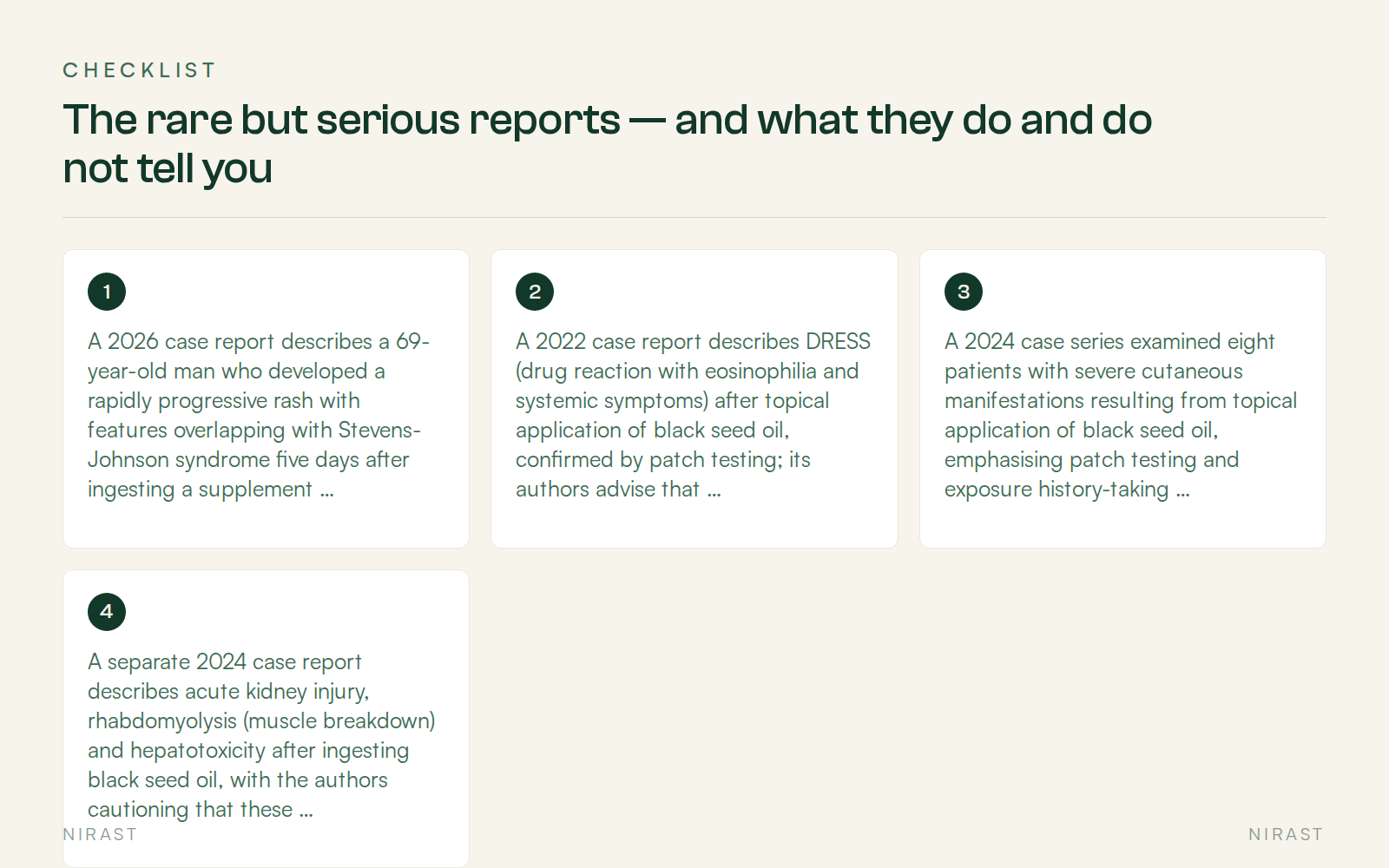
- A 2026 case report describes a 69-year-old man who developed a rapidly progressive rash with features overlapping with Stevens-Johnson syndrome five days after ingesting a supplement containing black seed oil; the report also reviews prior cases of severe bullous cutaneous reactions, and notes that topical black seed oil has been reported to cause reactions mimicking Stevens-Johnson syndrome and toxic epidermal necrolysis (PMID 42699335).
- A 2022 case report describes DRESS (drug reaction with eosinophilia and systemic symptoms) after topical application of black seed oil, confirmed by patch testing; its authors advise that severe cutaneous reactions attributed to these products be reported to pharmacovigilance networks (PMID 35419842).
- A 2024 case series examined eight patients with severe cutaneous manifestations resulting from topical application of black seed oil, emphasising patch testing and exposure history-taking (PMID 39759250).
- A separate 2024 case report describes acute kidney injury, rhabdomyolysis (muscle breakdown) and hepatotoxicity after ingesting black seed oil, with the authors cautioning that these problems may occur after black seed oil use and should be considered in the differential diagnosis for patients taking herbal products (PMID 38844000).
What these reports cannot do is tell you how often such reactions happen — that is the inherent limit of case-report evidence, and no incidence figure can honestly be attached to them. What they do establish is that “rare” is not “never”: severe skin reactions and a multi-organ case exist in the published record, and the case-report authors themselves ask for regulatory attention and pharmacovigilance reporting.
When should you stop and get advice?
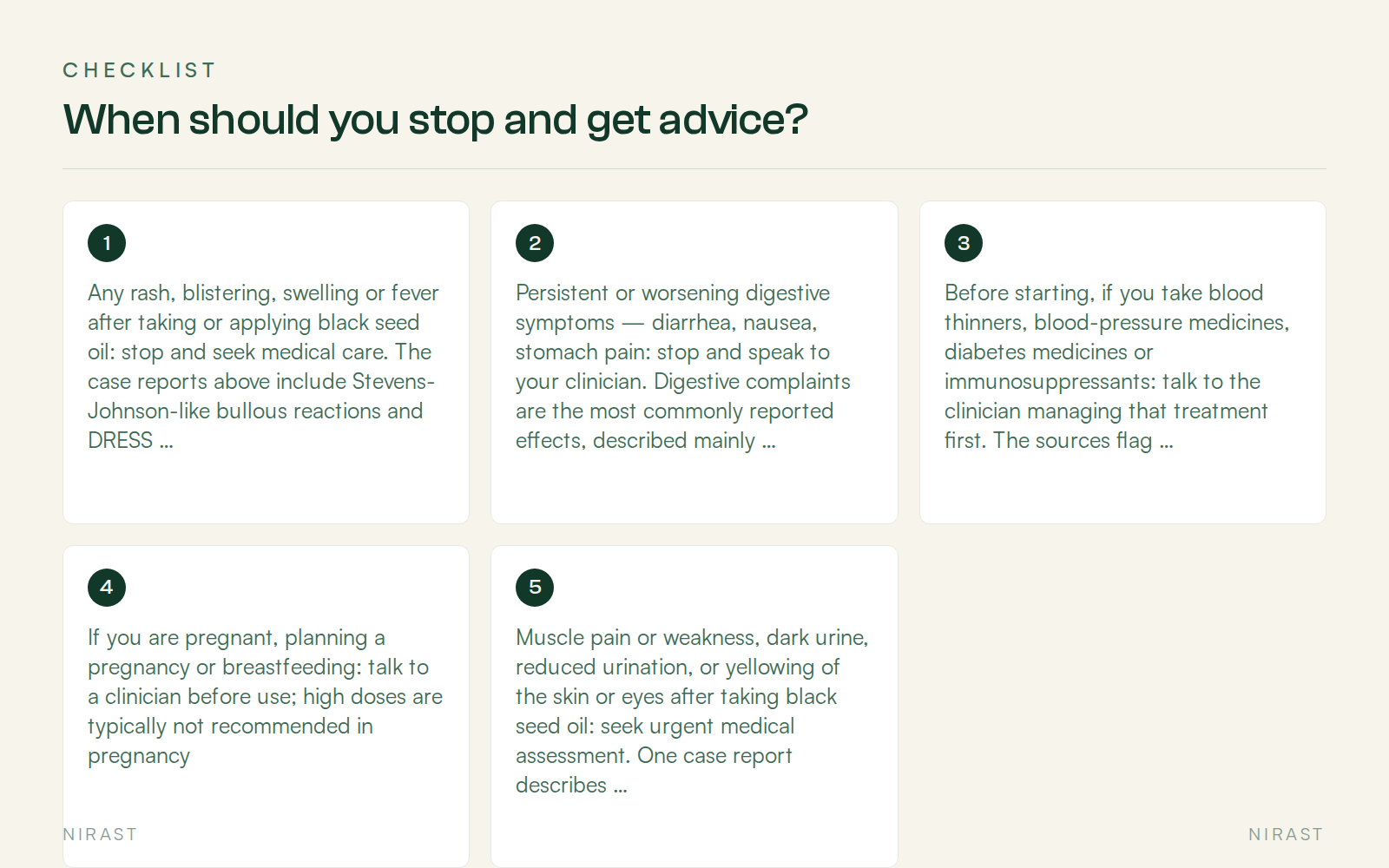
- Any rash, blistering, swelling or fever after taking or applying black seed oil: stop and seek medical care. The case reports above include Stevens-Johnson-like bullous reactions and DRESS; the DRESS authors advise reporting such reactions to your country’s medicines-safety pharmacovigilance scheme.
- Persistent or worsening digestive symptoms — diarrhea, nausea, stomach pain: stop and speak to your clinician. Digestive complaints are the most commonly reported effects, described mainly with higher intakes.
- Before starting, if you take blood thinners, blood-pressure medicines, diabetes medicines or immunosuppressants: talk to the clinician managing that treatment first. The sources flag interaction monitoring, a hypoglycemia caution, and a potential conflict with immunosuppressive treatment.
- If you are pregnant, planning a pregnancy or breastfeeding: talk to a clinician before use; high doses are typically not recommended in pregnancy.
- Muscle pain or weakness, dark urine, reduced urination, or yellowing of the skin or eyes after taking black seed oil: seek urgent medical assessment. One case report describes rhabdomyolysis, acute kidney injury and liver involvement after ingestion, and its authors say black seed oil use should be considered in the differential.
What the safety evidence does and does not establish
What it establishes: at the intakes and durations studied, black seed is generally well tolerated; digestive complaints are the most common side effect and track with higher intakes; specific events — contact dermatitis rates, appetite increase, enzyme-marker changes — have been quantified in particular trials; and a human interaction signal exists at the drug-metabolism level (CYP2D6/CYP3A4 inhibition).
What it does not: how common the rare severe reactions are, since they survive as case reports rather than trial data; long-term safety beyond the weeks-to-months durations studied; whether the rat coagulation findings and enzyme-inhibition findings translate into clinical outcomes for any specific medicine; long-term safety in children; and pregnancy safety beyond the single missed-abortion setting. A dedicated safety overview is unusually candid about the underlying literature itself: many studies “were conducted without characterizing the plant material or its extracts”, studies in both sexes and species beyond rats or mice were lacking, and “dose ranges vary among studies making it difficult to draw conclusions” (PMID 37551386). Its conclusion notes that clinical trials did not report severe adverse effects after consumption, while still requesting more detailed investigation of the toxicological profile. Preclinical work adds a dose-dependence warning: high-dose thymoquinone showed liver and kidney toxicity in rodents, and the reviewers of that evidence describe the overall safety profile as “dose- and context-dependent rather than uniformly benign” (PMID 41302106). In animals, acute-toxicity values vary widely by preparation — LD50 for the fixed oil ranged from 28.8 mL/kg to 3,371 mg/kg in mice, while some extracts at 21 g/kg caused no mortality (PMID 37551386).
The practical translation: “generally safe at usual doses” and “capable of serious effects in some people” are both true, and the honest reading keeps both. Dose matters, and the standard cautions — label directions, clinician advice, no self-treatment of serious conditions — are doing real work here.
FAQ
Are black seed oil side effects common?
The most commonly reported effects are digestive — diarrhea, bloating and nausea — described mainly with higher or “surplus” intakes, with bloating, nausea and burning sensation also observed in patients who already had functional dyspepsia. In trials at usual doses, most participants reported no problems; quantified effects like contact dermatitis (7.1% topical, 13.4% oral in one trial) and increased appetite with capsules come from specific trial populations rather than general use.
Can black seed oil cause bleeding or interact with blood thinners?
Reviews caution that people on anticoagulant medication may develop mild blood-thinning effects from black seed oil, and that anticoagulant and antihypertensive medicines need to be monitored closely for interaction because of the potential impact on blood pressure and platelet aggregation. Supporting signals include one multifactorial low-platelet case report and transient coagulation changes in rats. If you take a blood thinner or blood-pressure medicine, ask your prescriber before adding black seed oil (PMID 40842670; PMID 35329893).
Is black seed oil safe during pregnancy?
High doses are typically not recommended in pregnancy because they may induce uterine contractions. The one randomized trial in pregnant women used black seed oil for a specific clinical situation — managing a missed abortion under a protocol — and its short-term safety finding applies to that setting, not to healthy pregnancies. Ask your clinician before using black seed oil if you are pregnant, planning a pregnancy or breastfeeding (PMID 40842670; PMID 38633734).
Can black seed oil affect the liver or kidneys?
Safety reviews describe “slight” increases in liver and kidney enzymes in some patient groups, and specific preparations have been linked to higher AST, ALT, γ-GT and ALP, while other human studies show no significant changes. High-dose thymoquinone was liver- and kidney-toxic in rodents, and one case report describes acute kidney injury, rhabdomyolysis and liver involvement after black seed oil ingestion. If you have liver or kidney disease, or take medicines processed through the liver, talk to your clinician first (PMID 37551386; PMID 41302106).
What should I do if I get a side effect?
Stop taking the product and tell your clinician what you took, how much and when. For digestive symptoms, stopping and discussing is the standard step; for any rash, blistering, swelling or fever, seek medical care promptly, and consider reporting the reaction to your country’s pharmacovigilance or medicines-safety scheme, as the DRESS case authors advise (PMID 35419842).
How much black seed oil is too much?
There is no single threshold in the literature: side effects are described mainly with surplus or extreme intakes, and reviews report about 1–3 g/day as the range adults commonly take across studies; animal acute-toxicity values vary too widely by preparation to serve as a human guide. The label’s direction line is the practical anchor. For the fuller dose discussion, see can you take too much black seed oil.
About Nirast Ethiopian Black Seed Oil
If a daily softgel is the format that fits your routine, Nirast Ethiopian Black Seed Oil states 1,000 mg of black seed oil per serving, cold-pressed from Nigella sativa. The directions are simple — take 2 softgels daily with water, preferably with food — and the softgels are described on the product page as taste-free, gentle and easy to take. It is a dietary supplement, not a medicine, and it does not replace anything your clinician has prescribed.
The offer is a monthly subscription: 1 pouch for $29.99, delivered every month, backed by a 30-day money-back guarantee. You can cancel by emailing support@nirast.co at least 24 hours before the next scheduled renewal. Nothing about the softgel format changes the cautions on this page — if you take medication, are pregnant or breastfeeding, or manage a health condition, speak to your clinician before starting. To read the label facts and subscribe, the full product page is here: Nirast Ethiopian Black Seed Oil.
These statements have not been evaluated by the Food and Drug Administration. This product is not intended to diagnose, treat, cure, or prevent any disease. Talk to your doctor or pharmacist before starting a supplement, especially if you are pregnant, nursing, take medication or have a medical condition.
Related reading
- Black Seed Oil: What It Is, What the Evidence Covers, and How to Choose a Form
- Black Seed Oil Benefits: What the Evidence Shows
- Black Seed Oil Benefits for Men: What the Evidence Shows
- Black Seed Oil Benefits for Women: What the Evidence Shows
Related product: Ethiopian Black Seed Oil.