
Nigella Sativa: What the Botanical Name Covers — and What Black Seed Oil Labels State
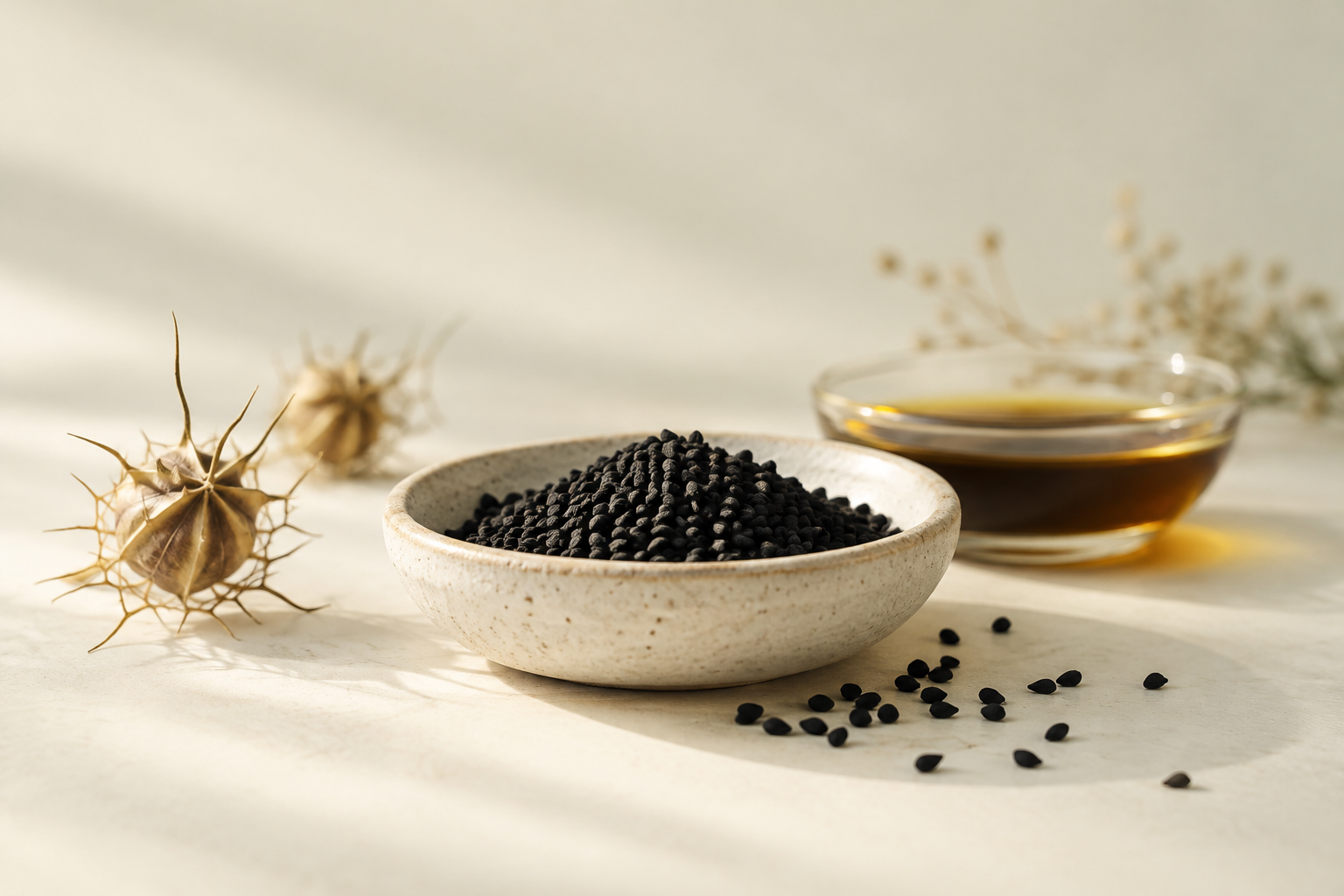
Nigella sativa is the botanical name of an annual flowering plant whose seeds are known as black seed and black cumin. The oil pressed from those seeds is what “black seed oil” products contain — and a product label, not the plant name, is what states how much of it a serving contains.
Nirast makes Ethiopian Black Seed Oil. This article was written by Nirast’s editorial team and reports what the published research does and does not show.
See Nirast Ethiopian Black Seed Oil → · $29.99 a month · 30-Day Money-Back Guarantee
Published by Thang Phi, founder of Nirast and publisher of the Nirast Journal.
That separation is the useful part of this page, because a search for a botanical name and a decision to buy a supplement are two different questions. Below: what the plant is, what the seeds contain, what the human trials cover so far — and the checks that matter when you read a label.
What is Nigella sativa?
Nigella sativa is an erect, annual flowering herb that grows 20–90 cm tall. It is one of about 20 species in the genus Nigella L., in the plant family Ranunculaceae, and the genus’s species are used as either food or medicine (Shaukat et al., 2023). The plant is native to Africa, the Middle East and South Asia (Arshad et al., 2025).
The part of the plant that is used is the seed — small and discoid, taking on its black tint when exposed to air, which is the origin of the names it is sold under (Shaukat et al., 2023). The oil sold as black seed oil is obtained from those seeds: the research literature refers directly to “Nigella sativa seed oil, also known as black seed oil” (Khaikin et al., 2022), and analytical studies extract the fatty oil from commercial N. sativa seeds (Dentato et al., 2025).
Black seed, black cumin, Kalonji: what the names cover
The colloquial names come from the seed’s appearance. The same review that describes the plant lists its colloquial names as “Black cumin,” “Black caraway,” “Alkamoun Alaswad,” or “Black seed” (Shaukat et al., 2023).
One caution hides inside that list. The review distinguishes black cumin and black caraway from true cumin and true caraway — the latter two being the seeds of different plants altogether (Shaukat et al., 2023). So “black cumin” is a colloquial name for the Nigella sativa seed, and it also sits beside names used for other species: when a label says “black cumin,” the species is the detail worth confirming. In the Unani tradition the seed is called “Kalonji” in India, and black seed appears across food, medicine and industry uses (Arshad et al., 2025). If you are untangling the oil, the seed and the spice names, our explainer What is black seed oil — and is it black cumin? walks the same question in plain terms.
What the seeds contain: fixed oil, volatile oil and thymoquinone
The seed is not a single substance, and the proportions matter for reading any product. Its fixed oil is the principal fraction at 36–38% of seed content, while the volatile oils make up only 0.4–2.5% (Shaukat et al., 2023). Thymoquinone (TQ) sits in that small volatile fraction: it makes up 18–57% of the volatile oil, with the exact composition depending on species, seed chemotype and extraction method, and reported TQ content in N. sativa oil runs from 0.05 to 7.2 mg/mL (Shaukat et al., 2023).
The oil’s fatty-acid profile is predominantly polyunsaturated — linoleic acid at 55–59% and oleic acid at 24–28%, followed by palmitic (11–12%) and stearic (2–3%) acids (Dentato et al., 2025). A specific commercial sample analysed by GC-MS showed how much one oil can differ from those reference figures: 14 fatty acids identified, with linoleic acid predominant at 64.9% — and the study notes such percentages vary with the extraction method and solvent used, as well as the ripening stage of the seeds (Dentato et al., 2025).
An independent analysis of oils from 13 seed batches grown across India, Syria, Egypt and Poland confirmed the same theme at batch level: high variation in phytochemical contents and quality indices between oils (Dąbrowski et al., 2024). Put together, these findings say something simple about the head term: “nigella sativa” names an ingredient with a variable composition, not one fixed formula.
The botanical name vs. a product label: two different statements
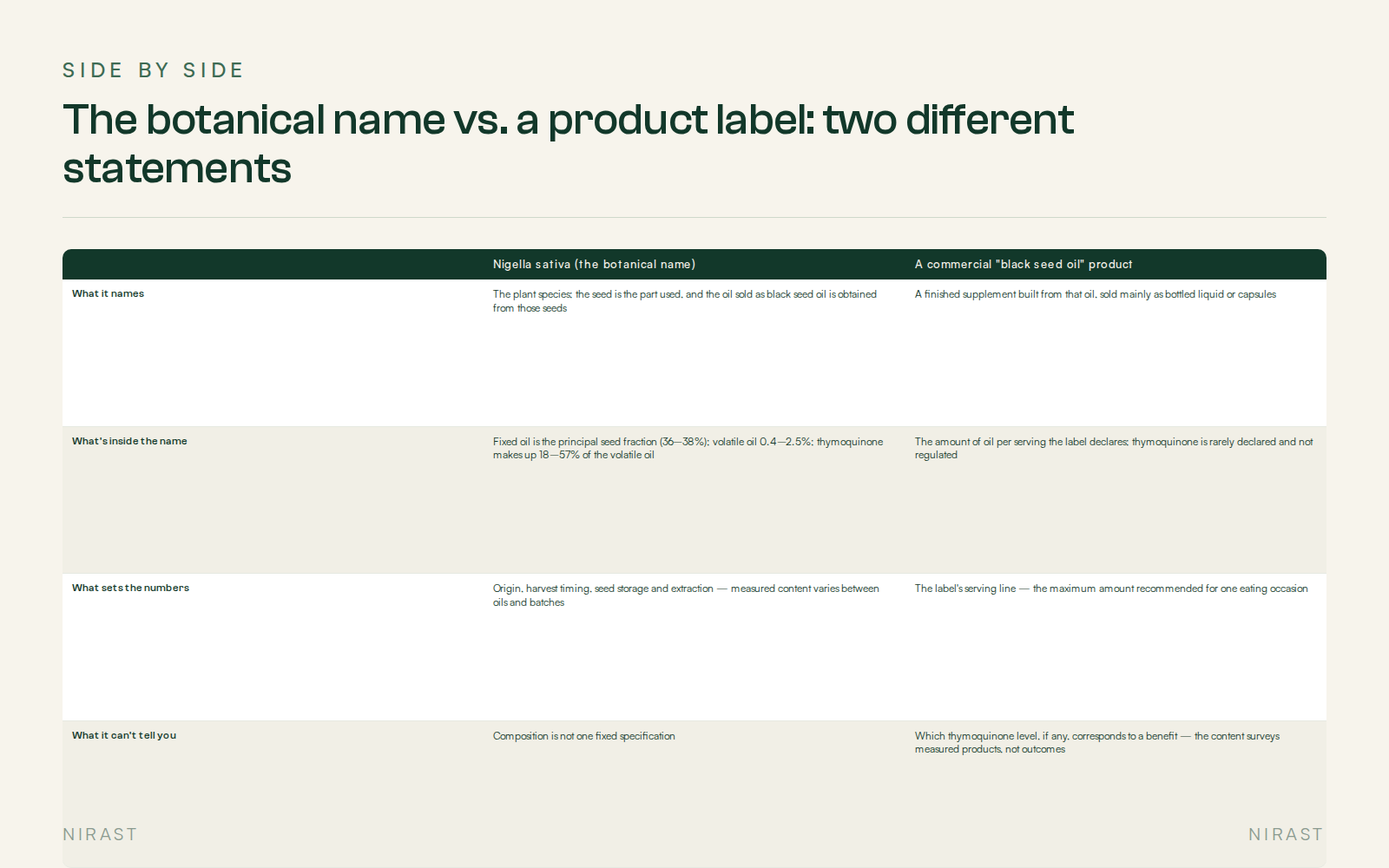
Reading a search term and reading a supplement label are two different jobs. This table separates what the botanical name covers from what a commercial “black seed oil” product states.
| Nigella sativa (the botanical name) | A commercial “black seed oil” product | |
|---|---|---|
| What it names | The plant species; the seed is the part used, and the oil sold as black seed oil is obtained from those seeds | A finished supplement built from that oil, sold mainly as bottled liquid or capsules |
| What’s inside the name | Fixed oil is the principal seed fraction (36–38%); volatile oil 0.4–2.5%; thymoquinone makes up 18–57% of the volatile oil | The amount of oil per serving the label declares; thymoquinone is rarely declared and not regulated |
| What sets the numbers | Origin, harvest timing, seed storage and extraction — measured content varies between oils and batches | The label’s serving line — the maximum amount recommended for one eating occasion |
| What it can’t tell you | Composition is not one fixed specification | Which thymoquinone level, if any, corresponds to a benefit — the content surveys measured products, not outcomes |
The serving rule in the bottom right comes from the FDA’s labeling framework: one serving equals the maximum amount the label recommends per eating occasion, or one unit where no amount is recommended, and labels may phrase amounts as “Amount per 1 Tablet” or “Amount per 2 Tablets” (FDA labeling guide). Both commercial forms carry the same oil, and measured thymoquinone did not track the packaging: the Malaysian survey found TQ “not directly related to packaging,” and a Swiss capsule filled from a specific oil measured a similar concentration to that oil (Alkhatib et al., 2020; Khaikin et al., 2022).
What the human evidence covers so far
In people, the Nigella sativa trials summarised by the reviews were run in specific clinical populations. A review covering 14 randomised controlled trials describes participants with metabolic disorders — diabetes, prediabetes, hypothyroidism, fatty liver disease, or excess weight — treated with N. sativa oil or powder in capsule form at about 1–3 g/day for 6–12 weeks (Derosa et al., 2024).
A 2026 GRADE-assessed meta-analysis widened that picture: 31 randomised trials, 2,145 participants, publications from 2008 to 2022, interventions running 4–24 weeks. It found “modest improvements in several cardiovascular risk factors,” with high-quality evidence supporting effects on weight, BMI, fasting glucose and blood pressure — and no significant effects on measures of insulin resistance or central adiposity. Twelve of the 31 studies were graded high quality, and the authors state that further well-designed trials are needed to clarify the clinical relevance (Musazadeh et al., 2026). For the outcome-by-outcome picture, our companion piece on black seed oil benefits goes through what each area of research shows.
Two more boundaries from the research itself. In children, the evidence is limited: a systematic review of 15 clinical trials concluded that limited paediatric studies exist and that more high-quality studies are needed to establish efficacy, dose and form (Abumadini et al., 2025). And the dose question remains unsettled: one review notes that the specific therapeutic dose of N. sativa has eluded determination so far (Shaukat et al., 2023).
What the evidence does and does not establish
What it does establish is measured reality: the seed’s oil fractions and fatty-acid ranges, the wide spread of thymoquinone between products and batches, and results from trials run in specific clinical populations at study doses.
What it does not establish is where three popular expectations go beyond the data.
“The botanical name guarantees a content.” It does not: two products can share the name while measuring very different thymoquinone levels, from 0.07%–1.88% by weight across ten products in one survey to 3.08–809.4 mg per 100 g across eleven products in another (Alkhatib et al., 2020; Khaikin et al., 2022).
“A content figure converts into a dose.” One survey ran that calculation and found that matching thymoquinone doses used in animal studies would require impractical daily amounts of some products — at least 277.71 g of one product per day — and it notes the estimates lack bioavailability data for how much of an ingested dose reaches the circulation (Alkhatib et al., 2020).
“Ingredient research transfers to any finished product.” The trials test the oil, powder or extract the researchers chose, in the populations they recruited; the content surveys show why reading that across products is not direct — the products themselves differ, and thymoquinone content is rarely declared and not regulated (Alkhatib et al., 2020; Khaikin et al., 2022).
Five checks before you buy a black seed oil product
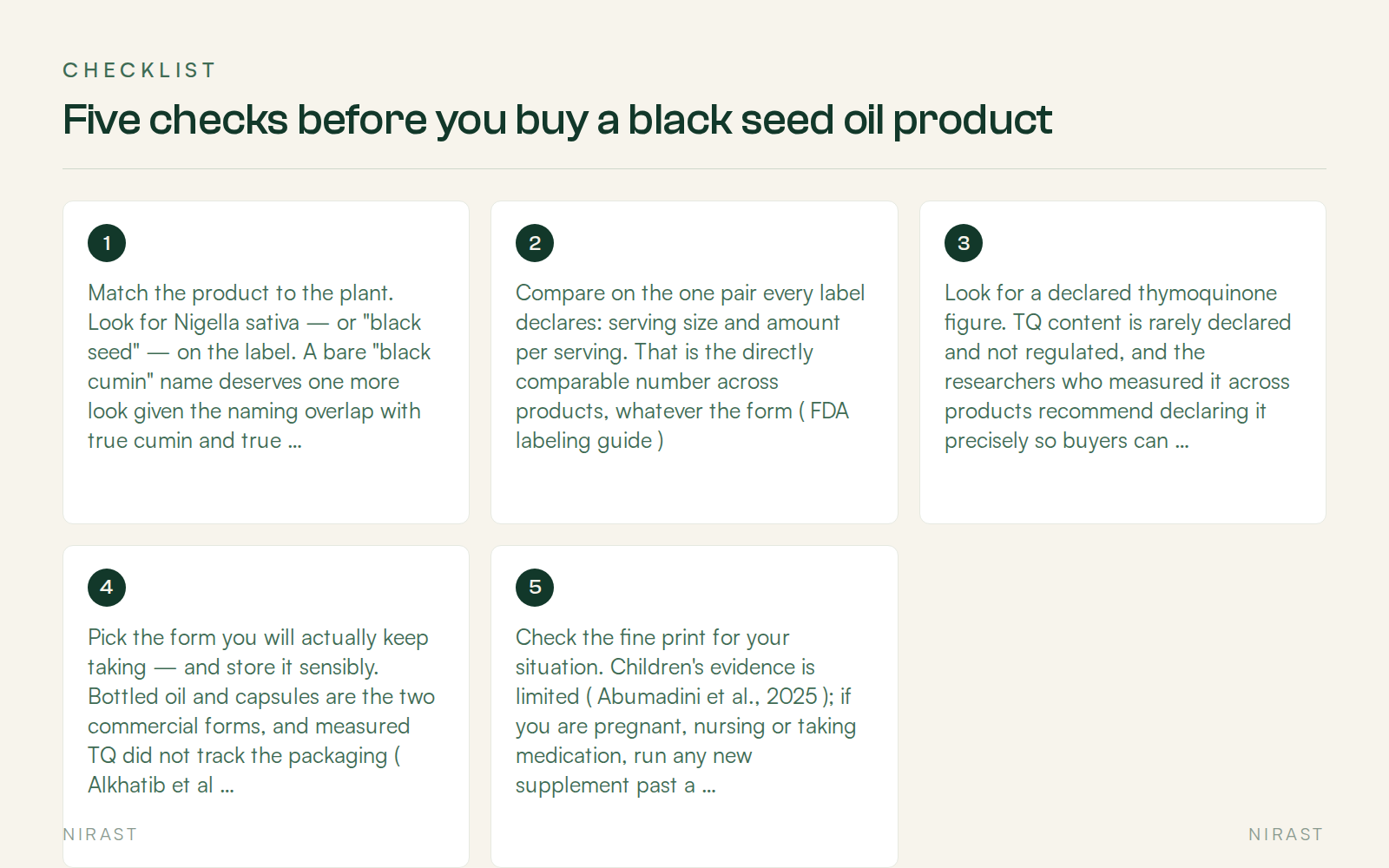
- Match the product to the plant. Look for Nigella sativa — or “black seed” — on the label. A bare “black cumin” name deserves one more look given the naming overlap with true cumin and true caraway (Shaukat et al., 2023).
- Compare on the one pair every label declares: serving size and amount per serving. That is the directly comparable number across products, whatever the form (FDA labeling guide).
- Look for a declared thymoquinone figure. TQ content is rarely declared and not regulated, and the researchers who measured it across products recommend declaring it precisely so buyers can choose products of known content (Alkhatib et al., 2020; Khaikin et al., 2022).
- Pick the form you will actually keep taking — and store it sensibly. Bottled oil and capsules are the two commercial forms, and measured TQ did not track the packaging (Alkhatib et al., 2020). A fresh oil’s TQ can decline during storage through heat, light and oxygen, so a closed pouch or bottle kept out of the light is part of the decision (Khaikin et al., 2022). We compare the two forms in detail in Black Seed Oil Capsules: How They Compare With the Liquid Oil.
- Check the fine print for your situation. Children’s evidence is limited (Abumadini et al., 2025); if you are pregnant, nursing or taking medication, run any new supplement past a clinician first.
FAQ
Is nigella sativa the same as black seed or black cumin?
Yes — “black seed” and “black cumin” are colloquial names for the seeds of the same plant, which take on their black tint when exposed to air (Shaukat et al., 2023). Keep one distinction in mind: true cumin (Cuminum cyminum) and true caraway (Carum carvi) are different plants, so when a label says only “black cumin,” the species is the detail to confirm (Shaukat et al., 2023).
Is black seed oil the same as Nigella sativa oil?
Yes. The literature refers to “Nigella sativa seed oil, also known as black seed oil” (Khaikin et al., 2022), and it is obtained from the seeds (Dentato et al., 2025). Commercially it appears as bottled liquid or as capsules containing the oil (Alkhatib et al., 2020).
What is thymoquinone?
Thymoquinone (TQ) is the compound product surveys measure and much of the research discusses. It sits in the seed’s volatile oil, which itself is only 0.4–2.5% of the seed, and it makes up 18–57% of that volatile oil depending on species, chemotype and extraction (Shaukat et al., 2023). Products rarely declare it (Alkhatib et al., 2020), and the researchers who measured it recommend declaring it on all black seed oil products (Khaikin et al., 2022).
How much nigella sativa has been used in studies?
In the summarised metabolic trials, about 1–3 g/day of N. sativa oil or powder in capsule form for 6–12 weeks (Derosa et al., 2024). Those are study conditions in specific populations, not a recommendation for an individual — and one review notes the specific therapeutic dose has eluded determination so far (Shaukat et al., 2023). The daily directions printed on a product’s label are that product’s own statement.
Why do black seed oil products differ so much?
Content depends on where the seeds were grown, when they were harvested, how they were stored and how the oil was extracted (Khaikin et al., 2022), and an independent analysis of 13 seed batches found high variation between oils (Dąbrowski et al., 2024). The two product surveys measured their spreads directly: 0.07%–1.88% by weight, and 3.08–809.4 mg per 100 g (Alkhatib et al., 2020; Khaikin et al., 2022).
Is black seed oil well tolerated?
In the studies these reviews summarise, the picture is generally favourable: two clinical studies administering 5 mL/day of black seed oil for eight weeks observed no adverse or toxic effects (Khaikin et al., 2022); a 3 g/day, 12-week trial reported no side effects except mild gastrointestinal complaints (Derosa et al., 2024); and a paediatric meta-analysis found no statistically significant side effects (Abumadini et al., 2025). The seeds and the oil are also recognised as safe (GRAS) by the US FDA (Khaikin et al., 2022). Individual circumstances differ — if you take medication or manage a health condition, check with a clinician before adding a supplement.
If you want the oil in a softgel: Nirast Ethiopian Black Seed Oil
Nirast Ethiopian Black Seed Oil is a softgel form of the oil this page has described: 1,000 mg of black seed oil per serving, cold-pressed from Nigella sativa, with stated directions to take 2 softgels daily with water, preferably with food. The softgels are described as taste-free, gentle, and easy to take.
The offer is a monthly subscription — 1 pouch, delivered every month, at $29.99 — backed by a 30-day money-back guarantee, with cancellation by emailing support@nirast.co at least 24 hours before the next scheduled renewal.
A product’s label is where its statements live. This one states the oil, how much per serving and the daily directions. If a softgel is the format you have been looking for, see Nirast Ethiopian Black Seed Oil here.
These statements have not been evaluated by the Food and Drug Administration. This product is not intended to diagnose, treat, cure, or prevent any disease. Talk to your doctor or pharmacist before starting a supplement, especially if you are pregnant, nursing, take medication or have a medical condition.
Related reading
- Black Seed Oil: What It Is, What the Evidence Covers, and How to Choose a Form
- Are Oil of Oregano and Black Seed Oil Interchangeable?
- Black Seed Oil Benefits: What the Evidence Shows
- Can Black Seed Oil Cure a Disease on Its Own?
Related product: Ethiopian Black Seed Oil.