
Astaxanthin Benefits: What Human Trials Show for Skin, Eyes, and Recovery
Human trials support astaxanthin benefits for skin moisture and elasticity, digital eye strain, and exercise-recovery markers, at daily doses of 4–28 mg. Pooled results for wrinkle depth and exercise performance were not significant, so judge each benefit by its own studies rather than a general ‘antioxidant’ promise.
Nirast makes Nirast Extra Strength Astaxanthin. This article was written by Nirast’s editorial team and reports what the published research does and does not show.
See Nirast Extra Strength Astaxanthin → · 30-Day Money-Back Guarantee
Published by Thang Phi, founder of Nirast and publisher of the Nirast Journal.
That short version holds up — the rest of this page is the detail behind it: what each benefit area’s trials actually measured, the effect sizes they reported, where the results turned null, and how to read a benefit claim before you buy. If you want the ingredient itself first — what astaxanthin is and how to choose between forms — see our astaxanthin guide.
What human trials have measured, benefit by benefit
The five benefit areas below are the ones human trials have actually tested. Each row states what was measured, the dose and duration studied, what came out — including the results that did not reach significance — and the main limits.
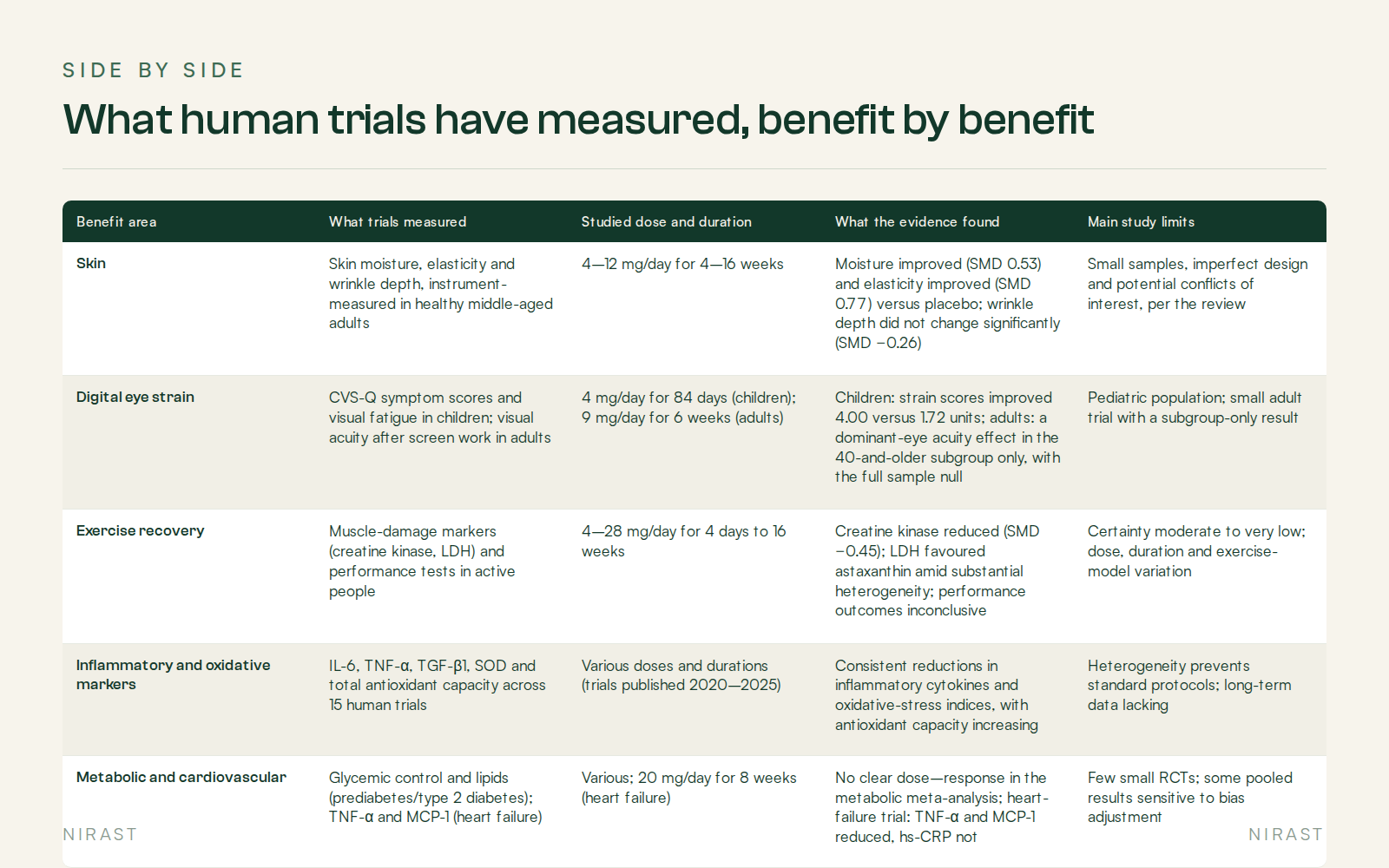
| Benefit area | What trials measured | Studied dose and duration | What the evidence found | Main study limits |
|---|---|---|---|---|
| Skin | Skin moisture, elasticity and wrinkle depth, instrument-measured in healthy middle-aged adults | 4–12 mg/day for 4–16 weeks | Moisture improved (SMD 0.53) and elasticity improved (SMD 0.77) versus placebo; wrinkle depth did not change significantly (SMD −0.26) | Small samples, imperfect design and potential conflicts of interest, per the review |
| Digital eye strain | CVS-Q symptom scores and visual fatigue in children; visual acuity after screen work in adults | 4 mg/day for 84 days (children); 9 mg/day for 6 weeks (adults) | Children: strain scores improved 4.00 versus 1.72 units; adults: a dominant-eye acuity effect in the 40-and-older subgroup only, with the full sample null | Pediatric population; small adult trial with a subgroup-only result |
| Exercise recovery | Muscle-damage markers (creatine kinase, LDH) and performance tests in active people | 4–28 mg/day for 4 days to 16 weeks | Creatine kinase reduced (SMD −0.45); LDH favoured astaxanthin amid substantial heterogeneity; performance outcomes inconclusive | Certainty moderate to very low; dose, duration and exercise-model variation |
| Inflammatory and oxidative markers | IL-6, TNF-α, TGF-β1, SOD and total antioxidant capacity across 15 human trials | Various doses and durations (trials published 2020–2025) | Consistent reductions in inflammatory cytokines and oxidative-stress indices, with antioxidant capacity increasing | Heterogeneity prevents standard protocols; long-term data lacking |
| Metabolic and cardiovascular | Glycemic control and lipids (prediabetes/type 2 diabetes); TNF-α and MCP-1 (heart failure) | Various; 20 mg/day for 8 weeks (heart failure) | No clear dose–response in the metabolic meta-analysis; heart-failure trial: TNF-α and MCP-1 reduced, hs-CRP not | Few small RCTs; some pooled results sensitive to bias adjustment |
The evidence behind each row, with citations: the skin meta-analysis, the children’s eye-strain trial, the adult visual-function trial, the exercise-recovery review, the inflammatory-marker review, the metabolic meta-analysis and the heart-failure trial.
Skin: moisture and elasticity improved — wrinkle depth did not
The pooled skin evidence comes from a 2021 systematic review and meta-analysis of randomized controlled trials in healthy middle-aged adults: oral astaxanthin significantly restored skin moisture (SMD 0.53; 95% CI 0.05–1.01) and improved elasticity (SMD 0.77; 95% CI 0.19–1.35) versus placebo — but the pooled analysis did not find a significant reduction in wrinkle depth (SMD −0.26; 95% CI −0.58 to 0.06) (PMID 34578794).
The trials it pooled used 4 mg to 12 mg a day for 4 to 16 weeks, in groups of 16 to 65 mostly middle-aged participants with age-related skin signs at baseline (PMID 34578794). The review itself cautions that the reliability and strength of the evidence were limited by small sample sizes, imperfect study design, data-extraction method and potential conflicts of interest (PMID 34578794).
Eyes: a clear signal in children, a mixed picture in adults
In a 2025 randomized, double-blind, placebo-controlled trial, 64 children aged 10–14 with mild-to-moderate digital eye strain took a daily 4 mg astaxanthin soft capsule for 84 days. Their CVS-Q symptom scores improved by 4.00 units versus 1.72 on placebo — a 20% between-group difference — and visual-fatigue scores were 27% better (PMID 40014233). The same trial found no significant intergroup difference in visual acuity, spherical equivalence, near point of accommodation or safety variables (PMID 40014233).
In adults the picture is mixed. A 6-week randomized, placebo-controlled trial in 60 healthy adults aged 20–64 taking a 9 mg daily soft capsule found no significant difference in any measurement across the full sample. The positive signal appeared only among participants aged 40 and older, where corrected visual acuity of the dominant eye after screen work showed a higher protective effect than control (p<0.05); under 40, no significant difference was seen (PMID 36777084). A smaller four-week study in 26 visual-display-terminal workers taking 5 mg a day reported improvement in accommodation amplitude, as recorded in a 2026 review’s study table (PMID 42193197).
Exercise recovery: a muscle-damage signal, not a performance boost
A 2026 systematic review and meta-analysis pooled 24 randomized trials in physically active people — doses from 4 to 28 mg a day, durations from 4 days to 16 weeks, all formulations given as capsules (PMID 42197030). Creatine kinase, a muscle-damage marker, fell significantly versus control (SMD −0.45, 95% CI −0.83 to −0.07; moderate between-study heterogeneity), and the review rated it the most consistent recovery-related signal, at moderate certainty (PMID 42197030). Pooled results for VO2 max, time-trial performance and maximal workload were inconclusive, and the authors concluded astaxanthin may be more relevant to recovery than to performance (PMID 42197030).
More is not automatically better. A four-week trial in 24 active males found 12 mg and 36 mg a day similarly reduced the creatine-kinase rise after resistance exercise — with no additional benefit at the higher dose (PMID 42051615).
Inflammation and oxidative stress: what those marker shifts mean
A separate 2026 systematic review of 15 human trials found consistent reductions in pro-inflammatory cytokines (IL-6, TNF-α, TGF-β1) and oxidative-stress indices, with antioxidant capacity increasing (PMID 41596351). These are blood markers, not felt outcomes — and the review flags heterogeneity in dosage, duration and formulation, noting that long-term data, especially on safety, are still lacking (PMID 41596351).
Metabolic, joint and heart outcomes: smaller and earlier evidence
A meta-analysis in people with prediabetes and type 2 diabetes reported no clear dose–response relationship: higher doses did not consistently produce greater metabolic improvements, suggesting a threshold or saturation effect (PMID 42100673).
For knees, a narrative review reports a randomized, double-blind, placebo-controlled trial in patients with moderate-to-severe knee osteoarthritis where 12 mg a day for 8 weeks produced significantly better improvements in pain, physical function and WOMAC scores than placebo — while noting that existing randomized trials are generally limited by small samples and short follow-up (PMID 42589430).
In an 8-week randomized trial in 80 patients with heart failure, 20 mg a day significantly reduced TNF-α (−3.19 vs −1.26 pg/mL; p = 0.013) and MCP-1 (−2.47 vs 6.48 pg/mL; p = 0.004) versus placebo, while no significant effect was observed on hs-CRP (PMID 42303733).
What the evidence does not show
The supplement category compresses complicated studies into single sentences. Five of those compressions are worth holding loosely.
1. “Antioxidant support” as an outcome. The marker studies on this page measured blood analytes — cytokines, SOD, total antioxidant capacity — not how anyone felt (PMID 41596351). A marker moving is a real finding, but it is not the same thing as a benefit you experience.
2. “N times stronger than X.” Astaxanthin’s headline potency multipliers come from laboratory chemistry: the review literature records it as roughly 550 times more effective than alpha-tocopherol at neutralizing singlet oxygen — a chemical assay measurement (PMID 42193197). That is a fact about how the molecule behaves in a lab system, not a multiplier on health effect. The human trials cited here measured skin moisture, eye-strain scores and recovery markers — not multipliers.
3. “Studied in humans, so it will work for you.” Each result belongs to its group and setting: the eye-strain result was in children aged 10–14, the exercise data in trained and active adults, the heart-failure data in patients with a specific condition (PMID 40014233; PMID 42197030; PMID 42303733). The children’s trial is exactly the kind of specific, bounded finding that gets flattened into a general promise.
4. “More milligrams, more benefit.” The comparisons available don’t show it: 12 mg and 36 mg performed similarly in the muscle-damage trial, and the metabolic meta-analysis found no clear dose–response (PMID 42051615; PMID 42100673).
5. “Results in days.” The controlled trials behind astaxanthin’s common uses ran for weeks to months — 84 days in the children’s eye trial, 4 to 16 weeks in the skin trials, up to 16 weeks in the exercise review (PMID 40014233; PMID 34578794; PMID 42197030). Their endpoints were instrumented and clinical, not a morning mirror check.
The reviews of this literature still call for well-designed, large-scale, long-term human trials, noting that many existing studies are constrained by small sample sizes, brief intervention periods and heterogeneous participant populations (PMID 42193197). That is the honest frame for every benefit above: measurable in defined groups, still being confirmed.
Five decisions before you buy astaxanthin for a specific benefit
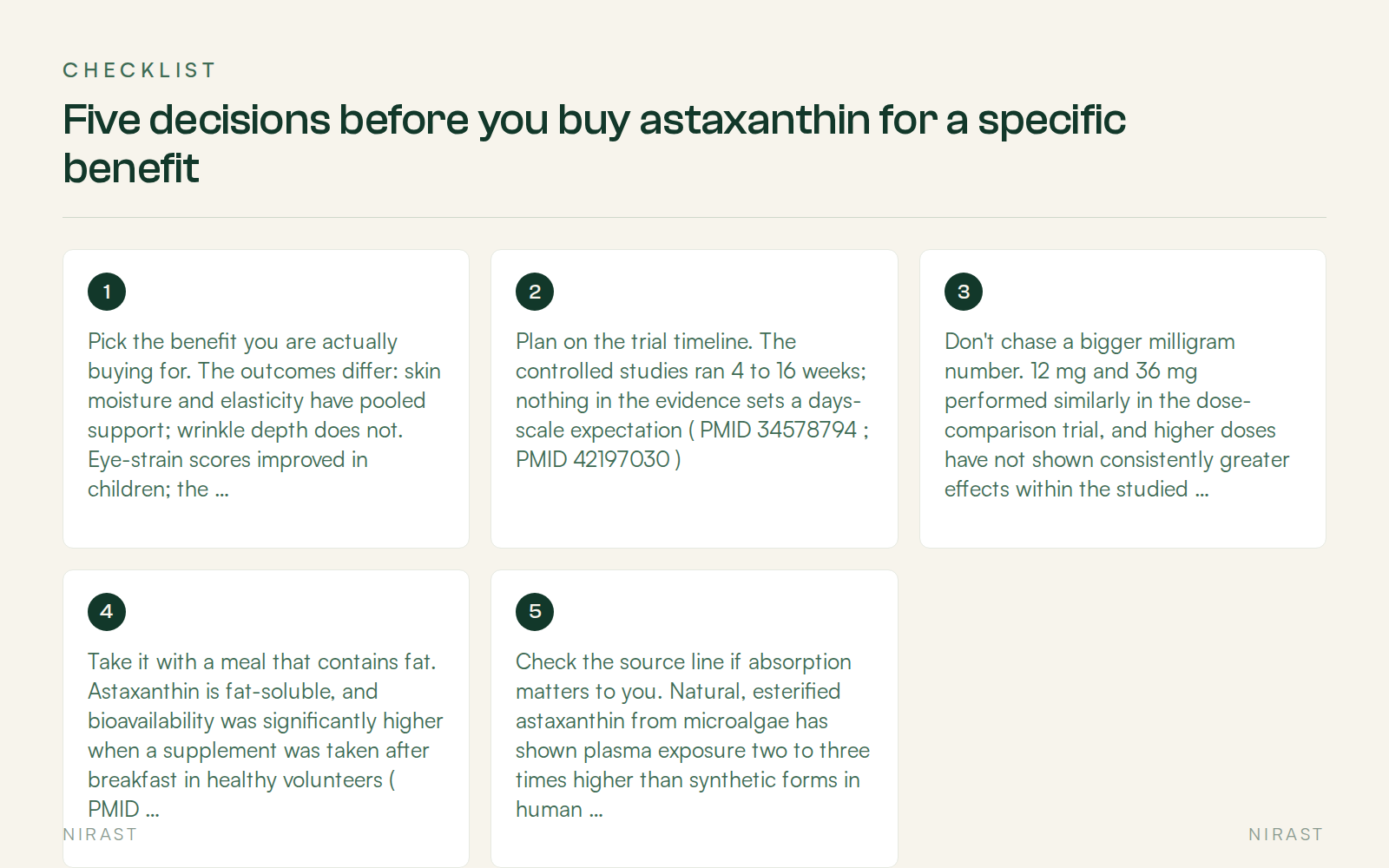
- Pick the benefit you are actually buying for. The outcomes differ: skin moisture and elasticity have pooled support; wrinkle depth does not. Eye-strain scores improved in children; the adult visual-acuity result was subgroup-only. Decide against the specific outcome, not the word “antioxidant” (PMID 34578794; PMID 40014233; PMID 36777084).
- Plan on the trial timeline. The controlled studies ran 4 to 16 weeks; nothing in the evidence sets a days-scale expectation (PMID 34578794; PMID 42197030).
- Don’t chase a bigger milligram number. 12 mg and 36 mg performed similarly in the dose-comparison trial, and higher doses have not shown consistently greater effects within the studied range (PMID 42051615; PMID 42100673).
- Take it with a meal that contains fat. Astaxanthin is fat-soluble, and bioavailability was significantly higher when a supplement was taken after breakfast in healthy volunteers (PMID 42198217).
- Check the source line if absorption matters to you. Natural, esterified astaxanthin from microalgae has shown plasma exposure two to three times higher than synthetic forms in human studies, and it carries the longer safety record (PMID 42193197).
Still choosing between forms and products? Our astaxanthin supplement guide covers the label and form checks in detail.
FAQ
What is astaxanthin actually good for?
On the human evidence, the areas with measurable results are skin moisture and elasticity, digital eye-strain symptoms, and exercise-recovery markers — the pooled skin analysis found improvements in moisture and elasticity, and a 24-trial review found creatine kinase reduced versus control (PMID 34578794; PMID 42197030). It is not a treatment for any disease, and results differ by population: the eye-strain trial was in children, and the recovery data come from active adults.
How long do astaxanthin benefits take?
The controlled trials ran weeks to months: 84 days in the children’s eye trial, 4 to 16 weeks in the skin trials, and up to 16 weeks in the exercise review (PMID 40014233; PMID 34578794; PMID 42197030). The evidence sets no fixed timeline, and the reviews note that dose, duration and formulation vary too much to standardise. Judge any supplement against its own label directions over a comparable window.
Does astaxanthin reduce wrinkles?
On the pooled evidence, no — the 2021 meta-analysis found improved skin moisture and elasticity versus placebo but did not find a significant reduction in wrinkle depth (PMID 34578794). Wrinkle depth is what the trials measured with instruments, and the review calls for larger, more robust trials before stronger conclusions (PMID 34578794).
Can astaxanthin help with screen-related eye strain?
There is a positive pediatric result: in 64 children with digital eye strain, 4 mg a day for 84 days improved symptom scores versus placebo (PMID 40014233). In adults the picture is mixed — a 6-week trial in 60 adults found the positive visual-acuity signal only in the 40-and-older subgroup, with the full sample showing no significant difference (PMID 36777084). It is not a substitute for screen breaks, blinking and eye care.
How much astaxanthin do I need for these benefits?
Across the human studies cited here, doses run from 4 mg a day (the children’s eye-strain trial) to 28 mg a day (the exercise-recovery review), with the skin trials using 4–12 mg (PMID 40014233; PMID 42197030; PMID 34578794). Higher doses have not shown consistently greater benefit within the studied range (PMID 42051615). Follow the product’s label — and if you take medication, are pregnant or manage a health condition, check with a clinician before adding any supplement.
Is astaxanthin safe to take every day?
The compiled safety record is good: no clinically important changes in blood markers at 6 or 20 mg daily for 8 and 4 weeks, no gastrointestinal distress at 8 mg daily for three months, and clinical safety described up to 100 mg daily in randomized trials (PMID 42193197). No clinical safety concerns have been reported in short-term studies using doses up to 24 mg a day for 12 weeks, or in long-term studies of more than 6 months at 12 mg a day in healthy subjects (PMID 37888449). For a regulatory benchmark, EFSA’s exposure assessment applies an acceptable daily intake of 0.2 mg/kg body weight per day for astaxanthin from H. pluvialis (PMID 41346945). At higher intakes — above roughly 12–18 mg a day — red stool, more frequent bowel movements or stomach discomfort have been reported, and long-term safety data remain thin (PMID 42382501; PMID 41596351).
A 12 mg softgel: Nirast Extra Strength Astaxanthin
Nirast Extra Strength Astaxanthin is a softgel supplement, and each softgel delivers 12 mg of pure natural astaxanthin. The label artwork states the astaxanthin is “from microalgae”, and the pouch reads “120 Softgels | Dietary Supplement”. The directions are to take 2 softgels daily with water, preferably with food — which fits the with-a-meal point above. The pouch artwork lists the label’s own claims — “Powerful Antioxidant Support”, “Vision & Skin Health” and “Immune Function” — and the softgels are described as clean, tasteless and easy to swallow. The offer is a monthly subscription, with tiers displayed at $29.99, $59.99 and $89.99, and every delivered order is covered by a 30-Day Money-Back Guarantee.
If the 12 mg softgel taken with a meal is the routine you will keep, this is that product: See Nirast Extra Strength Astaxanthin here.
These statements have not been evaluated by the Food and Drug Administration. This product is not intended to diagnose, treat, cure, or prevent any disease. Talk to your doctor or pharmacist before starting a supplement, especially if you are pregnant, nursing, take medication or have a medical condition.
Related reading
- Astaxanthin: What It Is, What the Evidence Covers, and How to Choose a Form
- Astaxanthin for Skin: What Human Trials Actually Measured
- Astaxanthin for Eyes: What Human Trials Measured for Digital Eye Strain
- Astaxanthin Dosage per Day: What the Human Trials Used
Related product: Nirast Extra Strength Astaxanthin.