
Astaxanthin Dosage per Day: What the Human Trials Used
For astaxanthin, the daily amount depends on the goal: human trials used 4–12 mg a day for skin outcomes, 4 mg in a children’s eye-strain trial, and up to 28 mg a day in exercise-recovery studies. Take it with a fat-containing meal, follow your product’s label, and check with a clinician.
Nirast makes Nirast Extra Strength Astaxanthin. This article was written by Nirast’s editorial team and reports what the published research does and does not show.
See Nirast Extra Strength Astaxanthin → · 30-Day Money-Back Guarantee
Published by Thang Phi, founder of Nirast and publisher of the Nirast Journal.
That is the short version — and the rest of this page is the detail behind it: where those daily amounts come from, why taking astaxanthin with food changes absorption, how long the studies ran, what the evidence shows about higher amounts, and what the safety record covers at the doses that were studied. For the broader ingredient picture, our astaxanthin guide covers what it is and where it comes from; if you are choosing between products, the astaxanthin supplement page covers the label checks.
Is there an official astaxanthin dosage per day?
There is no single official daily number for astaxanthin as a supplement. What exists instead is the label: a supplement’s serving is defined by its own label — one serving equals the maximum amount the label recommends per eating occasion, and labels may phrase the amount as “Each Tablet Contains” or “Amount Per 2 Tablets” (FDA labeling guide). That declared number is what makes two products comparable; it is a labeling definition, not a clinical dose.
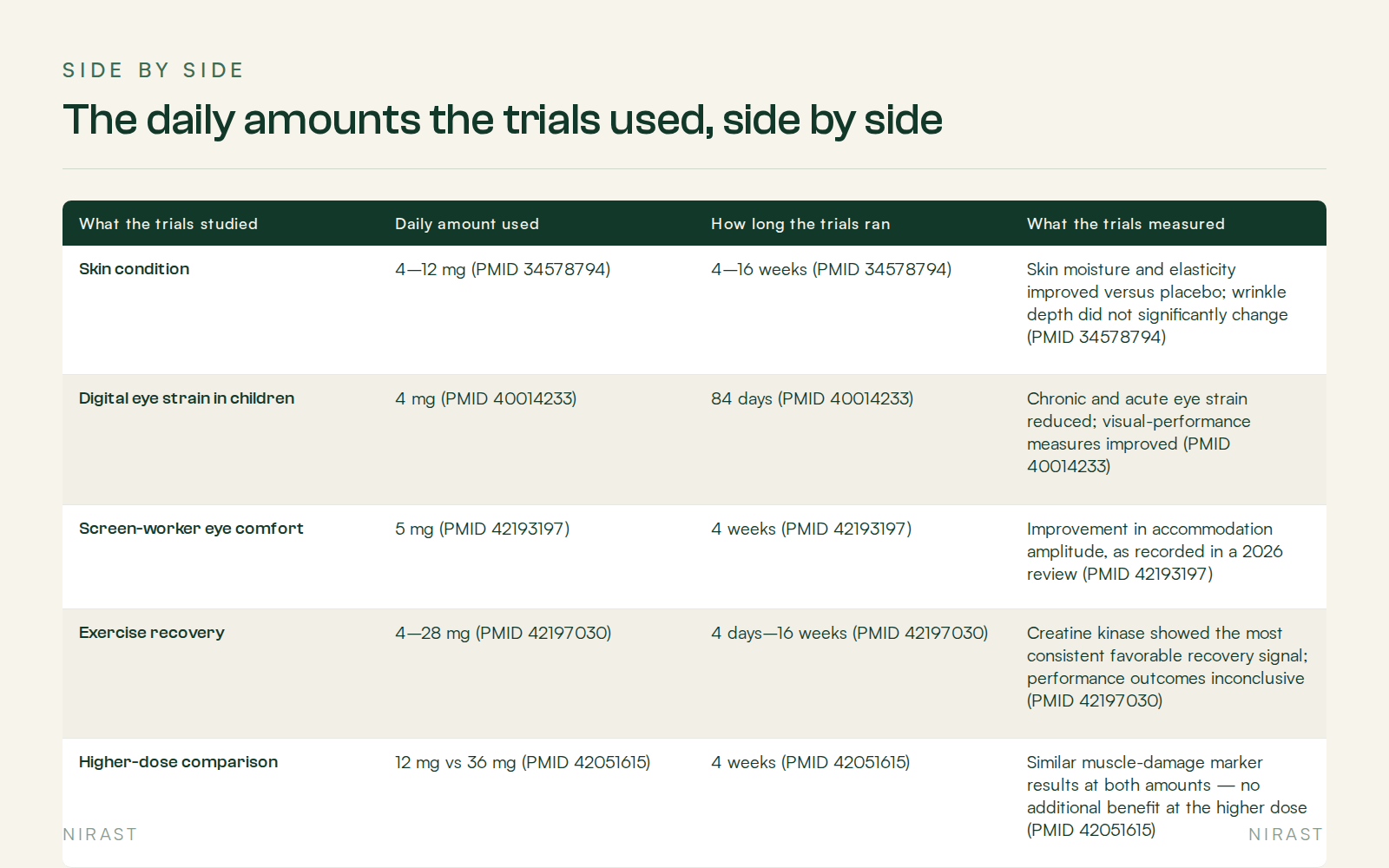
What researchers actually give people varies with the goal being studied. Across the human trials cited on this page, daily amounts run from 4 mg to 28 mg: the skin trials used 4–12 mg, a children’s eye-strain trial used 4 mg, and an exercise-recovery review pooled trials from 4 to 28 mg (PMID 34578794; PMID 40014233; PMID 42197030).
The daily amounts the trials used, side by side
This table summarises what each group of human trials actually administered — the amount, how long the trial ran, and what was measured. It is a record of study conditions, not a set of recommendations.
| What the trials studied | Daily amount used | How long the trials ran | What the trials measured |
|---|---|---|---|
| Skin condition | 4–12 mg (PMID 34578794) | 4–16 weeks (PMID 34578794) | Skin moisture and elasticity improved versus placebo; wrinkle depth did not significantly change (PMID 34578794) |
| Digital eye strain in children | 4 mg (PMID 40014233) | 84 days (PMID 40014233) | Chronic and acute eye strain reduced; visual-performance measures improved (PMID 40014233) |
| Screen-worker eye comfort | 5 mg (PMID 42193197) | 4 weeks (PMID 42193197) | Improvement in accommodation amplitude, as recorded in a 2026 review (PMID 42193197) |
| Exercise recovery | 4–28 mg (PMID 42197030) | 4 days–16 weeks (PMID 42197030) | Creatine kinase showed the most consistent favorable recovery signal; performance outcomes inconclusive (PMID 42197030) |
| Higher-dose comparison | 12 mg vs 36 mg (PMID 42051615) | 4 weeks (PMID 42051615) | Similar muscle-damage marker results at both amounts — no additional benefit at the higher dose (PMID 42051615) |
Two qualifications belong with that table: the eye-strain evidence is pediatric and the screen-worker study is small — neither shows what any particular adult reader will experience (PMID 40014233; PMID 42193197). And these are not the only amounts in the literature: a 2026 systematic review of 15 human trials describes the dosing across studies as heterogeneous, which makes standardized therapeutic protocols difficult to establish (PMID 41596351).
Why the fat in your meal matters
Astaxanthin is fat-soluble and follows the same absorption pathways as dietary lipids. Its bioavailability increases in the presence of fats, and it is higher when delivered in lipid- or oil-based formulations such as softgels than in hard capsules (PMID 42198217). In a study in healthy male volunteers, taking an astaxanthin supplement after breakfast significantly increased its bioavailability (PMID 42198217).
The practical translation is simple: pair the daily amount with a meal that contains some fat. That is also why labels that say “preferably with food” are not just a habit instruction — there is an absorption finding behind it.
How long do the trials run?
The controlled trials cited here measured their outcomes with instruments and clinical scales, not a same-week self-check. The skin trials ran 4 to 16 weeks (PMID 34578794), the children’s eye-strain trial ran 84 days (PMID 40014233), the 2026 taekwondo athlete trial used a 28-day protocol (PMID 42426781), and the exercise review’s trials ran from 4 days to 16 weeks (PMID 42197030).
If you are deciding whether to start, plan for consistent daily intake at the studied amount — the skin, eye and athlete trials ran for weeks, not days.
Do higher daily amounts work better?
Within the ranges studied, the comparisons available do not show extra benefit from bigger daily numbers.
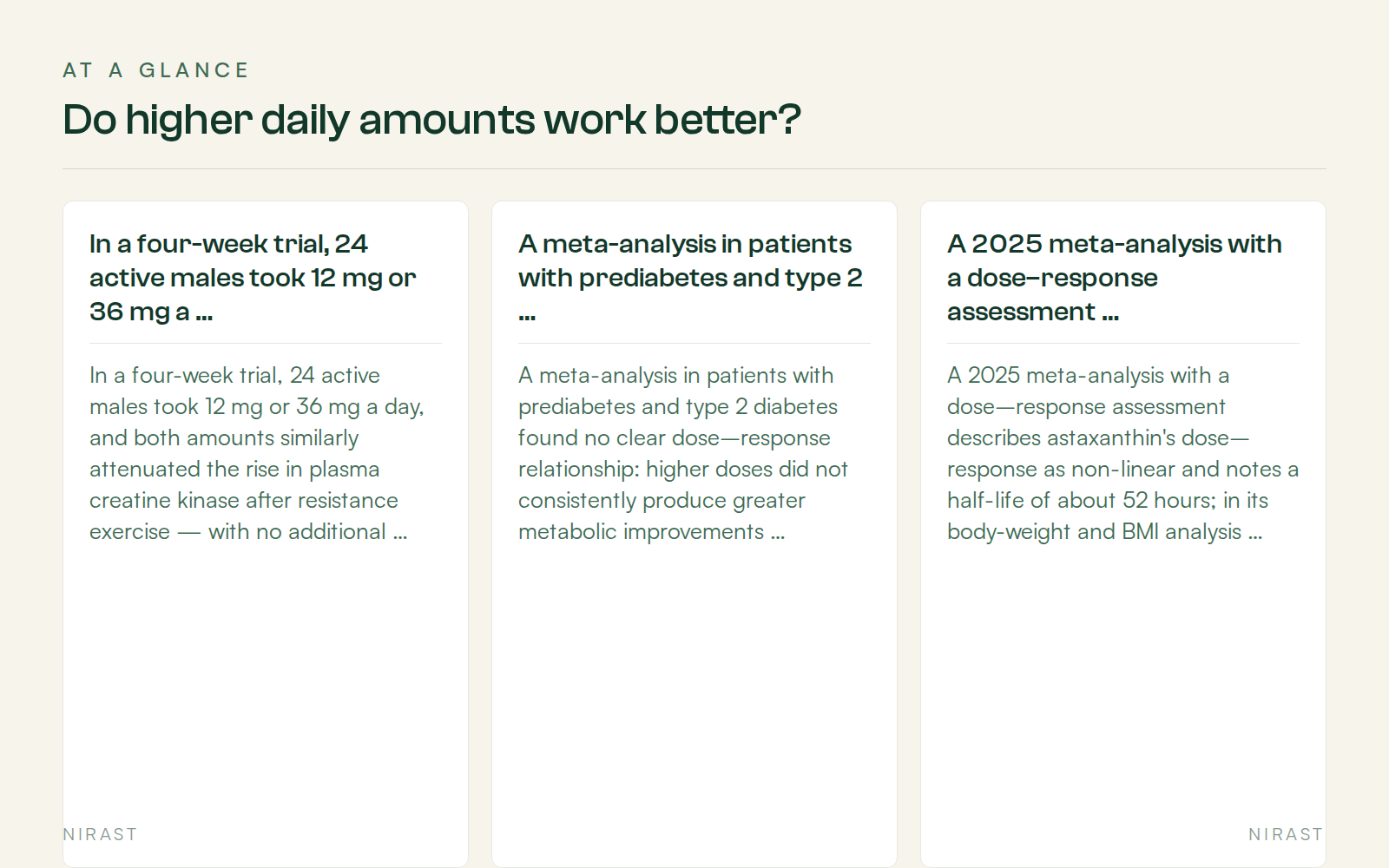
- In a four-week trial, 24 active males took 12 mg or 36 mg a day, and both amounts similarly attenuated the rise in plasma creatine kinase after resistance exercise — with no additional benefit at the higher dose (PMID 42051615).
- A meta-analysis in patients with prediabetes and type 2 diabetes found no clear dose–response relationship: higher doses did not consistently produce greater metabolic improvements, suggesting a threshold or saturation effect rather than linear dose dependency (PMID 42100673).
- A 2025 meta-analysis with a dose–response assessment describes astaxanthin’s dose–response as non-linear and notes a half-life of about 52 hours; in its body-weight and BMI analysis, increasing dose made no difference to the improvements observed (PMID 41155597).
One note keeps this honest: the taekwondo trial’s introduction points to previous athlete evidence that short-term higher-dose supplementation (e.g., 28 mg/day) may reduce perceived stress (PMID 42426781). So a higher-dose signal can appear for a specific endpoint — but no consistent benefit-per-milligram pattern shows up across the comparisons above, and “more is automatically better” is not what these studies show.
Is astaxanthin safe at the daily amounts studied?
The safety observations compiled in the 2026 review cover the studied daily amounts, and higher ranges as well:
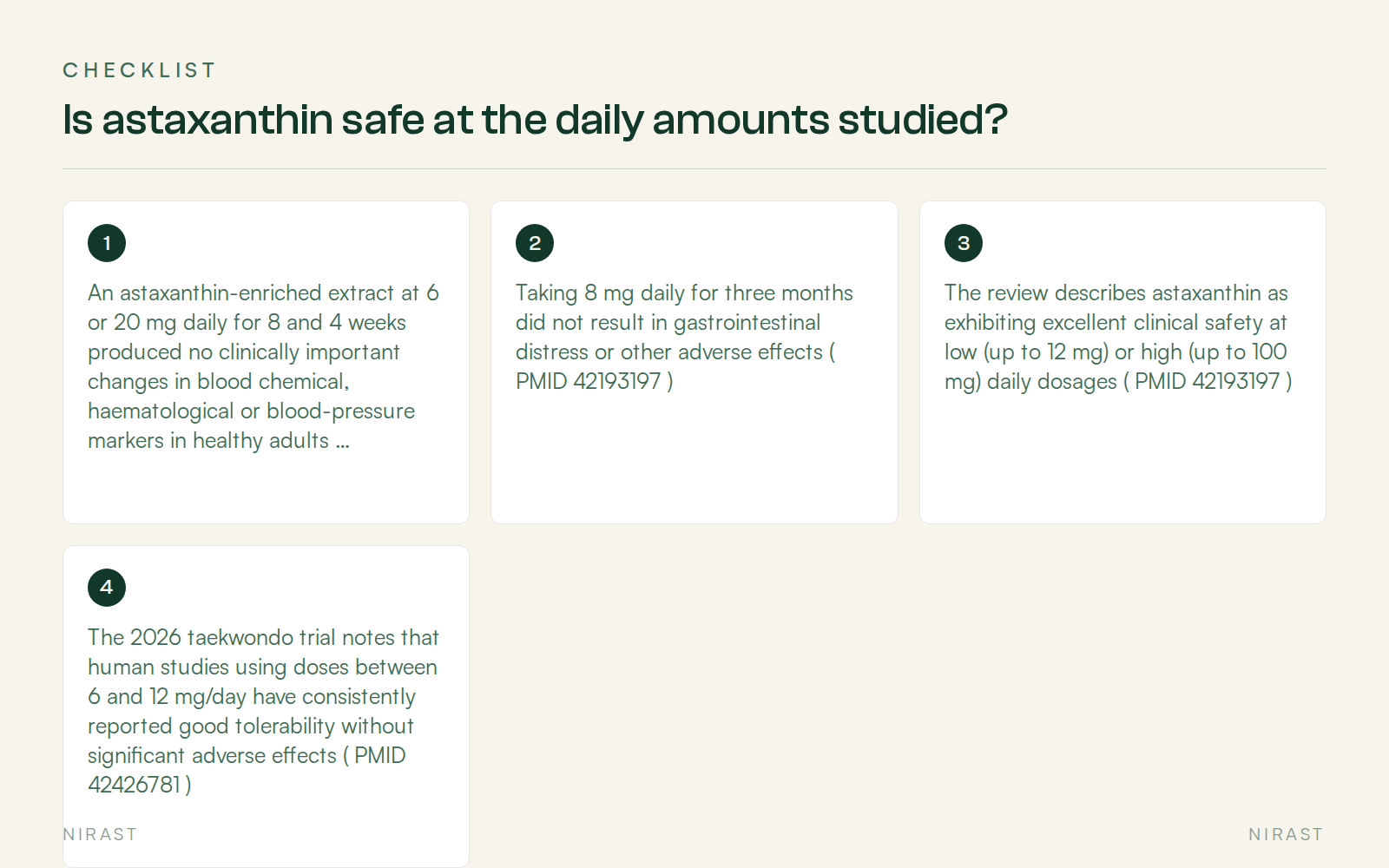
- An astaxanthin-enriched extract at 6 or 20 mg daily for 8 and 4 weeks produced no clinically important changes in blood chemical, haematological or blood-pressure markers in healthy adults (PMID 42193197).
- Taking 8 mg daily for three months did not result in gastrointestinal distress or other adverse effects (PMID 42193197).
- The review describes astaxanthin as exhibiting excellent clinical safety at low (up to 12 mg) or high (up to 100 mg) daily dosages (PMID 42193197).
- The 2026 taekwondo trial notes that human studies using doses between 6 and 12 mg/day have consistently reported good tolerability without significant adverse effects (PMID 42426781).
Two boundaries belong next to those observations. Long-term data are still lacking, especially regarding safety, per a 2026 systematic review of 15 human trials (PMID 41596351) — so treat “no adverse effects observed” as an observation from finite studies rather than a guarantee. And for a regulatory benchmark rather than a personal target, EFSA’s exposure assessment applies an acceptable daily intake of 0.2 mg/kg body weight per day (PMID 41346945).
If you take medication, are pregnant or breastfeeding, or manage a health condition, that is the point to bring a clinician in rather than adjusting a daily amount on your own.
What the evidence does not show
Dose questions attract tidy answers, and tidy answers are where this category’s claims tend to drift. Four are worth holding loosely.
1. “More milligrams, more benefit.” The comparisons available do not show it: 12 mg and 36 mg performed similarly for a muscle-damage marker, the diabetes meta-analysis found no clear dose–response, and the body-weight dose–response assessment found no differences with increasing dose (PMID 42051615; PMID 42100673; PMID 41155597). Within the ranges studied here, a bigger number on the label has not been shown to add benefit.
2. “Timing doesn’t matter.” Astaxanthin’s absorption depends on fat, and the breakfast study found a significant bioavailability increase when the supplement was taken with the morning meal (PMID 42198217). Taking it with a meal is part of the dose working as intended.
3. “Results in days.” The trials behind the outcomes on this page ran for weeks or longer — 4 to 16 weeks for skin, 84 days for the children’s eye trial, up to 16 weeks in the exercise review — and their endpoints were instrumented and clinical, not a morning mirror check (PMID 34578794; PMID 40014233; PMID 42197030). The exercise review’s outcomes were recovery biomarkers and performance tests, not appearance changes (PMID 42197030).
4. “There’s one right daily number.” The heterogeneity finding means there is no standardized protocol across the human literature, and the studied amounts differ by goal and population — 4 mg in a pediatric eye trial, up to 28 mg in athlete recovery research (PMID 41596351; PMID 40014233; PMID 42197030). EFSA’s benchmark is expressed per kilogram of body weight rather than as one flat number (PMID 41346945).
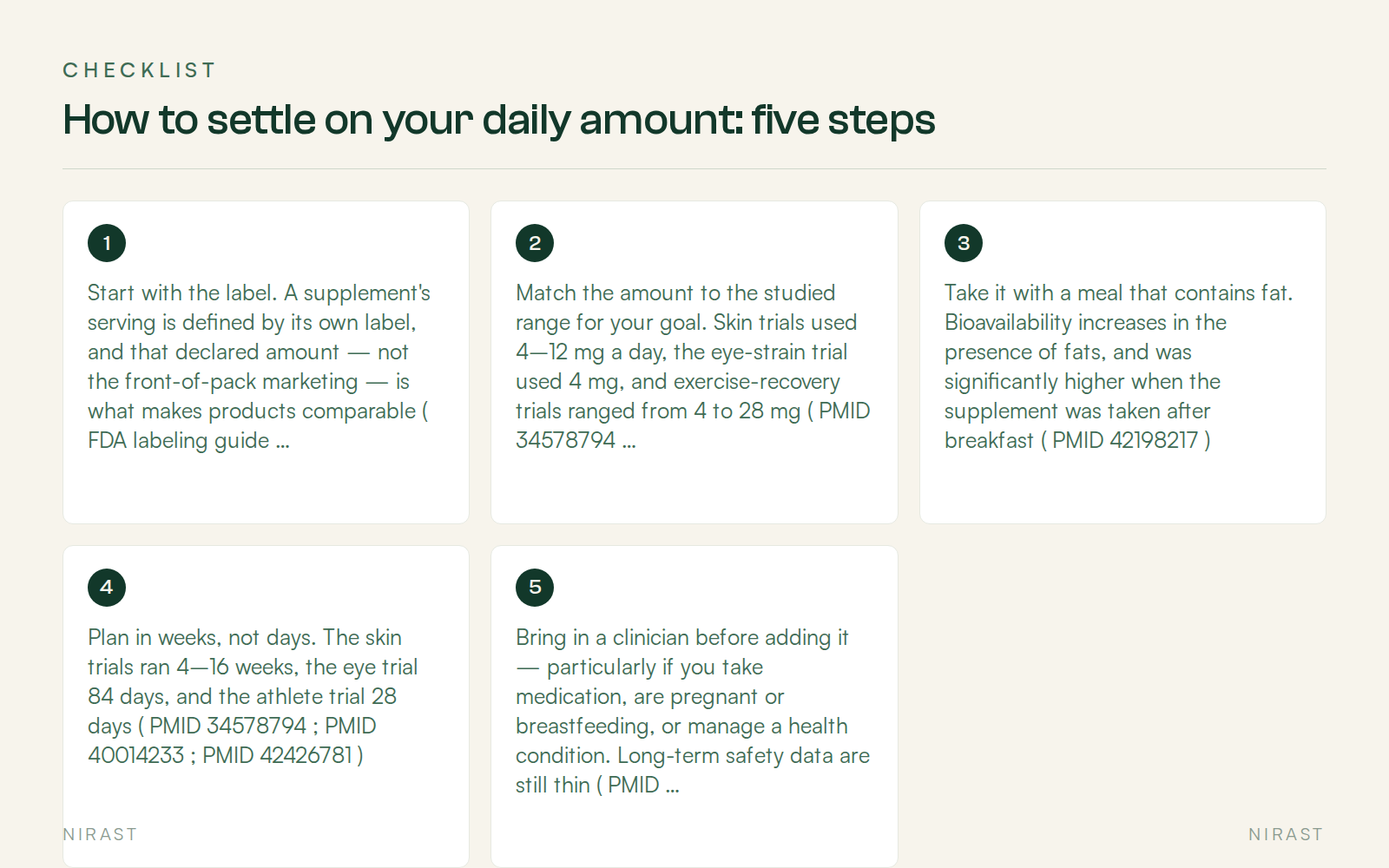
How to settle on your daily amount: five steps
- Start with the label. A supplement’s serving is defined by its own label, and that declared amount — not the front-of-pack marketing — is what makes products comparable (FDA labeling guide).
- Match the amount to the studied range for your goal. Skin trials used 4–12 mg a day, the eye-strain trial used 4 mg, and exercise-recovery trials ranged from 4 to 28 mg (PMID 34578794; PMID 40014233; PMID 42197030). Treat those as study conditions to compare against, not prescriptions.
- Take it with a meal that contains fat. Bioavailability increases in the presence of fats, and was significantly higher when the supplement was taken after breakfast (PMID 42198217).
- Plan in weeks, not days. The skin trials ran 4–16 weeks, the eye trial 84 days, and the athlete trial 28 days (PMID 34578794; PMID 40014233; PMID 42426781).
- Bring in a clinician before adding it — particularly if you take medication, are pregnant or breastfeeding, or manage a health condition. Long-term safety data are still thin (PMID 41596351).
FAQ
How much astaxanthin should I take per day?
Follow the label of the product you have: a serving is defined by the label, and the declared amount is what makes products comparable (FDA labeling guide). For context, the human trials cited here used 4–12 mg a day for skin, 4 mg in the children’s eye-strain trial, and 4–28 mg in exercise-recovery research (PMID 34578794; PMID 40014233; PMID 42197030). If you take medication, are pregnant or breastfeeding, or manage a health condition, check with a clinician before adding any supplement.
Should I take astaxanthin with food?
Yes — with a meal that contains some fat. Astaxanthin is fat-soluble, its bioavailability increases in the presence of fats, and in healthy male volunteers, taking a supplement after breakfast significantly increased its bioavailability (PMID 42198217).
How long does astaxanthin take to work?
The trials that measured skin and eye outcomes ran for weeks: 84 days in the children’s eye-strain trial and 4–16 weeks in the skin trials. A 2026 athlete trial used a 28-day protocol, and the exercise review’s durations ran from 4 days to 16 weeks (PMID 40014233; PMID 34578794; PMID 42197030; PMID 42426781). The endpoints were instrumented and clinical measures, not self-checks.
Is astaxanthin safe to take every day?
The compiled safety observations at studied amounts are reassuring but finite: no clinically important blood-marker changes at 6 or 20 mg for 8 and 4 weeks, no gastrointestinal distress or other adverse effects at 8 mg for three months, and clinical safety described up to 12 mg and up to 100 mg daily (PMID 42193197). At the same time, a 2026 systematic review says long-term data are still lacking, especially on safety (PMID 41596351) — so treat “no adverse effects observed” as an observation from finite studies rather than a guarantee.
Do higher doses of astaxanthin work better?
The comparisons available do not show it within the ranges studied: 12 mg and 36 mg performed similarly for a muscle-damage marker, a diabetes meta-analysis found no clear dose–response, and a dose–response assessment in body-weight outcomes found no differences with increasing dose (PMID 42051615; PMID 42100673; PMID 41155597). A higher-dose signal does appear for one specific endpoint — perceived stress in athletes at around 28 mg/day — but no consistent benefit-per-milligram pattern shows up across these analyses (PMID 42426781).
When should I ask a clinician before taking astaxanthin?
Before starting — if you take any medication, are pregnant or breastfeeding, or manage a health condition — and before going beyond the amounts used in the trials on this page. The human-evidence reviews note that standardized protocols are difficult to establish and long-term safety data are thin (PMID 41596351); a clinician can weigh that against your medications and history.
If a softgel taken with a meal is your routine: Nirast Extra Strength Astaxanthin
Nirast Extra Strength Astaxanthin is a softgel, and each softgel delivers 12 mg of pure natural astaxanthin. The label artwork notes the astaxanthin is “from microalgae”, and the pouch reads “120 Softgels | Dietary Supplement”. The directions are to take 2 softgels daily with water, preferably with food — which fits the with-a-meal point above. The pouch artwork lists the label’s own claims — “Powerful Antioxidant Support”, “Vision & Skin Health” and “Immune Function” — and the softgels are described as clean, tasteless and easy to swallow. The offer is a monthly subscription, with tiers displayed at $29.99, $59.99 and $89.99, and every delivered order is covered by a 30-Day Money-Back Guarantee.
If a softgel taken with a meal is the routine you’ll keep, this is that product: See Nirast Extra Strength Astaxanthin here.
These statements have not been evaluated by the Food and Drug Administration. This product is not intended to diagnose, treat, cure, or prevent any disease. Talk to your doctor or pharmacist before starting a supplement, especially if you are pregnant, nursing, take medication or have a medical condition.
Related reading
- Astaxanthin: What It Is, What the Evidence Covers, and How to Choose a Form
- Astaxanthin for Eyes: What Human Trials Measured for Digital Eye Strain
- Astaxanthin vs CoQ10: What the Human Evidence Shows for Each — and How to Choose
- Astaxanthin Supplement: What It Is and How to Choose
Related product: Nirast Extra Strength Astaxanthin.