
Astaxanthin: What It Is, What the Evidence Covers, and How to Choose a Form
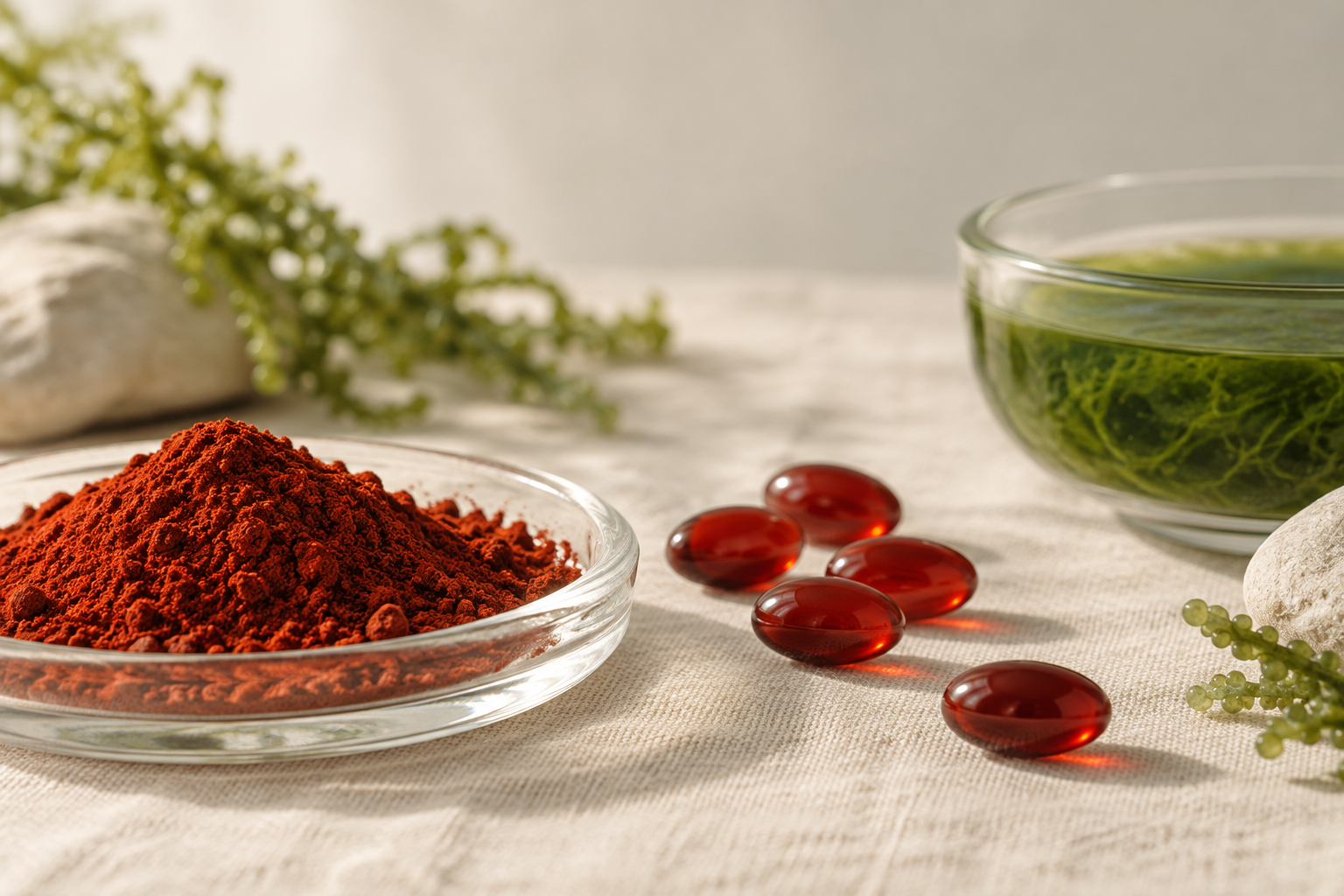
Astaxanthin is a lipid-soluble carotenoid — a xanthophyll — produced by microalgae such as Haematococcus pluvialis, and it is the red-pink pigment in salmon, krill, shrimp and lobster. Human trials of oral astaxanthin span eye comfort, skin, exercise recovery, joints and metabolic health, and reviewers say the evidence is promising but still needs larger trials.
Nirast makes Nirast Extra Strength Astaxanthin. This article was written by Nirast’s editorial team and reports what the published research does and does not show.
See Nirast Extra Strength Astaxanthin → · 30-Day Money-Back Guarantee
Published by Thang Phi, founder of Nirast and publisher of the Nirast Journal.
What astaxanthin is
Astaxanthin is a lipid-soluble pigment of the xanthophyll carotenoid family — the red carotenoid found in microalgae and seafood such as salmonids, shrimps and lobsters (Astaxanthin review, 2023; Ocular applications review, 2020). The name comes from Astacus, the lobster genus it was first isolated from; it was identified as a xanthophyll carotenoid and named “astaxanthin” in 1938 (Astaxanthin review, 2023), and its formula is C40H52O4, molecular mass 596.85 Da (Production review, 2025).
Where astaxanthin comes from
For supplements, Haematococcus algae is the more widely accepted natural source — some countries’ rules require natural astaxanthin to be derived from it — and product development for human health has focused heavily on natural astaxanthin from Haematococcus pluvialis (Astaxanthin review, 2023; Haematococcus review, 2026). In the algae the pigment is largely esterified as monoesters with C16–C18 fatty acids; natural Haematococcus astaxanthin is almost exclusively the all-trans (3S,3′S) isomer, and esterified astaxanthin has enhanced thermal stability and higher bioaccessibility than the free form (Haematococcus review, 2026).
One sourcing note: market astaxanthin is mostly synthetic, and reviews state synthetic astaxanthin is usually not directly used in human medicine and health supplements, with concerns about residual precursors and long-term safety limiting its use (Production review, 2025; Haematococcus review, 2026).
What the evidence covers — and where it thins out
Human trials of oral astaxanthin cover eye comfort, skin, exercise recovery, joints and metabolic outcomes; review authors say much of the wider evidence base remains preclinical and call for larger, rigorously controlled trials (Pharmacology review, 2026; Human-evidence review, 2026).
- Exercise recovery. A 2026 systematic review and meta-analysis pooled 24 randomised trials in active people and athletes; doses ran 4–28 mg/day, durations 4 days to 16 weeks, all as capsules (Exercise meta-analysis, 2026). Pooled, astaxanthin significantly reduced creatine kinase (SMD −0.45, 95% CI −0.83 to −0.07), and lactate dehydrogenase also favoured it amid substantial heterogeneity — but no significant pooled effects appeared for malondialdehyde, interleukin-6, VO2max, time-trial performance or maximal workload. The authors’ conclusion: not a universally effective ergogenic aid, though more relevant to recovery than to performance.
- Eyes. A randomised, double-blind trial in 64 children (about 10–14 years) who used screens 4+ hours daily found 4 mg/day for 84 days improved computer-vision-syndrome scores by 4.00 units versus 1.72 for placebo, and tear production rose (Digital eye strain trial, 2025). In a 6-week study of 60 healthy adults doing visual-display-terminal work, 9 mg/day was associated with a higher protective effect on the corrected visual acuity of the dominant eye in participants aged 40 and older; no significant difference appeared under 40 (Visual function trial, 2023). A review of ocular applications cautions that translation from animal models to human trials is complex (Ocular applications review, 2020).
- Skin. A 2026 review cites clinical trials supporting 3–6 mg/day for photoaged skin, including a 16-week study of 65 women at 6 or 12 mg daily reporting effects on wrinkle parameters and skin moisture (Aging review, 2026).
- Metabolic and inflammatory outcomes. A 2026 systematic review of 15 human studies (2020–2025) reports consistent reductions in pro-inflammatory cytokines (IL-6, TNF-α, TGF-β1) and oxidative-stress indices with increased antioxidant capacity (SOD, TAC); combined astaxanthin and exercise improved body composition, lipids, insulin sensitivity and immune recovery, and an endometriosis trial reported improved oocyte and embryo quality (Human-evidence review, 2026). In 80 patients with stage C/D heart failure, 8 weeks of 20 mg/day was associated with reduced TNF-α and MCP-1 — described by the authors as modest, with broader metabolic effects uncertain (Heart-failure trial, 2026).
- Joints. A 2026 narrative review states that animal studies show oral astaxanthin alleviates knee-osteoarthritis pain and frames it as holding potential there, while noting that existing randomised trials are limited by small samples and short follow-up (Knee-OA review, 2026).
Gaps matter: heterogeneity in dose, duration and formulation prevents standardised protocols, long-term safety data are lacking, and interactions with common medicines are poorly investigated (Human-evidence review, 2026). To see how ingredient-level evidence differs from product-level evidence, read ingredient evidence vs product evidence; for the same method on another ingredient, see our black seed oil guide.
How to choose between forms
Formulation shapes absorption. Bioavailability rises with fats and is higher in lipid- or oil-based softgels than in hard capsules; taking a supplement after breakfast significantly increased bioavailability in healthy volunteers, and the release profile is better in softgels (Delivery review, 2026). Conventional forms protect the molecule — astaxanthin is susceptible to heat, oxygen, light and moisture — but do not by themselves improve bioavailability (Delivery review, 2026; Production review, 2025). Absorption also varies with dose: lower amounts are absorbed more efficiently, with saturation at higher doses, and humans preferentially absorb the cis-isomers (Astaxanthin review, 2023).
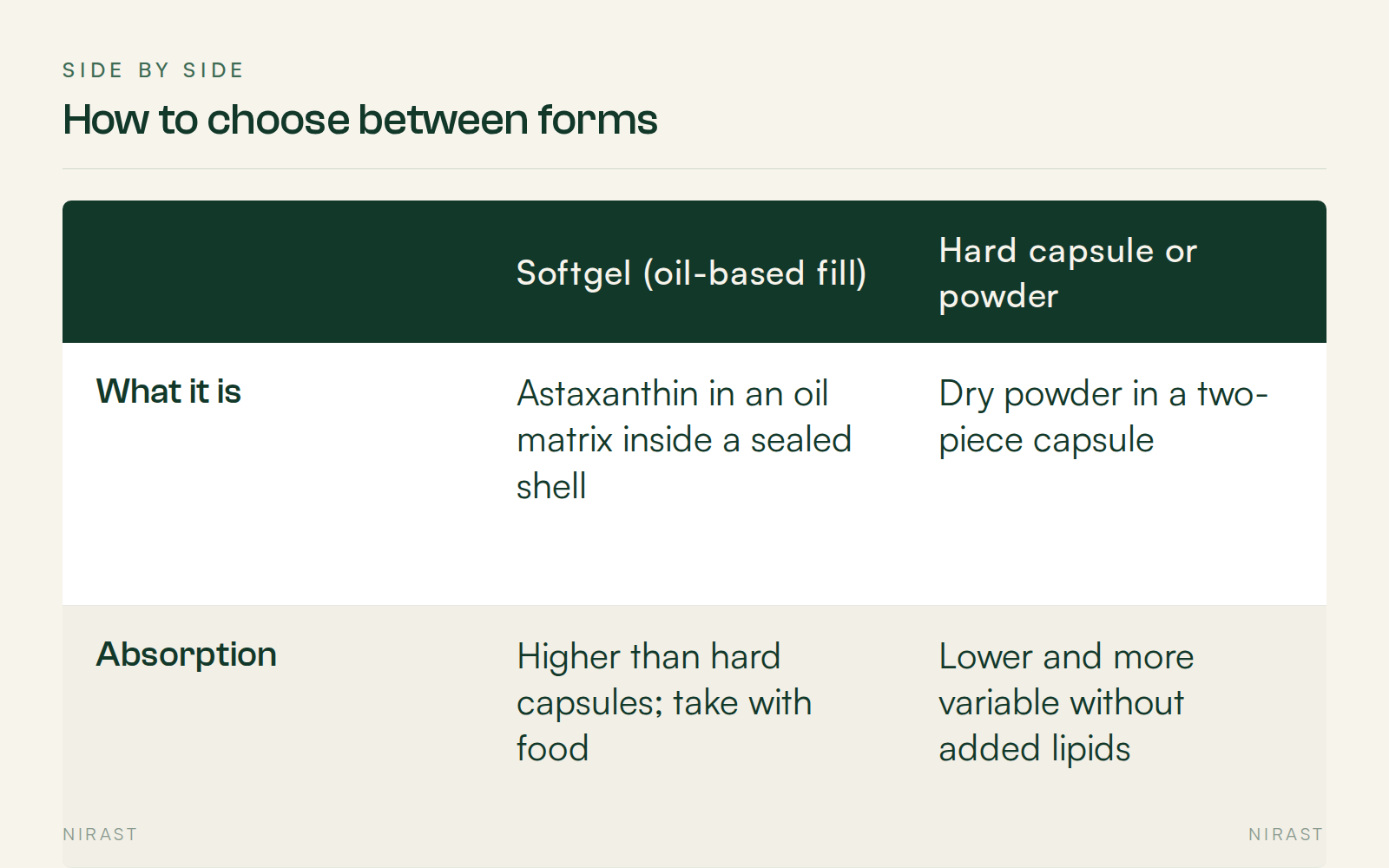
| Softgel (oil-based fill) | Hard capsule or powder | |
|---|---|---|
| What it is | Astaxanthin in an oil matrix inside a sealed shell | Dry powder in a two-piece capsule |
| Absorption | Higher than hard capsules; take with food | Lower and more variable without added lipids |
Five steps to decide:
- Match the form to your routine — a softgel with a meal fits the absorption story; consistency wins.
- Take it with fat — bioavailability rises with fats and after a meal (Delivery review, 2026).
- Check the source line — supplement astaxanthin centres on Haematococcus pluvialis (Haematococcus review, 2026).
- Read the label’s own numbers — trials differ in dose, duration and formulation, so the review cannot set standardised protocols from them (Human-evidence review, 2026).
- Ask what the product is not — a supplement ingredient, not an established treatment. Deeper read: is a softgel absorbed as well as oil from a spoon?.
The safety frame
Reviews of human studies report no clinical safety concerns in short-term studies up to 24 mg per day, or in long-term studies of more than six months at 12 mg per day in healthy subjects; short-term intakes of about 45 mg per day for up to 4 weeks were also studied without adverse effects (Astaxanthin review, 2023). Doses from 2 to 20 mg/day have been described as safe and well tolerated in cardiometabolic and inflammatory trials, and one 2026 review reports human doses of 4–100 mg/day as well tolerated for up to 12 weeks (Heart-failure trial, 2026; Oral-lesions review, 2026). A 2026 athlete trial chose 12 mg/day because previous human studies showed that dose safe and well tolerated (Taekwondo trial, 2026).
At higher intakes — above roughly 12–18 mg/day — the review notes possible off-target effects such as red stool, increased bowel movements or stomach pain, and rare allergic reactions (Oral-lesions review, 2026).
Two limits close the frame: interactions with common medicines are poorly investigated and long-term safety data are lacking (Human-evidence review, 2026); and review authors stress that supplementation should complement — not replace — foundational habits: nutrition, exercise and risk-factor control. If you take medication, are pregnant, or manage a health condition, ask a clinician first.
FAQ
What is astaxanthin?
A lipid-soluble carotenoid of the xanthophyll family, produced by microalgae such as Haematococcus pluvialis and found in seafood including salmon, krill and shrimp (Astaxanthin review, 2023). It is the pigment behind their red-pink colour, and it was first characterised from lobster in the 1930s.
How much astaxanthin do people take per day?
Published trials have used about 4 to 28 mg/day, over 4 days to 16 weeks (Exercise meta-analysis, 2026). Specific studies used 4 mg/day in children, 6 mg/day in endometriosis, 9 mg/day in the visual-function study, 12 mg/day in athletes and 20 mg/day in heart failure (Digital eye strain trial, 2025; Human-evidence review, 2026; Heart-failure trial, 2026). There is no single established dose; the label defines its own serving.
Is 12 mg of astaxanthin too much?
No — 12 mg/day sits inside the range studied in humans, including long-term studies of more than six months with no clinical safety concerns reported, and trials using up to 24 mg/day for 12 weeks (Astaxanthin review, 2023). A 2026 athlete trial selected 12 mg/day because previous studies showed it safe and well tolerated (Taekwondo trial, 2026). At higher intakes — above roughly 12–18 mg/day — red stool, more frequent bowel movements or stomach discomfort have been reported (Oral-lesions review, 2026).
What foods contain astaxanthin?
Seafood is the practical dietary source: sockeye salmon muscle and eggs contain about 2.0–3.8 mg per 100 g and krill about 2.0–4.0 mg per 100 g, while Haematococcus algae in its mature cyst stage can contain up to 9,800 mg per 100 g (Astaxanthin review, 2023). Supplement astaxanthin comes from algal sources instead: Haematococcus algae is the more widely accepted natural source, and some nutraceutical rules require it.
What should you not mix with astaxanthin?
This is not well mapped: interactions between astaxanthin and commonly used medicines are poorly investigated (Human-evidence review, 2026). Because of that gap, anyone on prescription medication should check with a clinician first.
How long does astaxanthin take to work?
The evidence sets no fixed timeline. Trial durations have ranged from 4 days to 16 weeks, and the reviews note that heterogeneity limits firm conclusions on optimal dosing (Exercise meta-analysis, 2026; Human-evidence review, 2026). Measured effects in the eye trials appeared over weeks to months — 6 weeks for the visual-acuity finding, 84 days for the children’s scores — so judge a supplement against its own stated serving over a comparable window.
A softgel option: Nirast Extra Strength Astaxanthin
If a softgel fits the form you want, Nirast Extra Strength Astaxanthin is one product to look at. It is a softgel supplement stating 12 mg of pure natural astaxanthin per softgel, with the label artwork describing the astaxanthin as “from microalgae” (product page). The stated directions are: “Take 2 softgels daily with water, preferably with food.” The offer is a monthly subscription — the page states changes and cancellation require contacting support at least 24 hours before the next renewal — and every delivered order is covered by the 30-Day Money-Back Guarantee, with refunds via support@nirast.co within 30 calendar days after delivery and no returns required (product page).
What this product is: a supplement, not a treatment — an oil-based softgel taken with food, 12 mg per softgel, and directions you can follow. The evidence above is ingredient-level, the right frame for judging any product in this category.
See Nirast Extra Strength Astaxanthin here.
These statements have not been evaluated by the Food and Drug Administration. This product is not intended to diagnose, treat, cure, or prevent any disease. Talk to your doctor or pharmacist before starting a supplement, especially if you are pregnant, nursing, take medication or have a medical condition.
Related reading
- Astaxanthin Supplement: What It Is and How to Choose
- Astaxanthin vs CoQ10: What the Human Evidence Shows for Each — and How to Choose
- Astaxanthin 12 mg: What the Dose Means on a Label
- Astaxanthin Softgels: What the Format Is and How to Read It
Related product: Nirast Extra Strength Astaxanthin.