
Astaxanthin for Eyes: What Human Trials Measured for Digital Eye Strain
Human trials of astaxanthin for eye outcomes used 4–9 mg a day for 4–12 weeks in screen workers and children with digital eye strain. A 64-child trial found better symptom and visual-fatigue scores than placebo; adult results were mixed — a visual-acuity effect appeared only in the 40-and-older subgroup.
Nirast makes Nirast Extra Strength Astaxanthin. This article was written by Nirast’s editorial team and reports what the published research does and does not show.
See Nirast Extra Strength Astaxanthin → · 30-Day Money-Back Guarantee
Published by Thang Phi, founder of Nirast and publisher of the Nirast Journal.
That short version holds up — the rest of this page is the detail behind it: what the eye trials measured, the doses and durations, where results turned null, and when an eye concern belongs with an eye-care professional. For the ingredient itself — what astaxanthin is and how to choose between forms — see our astaxanthin guide; the astaxanthin benefits overview covers the other outcome areas.
What do eye trials of astaxanthin actually measure?
Asthenopia — the clinical word for eye fatigue — is described as a common condition presenting with nonspecific symptoms including discomfort, lacrimation, blurry vision and light sensitivity (PMID 32370045). Screen time and symptoms are consistently linked in the reviewed literature (PMID 36235656), and the trials on this page were built around screen work: participants worked at a display terminal while researchers measured their eyes before and after.
That is why the endpoints matter more than the phrase “eye health.” The children’s trial scored symptoms with the Computer Vision Syndrome Questionnaire (CVS-Q) and a visual-fatigue Likert scale, and also measured visual acuity, near point of accommodation, dry eye intensity, stereopsis, blinking frequency and safety variables (PMID 40014233). The adult trials measured corrected visual acuity before and after 60 minutes of screen work, accommodative amplitude and the pupillary response to light (PMID 36777084; PMID 36235656). These are instrument and questionnaire endpoints — not a general promise that vision improves.
The children’s trial: 4 mg a day for 84 days
The symptom result quoted above comes from a randomized, double-blind, placebo-controlled trial in 64 children aged 10–14 who logged at least four hours of screen time daily and had mild-to-moderate computer vision syndrome symptoms (CVS-Q score ≥8 and <19). They took a daily 4 mg astaxanthin soft capsule or placebo for 84 days (PMID 40014233).
As reported:
- CVS-Q symptom scores improved by 4.00 ± 4.05 units from baseline with astaxanthin versus 1.72 ± 3.61 on placebo — a 20% between-group difference (PMID 40014233).
- Visual fatigue scores (VFLS) were lower with astaxanthin (11.55 ± 5.78) than placebo (15.78 ± 7.12), a 27% improvement at 84 days (PMID 40014233).
Tear production increased within the astaxanthin group at 14, 56 and 84 days, but there was no significant intergroup difference in the Schirmer I test, visual acuity, near point of accommodation, immune markers or safety variables (PMID 40014233). The positive results are symptom scores and tear changes — not sharper eyesight. And this was a pediatric trial: nothing in it establishes the same symptom response in adults.
The adult screen-worker trials: one mixed result, two small positives
The main adult trial randomised 60 healthy Japanese adults aged 20–64 who regularly did screen work and reported frequent eye fatigue. They took 9 mg astaxanthin or a placebo daily for six weeks, with acuity measured before and after 60 minutes of video-game screen work (PMID 36777084).
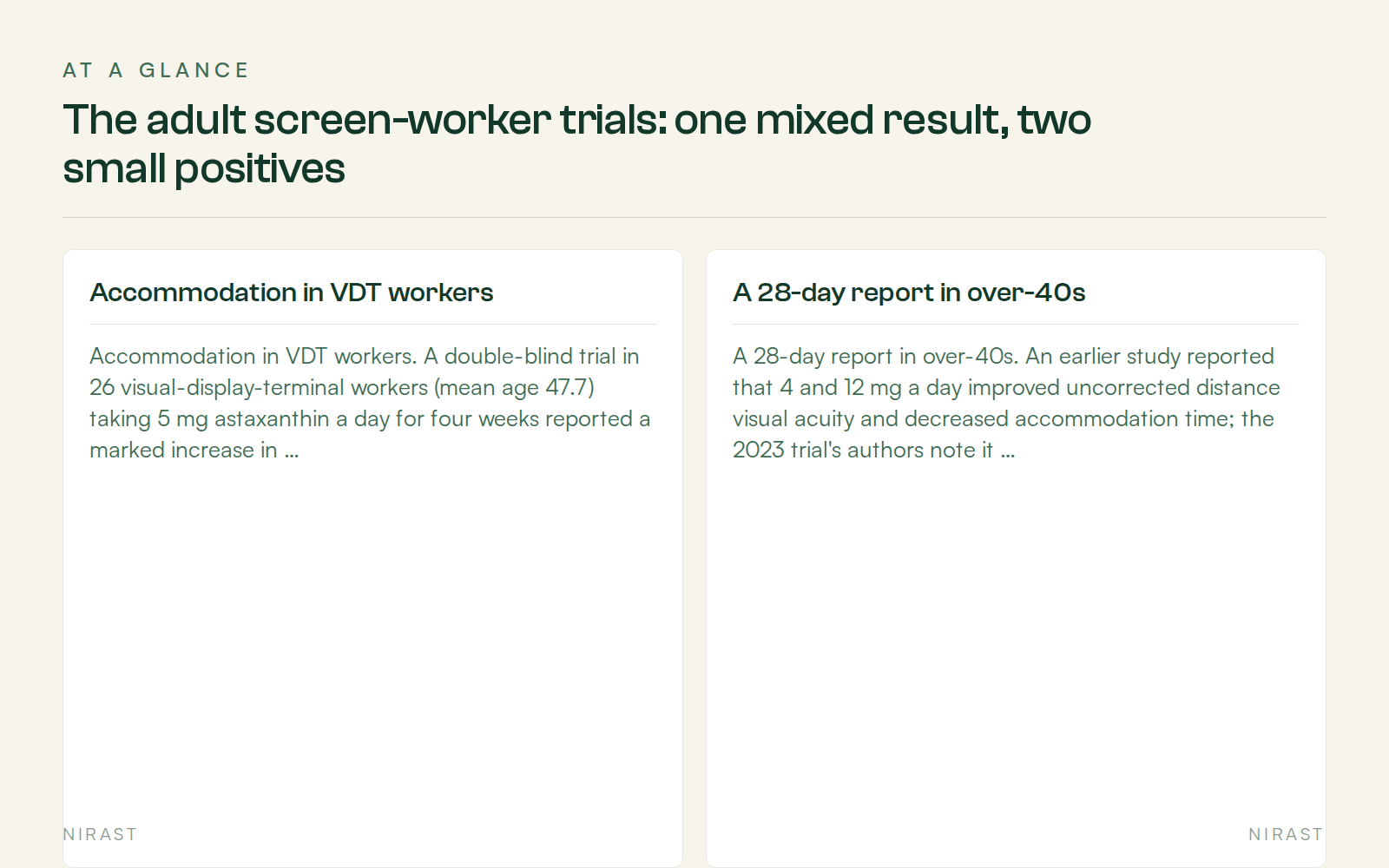
Across the full sample, no measurement differed significantly between the astaxanthin and placebo groups (PMID 36777084). The positive signal appeared only in the 40-and-older subgroup, where corrected visual acuity of the dominant eye after screen work differed significantly at week six; under 40, no significant difference was seen (PMID 36777084). The authors concluded that 9 mg a day for six weeks could prevent screen-work-related visual-acuity loss, while noting the trial did not test presbyopia or astigmatism and that the mechanism is not fully understood (PMID 36777084).
Two smaller adult studies complete the picture:
- Accommodation in VDT workers. A double-blind trial in 26 visual-display-terminal workers (mean age 47.7) taking 5 mg astaxanthin a day for four weeks reported a marked increase in accommodative amplitude (p<0.01) — relief from eyestrain in computer-monitor users, per review coverage (PMID 32370045; PMID 36235656).
- A 28-day report in over-40s. An earlier study reported that 4 and 12 mg a day improved uncorrected distance visual acuity and decreased accommodation time; the 2023 trial’s authors note it was not a well-controlled study and that improvement was only observed for uncorrected visual acuity (PMID 32370045; PMID 36777084).
One more adult study used a multivitamin rather than astaxanthin alone: 48 adults with eye strain (mean age 52.8) took a four-week formula with lutein, astaxanthin, cyanidin-3-glucoside and DHA and reported improvement in near-point accommodation and subjective symptoms (PMID 32370045; PMID 36235656).
The doses and durations behind the eye trials
The five rows below are what the human eye trials tested, at what dose, and what came out — including results that did not reach significance.
| Eye outcome studied | What the trial measured | Dose and duration | What it found | Main limits |
|---|---|---|---|---|
| Digital eye strain symptoms in children | CVS-Q symptom score and visual fatigue (VFLS) | 4 mg/day for 84 days (64 children aged 10–14) | CVS-Q improved 4.00 vs 1.72 units versus placebo (20%); VFLS 27% better | Pediatric only; one trial; acuity and accommodation measures were null (PMID 40014233) |
| Visual acuity after screen work in adults | Corrected visual acuity before/after 60 min screen work | 9 mg/day for 6 weeks (60 adults aged 20–64) | Full sample null; dominant-eye effect only in the 40-and-older subgroup | Subgroup-only result; mechanism not established (PMID 36777084) |
| Accommodation and eye fatigue in screen workers | Accommodative amplitude; near-point accommodation | 5 mg/day for 4 weeks (26 VDT workers, mean age 47.7) | Marked increase in accommodative amplitude (p<0.01) | Small trial; older report carried through reviews (PMID 36235656; PMID 32370045) |
| Dry eye signs and symptoms | OSDI score, tear-film stability, corneal staining | 12 mg/day for 30 days (60 patients, single-group) | Symptoms, tear stability and staining improved; tear quantity unchanged | Uncontrolled — no placebo comparison (PMID 41596351) |
| Combination formulas | Eye–hand coordination; pupillary response | 6 mg astaxanthin + 10 mg lutein + 2 mg zeaxanthin for 8 weeks; 3 mg astaxanthin + 36 mg anthocyanin + 5 mg lutein per capsule, two daily for 6 weeks | Coordination faster and more accurate at 8 weeks; pupillary response improved at 6 weeks | Cannot isolate astaxanthin’s contribution (PMID 36986186; PMID 34376917) |
Two notes from the rows: the screen-strain and accommodation trials used 4–9 mg a day, and the dry-eye study used 12 mg; nothing in this set compared two doses head-to-head, so a bigger milligram number is not backed here by a bigger measured effect.
Astaxanthin for dry eyes: what the human evidence covers
Dry eye is where the phrase “astaxanthin for eyes” often points, and the human evidence is thinner. The ocular-disease review is explicit: astaxanthin’s efficacy in dry eye has been assessed in the setting of a combined treatment including multiple nutraceuticals (PMID 32370045). That study gave dry-eye patients an antioxidant supplement containing anthocyanosides, astaxanthin, vitamins A, C and E, and herbal extracts; the supplemented group showed improved tear production and stability, decreased corneal staining and tear oxidative markers, and better signs and symptoms (PMID 32370045).
A separate systematic review summarises a single-group study — no placebo arm — in 60 dry-eye patients: 12 mg a day of astaxanthin tablets for 30 days improved OSDI symptoms, tear-film stability, corneal staining and eyelid-margin signs, with no significant change in tear quantity (PMID 41596351).
The honest reading: one uncontrolled study and one multi-ingredient formula point in a positive direction, and neither can attribute the result to astaxanthin alone. Persistent dryness or grittiness can have causes a supplement will not address.
What the evidence does not show
The supplement category compresses studies like these into single sentences. Six to hold loosely.
1. “A screen-strain cure.” The trials measured symptom scores, acuity and accommodation under controlled screen work. A 2026 structured review found that behavioural and ergonomic strategies and ocular-surface management were the approaches with demonstrated benefit, while blue-light filtering showed limited or no benefit (PMID 42787951). A supplement is not a substitute for screen breaks, blinking and an eye exam when symptoms persist.
2. “Sharper eyesight.” In the children’s trial there was no significant intergroup difference in visual acuity or near point of accommodation (PMID 40014233). The adult acuity result was subgroup-only — 40 and older — measured after a specific screen task (PMID 36777084).
3. “An eye-disease treatment.” Research interest spans diabetic retinopathy, age-related macular degeneration, glaucoma and cataract, and a review’s study table includes a 12-month, 4 mg/day study in patients with non-advanced AMD (PMID 32370045; PMID 42193197). But the same review states most of the available ocular evidence is preclinical and that translating animal findings to humans is complex (PMID 32370045). These are conditions diagnosed and managed by eye-care professionals.
4. “A dry-eye fix.” The human dry-eye evidence is one uncontrolled study and one combination formula — not placebo-controlled astaxanthin-alone data (PMID 41596351; PMID 32370045).
5. “Results in days.” The controlled eye trials ran weeks to months — 84 days in the children’s trial, six weeks in the adult trial, four weeks in the accommodation study (PMID 40014233; PMID 36777084; PMID 36235656). A 2022 review describes the nutraceutical findings for digital eye strain as preliminary and calls for more trials to quantify clinical benefits (PMID 36235656).
6. “A bigger dose is better.” The 28-day report described improvement in both its 4 mg and 12 mg groups rather than a larger effect at the higher dose — and it was not a well-controlled study (PMID 32370045; PMID 36777084).
On the safety side, the compiled record for the doses studied is quiet: a review reports a good safety profile with no adverse events in the clinical studies it covers, and another summarises that 8 mg a day for three months produced no gastrointestinal distress, while AMD patients took 4 mg daily for 12 months without adverse reactions (PMID 32370045; PMID 42193197). Long-term data remain thin — treat that as an observation, not a guarantee.
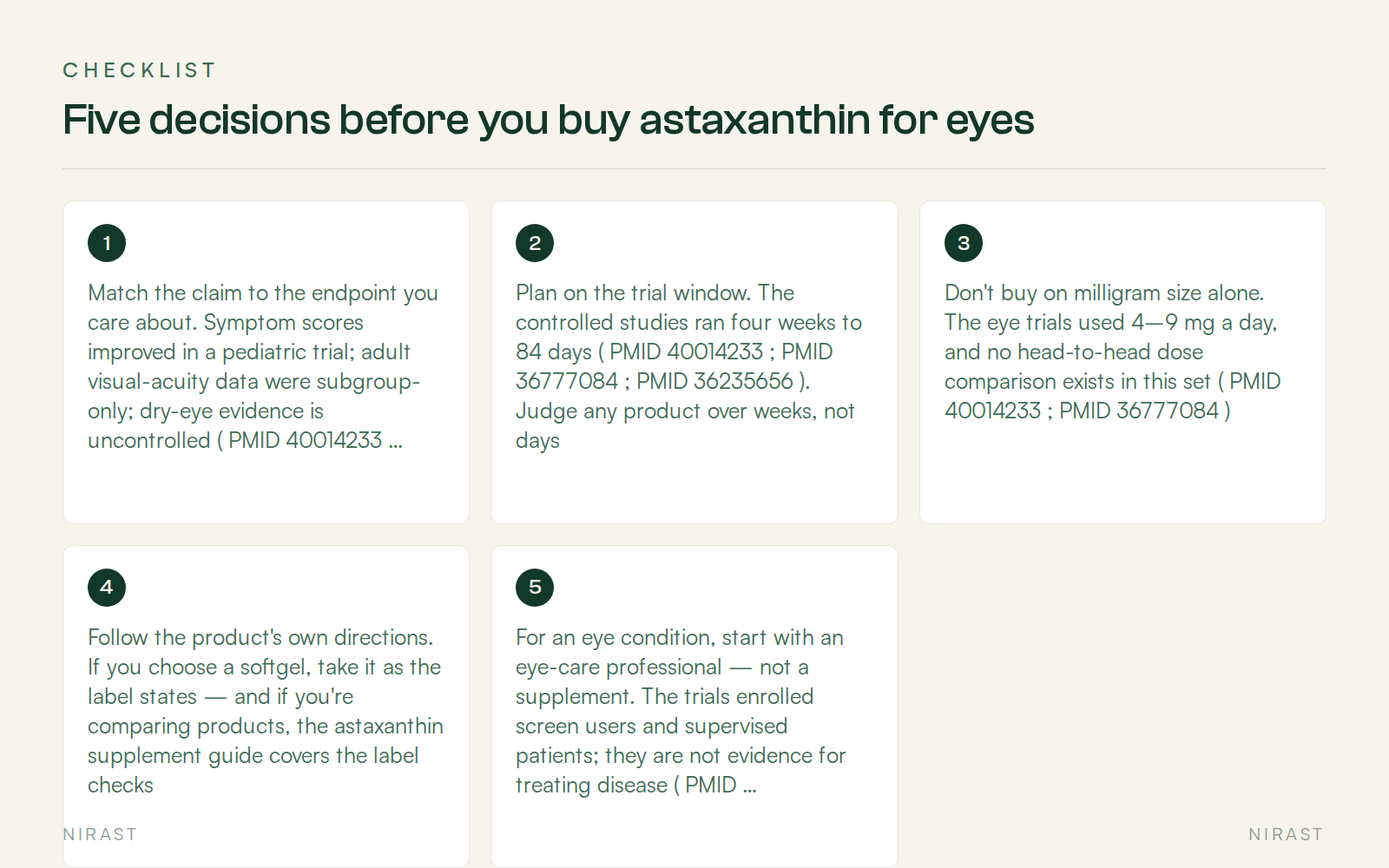
Five decisions before you buy astaxanthin for eyes
- Match the claim to the endpoint you care about. Symptom scores improved in a pediatric trial; adult visual-acuity data were subgroup-only; dry-eye evidence is uncontrolled (PMID 40014233; PMID 36777084; PMID 41596351).
- Plan on the trial window. The controlled studies ran four weeks to 84 days (PMID 40014233; PMID 36777084; PMID 36235656). Judge any product over weeks, not days.
- Don’t buy on milligram size alone. The eye trials used 4–9 mg a day, and no head-to-head dose comparison exists in this set (PMID 40014233; PMID 36777084).
- Follow the product’s own directions. If you choose a softgel, take it as the label states — and if you’re comparing products, the astaxanthin supplement guide covers the label checks.
- For an eye condition, start with an eye-care professional — not a supplement. The trials enrolled screen users and supervised patients; they are not evidence for treating disease (PMID 32370045; PMID 41596351).
When to see an optometrist instead of buying a supplement
Astaxanthin was studied in healthy screen users and in supervised patient groups — it is not a treatment for eye disease (PMID 32370045). Some eye concerns need a professional’s instruments:
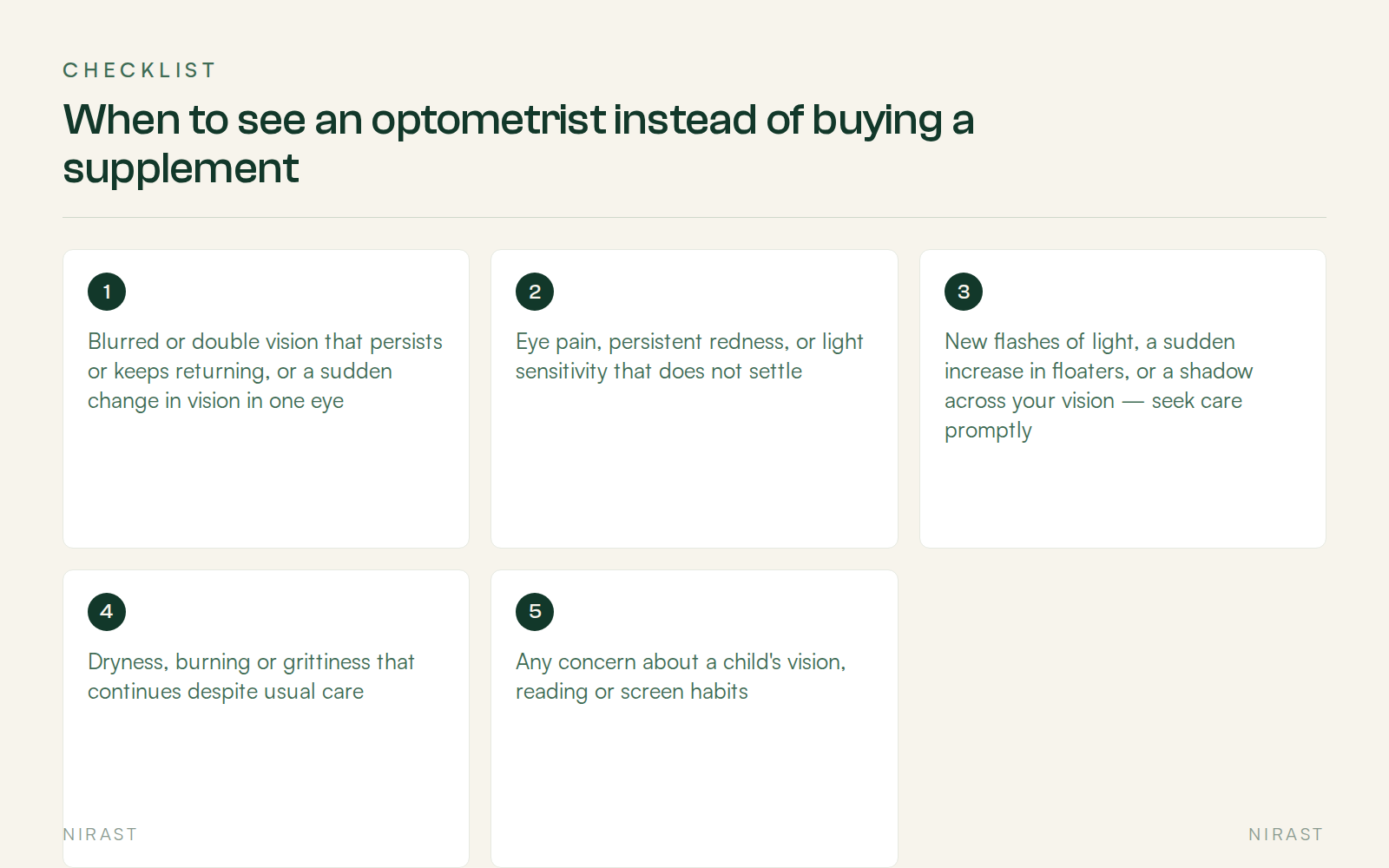
- Blurred or double vision that persists or keeps returning, or a sudden change in vision in one eye.
- Eye pain, persistent redness, or light sensitivity that does not settle.
- New flashes of light, a sudden increase in floaters, or a shadow across your vision — seek care promptly.
- Dryness, burning or grittiness that continues despite usual care.
- Any concern about a child’s vision, reading or screen habits.
If any of those apply, see an optometrist or your clinician first. The doses studied were well tolerated in the compiled record, but the reviews note that long-term data are limited (PMID 32370045; PMID 42193197). And if you take medication, are pregnant or manage a health condition, check with a clinician before adding any supplement.
FAQ
Does astaxanthin help with screen-related eye strain?
There is a positive pediatric result: in 64 children with digital eye strain, 4 mg a day for 84 days improved symptom and visual-fatigue scores (PMID 40014233). In adults the picture is mixed — a six-week trial in 60 adults found the visual-acuity signal only in the 40-and-older subgroup, with the full sample null (PMID 36777084). It does not replace screen breaks and eye care.
How much astaxanthin should I take for eye health?
The screen-strain and accommodation trials used 4–9 mg a day — 4 mg in the children’s trial, 5 mg in the VDT-worker study, 9 mg in the adult trial (PMID 40014233; PMID 36235656; PMID 36777084). The dry-eye study used 12 mg (PMID 41596351). No trial here compared doses head-to-head — follow the label of whatever product you choose, and check with a clinician first if you take medication, are pregnant or manage a health condition.
How long does astaxanthin take to work for eyes?
The controlled eye trials ran four weeks to 84 days: the children’s trial measured its endpoints at 84 days, the adult trial at six weeks (PMID 40014233; PMID 36777084; PMID 36235656). The evidence sets no days-scale expectation, and reviews call for more trials before clinical benefits can be quantified (PMID 36235656).
Is astaxanthin good for dry eyes?
The human evidence is limited: one uncontrolled study in 60 dry-eye patients found 12 mg a day for 30 days improved symptoms, tear-film stability and staining, with no change in tear quantity, and one multi-ingredient formula study reported improvements in tear production and stability (PMID 41596351; PMID 32370045). Neither can isolate astaxanthin’s contribution, and dry eye has causes a supplement will not address.
Can astaxanthin improve eyesight or replace glasses?
Not according to this evidence. The children’s trial found no significant intergroup difference in visual acuity or near point of accommodation, and the adult acuity effect appeared only in the 40-and-older subgroup (PMID 40014233; PMID 36777084). No trial here tested replacing corrective lenses. If your vision has changed, get an eye exam.
Should I take astaxanthin with lutein?
The combination trials in this evidence base paired astaxanthin with lutein or zeaxanthin — and in the eight-week combination trial the researchers could not say whether the effects were additive or synergistic (PMID 36986186). A multivitamin study that included lutein and astaxanthin reported improvements in near-point accommodation (PMID 32370045). If you want the combination approach, that is what was studied; to judge astaxanthin itself, read the astaxanthin-alone trials above.
A 12 mg softgel for an eye-focused routine: Nirast Extra Strength Astaxanthin
Nirast Extra Strength Astaxanthin is a softgel supplement, and each softgel delivers 12 mg of pure natural astaxanthin. The label artwork states the astaxanthin is “from microalgae” and lists “Vision & Skin Health” among its label lines; the pouch reads “120 Softgels | Dietary Supplement”. The directions are to take 2 softgels daily with water, preferably with food, and the softgels are described as clean, tasteless and easy to swallow. The offer is a monthly subscription, with tiers displayed at $29.99, $59.99 and $89.99, and every delivered order is covered by a 30-Day Money-Back Guarantee.
The studies above are ingredient-level — the right frame for judging any product in this category — and the label’s own directions are the routine to follow with this one.
See Nirast Extra Strength Astaxanthin here.
These statements have not been evaluated by the Food and Drug Administration. This product is not intended to diagnose, treat, cure, or prevent any disease. Talk to your doctor or pharmacist before starting a supplement, especially if you are pregnant, nursing, take medication or have a medical condition.
Related reading
- Astaxanthin: What It Is, What the Evidence Covers, and How to Choose a Form
- Astaxanthin Dosage per Day: What the Human Trials Used
- Astaxanthin vs CoQ10: What the Human Evidence Shows for Each — and How to Choose
- Astaxanthin Supplement: What It Is and How to Choose
Related product: Nirast Extra Strength Astaxanthin.