
Black Seed Oil: What It Is, What the Evidence Covers, and How to Choose a Form
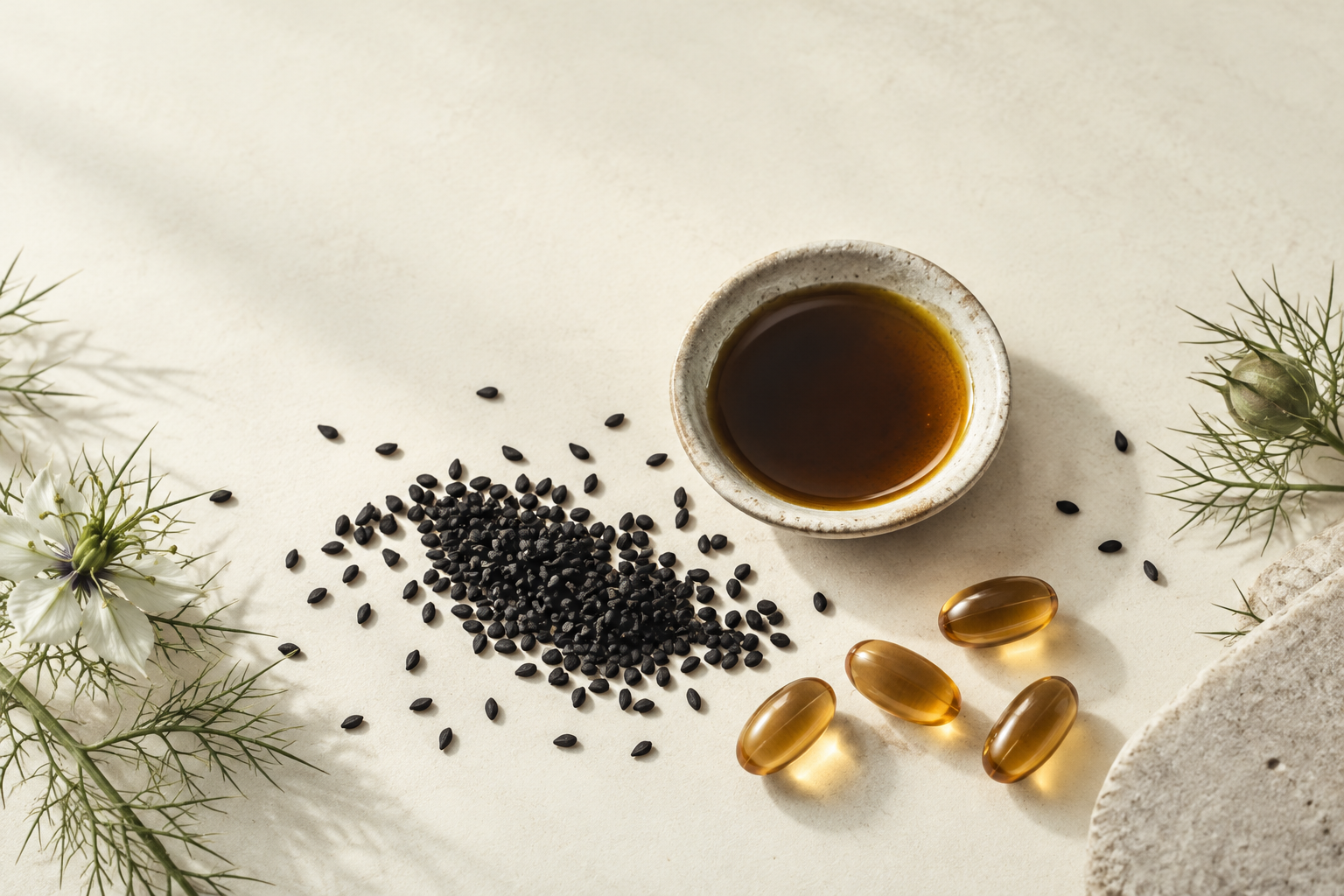
Black seed oil is pressed from the seeds of Nigella sativa (also called black cumin). It is sold as bottled liquid or in capsules, and most human research tests it as a supplement in small, short trials; average effects on blood pressure, blood sugar and weight were modest, and product quality varies widely.
Nirast makes Ethiopian Black Seed Oil. This article was written by Nirast’s editorial team and reports what the published research does and does not show.
See Nirast Ethiopian Black Seed Oil → · $29.99 a month · 30-Day Money-Back Guarantee
Published by Thang Phi, founder of Nirast and publisher of the Nirast Journal.
This guide maps the ingredient, the trials, the forms and the safety lines, with a deeper read linked at each step.
What black seed oil is
Black seed oil comes from the seeds of Nigella sativa L., an annual herbaceous plant in the Ranunculaceae family. It is “commonly known as ‘black cumin’ or ‘black seeds'” (Derosa et al., 2024), one species wearing several everyday names. If that naming tangle brought you here, it has its own page.
The seeds have a long history in cooking and traditional medicine across the Arab world, the Indian subcontinent and parts of eastern Europe, and Nigella sativa is approved for food use and Generally Recognized as Safe by the US FDA and FEMA (Derosa et al., 2024).
The oil is extracted in several ways, cold pressing among them (Arshad et al., 2025), and how the seeds are handled and extracted shapes the oil’s composition and quality (Dąbrowski et al., 2024): one reason two products differ so much on paper.
What the human evidence covers
Most black seed oil research is small, short and clinical. A pooled analysis combined 31 randomised trials with 2,145 participants diagnosed with metabolic diseases, run over 4–24 weeks with 38–144 people per trial (Musazadeh et al., 2026). Average changes:
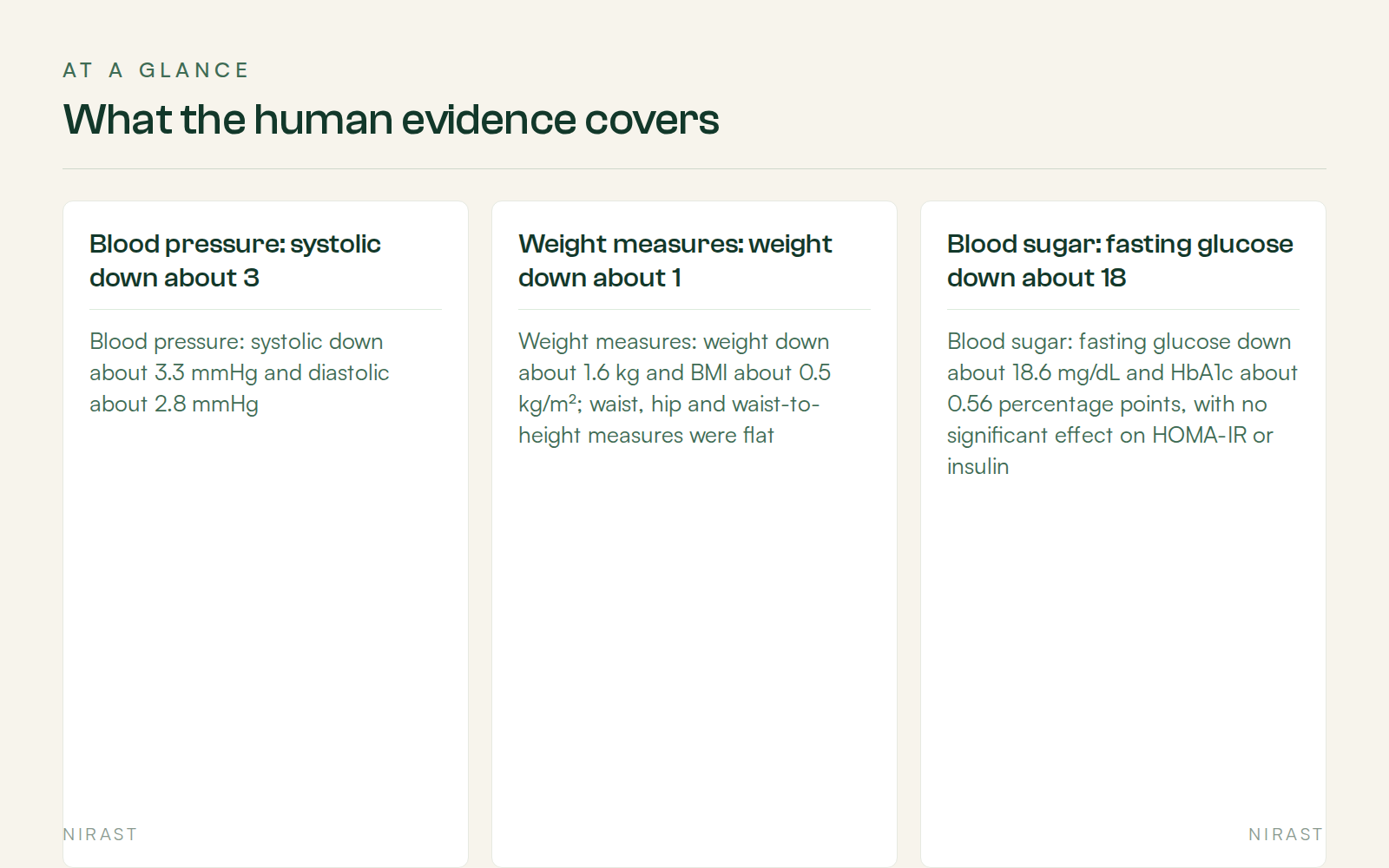
- Blood pressure: systolic down about 3.3 mmHg and diastolic about 2.8 mmHg.
- Weight measures: weight down about 1.6 kg and BMI about 0.5 kg/m²; waist, hip and waist-to-height measures were flat.
- Blood sugar: fasting glucose down about 18.6 mg/dL and HbA1c about 0.56 percentage points, with no significant effect on HOMA-IR or insulin.
The authors call these effects modest, below the 5% weight-loss and 5 mmHg thresholds used to mark meaningful change (Musazadeh et al., 2026); the wider literature spans 200–4,600 mg/day over 1–48 weeks (Jafari et al., 2025).
In knee osteoarthritis, a 2024 review of six trials found topical oil beat placebo for pain in three of four screened studies, while oral oil improved in only one of two and oral capsules showed no difference; its conclusion: insufficient evidence to recommend for or against use (Mousavi et al., 2024). A 116-patient knee trial dosed 2.5 mL of oil every 8 hours for a month; pain scores fell about 34% versus about 9% on placebo (Huseini et al., 2022).
In women’s health, a two-month placebo-controlled trial in 40 women with PMS found estradiol rose and PMS symptom scores fell, which the authors call “beneficial yet exploratory” (Afrin et al., 2025). In children the evidence is thin: a 2025 review of 15 trials asked for more high-quality work on dose and form (Abumadini et al., 2025).
None of this makes black seed oil a treatment for those conditions: it is a supplement tested in particular groups, at particular doses, for short periods. The full breakdown: what the evidence shows on black seed oil benefits; dosing specifically: how much black seed oil to take each day.
How to choose between the forms
There are two commercial forms: bottled liquid oil and capsules containing the oil (Alkhatib et al., 2020). A softgel is the oil held inside a shell, gelatin-based or a plant-derived alternative (Naharros-Molinero et al., 2024).
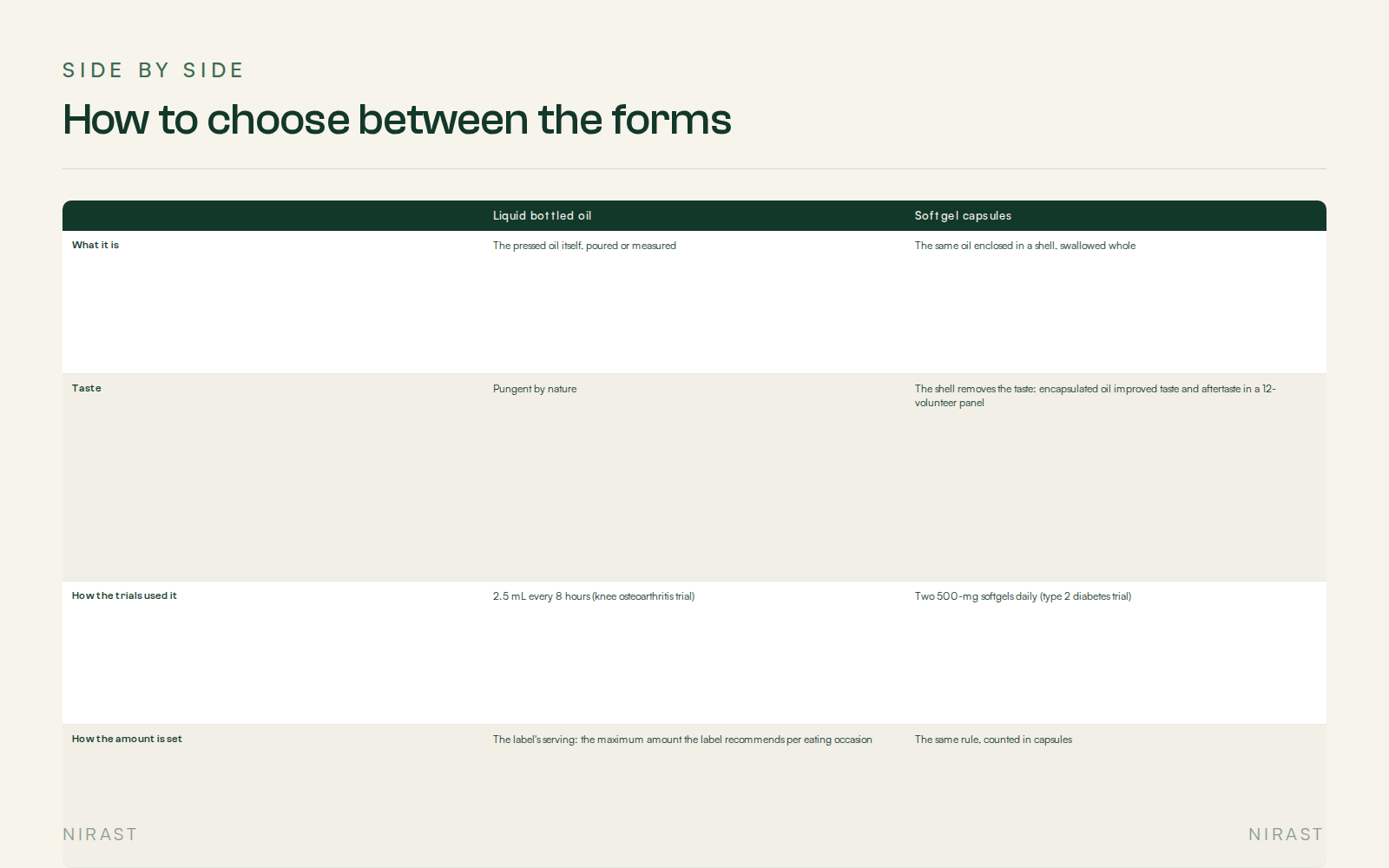
| Liquid bottled oil | Softgel capsules | |
|---|---|---|
| What it is | The pressed oil itself, poured or measured | The same oil enclosed in a shell, swallowed whole |
| Taste | Pungent by nature | The shell removes the taste: encapsulated oil improved taste and aftertaste in a 12-volunteer panel |
| How the trials used it | 2.5 mL every 8 hours (knee osteoarthritis trial) | Two 500-mg softgels daily (type 2 diabetes trial) |
| How the amount is set | The label’s serving: the maximum amount the label recommends per eating occasion | The same rule, counted in capsules |
Capsules are the common vehicle in the reviewed trials: all participants in one 14-trial review received oil or powder in capsule form, and a 43-patient type-2-diabetes trial dosed two 500-mg softgels daily for 8 weeks (Derosa et al., 2024; Hadi et al., 2021); measured liquid carried the dose in others, including the knee trial above. Neither form is ranked above the other by the measured evidence.
Five steps to decide:
- Match the form to your routine: both delivered study doses, so pick what you will actually take daily.
- Read the serving from the label, not the form: a spoonful and a capsule count are both label-defined servings (FDA labeling guide).
- Don’t treat “capsule versus liquid” as a quality signal: measured thymoquinone didn’t track packaging (below).
- Check the safety fit first: medication and pregnancy cautions apply to both forms (below).
- Judge the product by what it declares: declared numbers are the only comparable ones.
Deeper reads: black seed oil capsules versus the liquid oil and liquid black seed oil vs softgels.
What the label tells you — and what it doesn’t
The measured spread in thymoquinone (TQ) content is enormous: 0.07% to 1.88% by weight across ten products in one survey (roughly 27-fold) and 3.08 to 809.4 mg per 100 g across eleven in another (Alkhatib et al., 2020; Khaikin et al., 2022).
The spread is not about the form: TQ percentage “was not directly related to packaging”, and an oil/capsule pair filled from the same oil measured similarly (Alkhatib et al., 2020; Khaikin et al., 2022). It comes from the oil itself: growing region, harvest timing, seed storage and manufacturing all move TQ content, and heat, light and oxygen can reduce it in storage (Khaikin et al., 2022). Hence the researchers’ recommendation that TQ be declared on products — and hence the problem when clinical reporting goes missing: in a 2026 review of 14 periodontal trials, only one adequately reported the administered daily dose (Khaikin et al., 2022; Chrubasik-Hausmann et al., 2026).
Extraction is its own trade-off. Cold pressing retained the most total phenolics, tocopherols and TQ against solvent and microwave extraction, but the same comparison gave it the highest peroxide value and the lowest induction period, the stability measures (Dąbrowski et al., 2024). A trade-off to read, not a badge to trust. Three pages go deeper: what cold pressing tells you, Ethiopian vs Egyptian black seed oil, and how to verify a single-origin claim.
The safety frame
At study amounts, black seed oil is usually well tolerated: side effects are mostly reported with excess intake, chiefly gastrointestinal complaints such as diarrhea, bloating and nausea (Arshad et al., 2025). A 12-week trial at 3 g/day saw no side effects beyond mild gastrointestinal ones, and reviews describe an excellent safety profile for oil and standardised extracts (Derosa et al., 2024; Morar Romocea et al., 2025).
The caveats: allergic reactions are rare but possible; anticoagulant users may develop mild blood-thinning effects; anticoagulant and antihypertensive drugs need close interaction monitoring; and high doses are typically not recommended in pregnancy (Arshad et al., 2025). Preclinical work adds a dose-dependence point: at high doses, thymoquinone showed liver and kidney toxicity in rodents, so the safety profile is context-dependent rather than uniformly benign (Morar Romocea et al., 2025).
If you take medication, are pregnant, or manage a health condition, speak to a clinician before adding any supplement. The label’s directions anchor the intake side; see with food or on an empty stomach and can you take too much black seed oil.
FAQ
What is black seed oil?
The oil pressed from the seeds of Nigella sativa, a plant used as a spice and in traditional medicine and approved for food use in the US (Derosa et al., 2024). Sold as bottled liquid or capsules (Alkhatib et al., 2020). More: what black seed oil is, and whether it is black cumin.
Is black seed oil the same as black cumin?
Yes — “black cumin” and “black seeds” name the same species, Nigella sativa (Derosa et al., 2024). Product differences come from origin, processing and brand, not different plants; the naming page goes deeper.
How much black seed oil should I take each day?
Reviews describe adult intakes around 1–3 g/day for 6–12 weeks (Arshad et al., 2025; Derosa et al., 2024); the wider trial range runs 200–4,600 mg/day (Jafari et al., 2025). Follow the serving line on your label (FDA labeling guide); the long answer is here.
Should I take black seed oil with food or on an empty stomach?
The trials dosed on fixed daily schedules — the knee trial used 2.5 mL every 8 hours (Huseini et al., 2022) — so the label’s directions are the anchor. See with food or on an empty stomach.
Can you take too much black seed oil?
Side effects mostly follow excess intake — gastrointestinal complaints such as diarrhea, bloating and nausea — and high-dose preclinical work shows liver and kidney toxicity in rodents (Arshad et al., 2025; Morar Romocea et al., 2025). Follow the label’s serving; the full frame: can you take too much black seed oil.
Should I choose liquid oil or softgels?
The measured evidence doesn’t rank them: TQ didn’t track packaging, and a same-oil capsule pair measured similarly (Alkhatib et al., 2020; Khaikin et al., 2022). Choose by how you will take it: the shell removes the pungent taste (Alkhatib et al., 2024). Compare: liquid black seed oil vs softgels.
A softgel option: Nirast Ethiopian Black Seed Oil
Nirast Ethiopian Black Seed Oil is a softgel supplement stating 1,000 mg of black seed oil per serving, cold-pressed from Nigella sativa. Directions: take 2 softgels daily with water, preferably with food; the softgels are described as taste-free, gentle and easy to take. The offer is a monthly subscription — 1 pouch at $29.99, delivered every month — with a 30-day money-back guarantee; subscriptions can be cancelled by emailing support@nirast.co at least 24 hours before the next renewal. If a taste-free softgel fits your routine, see Nirast Ethiopian Black Seed Oil here.
These statements have not been evaluated by the Food and Drug Administration. This product is not intended to diagnose, treat, cure, or prevent any disease. Talk to your doctor or pharmacist before starting a supplement, especially if you are pregnant, nursing, take medication or have a medical condition.
Related reading
- Black Seed Oil Benefits: What the Evidence Shows
- Black Seed Oil Benefits for Men: What the Evidence Shows
- Black Seed Oil Benefits for Women: What the Evidence Shows
- Black Seed Oil Side Effects: What the Evidence Reports
Related product: Ethiopian Black Seed Oil.